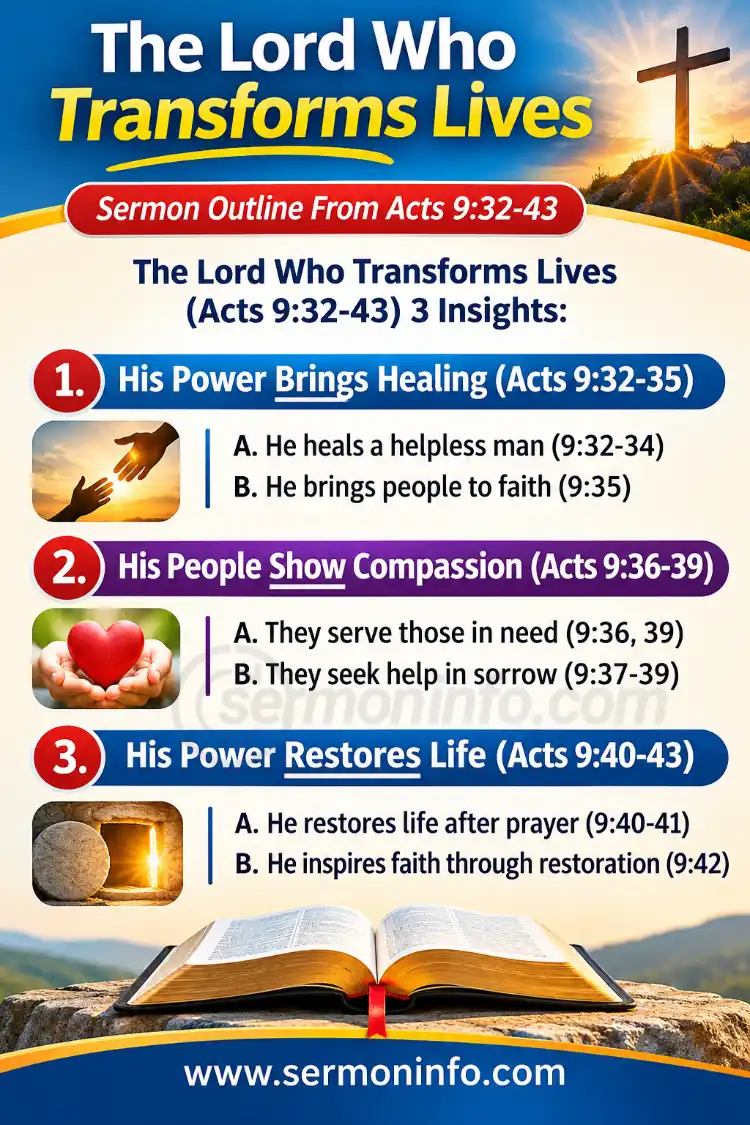
Sermon Outline From Acts 9:32–43 teaches three important truths about the Lord who transforms lives. First, His power brings healing. Second, His people demonstrate compassion through practical service. Third, His power restores life and leads people to faith. These truths reveal Christ’s authority and encourage believers to trust God, serve others, and share the gospel.

Key Takeaways – Sermon From Acts 9:32-43
- His Power Brings Healing (Acts 9:32–35): Jesus healed Aeneas and led many people to faith. Trust the Lord’s power and wisdom when facing difficult situations.
- His People Show Compassion (Acts 9:36–39): Tabitha demonstrated God’s love through generous acts of kindness. Follow her example by serving others and showing compassion to those in need.
- His Power Restores Life (Acts 9:40–43): Jesus restored Tabitha’s life and led many people to believe in Him. Trust the risen Savior and share His message of hope and eternal life.
Sermon Outline From Acts 9:32-43
Life often brings challenges that leave us feeling helpless, discouraged, or uncertain about tomorrow. Yet, no situation lies beyond the Lord’s power or wisdom. He knows our struggles, understands our needs, and cares deeply about every detail of our lives. When we cannot see a way forward, we can trust His perfect wisdom and unfailing love. Our circumstances may change, but His power and faithfulness never change.
In Acts 9:32–43, we discover how Jesus Christ transforms lives through His power and the compassion of His people. He heals a helpless man, inspires loving service, and restores a woman to life. These remarkable events remind us that the risen Lord remains powerful and faithful. As we explore three important truths, let us consider how His power and grace can transform our lives today.
1. His Power Brings Healing (Acts 9:32–35)
Jesus Christ demonstrates His power by healing Aeneas and leading people to faith in Him. (Summary Statement)
A. He heals a helpless man (Acts 9:32–34)
For eight long years, Aeneas lay helpless in bed because paralysis had taken away his ability to walk. When Peter visited Lydda, he met this suffering man and declared, “Jesus the Christ heals you” (Acts 9:34). Immediately, Aeneas rose from his bed. Peter did not claim the power to heal. Jesus Christ performed this remarkable miracle through His servant.
Imagine the joy Aeneas experienced when he stood after eight years of suffering. His healing reminds us that nothing lies beyond Christ’s power. Although God does not promise physical healing to everyone today, He remains powerful and compassionate. Whatever difficulties we face, we can trust His wisdom, seek His help, and rest in His care.
B. He brings people to faith (Acts 9:35)
The healing of Aeneas did more than restore one man’s ability to walk. Acts 9:35 tells us that the people of Lydda and Sharon saw him and turned to the Lord. This remarkable miracle directed their attention toward Jesus Christ. His healing power confirmed the message Peter proclaimed and encouraged people to place their faith in the risen Savior.
Notice how God used one man’s changed life to influence an entire community. Today, our transformed lives can also point others toward Jesus Christ. When people see His grace shaping our attitudes, words, and actions, they may become curious about our faith. Let us live so that others see Christ working in us (Matthew 5:16). (Source Material: William MacDonald, Believer’s Bible Commentary, pp. 1611-1612)
This material provides some ideas and thoughts for a sermon outline from Acts 9:32-43 (The Lord Who Transforms Lives).
2. His People Show Compassion (Acts 9:36–39)
The Lord’s people express their love through practical service and shared concern during sorrow. (Summary Statement)
A. They serve those in need (Acts 9:36, 39)
Tabitha lived in Joppa, where she demonstrated her faith through generous acts of kindness. Acts 9:36 describes her as a woman full of good works and charitable deeds. She made tunics and garments for those in need, including widows. When she died, the grieving widows showed Peter the clothing she had made. Her loving service touched many lives.
Tabitha reminds us that genuine faith expresses itself through practical acts of love. We may not have great wealth or special talents, but we can all help someone in need. A meal, a kind word, or a helping hand can make a lasting difference. Galatians 6:10 encourages us to do good to others whenever we have the opportunity.
B. They seek help in sorrow (Acts 9:37–39)
When Tabitha became sick and died, her fellow believers experienced deep sorrow. They washed her body and placed it in an upper room, following the customs of their day. Hearing that Peter was nearby in Lydda, the disciples urgently sent two men to ask him to come. Peter responded immediately and traveled with them to Joppa (Acts 9:37–39).
Notice how these believers faced their grief together rather than suffering alone. Their actions remind us that God provides caring people who can support us during difficult times. When sorrow enters our lives, we should seek encouragement, prayer, and practical help from fellow believers. Galatians 6:2 encourages us to bear one another’s burdens and fulfill the law of Christ. (Source Material: John MacArthur, The MacArthur Bible Commentary, pp. 1454-1455)
3. His Power Restores Life (Acts 9:40–43)
The Lord demonstrates His power over death by restoring Tabitha’s life and leading many to believe in Him. (Summary Statement)
A. He restores life after prayer (Acts 9:40–41)
When Peter entered the upper room, he sent everyone outside and knelt in prayer. He knew that only God possessed the power to restore life. After praying, Peter turned toward Tabitha and said, “Tabitha, arise” (Acts 9:40). Immediately, she opened her eyes and sat up. Peter helped her stand and presented her alive to the believers and widows.
Notice how Peter prayed before taking action. His example reminds us that prayer expresses our dependence upon God’s power rather than our abilities. We may face situations that seem impossible, but nothing exceeds God’s power. Although God does not promise miraculous restoration in every situation, He invites us to seek His help and trust His wisdom (Philippians 4:6–7).
B. He inspires faith through restoration (Acts 9:42)
News of Tabitha’s restoration quickly spread throughout Joppa, and many people believed in the Lord (Acts 9:42). Imagine the amazement as people heard that the woman who had died now lived again. This remarkable miracle demonstrated the risen Christ’s authority over death. God used Tabitha’s restoration to direct people’s attention toward Jesus Christ and His saving power.
The greatest miracle God performs today is giving spiritual life to those who trust Jesus Christ. Ephesians 2:4–5 reminds us that God makes sinners alive with Christ through His mercy and love. When we share how Christ has changed our lives, we can encourage others to trust Him. Our testimony can point people toward the Savior who gives eternal life. (Source Material: John F. Walvoord and Roy B. Zuck, The Bible Knowledge Commentary: New Testament, p. 378-379)
Conclusion
Acts 9:32–43 reminds us that the Lord has the power to transform lives. Through Peter, Jesus healed Aeneas and led many people to faith. Tabitha demonstrated God’s love through her compassionate service to those in need. When she died, the believers sought help, and the Lord restored her life. These remarkable events reveal His power, compassion, and grace toward His people.
Today, we can trust the same Lord who worked so powerfully in these lives. When difficulties arise, we should seek His help through prayer and trust His perfect wisdom. We can also reflect His love by serving others with kindness and compassion. Above all, let us live faithfully and point others toward Jesus Christ, our Savior and Lord.
Closing Prayer
Heavenly Father, we thank You for Your wonderful power, unfailing love, and perfect wisdom. Thank You for reminding us that nothing lies beyond Your power. Just as You healed Aeneas and restored Tabitha’s life, You continue to care for Your people today. Help us trust You when life becomes difficult and the way forward seems uncertain. Strengthen our faith, guide our decisions, and teach us to depend upon Your grace each day.
Lord, help us follow Tabitha’s example by showing kindness and compassion to those around us. Give us willing hearts to serve others and encourage those who struggle. May our words, actions, and daily lives point people toward Jesus Christ. Above all, help us remain faithful to Your Word and confident in Your promises. We thank You for the eternal life we have through our risen Savior. In Jesus’ precious name, we pray. Amen.
Frequently Asked Questions (FAQ)
Q: What is the main message of Acts 9:32–43?
A: Acts 9:32–43 reveals Jesus Christ’s power to heal, restore life, and lead people to faith. Through Peter’s ministry, the Lord heals Aeneas and restores Tabitha. These miracles encourage believers to trust God’s power, show compassion to others, and share the message of salvation.
Q: Why did Peter heal Aeneas in Acts 9?
A: Peter healed Aeneas through the power of Jesus Christ, not his own ability. After eight years of paralysis, Aeneas immediately stood and walked (Acts 9:33–34). This miracle demonstrated Christ’s divine authority and led the people of Lydda and Sharon to turn to the Lord.
Q: What can we learn from Tabitha in Acts 9?
A: Tabitha teaches us that genuine faith expresses itself through practical love and compassion. She helped widows and others through generous deeds and clothing she made (Acts 9:36–39). Her example encourages believers to serve those in need and demonstrate God’s love through everyday acts of kindness.
Q: Why did Peter pray before raising Tabitha?
A: Peter prayed before raising Tabitha because he depended entirely upon God’s power. He knelt in prayer before commanding her to arise (Acts 9:40). His actions remind believers that prayer expresses our dependence upon the Lord, especially when we face difficult situations beyond our human abilities.
Q: How does Acts 9:32–43 apply to our lives today?
A: Acts 9:32–43 encourages believers to trust God’s power, demonstrate compassion, and share their faith. Although God does not promise miraculous healing in every situation, He remains faithful and powerful. We can seek His help through prayer, serve others with love, and point people toward Jesus Christ.
BONUS: Do we need to perform a healing so that onlookers can be saved?
No, we do not need to perform a healing for onlookers to receive salvation. In Acts 9:35 and 42, miracles prompted people to turn to the Lord. However, these events do not establish healing as a requirement for salvation. The gospel proclaims Christ’s death for our sins and His resurrection (1 Corinthians 15:3–4).
Our responsibility involves sharing the gospel clearly and pointing people to Jesus. Romans 10:17 explains that faith comes through hearing God’s Word. God saves people by grace through faith in Christ, not through our ability to perform miracles (Ephesians 2:8–9). We can witness confidently, trusting God to work through His truth.
BONUS: What does Peter’s prayer teach about dependence on God?
Peter knelt and prayed before telling Tabitha to arise (Acts 9:40). His prayer expressed dependence on God’s power. Peter could not restore life through personal ability or spiritual status. Earlier, he identified Jesus Christ as the source of Aeneas’s healing (Acts 9:34).
We follow Peter’s example when we bring our needs to God and trust His wisdom. Prayer acknowledges that we need His help. We can ask confidently while submitting our requests to His will (1 John 5:14). Our confidence rests in God’s power and goodness, not our ability to produce results.
BONUS: Does Acts 9:32–43 promise physical healing to every believer?
Acts 9:32–43 records two particular miracles; it does not promise physical healing to every believer. Christ healed Aeneas and restored Tabitha through Peter’s ministry. These miracles prompted people to turn to the Lord and believe in Him (Acts 9:35, 42). Luke describes what happened without guaranteeing identical outcomes for everyone.
God can heal, and we can ask Him for healing. However, faithful believers also experience ongoing illness. Paul left Trophimus sick in Miletus (2 Timothy 4:20). Sickness does not automatically reveal weak faith. We can trust God’s care while seeking treatment, receiving support, and submitting to His will.
BONUS: Is a healing experience a prerequisite for salvation?
No, salvation does not require a healing experience. God saves sinners by grace through faith in Jesus Christ, apart from works (Ephesians 2:8–9). Jesus died for our sins and rose again (1 Corinthians 15:3–4). We receive salvation through trusting Him, not through experiencing physical recovery.
In Acts 9:35 and 42, people believed after learning about miracles involving others. Luke never says these believers first experienced personal healing. Physical healing and salvation are distinct gifts. When the jailer asked how to receive salvation, Paul directed him to believe in the Lord Jesus Christ (Acts 16:30–31).
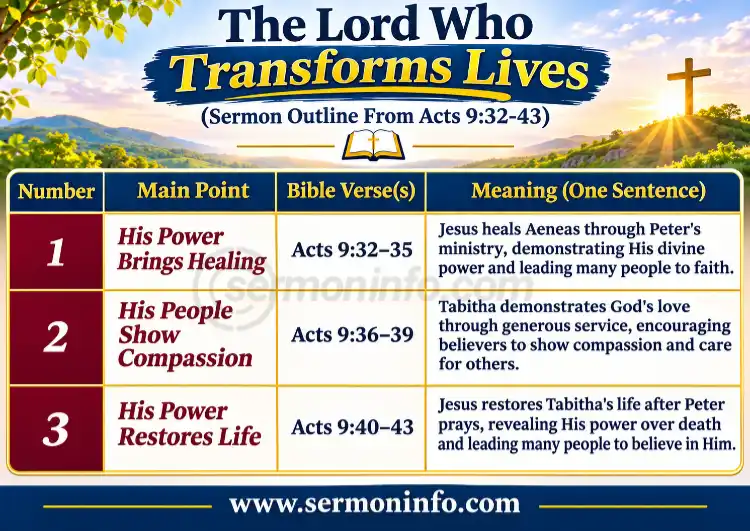
| Sermon Outline From Acts 9:32-43 – Sermon From Acts | |||
|---|---|---|---|
| Number | Main Point | Bible Verse | Meaning |
| 1 | His Power Brings Healing | Acts 9:32–35 | Jesus heals Aeneas through Peter’s ministry, demonstrating His divine power and leading many people to faith. |
| 2 | His People Show Compassion | Acts 9:36–39 | Tabitha demonstrates God’s love through generous service, encouraging believers to show compassion and care for others. |
| 3 | His Power Restores Life | Acts 9:40–43 | Jesus restores Tabitha’s life after Peter prays, revealing His power over death and leading many people to believe in Him. |
Source Material
William MacDonald, Believer’s Bible Commentary, rev. ed. (Nashville: Thomas Nelson, 1995), 1611-1612
John MacArthur, The MacArthur Bible Commentary (Nashville: Thomas Nelson, 2005), 1454-1455
John F. Walvoord and Roy B. Zuck, eds., The Bible Knowledge Commentary: New Testament (Colorado Springs, CO: David C. Cook, 1985), 378-379