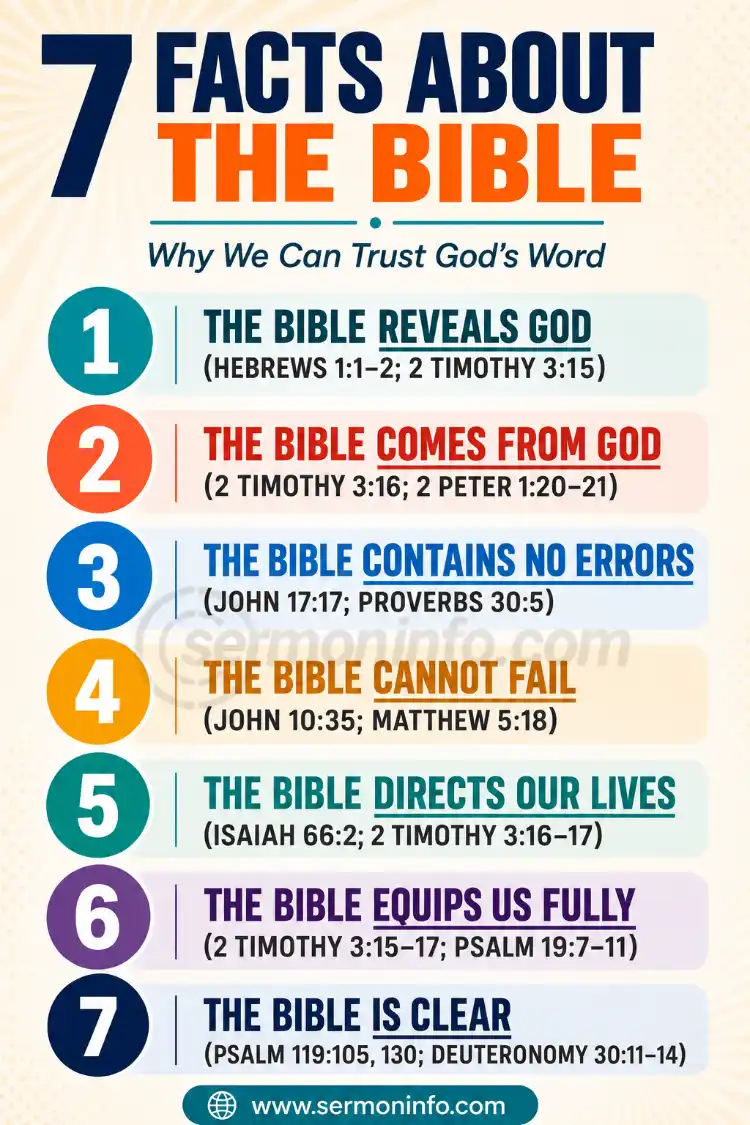
The 7 facts about the Bible explain why we can trust God’s Word. Scripture reveals God, comes from Him, contains no errors, and cannot fail. It directs our lives, equips us fully, and communicates its central message clearly. Its divine authority and complete trustworthiness give us confidence to believe and obey God.

Key Takeaways – 7 Facts About the Bible
- Trust the Bible as God’s Word. It reveals God, comes from Him, contains no errors in its original writings, and cannot fail.
- Let Scripture guide your daily choices. Receive its authority humbly, follow its instruction, and use its wisdom to serve others faithfully.
- Read God’s Word with confidence. Its central message is clear, and it equips you for faithful living. Study each passage in context and practice what you learn.
7 Facts About The Bible
Where did we come from, why are we here, and where will we spend eternity? God answers life’s deepest questions through His Word, and we can trust Him to speak truth. Jesus affirmed, “Your word is truth” (John 17:17). When uncertainty troubles our hearts, God gives dependable guidance and directs us to life through His Son.
Today, we will explore seven facts that strengthen our confidence in God’s Word. The Bible reveals God, comes from Him, contains no errors, and cannot fail. It directs our lives, equips us fully, and communicates its central message clearly. Let’s begin by considering how God reveals Himself through Scripture and invites us to know Him.
1. The Bible Reveals God (Hebrews 1:1–2; 2 Timothy 3:15)
The Bible reveals who God is and shows how we can know Him through Jesus Christ. (Summary Statement)
A. It reveals God’s Son (Hebrews 1:1–2)
Hebrews opens by reminding readers that God spoke to Israel through His prophets across many generations. Then God spoke through His Son, Jesus Christ (Hebrews 1:1–2). Those earlier messages prepared the way for Him. Jesus reveals God perfectly because He shares the Father’s divine nature (Hebrews 1:3).
When trouble clouds your thoughts, you may wonder what God is like or whether He cares. Look at Jesus in Scripture. His compassion reveals God’s heart, and His faithfulness gives us reasons to trust Him. Open your Bible during difficult days, and listen to the Son who reveals the Father.
B. It reveals God’s salvation (2 Timothy 3:15)
Paul reminded Timothy that he had known the Holy Scriptures since childhood (2 Timothy 3:15). These Old Testament writings pointed toward the Savior and prepared him to understand the gospel. Scripture makes us wise for salvation through faith in Jesus Christ. Knowing biblical facts cannot save us; we must trust the Savior Scripture reveals.
Jesus died for our sins and rose again, so we can receive forgiveness and eternal life (1 Corinthians 15:3–4). We cannot earn this gift through good behavior or religious effort (Ephesians 2:8–9). Turn from sin and trust Him. When hardships shake your confidence, remember that your salvation rests on Christ’s finished work, not your changing feelings.
2. The Bible Comes From God (2 Timothy 3:16; 2 Peter 1:20–21)
God gave us Scripture through human writers who communicated His message under the Holy Spirit’s direction. (Summary Statement)
A. It originates with God (2 Timothy 3:16)
Paul urged Timothy to continue in Scripture while false teachers spread deception (2 Timothy 3:13–16). Timothy could trust Scripture because God breathed out every part of it. The Bible carries God’s authority because He supplied its words. Its teaching offers more than human wisdom; it tells us what God wants us to believe and do.
Today, countless voices compete for our attention, especially when trouble leaves us searching for answers. God’s Word gives us a dependable place to turn. When you open your Bible, receive its teaching as God’s instruction. Let it correct your thinking, strengthen your faith, and guide your next step.
B. It comes through Spirit-guided writers (2 Peter 1:20–21)
Peter explained that biblical prophecy never began with human will or personal invention (2 Peter 1:20–21). The Holy Spirit moved holy men to speak God’s message. He worked through their personalities and writing styles while guiding their words. These writers faithfully communicated what God intended, rather than simply recording their own religious ideas.
Think of the different voices you hear throughout Scripture: David sings, Isaiah warns, and Paul teaches. Their styles differ, yet the same Spirit guided them. When hardship comes, remember that God stands behind His written Word. You can trust its truth even when your feelings change and your circumstances seem uncertain.
3. The Bible Contains No Errors (John 17:17; Proverbs 30:5)
The Bible’s original writings contain no errors in anything they affirm because God always speaks truth. (Summary Statement)
A. It declares God’s truth (John 17:17)
Before His arrest, Jesus prayed for His disciples as they faced a world that opposed Him. He asked the Father, “Sanctify them by Your truth. Your word is truth” (John 17:17). God’s Word does more than inform us. It shapes our beliefs and sets us apart to serve Him.
Because God speaks truth, Scripture’s original writings contain no errors in anything they affirm. When popular opinions challenge your faith, let Scripture guide your thinking. Like a compass, God’s truth gives direction when life feels confusing. As you follow His Word, He changes your attitudes and helps you live for Him.
B. It conveys God’s flawless words (Proverbs 30:5)
Agur acknowledged the limits of human understanding before declaring, “Every word of God is pure” (Proverbs 30:5). Like silver refined in a furnace, God’s words contain no impurity or falsehood. Agur also described God as a shield for those who trust Him. His flawless words invite us to trust their faithful Author.
People sometimes offer advice that fails, even when they mean well. God never misleads us, so His instruction deserves our confidence. When worries crowd your mind, read His Word carefully and trust what He says. His truth will guide you through hardship, though He never promises a life without trouble.
4. The Bible Cannot Fail (John 10:35; Matthew 5:18)
God’s Word remains dependable because nothing can overturn its truth or prevent its fulfillment. (Summary Statement)
A. It retains its binding authority (John 10:35)
When religious opponents accused Jesus of blasphemy, He answered them from the Psalms. He reminded them that “the Scripture cannot be broken” (John 10:35). His argument rested on Scripture’s lasting authority, even in a brief statement. People may reject God’s Word, but they cannot overturn its truth or cancel its authority.
Today, changing opinions can pressure us to question what God has said. Yet public approval never determines biblical truth. When difficult choices arise, let Scripture guide you, even when obedience costs you something. The God who speaks with authority also deserves your trust when you cannot see the road ahead.
B. It reaches its certain fulfillment (Matthew 5:18)
In His Sermon on the Mount, Jesus explained that He came to fulfill the Law and the Prophets. He affirmed that even the smallest details of the Law would stand until everything reached fulfillment (Matthew 5:17–18). God overlooks nothing in His Word. He will accomplish everything He declares, exactly as He intends.
Waiting can test our faith, especially when God’s timing differs from our hopes. Yet a delayed answer does not mean His Word has failed. Read each promise in its context, remembering whom God addressed and what He promised. As you await Christ’s return, trust the Lord who always keeps His word (John 14:1–3).
5. The Bible Directs Our Lives (Isaiah 66:2; 2 Timothy 3:16–17)
The Bible guides our beliefs, corrects our choices, and teaches us how to honor God. (Summary Statement)
A. It calls for humble submission (Isaiah 66:2)
Through Isaiah, God reminded Israel that impressive buildings and religious activity could never replace a humble heart. He looks favorably upon those who grieve over sin and tremble at His Word (Isaiah 66:2). This reverence takes His instruction seriously. We honor God when we receive His correction and willingly obey Him.
When Scripture challenges your attitude, resist the urge to defend yourself. Ask God to show you what needs to change. Perhaps you need to admit a wrong or forgive someone who hurt you. Even when obedience feels difficult, trust His wisdom. A humble heart welcomes God’s direction before it understands every turn ahead.
B. It calls for righteous living (2 Timothy 3:16–17)
Paul reminded Timothy that Scripture teaches, rebukes, corrects, and trains us in righteousness (2 Timothy 3:16–17). Timothy faced false teaching, so he needed God’s truth to guide both his message and conduct. Scripture exposes sinful patterns and shows us how to change. God uses His Word to develop habits that reflect His righteousness.
Like a loving father, God corrects us for our good. His Word teaches us to speak honestly, control our anger, and treat others kindly. During stressful days, these choices can feel especially difficult. Ask the Holy Spirit to help you practice what you read. Through daily obedience, you learn to honor God under pressure.
6. The Bible Equips Us Fully (2 Timothy 3:15–17; Psalm 19:7–11)
Scripture teaches us the way of salvation and fully equips us to live faithfully and serve God. (Summary Statement)
A. It equips us for service (2 Timothy 3:16–17)
Paul reminded Timothy that God uses Scripture to prepare His servants for every good work (2 Timothy 3:16–17). Timothy needed more than enthusiasm as he taught others and faced opposition. He needed the teaching, correction, and training that Scripture provides. Through His Word, God shapes our character and prepares us to serve faithfully.
You may feel inadequate when someone needs comfort, guidance, or practical help. Begin with what God has taught you. Scripture teaches you to listen patiently, speak truthfully, and care for others. You can serve faithfully even during your own struggles. God uses His Word to prepare you for the opportunities He places before you.
B. It equips us with wisdom (Psalm 19:7–11)
David praised God’s instruction because it restores the soul, brings understanding, and makes the simple wise (Psalm 19:7–8). He valued God’s words above gold and welcomed their warnings (Psalm 19:10–11). Scripture helps us recognize spiritual danger and choose what pleases God. Its wisdom guides ordinary people through the choices of daily life.
Think of Scripture’s warnings as signs beside a dangerous road. They reveal hazards we might otherwise miss. Before you answer in anger or follow tempting advice, consider what God says. His Word helps you look beyond immediate feelings and weigh lasting consequences. When life feels uncertain, follow His wisdom one obedient step at a time.
7. The Bible Is Clear (Psalm 119:105, 130; Deuteronomy 30:11–14)
The Bible communicates its central message clearly, although some passages require greater study. (Summary Statement)
A. It helps us understand (Psalm 119:105, 130)
The psalmist described God’s Word as a lamp that lights the path ahead (Psalm 119:105). He also explained that God’s words give understanding to ordinary people (Psalm 119:130). Scripture’s central message does not belong only to scholars. God speaks clearly about salvation and faithful living, although some passages require careful study.
When worry clouds your thinking, ask God to help you understand His Word (Psalm 119:18). Read a short passage carefully, noticing what the surrounding verses explain. Like a lamp at your feet, Scripture gives enough light for your next faithful step. You may not see tomorrow, but you can follow God’s instruction today.
B. It helps us obey (Deuteronomy 30:11–14)
As Israel prepared to enter the promised land, Moses reminded the people that God had made His command accessible. They did not need to search heaven or cross the sea to discover it (Deuteronomy 30:11–14). God had brought His instruction near so they could understand and obey. His clear command called for a willing response.
James urges us to practice God’s Word instead of merely hearing it (James 1:22). What clear instruction can you follow today? You might offer a gentle answer during conflict or show kindness to someone difficult (Proverbs 15:1; Ephesians 4:32). Ask God for strength, then act on what you understand, even while you face unanswered questions.
Conclusion
God has given us every reason to trust His Word. The Bible reveals Him, comes from Him, contains no errors, and cannot fail. It directs our lives, equips us fully, and communicates its central message clearly. These seven truths remind us that God speaks with authority and guides us with wisdom and love.
Therefore, open your Bible with a humble heart, and ask God to help you understand His instruction. Read each passage in context, consider its original audience, and apply its teaching faithfully. When Scripture corrects you, welcome God’s direction. When trials unsettle you, trust His promises. As you follow His Word, depend on His strength to practice what you learn.
Frequently Asked Questions (FAQ)
Q: Why should I trust the Bible?
A: We can trust the Bible because God speaks truth and gave Scripture through writers whom His Spirit directed. Jesus affirmed Scripture’s truth and lasting authority (John 17:17; John 10:35). Its divine origin gives us confidence to receive its teaching and follow its instruction.
Q: What does it mean that the Bible is inspired by God?
A: Biblical inspiration means God breathed out Scripture and guided human writers to communicate His words faithfully. He worked through their personalities and styles without surrendering divine authority. Second Timothy 3:16 and Second Peter 1:20–21 explain why Scripture offers more than human wisdom or religious opinion.
Q: What is the difference between biblical inerrancy and infallibility?
A: Biblical inerrancy means Scripture’s original writings contain no errors in anything they affirm. Infallibility means Scripture cannot fail or prove false. These closely related truths reflect God’s trustworthy character. Together, they encourage us to believe His Word and submit to its authority (John 17:17; 10:35).
Q: Why is biblical inerrancy important?
A: Biblical inerrancy matters because it connects Scripture’s reliability with God’s truthful character. If God speaks truth, His Word deserves our confidence. This doctrine encourages careful interpretation rather than careless assumptions. We should examine each passage’s context and meaning before applying its teaching (John 17:17).
Q: Do I have to believe the Bible is inerrant to be saved?
A: Salvation comes through faith in Jesus Christ, not through mastering the doctrine of inerrancy. Jesus died for our sins and rose again. Scripture calls us to trust Him as Savior. As believers grow, they should deepen their confidence in God’s Word (Ephesians 2:8–9; 1 Corinthians 15:3–4).
BONUS: How can I know God?
You can know God through Jesus Christ, whom Scripture reveals as His Son and our Savior. Jesus shows us the Father and brings us into a relationship with Him (John 14:6–9). He died for our sins and rose again. Turn from sin and trust Him for forgiveness and eternal life.
As you read Scripture, you discover God’s character, His purposes, and His promises. Speak to Him in prayer and respond to His teaching with obedience. Jesus described eternal life as knowing the Father and Himself (John 17:3). This relationship grows as you trust His Word and follow Him through daily life.
BONUS: How does Scripture communicate God’s Word?
God communicated His Word through human writers whom the Holy Spirit directed (2 Peter 1:20–21). He worked through their personalities, experiences, and writing styles while guiding their words. Paul explained that all Scripture comes from God’s inspiration (2 Timothy 3:16). The Bible therefore communicates God’s message with His authority.
Scripture uses history, poetry, prophecy, letters, and other forms to communicate God’s truth. Read each passage according to its context, purpose, and original audience. Ask the Holy Spirit to help you understand and apply its teaching (Psalm 119:18). God uses His written Word to teach, correct, and equip you for faithful living.
BONUS: Can I trust what Scripture says?
Yes, you can trust Scripture because God speaks truth and never lies (Titus 1:2). Jesus affirmed that God’s Word is truth (John 17:17). Scripture’s original writings contain no errors in anything they affirm. Its reliability rests on God’s character, giving us confidence to believe His teaching and follow His instruction.
When a passage raises questions, study its context rather than assuming Scripture has failed. Our understanding can fall short, but God’s truth remains dependable. Examine difficult passages carefully and seek sound biblical guidance. Like the Bereans, test what you hear against Scripture (Acts 17:11), and let God’s Word shape your convictions.
BONUS: Why is God’s Word authoritative?
God’s Word carries authority because God Himself gave it. As our Creator and Lord, He rightly directs our beliefs and conduct. Second Timothy 3:16 identifies God as Scripture’s source. Its authority rests on His character, rather than human approval, popular opinion, or personal feelings.
God calls us to receive His Word with humility and reverence (Isaiah 66:2). When Scripture challenges our choices, we should change our ways rather than adjust its meaning. Read each passage in context and follow its teaching faithfully. God’s authority gives us dependable direction when competing voices create confusion.
BONUS: How does God’s Word equip for ministry?
God uses Scripture to teach truth, expose sin, correct wrong behavior, and train believers in righteousness (2 Timothy 3:16–17). Through these works, He prepares us for every good work. Scripture shapes both our message and our character, helping us serve with wisdom, integrity, and love.
Whether you teach children, encourage a neighbor, or comfort someone grieving, Scripture supplies truth that strengthens your service. Paul urged Timothy to teach God’s Word with patience (2 Timothy 4:2). Study faithfully, practice what you learn, and depend on the Holy Spirit. Effective ministry grows as biblical truth shapes everyday actions.
BONUS: Is God’s Word easy to understand?
God’s Word clearly communicates its central message about salvation and faithful living. Psalm 119:130 teaches that God’s words give understanding to ordinary people. However, some passages require greater study. Peter acknowledged that Paul wrote some things readers find difficult to understand (2 Peter 3:16).
Begin with a clear translation, read surrounding verses, and consider the writer’s purpose and original audience. Ask God to open your understanding (Psalm 119:18). Compare related passages and seek help from faithful Bible teachers. As you learn, obey what you understand instead of waiting until you can explain every difficult passage.
| 7 Facts About The Bible – Article About God’s Word | |||
|---|---|---|---|
| Number | Main Point | Bible Verse | Meaning |
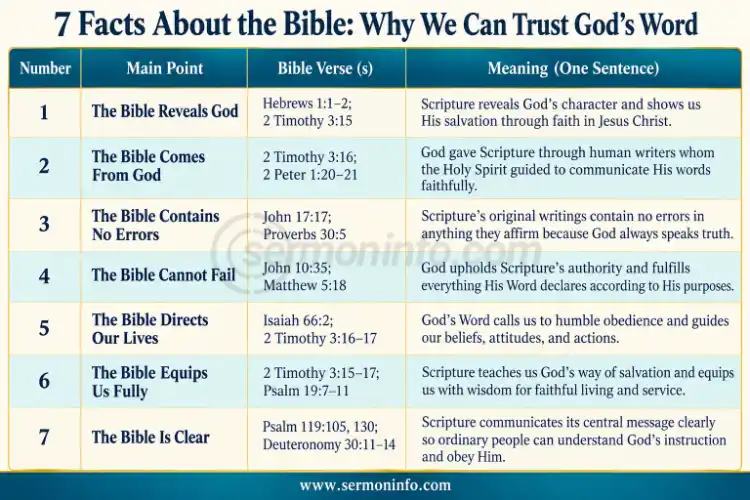
| 1 | The Bible Reveals God | Hebrews 1:1–2; 2 Timothy 3:15 | Scripture reveals God’s character and shows us His salvation through faith in Jesus Christ. |
| 2 | The Bible Comes From God | 2 Timothy 3:16; 2 Peter 1:20–21 | God gave Scripture through human writers whom the Holy Spirit guided to communicate His words faithfully. |
| 3 | The Bible Contains No Errors | John 17:17; Proverbs 30:5 | Scripture’s original writings contain no errors in anything they affirm because God always speaks truth. |
| 4 | The Bible Cannot Fail | John 10:35; Matthew 5:18 | God upholds Scripture’s authority and fulfills everything His Word declares according to His purposes. |
| 5 | The Bible Directs Our Lives | Isaiah 66:2; 2 Timothy 3:16–17 | God’s Word calls us to humble obedience and guides our beliefs, attitudes, and actions. |
| 6 | The Bible Equips Us Fully | 2 Timothy 3:15–17; Psalm 19:7–11 | Scripture teaches us God’s way of salvation and equips us with wisdom for faithful living and service. |
| 7 | The Bible Is Clear | Psalm 119:105, 130; Deuteronomy 30:11–14 | Scripture communicates its central message clearly so ordinary people can understand God’s instruction and obey Him. |
Source Material
MacArthur, John, and Richard Mayhue, eds. Biblical Doctrine: A Systematic Summary of Bible Truth. Wheaton, IL: Crossway, 2017, pp. 69–119.
Grudem, Wayne A. Systematic Theology: An Introduction to Biblical Doctrine. 2nd ed. Grand Rapids, MI: Zondervan Academic, 2020, pp. 47–127.