The Sermon Outline From Acts 8:9–24 explains that God’s saving grace cannot be earned through human effort or purchased with earthly resources. Genuine salvation comes through faith in Christ, produces sincere repentance, and results in a transformed life that faithfully follows the Lord.

Key Takeaways – Sermon From Acts 8:8-24
- God’s saving grace is a free gift that cannot be earned or purchased. Trust Jesus Christ alone because salvation comes through faith, not human effort, good works, or personal achievement (Ephesians 2:8–9).
- Genuine faith transforms the heart and life. Reject pride, embrace the gospel, and let God’s grace produce humility, sincere repentance, and faithful obedience to Christ (Acts 8:21–22)
- Honor God’s work by proclaiming His grace. Share the gospel confidently, exalt Christ above human ability, and remind others that salvation belongs to the Lord alone (Acts 8:12; Romans 1:16).
Sermon Outline From Acts 8:9-24
Acts 8:9–24 takes us to Samaria, where Philip preached Christ and many believed the gospel. Among them stood Simon, a sorcerer who amazed the people with his power and held an inflated view of himself. Although he professed faith, his later actions revealed a wrong view of salvation. He tried to purchase what only God freely gives. Luke contrasts human pride with humble faith and exposes the difference between outward religion and genuine conversion.
This passage reminds us that God’s saving grace cannot be earned, purchased, or manipulated. Instead, it calls us to humble ourselves, trust Christ alone, and respond with sincere repentance. As we study this passage, we will discover three life-changing truths about God’s saving grace. These truths will help us examine our hearts, strengthen our faith, and rejoice that salvation comes entirely through God’s grace in Jesus Christ.
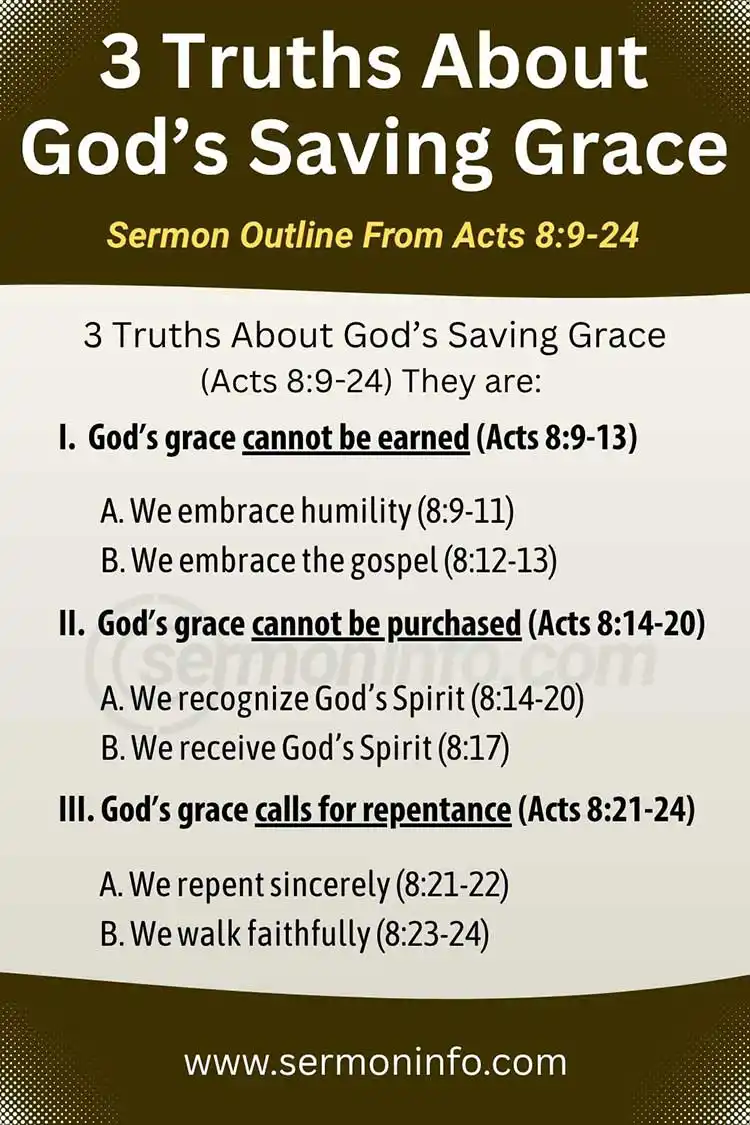
1. God’s Grace Cannot Be Earned (Acts 8:9–13)
God’s salvation comes by His grace alone and never through human merit, ability, or personal achievement. (Summary Explanation)
A. We Embrace Humility (Acts 8:9–11)
Simon amazed the people of Samaria with his sorcery and claimed to be someone great. The crowds praised him and called him “the great power of God” (Acts 8:9–10). Simon held an inflated view of himself instead of giving glory to God. Pride filled his heart and blinded him to his true spiritual condition.
This account reminds us to reject pride and embrace humility. James 4:6 says, “God resists the proud, but gives grace to the humble.” Every ability and blessing comes from God alone. Like John the Baptist declared, “He must increase, but I must decrease” (John 3:30). Humble hearts gladly give Christ all the glory.
B. We Embrace the Gospel (Acts 8:12–13)
Philip faithfully preached the good news about the kingdom of God and the name of Jesus Christ. Many Samaritans believed and were baptized because they trusted Christ alone (Acts 8:12). Simon also believed outwardly and was baptized, yet the events that followed revealed he misunderstood God’s saving grace and the work of the Holy Spirit.
This brings us to an important lesson. Salvation comes by grace through faith and never through religious activity or human effort (Ephesians 2:8–9). Simon later tried to obtain God’s gift with money, exposing his false understanding (Acts 8:18–23). We must trust Jesus Christ alone, resting completely in His finished work on the cross for our salvation. (Source Material: John MacArthur, The MacArthur New Testament Commentary: Acts 1–12 (Chicago, IL: Moody Publishers, 1994), 238–247)
This material provides some ideas and thoughts for a sermon outline from Acts 8:8-24 (3 Truths About God’s Saving Grace).
2. God’s Grace Cannot Be Purchased (Acts 8:14–20)
God’s grace and the gift of the Holy Spirit are freely given by God and can never be bought with money. (Summary Explanation)
A. We Recognize God’s Spirit (Acts 8:14–20)
When Peter and John arrived in Samaria, they prayed for the new believers to receive the Holy Spirit. Simon watched the apostles lay hands on them and saw God’s power displayed. Instead of worshiping God, he offered money to obtain the same authority. Simon treated the Holy Spirit as a power to possess rather than God’s sovereign gift.
This passage reminds us that the Holy Spirit is not a force we control but the third Person of the Trinity. He works according to God’s perfect will and purpose. 1 Corinthians 12:11 says He distributes His gifts “to each one individually as He wills.” We honor the Holy Spirit by submitting to Him, not by seeking personal influence or recognition.
B. We Receive God’s Spirit (Acts 8:17)
The Samaritan believers received the Holy Spirit through God’s gracious work, not through human effort or financial payment. God used this unique event to confirm the inclusion of the Samaritans into the body of Christ through apostolic ministry. Simon misunderstood this truth because he viewed God’s gift as something people could obtain through human means.
This warning reaches every generation. The Holy Spirit comes to every believer through faith in Jesus Christ, not through money, status, or religious performance. Ephesians 1:13 teaches that believers are sealed with the Holy Spirit after hearing and believing the gospel. Simon’s later response revealed an unchanged heart (Acts 8:23–24). Genuine faith receives God’s Spirit through His grace and produces a transformed life. (Source Material: Charles R. Swindoll, Swindoll’s Living Insights New Testament Commentary: Acts (Carol Stream, IL: Tyndale House Publishers, 2019), 144–146.)
3. God’s Grace Calls for Repentance (Acts 8:21–24)
God’s grace lovingly confronts sin and calls every sinner to genuine repentance. (Summary Explanation)
A. We Repent Sincerely (Acts 8:21–24)
Peter exposed Simon’s heart with direct words. He declared that Simon had no part in this ministry because his heart was not right before God (Acts 8:21). Peter then urged him to repent of his wickedness and pray for God’s forgiveness. Simon feared the consequences of sin, but the passage never records genuine repentance.
This account reminds us that true repentance begins in the heart before it appears in our actions. Second Corinthians 7:10 says, “godly sorrow produces repentance leading to salvation” (NKJV). God invites us to confess our sin and seek His mercy with sincere hearts. When we come honestly before Him, He forgives and restores us (1 John 1:9).
B. We Walk Faithfully (Acts 8:24)
After Peter’s rebuke, Simon asked the apostles to pray so that judgment would not come upon him (Acts 8:24). His words focused on escaping punishment rather than following Christ. Genuine repentance produces a changed direction. A transformed heart continues to trust, obey, and grow in the Lord each day.
This brings us to a practical lesson. Genuine faith does not stop with an emotional response. It continues in faithful obedience. Jesus said, “If you love Me, keep My commandments” (John 14:15). Like a healthy tree producing good fruit, a believer’s life displays lasting evidence of God’s saving grace through faithful devotion to Christ. (Source Material: John MacArthur, The MacArthur New Testament Commentary: Acts 1–12 (Chicago, IL: Moody Publishers, 1994), 238–247)
Conclusion
As we conclude, Acts 8:9–24 reveals 3 truths about God’s saving grace. First, God’s grace cannot be earned because salvation comes through faith, not human merit. Second, God’s grace cannot be purchased because the Holy Spirit is God’s sovereign gift. Third, God’s grace calls for repentance because genuine faith produces a transformed life. These truths point us to the Lord Jesus Christ.
Let us receive God’s Word with humble hearts and share it faithfully. We must proclaim that salvation comes by grace alone through faith in Christ alone. As we teach others, let us exalt God’s glory, not human ability. If you have never trusted Christ, acknowledge your sin, believe in His finished work, confess Him as Lord, and dedicate your life to Him. Then walk faithfully each day for God’s glory.
Closing Prayer
Heavenly Father, thank You for Your amazing saving grace that comes through Jesus Christ alone. We praise You because salvation cannot be earned or purchased. Forgive us for every proud thought and every attempt to depend on ourselves. Give us humble hearts that trust Your Word, treasure the gospel, and gladly submit to the work of Your Holy Spirit. Help us to live each day for Your glory.
Lord Jesus, deepen our faith and produce genuine repentance in our lives. Keep us faithful as we follow You and proclaim Your gospel with courage and love. Strengthen us to honor You in our words, our actions, and our witness. If anyone has not yet trusted You as Savior and Lord, draw them to Yourself today. May our lives always point others to Your saving grace. We pray in Jesus’ name. Amen.
Frequently Asked Questions (FAQ)
Q: What does Acts 8:9–24 teach about God’s saving grace?
A: Acts 8:9–24 teaches that God’s saving grace is a free gift that cannot be earned, bought, or controlled. Salvation comes through faith in Jesus Christ alone and produces genuine repentance, humility, and a transformed life that honors God.
Q: Who was Simon the Sorcerer in the Bible?
A: Simon the Sorcerer was a well known magician in Samaria who amazed people through sorcery before hearing Philip preach the gospel. Although he professed belief and was baptized, his attempt to buy spiritual authority exposed serious problems in his understanding of God’s grace.
Q: Why did Peter rebuke Simon so strongly?
A: Peter rebuked Simon because he believed God’s gift could be purchased with money and revealed a heart that was not right before God. Peter called him to sincere repentance, showing that spiritual blessings come only through God’s grace.
Q: Can the Holy Spirit be received through money or human effort?
A: No. The Holy Spirit is God’s sovereign gift, given according to His will and received through faith in Jesus Christ. No amount of money, influence, or religious effort can obtain what God freely gives by His grace.
Q: What is the main lesson from Simon the Sorcerer’s story?
A: The main lesson is that outward profession without genuine heart transformation is insufficient. God calls every person to humble faith, sincere repentance, and complete trust in Christ rather than confidence in personal power, religious activity, or earthly possessions.
BONUS: Was Simon the Sorcerer truly saved in Acts 8?
Many interpreters believe Simon the Sorcerer was not truly saved because his heart remained unchanged. Although he believed and was baptized (Acts 8:13), Peter later declared, “your heart is not right in the sight of God” and “you are poisoned by bitterness and bound by iniquity” (Acts 8:21, 23). His desire to purchase God’s gift revealed a false understanding of salvation.
Acts 8 does not explicitly state whether Simon was saved, so faithful interpreters differ. However, the evidence points toward a profession of faith without genuine conversion. Simon feared God’s judgment but showed no clear repentance (Acts 8:24). Genuine saving faith produces repentance and a transformed life (2 Corinthians 5:17; James 2:17), not merely outward belief or religious activity.
BONUS: Why did the Samaritans receive the Holy Spirit after Peter and John arrived?
The Samaritans received the Holy Spirit after Peter and John arrived because God used the apostles to confirm that Samaritans fully belonged to the body of Christ (Acts 8:14–17). This unique event preserved unity between Jewish and Samaritan believers under apostolic authority. God demonstrated that there was one gospel, one Spirit, and one people in Christ (Ephesians 4:4–6).
This delay was a special historical event, not the normal pattern for every believer. Later in Acts, people received the Holy Spirit immediately upon believing the gospel (Acts 10:44–48; Acts 16:30–34). Today, every person who trusts Christ receives the Holy Spirit at salvation (Romans 8:9; Ephesians 1:13–14). This truth assures believers that salvation rests on God’s grace, not on apostolic presence or human ceremony.
BONUS: What does Acts 8:20 mean when Peter says, “Your money perish with you”?
Peter’s words, “Your money perish with you” (Acts 8:20), strongly rebuked Simon’s attempt to purchase God’s gift with money. Simon treated the Holy Spirit as something to own rather than God’s sovereign gift. Peter declared that God’s grace cannot be bought because salvation and spiritual blessings come freely from the Lord alone (Ephesians 2:8–9).
Peter’s rebuke also exposed Simon’s sinful heart and called him to repentance (Acts 8:21–22). God values a humble heart over outward religion or financial resources. Isaiah 55:1 invites everyone to receive God’s blessings “without money and without price.” This passage reminds us to trust Christ alone and never substitute human effort for God’s amazing grace.
BONUS: What is the sin of simony, and how does it relate to Simon the Sorcerer?
The sin of simony is the attempt to buy or sell spiritual offices, gifts, or blessings for personal gain. The name comes from Simon the Sorcerer, who offered money to receive the authority to impart the Holy Spirit (Acts 8:18–19). Peter immediately rejected his offer, declaring that God’s gift cannot be purchased with money (Acts 8:20).
This passage teaches that God’s grace, salvation, and spiritual ministry come from His sovereign will, not human wealth or influence. First Peter 5:2 calls leaders to serve “not for dishonest gain, but eagerly.” Every believer should treasure God’s gifts with humility, remembering that spiritual blessings are received by grace through faith, never through financial payment or personal ambition.
BONUS: How can believers distinguish genuine faith from false profession?
Genuine faith begins with wholehearted trust in Jesus Christ and produces a transformed life. While outward profession may appear convincing, God looks at the heart (1 Samuel 16:7). Jesus said, “You will know them by their fruits” (Matthew 7:16). True believers increasingly display humility, obedience, and a growing love for Christ and His Word.
False profession may include religious activity without genuine repentance or spiritual transformation. Simon the Sorcerer professed belief, yet Peter exposed the condition of his heart (Acts 8:21–23). First John 2:3 teaches that those who know Christ keep His commandments. Genuine faith continues to trust, obey, and follow the Lord because God’s saving grace changes both the heart and the life.
BONUS: What does Acts 8:9–24 teach about the relationship between faith, repentance, and the Holy Spirit?
Acts 8:9–24 shows that faith, repentance, and the Holy Spirit work together in God’s plan of salvation. The Samaritans believed the gospel, and God confirmed their inclusion by giving them the Holy Spirit through the apostles (Acts 8:12–17). Simon professed faith, yet Peter exposed an unrepentant heart that misunderstood God’s grace and the Spirit’s work (Acts 8:21–23).
This passage teaches that genuine faith leads to sincere repentance, and true repentance reveals a transformed heart. The Holy Spirit is God’s gracious gift to those who believe in Christ, not a reward for human effort (Ephesians 1:13–14). When sinners trust Christ, God forgives, indwells, and empowers them to live faithfully for His glory (Romans 8:9).
| Sermon Outline From Acts 8:9-24 – Free Expository Sermon Outlines | |||
|---|---|---|---|
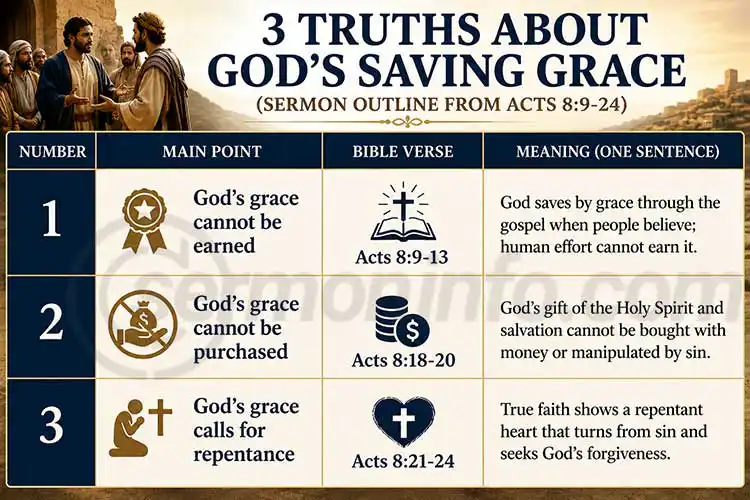
| Number | Main Point | Bible Verse | Meaning |
| 1 | God’s Grace Cannot Be Earned | Acts 8:9–13 | God’s saving grace comes through faith in Jesus Christ and cannot be earned by human ability, reputation, or personal achievement. |
| 2 | God’s Grace Cannot Be Purchased | Acts 8:14–20 | God’s grace and the gift of the Holy Spirit are freely given by God and can never be bought with money or obtained through human effort. |
| 3 | God’s Grace Calls for Repentance | Acts 8:21–24 | God’s saving grace exposes sinful hearts, calls sinners to genuine repentance, and produces a life of faithful obedience to Christ. |
Source Material Bibliography
MacArthur, John. The MacArthur New Testament Commentary: Acts 1–12. Chicago, IL: Moody Publishers, 1994, pp. 238–247.
Swindoll, Charles R. Swindoll’s Living Insights New Testament Commentary: Acts. Carol Stream, IL: Tyndale House Publishers, 2019, pp. 144–146.