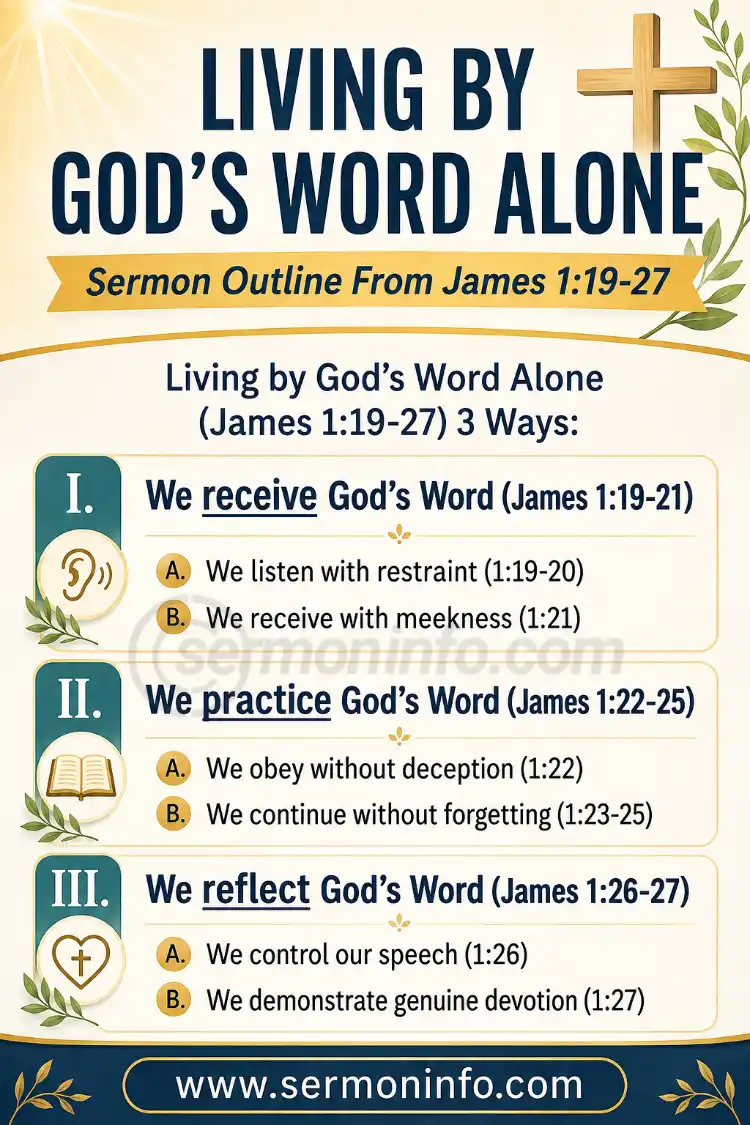
Sermon Outline From James 1:19–27 teaches that living by God’s Word alone requires three responses. We receive the Word humbly, practice the Word obediently, and reflect the Word visibly. Genuine faith produces action because Scripture changes our speech, directs our compassion, and calls us to live differently from the sinful values of the world.

Key Takeaways – Sermon From James 1:19-27
- We receive God’s Word with humility. Listen carefully, control your anger, and prepare your heart to welcome God’s truth (James 1:19–21).
- We practice God’s Word through obedience. Do not merely hear Scripture. Act on what God says, remember His truth, and continue faithfully in it (James 1:22–25).
- We reflect God’s Word in daily life. Let Scripture shape your speech, compassion, and personal holiness so others can see genuine devotion to God (James 1:26–27).
Sermon Outline From James 1:19-27
Hearing God’s Word matters because God uses His truth to shape our hearts and direct our lives. James warns us not to become hearers only. We must receive Scripture with humility and respond with obedience. God’s Word acts like a mirror, showing us what needs to change. True spiritual growth begins when hearing leads to doing.
James 1:19–27 shows us how to live by God’s Word alone. We must receive God’s Word, practice God’s Word, and reflect God’s Word. These truths move Scripture from our ears into everyday life. As we study this passage, we will see that God blesses those who hear His truth and faithfully live it.
1. We Receive God’s Word (James 1:19–21)
“So then, my beloved brethren, let every man be swift to hear, slow to speak, slow to wrath; for the wrath of man does not produce the righteousness of God. Therefore lay aside all filthiness and overflow of wickedness, and receive with meekness the implanted word, which is able to save your souls. (James 1:19-21)
A. We Listen With Restraint (James 1:19–20)
James tells us to remain “swift to hear, slow to speak, slow to wrath” (James 1:19). We prepare our hearts by listening carefully and speaking wisely. Anger often makes us defend ourselves instead of hearing God. An angry person seldom hears God’s instructions clearly because strong emotions can drown out His truth.
James warns that “the wrath of man does not produce the righteousness of God” (James 1:20). Our anger cannot accomplish God’s spiritual purposes. When Scripture corrects us, we should listen before reacting. A quiet, teachable heart gives God’s Word room to expose wrong attitudes and guide us toward righteous living.
B. We Receive With Meekness (James 1:21)
James commands us to “lay aside all filthiness” and “receive with meekness the implanted word” (James 1:21). Before planting seed, a gardener prepares the soil. Likewise, we must remove sinful attitudes that resist God’s truth. Pride, bitterness, and stubbornness can harden our hearts and hinder spiritual growth.
A prepared heart welcomes Scripture with humility and allows God to change us. The “implanted word” takes root as we receive and obey its truth. We should approach Scripture saying, “Lord, show me what must change.” God’s Word then corrects our thinking, strengthens our faith, and directs our daily walk with Christ. (Source Material: William MacDonald, Believer’s Bible Commentary, pp. 2222-2224)
This material provides some ideas and thoughts for a sermon outline from James 1:19-27 (Living by God’s Word Alone).
2. We Practice God’s Word (James 1:22–25)
“But be doers of the word, and not hearers only, deceiving yourselves. For if anyone is a hearer of the word and not a doer, he is like a man observing his natural face in a mirror; for he observes himself, goes away, and immediately forgets what kind of man he was. But he who looks into the perfect law of liberty and continues in it, and is not a forgetful hearer but a doer of the work, this one will be blessed in what he does.” (James 1:22-25)
A. We Obey Without Deception (James 1:22)
James gives a clear command: “be doers of the word, and not hearers only” (James 1:22). Hearing truth without obeying it creates spiritual self deception. We may know many verses and still resist God’s will. True growth begins when we act on what Scripture says.
God does not call us to admire His Word from a distance. He calls us to obey it in daily life. When Scripture exposes pride, fear, bitterness, or selfishness, we must respond. Obedience turns hearing into discipleship and helps us walk faithfully with Christ.
B. We Continue Without Forgetting (James 1:23–25)
James compares Scripture to a mirror that reveals our true condition (James 1:23–24). A person who looks and walks away unchanged gains nothing. In the same way, we should remember what God reveals. His Word shows where our lives need correction, encouragement, and renewed obedience.
James then describes the believer who “continues in it” (James 1:25). Spiritual growth requires more than a brief glance at Scripture. We must keep returning, remembering, and obeying. Like a path marked by clear signs, God’s Word keeps directing our steps when trials make life confusing. (Source Material: John MacArthur, The MacArthur Bible Commentary, pp. 1884-1885)
3. We Reflect God’s Word (James 1:26–27)
“If anyone among you thinks he is religious, and does not bridle his tongue but deceives his own heart, this one’s religion is useless. Pure and undefiled religion before God and the Father is this: to visit orphans and widows in their trouble, and to keep oneself unspotted from the world.” (James 1:26-27)
A. We Control Our Speech (James 1:26)
James warns that a person may appear religious while failing to control the tongue. Words reveal what rules the heart. When God’s truth shapes us, it should also govern our speech. We reflect His Word when we refuse gossip, harshness, careless criticism, and angry reactions.
James says uncontrolled speech can make our religion “useless” (James 1:26). That warning should humble us. A bridled tongue shows spiritual maturity because we choose words that honor Christ. Proverbs 15:1 reminds us that “a soft answer turns away wrath.” Godly speech makes biblical truth visible in daily relationships.
B. We Demonstrate Genuine Devotion (James 1:27)
James defines pure devotion through compassion and holiness. He points to orphans and widows because they often lacked protection and support. Genuine faith notices vulnerable people and responds with practical care. We reflect God’s heart when we serve those who cannot repay us.
James also calls believers to remain “unspotted from the world” (James 1:27). Compassion must walk with personal holiness. We live among people who often reject God’s standards, yet we must remain faithful. God’s Word shapes both our service and our conduct, so our lives display sincere devotion to Christ. (Source Material: John F. Walvoord and Roy B. Zuck, The Bible Knowledge Commentary: New Testament, pp. 822-824)
Conclusion
James calls us to receive God’s Word, practice God’s Word, and reflect God’s Word each day. We receive it with humility, practice it through obedience, and reflect it through godly speech and genuine devotion. God never intends His truth to stop at our ears. He desires His Word to shape our hearts, choices, relationships, and daily conduct.
So, we must approach Scripture with open hearts and willing lives. We should ask what God says, what He reveals, and how we must respond. His Word corrects us, strengthens us, and directs us through every season. As James reminds us, blessing comes when we continue in God’s truth and faithfully do what He says.
Closing Prayer
Heavenly Father, thank You for giving us Your living and powerful Word. Give us humble hearts to receive Your truth and willing hearts to obey it. Help us listen carefully, control our words, and faithfully practice what You teach us each day.
Lord, may Your Word shape our thoughts, choices, relationships, and conduct. Help us reflect Christ through compassionate service and holy living. Keep us faithful when trials come, and strengthen us to walk according to Your truth. We pray in Jesus’ name. Amen.
Frequently Asked Questions (FAQ)
Q: What does James 1:19 mean by being quick to hear?
A: James 1:19 teaches believers to listen carefully, speak wisely, and control anger. A teachable heart hears God’s truth before reacting. Human anger rarely produces God’s righteous purposes. When we slow our responses and receive Scripture humbly, God’s Word can correct our attitudes and guide our conduct.
Q: What is the implanted word in James 1:21?
A: The “implanted word” in James 1:21 refers to God’s truth received deeply into the heart. Believers should remove sinful attitudes and welcome Scripture with humility. Like seed in prepared soil, God’s Word takes root, shapes our thinking, strengthens faith, and produces obedient spiritual growth.
Q: What does “doers of the word” mean in James 1:22?
A: James 1:22 means believers must act on what Scripture teaches, not merely listen to it. Hearing without obedience creates spiritual self deception. Genuine faith responds to God’s truth with action. We grow when we obey His commands and allow Scripture to shape our choices, attitudes, and relationships.
Q: What is the perfect law of liberty in James 1:25?
A: The “perfect law of liberty” in James 1:25 describes God’s revealed truth as complete and life giving. Biblical freedom does not mean freedom to sin. God’s Word frees believers to live as He intended. Blessing comes as we continue in Scripture, remember its truth, and obey it faithfully.
Q: What does pure and undefiled religion mean in James 1:27?
A: Pure and undefiled religion in James 1:27 describes devotion that God approves. Genuine faith shows compassion toward vulnerable people and pursues personal holiness. Caring for orphans and widows reflects God’s heart, while remaining unspotted from the world shows a life increasingly shaped by His truth.
BONUS: What is the “wrath of man” in James 1:20?
The “wrath of man” in James 1:20 refers to sinful human anger that rises from pride, frustration, or selfish desires. Such anger often produces harsh words, damaged relationships, and foolish reactions. James warns that “the wrath of man does not produce the righteousness of God.” Human anger cannot accomplish God’s holy purposes.
Believers should respond to conflict with patience, humility, and self control. James 1:19 tells us to remain “slow to wrath,” while Proverbs 15:1 says, “A soft answer turns away wrath.” God’s Word should govern our reactions. When we surrender anger to Him, we make room for wisdom, grace, and righteous conduct.
BONUS: Is anger always sinful according to James 1:19–20?
Anger is not always sinful. Ephesians 4:26 says, “Be angry, and do not sin.” Jesus also showed righteous anger toward hardened hearts (Mark 3:5). James 1:19–20 condemns uncontrolled human anger because it often grows from pride, selfishness, or frustration and fails to produce God’s righteousness.
Believers must therefore handle anger carefully. We should become “slow to wrath” and allow God’s Word to govern our responses (James 1:19). Righteous anger opposes sin while still seeking God’s honor. Sinful anger attacks people, feeds bitterness, and damages relationships. God calls us to respond with truth, patience, and self control.
BONUS: Why does James compare God’s Word to a mirror in James 1:23–24?
James compares God’s Word to a mirror because Scripture reveals our true spiritual condition. A mirror shows what needs attention, and God’s Word exposes attitudes, motives, and actions. James 1:23–24 warns that hearing Scripture without responding resembles someone who sees his reflection, then walks away unchanged.
God does not show us our condition merely to inform us. He calls us to respond with obedient faith. James 1:25 says blessing comes to the person who continues in God’s truth and acts upon it. We should therefore read Scripture prayerfully, accept its correction, and allow God to shape our daily lives.
BONUS: What does it mean to bridle your tongue in James 1:26?
To “bridle your tongue” means to control your speech under God’s direction. James uses the picture of a bridle guiding a horse. Our words reveal the condition of our hearts. James 1:26 warns that uncontrolled speech can expose empty devotion and deceive the person who speaks carelessly.
Believers should allow God’s Word to govern what they say and how they say it. We should reject gossip, harsh criticism, angry words, and careless speech. Proverbs 15:1 says, “A soft answer turns away wrath.” When Christ shapes our hearts, our words should increasingly display grace, wisdom, and self control.
BONUS: Why does James emphasize caring for orphans and widows in James 1:27?
James emphasizes orphans and widows because they often lacked protection, provision, and social influence. Caring for them reveals genuine compassion and practical faith. James 1:27 describes this as “pure and undefiled religion before God.” God repeatedly shows special concern for the vulnerable and commands His people to reflect that concern.
This care does not earn salvation, but it shows the fruit of a transformed life. Deuteronomy 10:18 says God “administers justice for the fatherless and the widow.” Genuine devotion notices need, responds with mercy, and serves without seeking repayment. When believers care for vulnerable people, they reflect God’s compassion in practical ways.
BONUS: What does it mean to remain unspotted from the world in James 1:27?
To remain “unspotted from the world” means refusing the sinful values, attitudes, and practices that oppose God. James 1:27 calls believers to live with moral purity while serving others compassionately. We do not withdraw from people. Instead, we reject the world’s sinful influence and remain faithful to Christ.
Believers stay spiritually clean by allowing God’s Word to shape their thinking, choices, and conduct. Romans 12:2 says, “Do not be conformed to this world.” We should resist sinful pressures, pursue holiness, and seek God’s will daily. Genuine devotion combines compassionate service with a life that honors God.
| Sermon Outline From James 1:19-27 – Sermon Outlines From James | |||
|---|---|---|---|
| Number | Main Point | Bible Verse | Meaning |
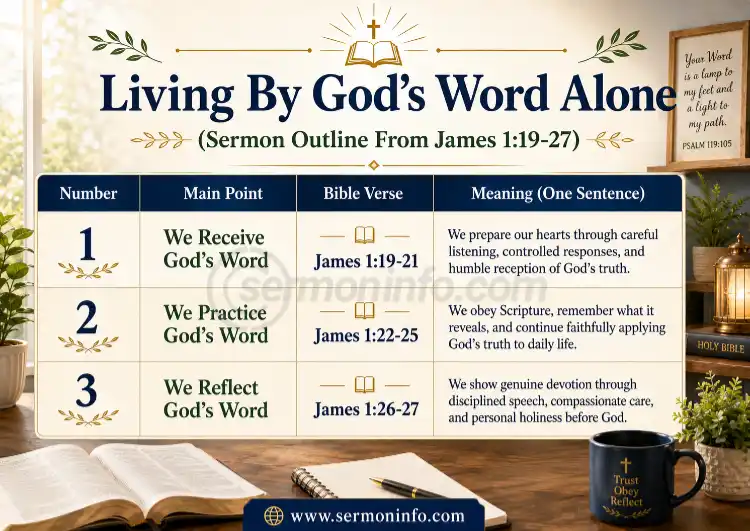
| 1 | We Receive God’s Word | James 1:19–21 | We prepare our hearts through careful listening, controlled responses, and humble reception of God’s truth. |
| 2 | We Practice God’s Word | James 1:22–25 | We obey Scripture, remember what it reveals, and continue faithfully applying God’s truth to daily life. |
| 3 | We Reflect God’s Word | James 1:26–27 | We show genuine devotion through disciplined speech, compassionate care, and personal holiness before God. |
Source Material
William MacDonald, Believer’s Bible Commentary, rev. ed. (Nashville: Thomas Nelson, 1995), 2222-2224
John MacArthur, The MacArthur Bible Commentary (Nashville: Thomas Nelson, 2005), 1884-1885
John F. Walvoord and Roy B. Zuck, eds., The Bible Knowledge Commentary: New Testament (Colorado Springs, CO: David C. Cook, 1985), 822-824