These 7 Bible Verses About Bitterness reveal how to guard against grudges, heal from hurt, and walk in Christ’s peace.

Key Takeaways – 7 Bible Verses About Bitterness
- Bitterness is spiritually dangerous – Ephesians 4:31 warns that holding on to resentment allows anger and malice to take root.
- Complaints can reveal the heart – Job 7:11 shows that bitter words often uncover inner pain and a need for healing.
- Envy fuels division – James 3:14 teaches that bitter envy leads to strife and damages relationships.
- Bitterness grows like roots – Hebrews 12:15 urges believers to uproot bitterness before it spreads and harms others.
- Words reflect the soul – Romans 3:14 reminds us that bitter speech exposes an unhealed heart.
- Sorrows can isolate – Proverbs 14:10 reveals that only God fully understands personal bitterness, yet He invites us to share burdens.
- Trials test trust – Isaiah 38:15 shows that bitter seasons can grow our faith when we respond with trust instead of resentment.
7 Bible Verses About Bitterness
Bitterness can creep into our hearts like a hidden weed, choking joy and peace. Left unchecked, it spreads quickly and deeply.
I once knew a believer who carried an offense for years, and it robbed him of worship’s joy. God’s Word warns us often to guard against this spiritual poison.
Today, we’ll explore 7 Bible verses about bitterness that show us how to resist, remove, and replace it with Christ’s peace.
1. Guard Against Lingering Resentment
“Let all bitterness, wrath, anger, clamor, and evil speaking be put away from you, with all malice.” (Ephesians 4:31)
A. Bitterness Poisons the Heart
Bitterness is not harmless. When we choose to hold on to it, anger and malice begin to take root in our hearts. Like weeds in a garden, these roots grow quietly but spread widely, choking out love and peace. Paul warns in Ephesians 4:31 to “put away” all bitterness before it destroys our fellowship with God and others.
I have seen believers carry resentment for years, and it slowly drains their joy. Instead of living free, they rehearse old wounds. Jesus calls us to guard our hearts because “out of it spring the issues of life” (Proverbs 4:23). If we allow bitterness to stay, it will shape our attitudes, words, and relationships in destructive ways.
B. Bitterness Must Be Removed
Removing bitterness is not a one-time decision but a daily choice. We forgive not because people deserve it but because Christ forgave us (Colossians 3:13). Letting go releases us from the prison of resentment and opens our hearts to God’s healing peace. This is how we protect the joy He gives.
Sometimes you must forgive the same person for the same hurt many times. That is not weakness, it is spiritual strength. Each day, choose grace over grudges. Pray for the one who hurt you, and you will find your heart growing lighter. Forgiveness is the tool God uses to keep our hearts clean.
2. Guard Against Bitter Complaints
“Therefore I will not restrain my mouth; I will speak in the anguish of my spirit; I will complain in the bitterness of my soul.” (Job 7:11)
A. Complaints Reveal Inner Pain
When Job spoke of his bitter complaints, he was revealing the deep sorrow within his heart (Job 7:11). Our words often uncover what we try to hide. Pain that is unaddressed can slip into our speech and affect how we talk to God and others. It is a sign our hearts need healing.
I have met people who can hardly speak without bitterness spilling out. They are not bad people—they are hurting people. Jesus reminds us in Luke 6:45 that our mouths speak from the overflow of our hearts. Honest confession to God is the first step to cleansing that inner well.
B. Complaints Must Be Surrendered
It is not wrong to tell God how you feel, but you must also surrender those feelings into His hands. David often began his psalms with complaint yet ended with praise because he gave his burden to the Lord (Psalm 55:22).
Instead of repeating our hurt to others, we should pour it out before the Lord. Surrendering our complaints keeps them from turning into accusations against God. In His presence, pain can transform into peace, and our speech can change from bitter to hopeful.
This material provides some ideas and thoughts for a message about bitterness (7 Bible Verses About Bitterness).
3. Guard Against Bitter Envy
“But if you have bitter envy and self-seeking in your hearts, do not boast and lie against the truth.” (James 3:14)
A. Envy Breeds Selfish Strife
James warns that bitter envy in the heart leads to confusion and every evil work (James 3:14–16). When we let jealousy take hold, it fuels competition and rivalry. It whispers that God has been unfair to us, which is a dangerous lie.
I have seen friendships destroyed because one person could not rejoice in another’s blessing. Envy turns allies into adversaries. It replaces gratitude with comparison. If we do not root it out, it will poison both our relationships and our testimony.
B. Envy Must Be Confessed
Confession breaks envy’s hold. We admit to God that our desire for what others have is sinful. We ask Him to restore our gratitude and contentment. The Bible tells us to “rejoice with those who rejoice” (Romans 12:15), and that becomes easier when our hearts are right.
When you feel jealousy rising, speak it to the Lord before it festers. Begin to thank Him for what He has given you. As you practice gratitude, envy loses its grip, and your heart grows more at peace with God’s plan.

4. Guard Against Bitter Roots
“Looking carefully lest anyone fall short of the grace of God; lest any root of bitterness springing up cause trouble, and by this many become defiled.” (Hebrews 12:15)
A. Roots Grow Unnoticed Deep
Hebrews 12:15 warns us about a “root of bitterness” springing up to cause trouble and defile many. Roots are unseen at first, but they grow quietly until they break the surface. Bitterness can develop in the same way if offenses go unresolved.
I once pulled a small weed from my garden and discovered its roots stretched far wider than expected. Offenses do the same in the soul—they spread beyond what we can see, affecting more areas than we realize.
B. Roots Must Be Uprooted Quickly
The best time to deal with bitterness is before it grows deep. Jesus taught us to reconcile quickly with others (Matthew 5:23–24). Waiting makes the work harder.
Pray about offenses the moment they happen. Talk directly and kindly to the person if needed. Ask God to remove anything that hinders love. Quick action keeps small grievances from becoming spiritual strongholds.
5. Guard Against Bitter Speech
“Whose mouth is full of cursing and bitterness.” (Romans 3:14)
A. Speech Reflects Inner State
Paul describes those whose mouths are “full of cursing and bitterness” (Romans 3:14). The tongue reveals the heart’s condition. Bitter words come from a bitter spirit, just as sweet words come from a heart at peace with God.
Think of your words as seeds. Harsh ones grow into division, while kind ones plant peace. The more bitterness in our hearts, the more our speech will wound instead of heal.
B. Speech Must Honor Christ
Ephesians 4:29 urges us to speak what builds up and gives grace. This does not mean avoiding truth—it means speaking truth in love.
Before you speak, ask yourself: Will these words honor Christ? Will they heal or harm? Choosing speech that glorifies God helps guard your heart and witness. It transforms conversations from sources of hurt to channels of grace.
6. Guard Against Bitter Sorrows
The heart knows its own bitterness, And a stranger does not share its joy. (Proverbs 14:10)
A. Sorrows Are Deeply Personal
Proverbs 14:10 reminds us that “the heart knows its own bitterness.” Some pain is so personal that no one else can fully understand. This is why we must bring it to God.
Even the closest friend may not grasp the weight of your grief. But the Lord is “close to the brokenhearted” (Psalm 34:18) and understands every tear you shed.
B. Sorrows Must Be Shared
Though some pain is deeply personal, God still calls us to bear one another’s burdens (Galatians 6:2). Sharing sorrow does not mean telling everyone; it means letting trusted believers walk with you.
Open up to those who will pray for you and speak truth into your life. Sharing sorrow invites encouragement and allows God to use others to bring healing.
7. Guard Against Bitter Trials
“What shall I say? He has both spoken to me, And He Himself has done it. I shall walk carefully all my years In the bitterness of my soul.” (Isaiah 38:15)
A. Trials Can Taste Bitter
When Hezekiah faced illness and uncertainty, he described his soul’s bitterness (Isaiah 38:15). Even faithful believers face seasons that feel unbearably hard. Trials test us deeply.
God never promised that His path would always feel sweet. Yet even bitter seasons have purpose. They can drive us to depend more fully on Him and trust His wisdom.
B. Trials Must Build Trust
Hezekiah’s trial taught him to rest in God’s promises. Difficult seasons can deepen faith if we respond with trust instead of resentment.
Pray through your trials and look for God’s hand in them. Remember Romans 8:28—He works all things for good. As trust grows, bitterness loses its power, and your heart becomes stronger in Christ.
Conclusion
Bitterness may seem small at first, but it never stays that way—it grows and harms our walk with Christ.
God’s truth gives us tools to guard against resentment, envy, and hurt before they take root. As we follow these verses, we choose forgiveness, grace, and love over anger.
So, let’s leave bitterness at the foot of the cross, where mercy flows freely, and walk forward with hearts protected by God’s peace.
Frequently Asked Questions (FAQ)
Q: What are some Bible verses that teach us to guard against bitterness?
A: Ephesians 4:31 urges us to “get rid of all bitterness.” Hebrews 12:15 warns about “a root of bitterness” that can defile many. Both highlight the need for vigilance and proactive spiritual care.
Q: Why does the Bible compare bitterness to a root?
A: Hebrews 12:15 describes bitterness as a root—something that starts small, grows unnoticed, then spreads and defiles. This imagery reminds us to address bitterness early before it damages relationships and peace.
Q: How does bitterness affect our hearts and relationships?
A: Bitterness distorts how we see others, strains relationships, and hinders spiritual growth. As one commentary puts it, bitterness can “poison our relationships” and isolate us from the abundant life God intends.
Q: What does the Bible say about forgiving to overcome bitterness?
A: Scripture is clear: we are called to forgive as Christ forgave us. Verses like Ephesians 4:32 and Matthew 6:14 connect forgiving others directly to healing our hearts and releasing bitterness.
Q: Can sharing bitterness help in overcoming it?
A: Yes. Proverbs 14:10 affirms that only each heart knows its own bitterness. Sharing burdens with trusted believers brings healing, prayer, and perspective—helping us move toward peace.

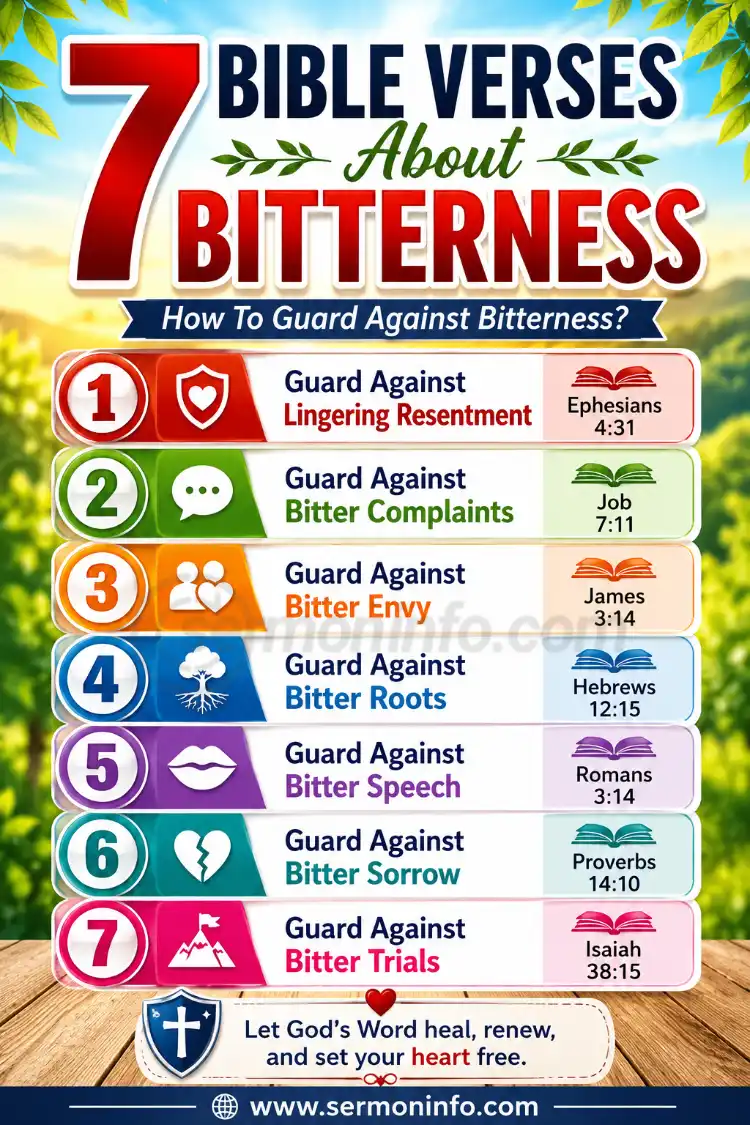
| Number | Main Point | Bible Verse | Meaning |
|---|---|---|---|
| 1 | Guard Against Lingering Resentment | Ephesians 4:31 | Believers must remove all bitterness, anger, and malice to keep relationships pure and hearts aligned with God’s will. |
| 2 | Guard Against Bitter Complaints | Job 7:11 | Expressing bitterness through complaints reveals inner pain that must be brought honestly to God for healing. |
| 3 | Guard Against Bitter Envy | James 3:14 | Harboring bitter envy fuels selfish ambition and damages both relationships and spiritual health. |
| 4 | Guard Against Bitter Roots | Hebrews 12:15 | A root of bitterness can grow unnoticed, spreading harm and defiling many if left unresolved. |
| 5 | Guard Against Bitter Speech | Romans 3:14 | Bitter and cursing words reflect a heart not yet surrendered to God’s grace. |
| 6 | Guard Against Bitter Sorrows | Proverbs 14:10 | Only God fully understands the depth of personal bitterness, yet He calls us to share our burdens. |
| 7 | Guard Against Bitter Trials | Isaiah 38:15 | Bitter seasons can deepen faith when met with trust in God’s promises rather than resentment. |
Source Material
The Peacemaker: A Biblical Guide To Resolving Personal Conflict by Ken Sande
Total Forgiveness by R.T. Kendall
Love, Acceptance, and Forgiveness by Jerry Cook with Stanley C. Baldwin
The Peacemaking Pastor: A Biblical Guide to Resolving Church Conflict by Alfred Poirier