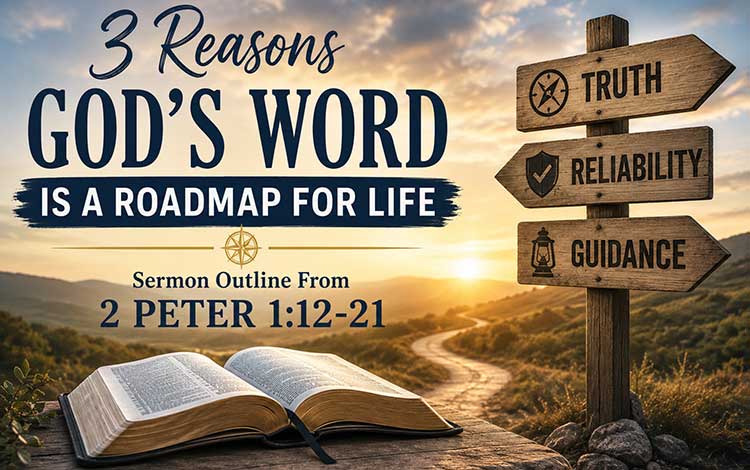
3 Reasons God’s Word is a Roadmap for Life (Sermon Outline From 2 Peter 1:16-21) teaches that Scripture provides trustworthy direction because it reflects truth, reliably reveals Jesus Christ, and originates from God. God’s Word guides believers through life’s challenges, strengthens faith, and illuminates the path of obedience with divine authority and wisdom.
Key Takeaways – Sermon From 2 Peter 1:12-21
- God’s Word provides trustworthy direction for life because it reflects unchanging truth and continually strengthens believers in their faith.
- God’s Word reliably reveals Jesus Christ through eyewitness testimony, giving believers confidence in His divine identity, power, and promises.
- God’s Word originates from God and illuminates our path, guiding us through a dark world with wisdom, hope, and spiritual clarity.
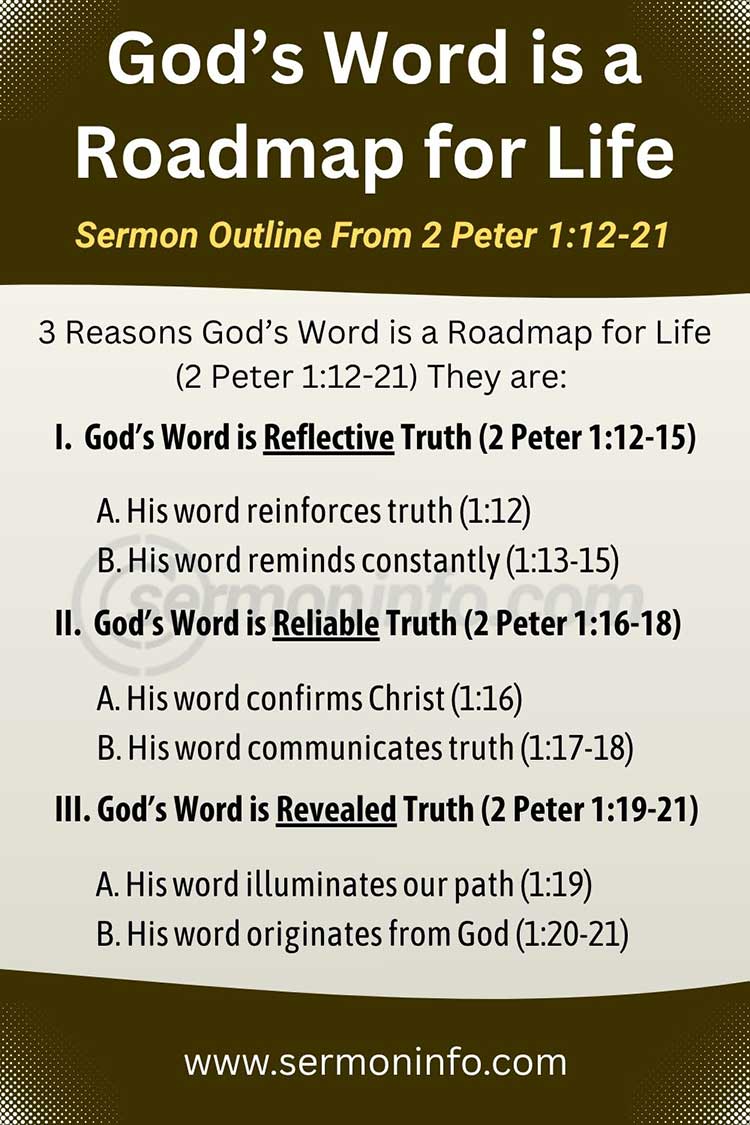
Sermon Outline From 2 Peter 1:12-21
For most of us, life often feels like a journey through unfamiliar roads. We face decisions, challenges, temptations, and uncertainties every day. Many voices offer direction, yet only one voice always speaks truth. God has not left His people without guidance. He has given us His Word to direct our steps and strengthen our faith.
In 2 Peter 1:16-21, Peter reminds believers that Scripture stands above human opinion and changing circumstances. God’s Word reflects truth, reveals Christ, and shines light on our path. It comes from God Himself and remains completely trustworthy. As we open this passage, we will discover three reasons God’s Word is a roadmap for life and why we can confidently follow its direction every day.
1. God’s Word Is Reflective Truth (2 Peter 1:12-15)
Peter teaches that God’s Word continually reflects unchanging truth that believers must remember and apply throughout their lives (Summary Statement).
A. His Word Reinforces Truth (2 Peter 1:12)
Peter knew these believers already understood the truth, yet he continued to remind them of it. He wanted them to remain established in the faith and firmly grounded in God’s Word. Truth strengthens believers when they hear it repeatedly. Romans 10:17 says, “faith comes by hearing, and hearing by the word of God.”
Many people need reminders of important things each day. We check calendars, alarms, and notes because we forget. In the same way, God’s Word reinforces spiritual truth and keeps us focused on Christ. When trials come, repeated exposure to Scripture helps us stand firm and trust God’s promises rather than our feelings.
B. His Word Reminds Constantly (2 Peter 1:13-15)
Peter viewed his ministry as a sacred responsibility. Knowing his earthly life would soon end, he diligently stirred believers to remember God’s truth. He understood that spiritual growth requires continual biblical instruction. Proverbs 4:23 teaches believers to guard their hearts, and God’s Word provides that daily protection.
Notice Peter’s urgency in these verses. He wanted believers to remember biblical truth long after he was gone. A healthy believer does not outgrow Scripture but returns to it continually. Like a lamp that lights a dark path, God’s Word guides, corrects, and encourages us as we walk through life’s challenges (Psalm 119:105). (Source Material: William MacDonald, Believer’s Bible Commentary, pp. 2291–2294)
This material provides some ideas and thoughts for a sermon outline from 2 Peter 1:12-21 (God’s Word is a Roadmap for Life).
2. God’s Word Is Reliable Truth (2 Peter 1:16-18)
Peter shows that God’s Word stands as reliable truth because it rests on eyewitness testimony and divine confirmation (Summary Statement).
A. His Word Confirms Christ (2 Peter 1:16)
Peter reminded his readers that the apostles did not follow cleverly invented stories. They personally witnessed the majesty of Jesus Christ. On the Mount of Transfiguration, they saw His glory revealed before their eyes. Their testimony confirmed that Jesus is the divine Son of God who possesses all authority and power.
This eyewitness account strengthens our faith today. Christianity rests on historical events, not religious imagination. When doubts arise, we can trust the testimony God preserved in Scripture. Jesus Christ remains the same yesterday, today, and forever (Hebrews 13:8). His proven identity gives believers confidence during uncertain times.
B. His Word Communicates Truth (2 Peter 1:17-18)
Peter recalled hearing the Father’s voice from heaven declare, “This is My beloved Son” (2 Peter 1:17). God publicly affirmed the identity of Christ before chosen witnesses. The apostles heard those words and later recorded them for future generations. God’s Word faithfully communicates what truly happened.
In a world filled with competing voices, Scripture remains a trustworthy guide. God’s Word does not promote myths or human speculation. Instead, it reveals the reality of Christ and His saving work. Like a compass that points north, Scripture directs us toward truth and helps us remain faithful when confusion surrounds us. (Source Material: John MacArthur, The MacArthur Bible Commentary, pp. 1931-1933)
3. God’s Word Is Revealed Truth (2 Peter 1:19-21)
Peter declares that God’s Word reveals divine truth through prophetic Scripture given by the Holy Spirit (Summary Statement).
A. His Word Illuminates Our Path (2 Peter 1:19)
Peter compared God’s prophetic Word to a lamp shining in a dark place. The world often confuses people with false ideas and changing values. Scripture provides clear direction when life feels uncertain. Psalm 119:105 says, “Your word is a lamp to my feet and a light to my path.” God’s truth helps us walk safely.
Consider a traveler carrying a lamp on a dark road. Each step becomes clearer because the light reveals the way ahead. In the same manner, God’s Word guides believers through trials, temptations, and difficult decisions. When circumstances seem overwhelming, Scripture points us toward Christ and fills our hearts with hope.
B. His Word Originates From God (2 Peter 1:20-21)
Peter explained that no prophecy of Scripture came from human interpretation or invention. The biblical writers did not create their message from personal ideas. Instead, “holy men of God spoke as they were moved by the Holy Spirit” (v. 21). The Spirit guided them so they accurately recorded God’s truth.
This truth gives believers great confidence in Scripture. We read a book that comes from God’s heart and mind. Paul affirmed this reality in 2 Timothy 3:16, saying, “All Scripture is given by inspiration of God.” Because God authored His Word, it remains trustworthy, authoritative, and sufficient for every season of life. (Source Material: John F. Walvoord and Roy B. Zuck, The Bible Knowledge Commentary: New Testament, pp. 867–869)
Conclusion
As we conclude, Peter reminds us that God’s Word is a trustworthy roadmap for life. It is reflective truth that reinforces and reminds us of God’s unchanging promises; It is reliable truth that confirms Christ and communicates reality. It is revealed truth that illuminates our path and originates from God Himself. When we follow Scripture, we walk in the light of God’s wisdom and direction.
Today, God invites each of us to trust His Word and follow His Son. If you know Christ, commit yourself to daily obedience and confidence in Scripture. If you have never trusted Christ, come to Him today. Acknowledge your sin, believe in His death and resurrection, confess Him as Lord, and dedicate your life to Him. Jesus Christ alone can save, guide, and keep you as you journey through life.
Closing Prayer
Heavenly Father, we thank You for the gift of Your Word. Thank You for giving us truth that never changes and guidance that never fails. Thank You for revealing Your Son through the pages of Scripture and for strengthening our faith through Your promises. Help us treasure Your Word in our hearts and trust its direction each day. When life feels uncertain, remind us that Your truth remains firm and dependable forever.
Lord Jesus, help us walk in the light of Your Word and follow You with faithful hearts. Give us wisdom for every decision and courage for every challenge. Draw those who do not know You to saving faith today. May they acknowledge their sin, believe in Your finished work, confess You as Lord, and dedicate their lives to You. Fill us with Your Spirit and help us live for Your glory until the day we see You face to face. In Jesus’ name, Amen.
Frequently Asked Questions (FAQ)
Q: Why is God’s Word compared to a lamp in 2 Peter 1:19?
A: God’s Word acts like a lamp because it provides guidance in a spiritually dark world. Just as a light helps travelers avoid danger, Scripture directs believers toward truth, wisdom, and obedience until Christ returns in glory.
Q: How can I trust that the Bible is true?
A: Peter explained that the apostles witnessed Christ’s majesty firsthand and did not follow myths (2 Peter 1:16-18). The Bible comes from eyewitness testimony and divine inspiration, making it a trustworthy and reliable source of truth for life and faith.
Q: What does it mean that Scripture originated from God?
A: According to 2 Peter 1:21, the Holy Spirit moved biblical writers to record God’s message. While human authors wrote the words, God directed the process, ensuring that Scripture accurately communicates His truth and purpose.
Q: How does God’s Word help believers make decisions?
A: God’s Word reveals God’s character, principles, and will for daily living. As believers study and obey Scripture, they gain wisdom, discern truth from error, and make decisions that honor Christ and align with biblical truth.
Q: Why should Christians read the Bible regularly?
A: Regular Bible reading strengthens faith, renews the mind, and reminds believers of God’s promises. Like food nourishes the body, Scripture nourishes the soul and equips Christians to face challenges, resist temptation, and grow spiritually.
BONUS: What does 2 Peter 1:16-21 teach about the authority of Scripture?
Peter teaches that Scripture possesses divine authority because it rests on God’s revelation, not human imagination. The apostles did not follow “cunningly devised fables” but witnessed Christ’s majesty firsthand (2 Peter 1:16-18). God the Father affirmed Jesus at the Transfiguration, confirming His identity and validating the message proclaimed by the apostles.
Peter also teaches that Scripture carries God’s authority because the Holy Spirit inspired its writers. “Holy men of God spoke as they were moved by the Holy Spirit” (2 Peter 1:21). Therefore, the Bible stands as God’s Word, not man’s opinion. Believers can trust Scripture completely because God Himself is its ultimate Author (2 Timothy 3:16).
BONUS: How does the Bible guide believers through difficult decisions?
The Bible guides believers through difficult decisions by revealing God’s wisdom and principles for daily living. Psalm 119:105 says, “Your word is a lamp to my feet and a light to my path.” As believers study Scripture, God provides direction, exposes error, and helps them choose paths that honor Him.
God’s Word also renews the mind and develops spiritual discernment. Romans 12:2 teaches believers to know God’s good, acceptable, and perfect will through transformed thinking. When facing uncertainty, Christians should pray, seek biblical counsel, and compare every option with Scripture. God’s truth provides clarity when circumstances seem confusing.
BONUS: Why did Peter emphasize eyewitness testimony in 2 Peter 1?
Peter emphasized eyewitness testimony to show that the gospel rests on historical truth, not religious myths. He declared, “we were eyewitnesses of His majesty” (2 Peter 1:16). Peter, James, and John personally witnessed Christ’s glory at the Transfiguration. Their testimony confirmed Jesus as the promised Messiah and divine Son of God.
Peter also used eyewitness testimony to strengthen believers against false teachers who denied Christ’s power and coming kingdom. He heard the Father’s voice declare, “This is My beloved Son” (2 Peter 1:17). By pointing to real events, Peter assured believers that their faith stands on God’s revealed truth rather than human speculation.
BONUS: What is the significance of the Transfiguration in confirming Christ’s deity?
The Transfiguration confirmed Christ’s deity by revealing His divine glory before Peter, James, and John. Jesus’ face shone like the sun, and His garments became radiant with light (Matthew 17:2). This event allowed the disciples to see a glimpse of His heavenly majesty, affirming that He is far more than a prophet or teacher.
The Transfiguration also confirmed Christ’s deity through the Father’s voice from heaven. God declared, “This is My beloved Son, in whom I am well pleased” (Matthew 17:5). Peter later referenced this event in 2 Peter 1:17-18 as evidence of Christ’s divine identity. The Transfiguration strengthened the disciples’ faith and authenticated Jesus as God’s eternal Son.
BONUS: How does the Holy Spirit inspire the writing of Scripture?
The Holy Spirit inspired Scripture by superintending the biblical writers as they recorded God’s message. Peter explained that “holy men of God spoke as they were moved by the Holy Spirit” (2 Peter 1:21). The Spirit guided their writing so they communicated exactly what God intended while preserving their individual personalities and writing styles.
This process means that Scripture originates from God rather than human invention. Paul declared, “All Scripture is given by inspiration of God” (2 Timothy 3:16). The Holy Spirit ensured the accuracy and authority of God’s Word. Therefore, believers can trust the Bible completely because it reveals God’s truth, wisdom, and will for every generation.
BONUS: Why is God’s Word essential for spiritual growth and maturity?
God’s Word is essential for spiritual growth because it nourishes and strengthens believers. Peter urged Christians to desire “the pure milk of the word” so they may grow spiritually (1 Peter 2:2). Just as food sustains the body, Scripture feeds the soul and helps believers mature in faith, wisdom, and obedience.
God’s Word also transforms the mind and equips believers for godly living. Paul taught that “All Scripture is given by inspiration of God” and thoroughly equips believers for every good work (2 Timothy 3:16-17). As Christians read, study, and apply Scripture, the Holy Spirit shapes their character and conforms them to the image of Christ.
BONUS: Why is God’s Word more sure than experience?
God gave Peter a remarkable experience on the Mount of Transfiguration, where he saw Christ’s glory and heard the Father’s voice (2 Peter 1:16-18). Yet Peter immediately pointed believers to the “more sure prophetic word” (2 Peter 1:19). Experiences can inspire us, but God’s written Word provides a permanent, objective, and trustworthy foundation for faith.
Human experiences can be misunderstood, forgotten, or influenced by emotions. Scripture never changes because God authored it through the Holy Spirit (2 Peter 1:20-21). God’s Word tests every experience and reveals absolute truth. Therefore, believers must build their faith on Scripture rather than personal feelings, for “Your word is truth” (John 17:17).
| Sermon Outline From 2 Peter 1:12-21 – Free Expository Sermon Outlines | |||
|---|---|---|---|
| Number | Main Point | Bible Verse | Meaning |
| 1 | God’s Word Is Reflective Truth | 2 Peter 1:12-15 | God’s Word continually reinforces and reminds believers of unchanging truth so they remain steadfast in their faith. |
| 2 | God’s Word Is Reliable Truth | 2 Peter 1:16-18 | God’s Word reliably confirms the person and work of Jesus Christ through eyewitness testimony and divine affirmation. |
| 3 | God’s Word Is Revealed Truth | 2 Peter 1:19-21 | God’s Word originates from God and illuminates the believer’s path with divine guidance, wisdom, and authority. |
Source Material
William MacDonald, Believer’s Bible Commentary, rev. ed. (Nashville: Thomas Nelson, 1995), 2291–2294
John MacArthur, The MacArthur Bible Commentary (Nashville: Thomas Nelson, 2005), 1931-1933
John F. Walvoord and Roy B. Zuck, eds., The Bible Knowledge Commentary: New Testament (Colorado Springs, CO: David C. Cook, 1985), 867–869