The 7 biblical truths about faithful giving explain how generosity honors God and reflects trust in His provision. They encourage cheerful giving, spiritual growth, and faithful stewardship. Believers apply these truths by sharing willingly, regularly, and according to their resources.

Key Takeaways – 7 Biblical Truths About Giving
- Faithful giving honours God and expresses trust in His provision. Give Him priority and gratefully share His gifts (Proverbs 3:9; 1 Timothy 6:17–18).
- Cheerful giving encourages spiritual growth and blesses others. Give willingly, help those in need, and remember Jesus’ promise of greater blessing (2 Corinthians 9:7; Acts 20:35).
- Regular, proportionate giving cultivates faithful stewardship. Plan your giving according to your resources, and adjust thoughtfully as circumstances change (1 Corinthians 16:2).
7 Biblical Truths About Faithful Giving
Giving brings blessings that reach beyond the gift itself. Jesus teaches that giving brings greater blessing than receiving (Acts 20:35). Through generosity, we honour God, help others, and grow in gratitude for His provision. Even when resources feel limited, we can experience the privilege of sharing what our faithful Father supplies.
What does faithful giving look like in everyday life? These seven biblical truths reveal how giving honours God, reflects cheerfulness, and encourages spiritual growth. We will also explore His provision, our trust, the blessing of generosity, and faithful stewardship. As we open Scripture, let us ask God to shape our hearts and guide our giving.
1. Giving Honors the Lord (Prov 3:9)
“Honor the Lord with your possessions, and with the firstfruits of all your increase.” (Proverbs 3:9)
A. We honor Him with possessions (Proverbs 3:9a)
Proverbs 3:9 calls God’s people to honour Him with their possessions. For Israel, this included crops, livestock, and other resources. Everything belonged to the Lord, just as everything we have belongs to Him today (Psalm 24:1). Our giving acknowledges His ownership and puts His gifts to work for His purposes.
Think about the money, food, and belongings God has entrusted to you. These resources can support gospel ministry or help a struggling family. When finances tighten, trusting God may feel difficult. Yet we can honour Him through thoughtful generosity within our means (2 Corinthians 8:12). Even a modest gift can express sincere gratitude.
B. We honor Him with firstfruits (Proverbs 3:9b)
Firstfruits meant the first portion of Israel’s harvest, which the people brought to the Lord (Exodus 23:19). They honoured Him before enjoying the rest themselves. This practice acknowledged God as their provider and gave Him priority. Proverbs 3:9 therefore challenges us to consider where God stands in our financial decisions.
Although Israel’s harvest laws do not govern believers today, their example teaches us to give God priority. We can plan our giving when income arrives, instead of waiting until every want consumes our resources. Regular giving helps us practise this priority (1 Corinthians 16:2). During difficult seasons, we can give thoughtfully and trust our faithful Provider.
2. Giving Reflects a Cheerful Heart (2 Cor 9:6-7)
“But this I say: He who sows sparingly will also reap sparingly, and he who sows bountifully will also reap bountifully. So let each one give as he purposes in his heart, not grudgingly or of necessity; for God loves a cheerful giver.” (2 Corinthians 9:6-7)
A. We give willingly (2 Corinthians 9:7a)
Paul encouraged the Corinthians to prepare an offering for needy believers in Jerusalem. He wanted each person to decide what to give from the heart. Their gifts should express willingness, without resentment or pressure. God cares about our motives, so faithful giving begins with a thoughtful decision rather than an emotional reaction.
Before giving, prayerfully consider the need and the resources God has entrusted to you. You do not need to match someone else’s gift or respond to guilt. When money feels tight, give according to what you have (2 Corinthians 8:12). A willing heart can trust God while making careful, generous choices.
B. We give cheerfully (2 Corinthians 9:7b)
Paul explains why our attitude matters: “God loves a cheerful giver” (2 Corinthians 9:7). He delights in generosity that welcomes opportunities to help others. Such giving expresses gratitude for His grace. We do not purchase God’s love through our gifts; we respond joyfully to the love He has already shown.
Imagine buying groceries for a family facing a difficult week. Your gift can turn their worry into thanksgiving to God (2 Corinthians 9:12). That opportunity gives us reason for joy, even when sharing involves sacrifice. During our own struggles, remembering God’s goodness helps us welcome opportunities to give with glad hearts.
This material provides some ideas and thoughts for a lesson outline on biblical giving (7 Biblical Truths About Faithful Giving).
3. Giving Encourages Spiritual Growth (2 Cor 8:7)
“But as you abound in everything—in faith, in speech, in knowledge, in all diligence, and in your love for us—see that you abound in this grace also.” (2 Corinthians 8:7)
A. We grow in spiritual qualities (2 Corinthians 8:7a)
Paul recognises the Corinthians’ abundance in faith, speech, knowledge, diligence, and love for those who ministered to them. As he discusses the collection for needy believers, he builds upon these spiritual strengths. They had reasons for gratitude and opportunities for further growth. Paul encourages them to bring that same commitment into their giving.
Consider how these qualities shape our daily lives. Faith helps us trust God, while knowledge helps us understand His Word. Diligence moves us to act, and love directs our attention towards others. When hardship comes, God can strengthen these qualities as we obey Him. Spiritual growth touches our decisions, including how we use our resources.
B. We grow in giving (2 Corinthians 8:7b)
Paul urges the Corinthians to excel in giving alongside their other spiritual strengths. He describes giving as a grace, connecting generosity with God’s work in their lives. Christ’s gracious sacrifice provides their example and motivation (2 Corinthians 8:9). As they understand His generosity towards them, they should increasingly reflect that generosity towards others.
Growth in giving begins with a willing heart, not a larger income. We might plan a regular gift or share a meal with someone facing hardship. Paul encourages giving according to what we have (2 Corinthians 8:12). Even during difficult seasons, we can practise generosity within our means and trust God with our needs.
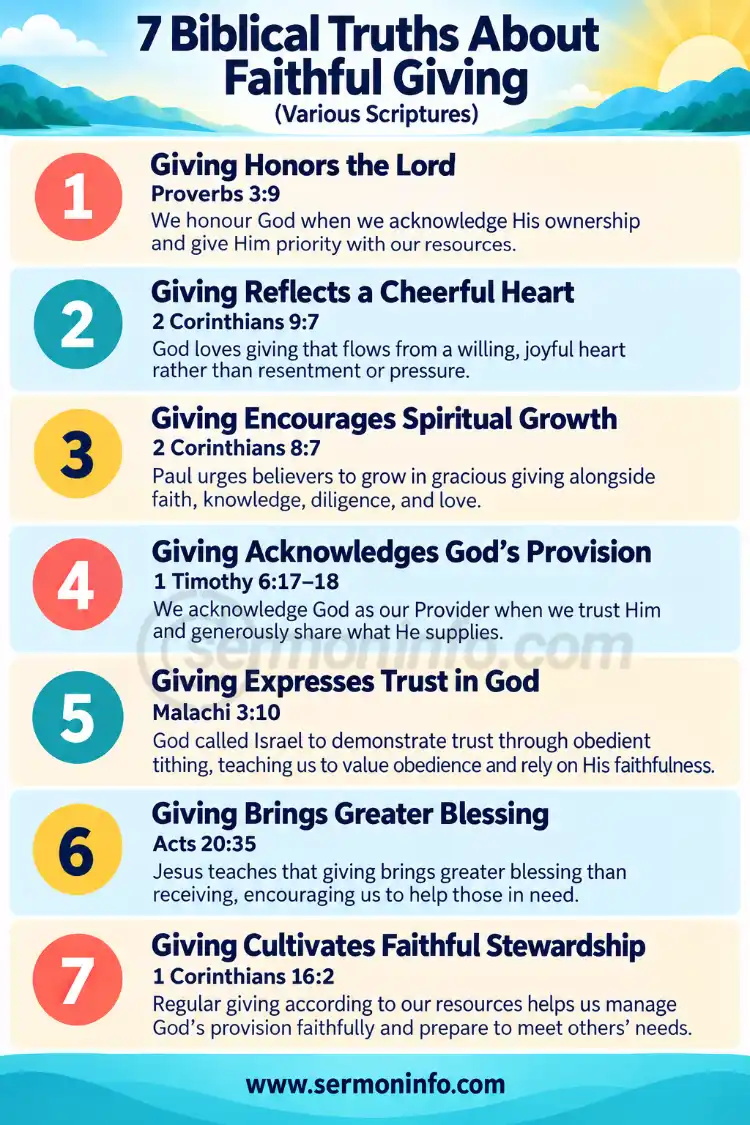
4. Giving Acknowledges God’s Provision (1 Tim 6:17–18)
“Command those who are rich in this present age not to be haughty, nor to trust in uncertain riches but in the living God, who gives us richly all things to enjoy. Let them do good, that they be rich in good works, ready to give, willing to share.” (1 Timothy 6:17-18)
A. We trust our Provider (1 Timothy 6:17)
Paul instructs Timothy to warn wealthy believers against pride and dependence on uncertain riches. Money can disappear, but the living God remains faithful. He richly provides gifts for our enjoyment, so we should receive them with gratitude. Our confidence belongs in the Provider, whose generosity makes every good gift possible.
A healthy bank balance can make tomorrow feel secure, yet an unexpected bill can quickly disturb that confidence. God invites us to trust Him through both plenty and hardship. We can manage money wisely without making it our refuge. When worry rises, remember His care and bring your needs to Him in prayer (Philippians 4:6).
B. We share our resources (1 Timothy 6:18)
Paul directs wealthy believers to do good, practise generosity, and willingly share. They should become rich in good works, using their resources to benefit others. God’s provision brings opportunities to serve, not grounds for pride. Our generosity acknowledges that everything we share first came from His hand (1 Chronicles 29:14).
Perhaps you could provide groceries, help with transport, or contribute towards someone’s urgent bill. Such practical kindness turns available resources into help for real people. You do not need great wealth to begin. Ask God to show you a need you can meet, then share willingly within your means (2 Corinthians 8:12).
5. Giving Expresses Trust in God (Mal 3:10)
“‘Bring all the tithes into the storehouse, That there may be food in My house, And try Me now in this,’ Says the Lord of hosts, ‘If I will not open for you the windows of heaven And pour out for you such blessing That there will not be room enough to receive it.'” (Malachi 3:10)
A. We respond with obedience (Malachi 3:10a)
Through Malachi, God commanded Israel to bring the full tithe into His storehouse, providing food for His house. The people had withheld what His covenant required (Malachi 3:8). Their disobedience revealed a deeper need to return to Him. Bringing the tithe would demonstrate renewed obedience and support those serving at the temple.
Israel’s covenant command helps us see that trust should lead to action. Today, God calls believers to give willingly and according to their means (2 Corinthians 8:12). When bills mount, we may hesitate to share anything. Yet thoughtful, obedient giving expresses confidence in our Provider while respecting the responsibilities He has entrusted to us.
B. We rely on God’s faithfulness (Malachi 3:10b)
God promised abundant provision when Israel obeyed His covenant command. His promise to open heaven’s windows pictured blessing upon a land that depended on rain and fruitful harvests. He invited Israel to test His faithfulness in this specific matter. This covenant promise reveals His reliability, but it does not guarantee personal wealth for believers today.
We cannot purchase prosperity through giving, but we can trust our Father’s care. Jesus reminds us that our Father knows our daily needs (Matthew 6:31–33). During difficult seasons, bring your concerns to Him and follow His Word. His faithfulness gives us courage to remain generous, even when we cannot see how tomorrow will unfold.
6. Giving Brings Greater Blessing (Acts 20:35)
“I have shown you in every way, by laboring like this, that you must support the weak. And remember the words of the Lord Jesus, that He said, ‘It is more blessed to give than to receive.'” (Acts 20:35)
A. We support the needy (Acts 20:35a)
As Paul farewelled the Ephesian elders, he reminded them how he had worked to provide for himself and his companions. His example showed that diligent work could also help the weak. He urged these leaders to follow that pattern. Our labour gives us opportunities to care for people who cannot fully provide for themselves.
Think about someone whose illness has interrupted their income. Your work may help put food on their table or cover an essential bill. Paul reinforces this purpose in Ephesians 4:28, connecting honest work with sharing. Even when our own budget feels tight, we can prayerfully consider what help our resources allow.
B. We embrace the giver’s greater blessing (Acts 20:35b)
Paul asked the elders to remember Jesus’ words: “It is more blessed to give than to receive.” Receiving help brings real benefit, but Jesus teaches us to value giving even more. His words invite us to see generosity as a privilege. We can participate in caring for others rather than focus only on ourselves.
When you meet a need, remember that Jesus calls giving a blessing, even when it involves sacrifice. You may never receive repayment or public thanks. Still, you can value the opportunity to serve someone in His name. During difficult seasons, trusting His words helps us give gladly without expecting financial gain.
7. Giving Cultivates Faithful Stewardship (1 Cor 16:2)
“On the first day of the week let each one of you lay something aside, storing up as he may prosper, that there be no collections when I come.” (1 Corinthians 16:2)
A. We give regularly (1 Corinthians 16:2a)
Paul instructed the Corinthians to prepare a collection for needy believers in Jerusalem. Each person should set something aside on the first day of every week. This regular preparation would prevent a hurried collection when he arrived. Their weekly habit would turn a desire to help into practical, dependable support.
Consider including giving when you plan your weekly expenses. Following Paul’s instruction helps us prepare before another need competes for our attention (1 Corinthians 16:2). Small amounts set aside regularly can become meaningful help over time. During uncertain seasons, a thoughtful plan helps us practise generosity while managing our responsibilities.
B. We give proportionally (1 Corinthians 16:2b)
Paul connected each person’s contribution with how much they had prospered. God provides different amounts to different people, so Paul did not require everyone to contribute an identical sum. Those with greater resources could give more. Each believer could participate according to the provision God had entrusted to them.
Perhaps your income has fallen, and you cannot give what you once gave. God welcomes willingness according to what you have, not what you lack (2 Corinthians 8:12). Review your giving honestly as your circumstances change. When God provides more, consider sharing more; when resources shrink, continue trusting Him and giving within your means.
Conclusion
Faithful giving honours the Lord, reflects a cheerful heart, and encourages spiritual growth. It acknowledges God’s provision and expresses trust in His faithfulness. Jesus teaches that giving brings greater blessing than receiving, while regular, proportionate giving cultivates faithful stewardship. Together, these truths direct our attention towards God, who supplies everything we have.
How will these truths shape your giving this week? Thank God for His provision, then prayerfully plan what you can share. Give willingly and cheerfully, and look for someone you can help. When resources feel limited, trust His care and give within your means. Let gratitude for His grace guide your generosity as you honour Him with what He provides.

Frequently Asked Questions (FAQ)
Q: What does the Bible say about giving?
A: The Bible teaches believers to give willingly, cheerfully, and according to their resources. Faithful giving honors God, supports others, and expresses trust in His provision. Proverbs 3:9 emphasises honoring the Lord, while 1 Corinthians 16:2 encourages regular, planned generosity.
Q: Why does God love a cheerful giver?
A: God loves a cheerful giver because joyful generosity expresses a willing heart rather than resentment or pressure. 2 Corinthians 9:7 teaches believers to decide thoughtfully what to give. Cheerful giving responds gratefully to God’s grace and welcomes opportunities to help others.
Q: How much should Christians give according to the Bible?
A: Christians should give willingly and proportionately, according to what God provides. First Corinthians 16:2 encourages regular giving based on each person’s resources. Second Corinthians 8:12 emphasises willingness according to what someone has. These passages encourage thoughtful generosity without prescribing one percentage for every believer.
Q: What is the difference between tithing and giving?
A: Biblical tithing involved giving a tenth, with specific requirements for Israel under the Mosaic covenant. Giving describes the broader practice of sharing resources. Malachi 3:10 addresses Israel’s covenant obligations, while New Testament instructions emphasise willing, cheerful, proportionate generosity rather than imposing Israel’s tithe requirements.
Q: Does giving guarantee financial blessings from God?
A: Giving does not guarantee personal wealth or financial returns. Jesus teaches that giving brings greater blessing than receiving (Acts 20:35). Generosity helps others and encourages thanksgiving to God. Malachi 3:10 records God’s covenant promise to Israel, not a universal promise of riches for donors.
BONUS: What is the connection between stewardship and faithful giving?
Stewardship means managing what God entrusts to us, and faithful giving puts that responsibility into practice. God owns everything, so we manage His resources for His purposes (Psalm 24:1). Paul calls believers to share generously and willingly (1 Timothy 6:18). Our giving acknowledges His ownership and uses His provision to help others.
Faithful stewards plan their giving according to what God provides (1 Corinthians 16:2). They give cheerfully because they value opportunities to serve Him (2 Corinthians 9:7). Consider including generosity when you plan your household budget. Even during difficult seasons, you can honor God by sharing within your means and trusting His care.
BONUS: What is faithful stewardship in the Bible?
Faithful stewardship means managing what God entrusts to us according to His purposes. Everything belongs to Him (Psalm 24:1). We serve as caretakers of His gifts, including our time, abilities, money, and opportunities. Peter teaches believers to use their gifts to serve others as stewards of God’s grace (1 Peter 4:10).
This responsibility touches everyday decisions. We practise stewardship when we work honestly, care for our families, share generously, and make time to serve. Paul instructs believers to plan their giving according to their resources (1 Corinthians 16:2). Begin with what God has provided, and ask how you can use it to honor Him.
BONUS: What are the benefits of good stewardship in the Bible?
Good stewardship honours God, meets practical needs, and encourages gratitude. Paul explains that generous giving supplies believers’ needs and produces thanksgiving to God (2 Corinthians 9:12). Jesus also teaches that giving brings greater blessing than receiving (Acts 20:35). Through faithful stewardship, we experience the privilege of serving others with what God provides.
Careful stewardship also helps us prepare to give consistently (1 Corinthians 16:2). Planning our resources makes room for generosity alongside daily responsibilities. These benefits do not guarantee wealth or freedom from hardship. When finances tighten, we can continue trusting God, making wise decisions, and sharing within our means (2 Corinthians 8:12).
BONUS: What are the characteristics of a faithful steward?
A faithful steward shows trustworthiness, obedience, wisdom, and willingness to serve. Paul stresses faithfulness when describing his responsibility as a steward of God’s revealed truth (1 Corinthians 4:1–2). Peter connects stewardship with serving others through God’s gifts (1 Peter 4:10). These passages direct our attention towards dependable service that honours the Giver.
In daily life, faithful stewards handle money honestly, fulfil responsibilities, and share cheerfully (2 Corinthians 9:7). They also remain dependable in small matters (Luke 16:10). Consider the resources and responsibilities God has entrusted to you. Choose one practical step today, such as planning a gift, keeping a promise, or helping someone in need.
BONUS: Is there a connection between faithful giving and financial blessing?
Scripture connects faithful giving with God’s provision, but it does not promise personal wealth in return for generosity. God promised Israel abundant harvests under His covenant (Malachi 3:10–12). Paul teaches that God supplies resources so believers can continue doing good and sharing with others (2 Corinthians 9:8–11). His provision serves His purposes.
God may provide financial resources, yet we should never treat giving as a way to secure financial gain. Jesus teaches that giving brings greater blessing than receiving (Acts 20:35). That blessing includes serving others and encouraging thanksgiving to God (2 Corinthians 9:12). Give cheerfully within your means, and trust God’s care through plenty and hardship.
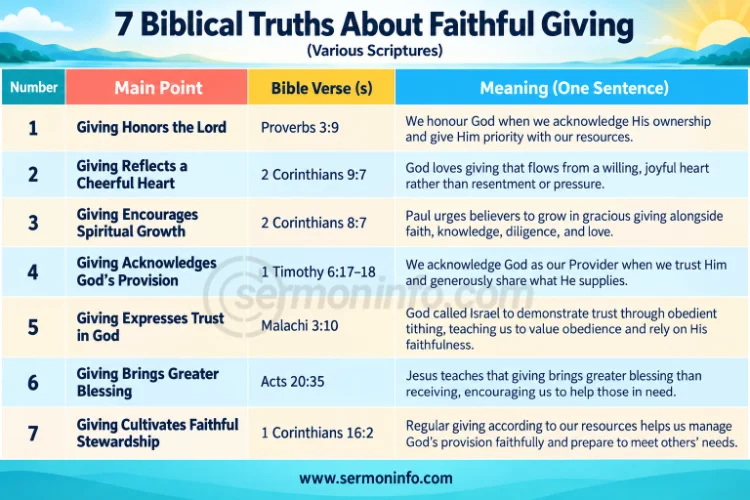
| 7 Biblical Truths About Faithful Giving | |||
|---|---|---|---|
| Number | Main Point | Bible Verse | Meaning |
| 1 | Giving Honors the Lord | Proverbs 3:9 | We honour God when we acknowledge His ownership and give Him priority with our resources. |
| 2 | Giving Reflects a Cheerful Heart | 2 Corinthians 9:7 | God loves giving that flows from a willing, joyful heart rather than resentment or pressure. |
| 3 | Giving Encourages Spiritual Growth | 2 Corinthians 8:7 | Paul urges believers to grow in gracious giving alongside faith, knowledge, diligence, and love. |
| 4 | Giving Acknowledges God’s Provision | 1 Timothy 6:17–18 | We acknowledge God as our Provider when we trust Him and generously share what He supplies. |
| 5 | Giving Expresses Trust in God | Malachi 3:10 | God called Israel to demonstrate trust through obedient tithing, teaching us to value obedience and rely on His faithfulness. |
| 6 | Giving Brings Greater Blessing | Acts 20:35 | Jesus teaches that giving brings greater blessing than receiving, encouraging us to help those in need. |
| 7 | Giving Cultivates Faithful Stewardship | 1 Corinthians 16:2 | Regular giving according to our resources helps us manage God’s provision faithfully and prepare to meet others’ needs. |