Sermon Outline From Hosea 9:1–17 teaches that Israel’s persistent rejection of God brought divine judgment. God removed their prosperity and security, exposed their spiritual corruption, and scattered them among the nations. Their experience demonstrates that rebellion carries consequences and that God takes obedience to His Word seriously.

Key Takeaways – Sermon From Hosea 9:1-17
- Rejecting God brings serious consequences. Hosea 9 shows that persistent rebellion can cost joy, security, and spiritual fruitfulness.
- Sin can blind and corrupt the heart. Israel rejected God’s truth and resisted His messenger, so we must receive biblical correction humbly.
- God calls us to faithful obedience. We should reject idols, treasure His Word, and walk closely with Him each day.
Sermon Outline From Hosea 9:1-17
Rejecting God always carries a high cost, while accepting His truth leads us toward life, peace, and blessing. Israel enjoyed God’s goodness but turned from the One who provided it. Their choices robbed them of joy, security, and fruitfulness. God still calls us to receive His Word, trust His wisdom, and walk faithfully with Him.
Hosea 9 shows us what happens when people continue resisting God’s voice. First, God removes their joy. Second, He exposes their corruption. Finally, He judges their rebellion. As we examine these warnings, we should also examine our own hearts. God’s message invites us to reject empty substitutes and treasure Him above everything else.
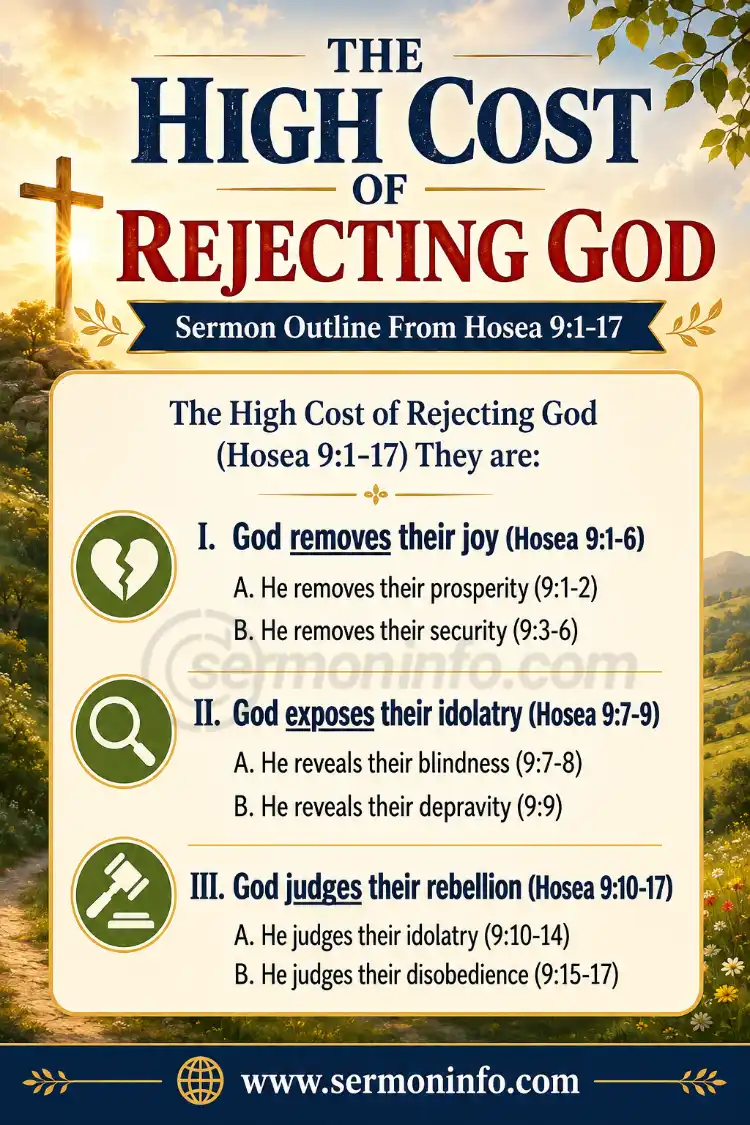
1. God Removes Their Joy (Hosea 9:1–6)
Israel’s rejection of God would turn their celebration into sorrow as He removed the blessings they had taken for granted. (Summary Statement)
A. He Removes Their Prosperity (Hosea 9:1–2)
Israel celebrated the harvest, but their hearts had wandered from God. They treated grain as payment from false gods for spiritual unfaithfulness. Hosea warned, “The threshing floor and the winepress shall not feed them” (Hosea 9:2). God would remove their prosperity because they gave idols credit for His provision.
Prosperity can quietly draw our hearts away from the One who provides it. We may trust income, possessions, careers, or success more than God. James 1:17 reminds us that every good gift comes from above. Enjoy God’s blessings with gratitude, but never allow the gift to replace the Giver.
B. He Removes Their Security (Hosea 9:3–6)
Israel also assumed that their land and national security would continue. Yet Hosea declared, “They shall not dwell in the LORD’S land” (Hosea 9:3). Assyria would eventually carry the northern kingdom into exile. Persistent rebellion would cost them the security they once enjoyed under God’s covenant blessing.
We should never confuse present comfort with God’s approval of our choices. Israel felt secure while moving farther from the Lord. God may use difficult circumstances to expose misplaced confidence and call us back to Himself. Therefore, trust the Lord above possessions, circumstances, or human strength. He remains our true refuge in troubled times (Psalm 46:1). (Source Material: William MacDonald, Believer’s Bible Commentary, pp. 1101-1102)
This material provides some ideas and thoughts for a sermon outline from Hosea 9:1-17 (The High Cost of Rejecting God).
2. God Exposes Their Corruption (Hosea 9:7–9)
God revealed how deeply sin had corrupted Israel’s thinking, attitudes, and response to His Word. (Summary Statement)
A. He Reveals Their Blindness (Hosea 9:7–8)
Israel had become so spiritually blind that they rejected the very messenger God sent to warn them. Hosea 9:7 says they called the prophet a fool and the spiritual man insane. Sin had twisted their judgment. Instead of receiving correction, they attacked the one who spoke God’s truth.
That same danger remains today. When hearts drift from God, biblical truth can feel offensive instead of helpful. Proverbs 12:1 says whoever hates correction is stupid. We need humble hearts that welcome God’s Word, even when it confronts us. A faithful messenger may wound our pride, but God uses truth to restore us.
B. He Reveals Their Depravity (Hosea 9:9)
Hosea says Israel had “deeply corrupted themselves, as in the days of Gibeah” (Hosea 9:9). Gibeah recalled one of Israel’s darkest moral failures in Judges 19. Their corruption was no longer shallow or occasional. Rebellion had become deeply rooted in the nation’s character.
Sin grows when we excuse it, protect it, or refuse to repent. What begins as compromise can become a settled pattern. Galatians 6:7 warns that we reap what we sow. God exposes corruption because He is holy, but His warning also calls us back. We should confess sin quickly and walk again in His truth. (Source Material: John MacArthur, The MacArthur Bible Commentary, p. 978)
3. God Judges Their Rebellion (Hosea 9:10–17)
God would judge Israel because they repeatedly exchanged His blessings for idolatry and stubborn disobedience. (Summary Statement)
A. He Judges Their Idolatry (Hosea 9:10–14)
God remembered Israel with delight, like “grapes in the wilderness” and early figs (Hosea 9:10). Yet Israel followed Baal at Peor and became spiritually shameful. Their idolatry eventually brought barrenness and loss. The people who once enjoyed God’s fruitfulness exchanged His blessings for the emptiness of false gods.
Idols still promise much but finally leave us empty. Money, pleasure, success, or relationships become idols when they take God’s rightful place. First John 5:21 warns, “keep yourselves from idols.” God calls us to treasure Him above every earthly blessing. Lasting fruitfulness grows from faithful fellowship with the Lord, not substitutes for Him.
B. He Judges Their Disobedience (Hosea 9:15–17)
Israel’s rebellion continued at Gilgal, a place once associated with God’s covenant dealings with His people. Their persistent wickedness now marked that place. God declared judgment because they repeatedly refused His voice. Hosea concludes, “My God will cast them away, because they did not obey Him” (Hosea 9:17).
Israel would become “wanderers among the nations” because persistent disobedience brought covenant judgment (Hosea 9:17). Their national scattering does not describe the believer losing salvation. Yet their example warns us against stubborn rebellion. God calls believers to loving obedience. Jesus said, “If you love Me, keep My commandments” (John 14:15). (Source Material: John F. Walvoord and Roy B. Zuck, The Bible Knowledge Commentary: Old Testament, pp. 1398-1400)
Conclusion
Hosea 9 reminds us that rejecting God always carries a serious cost. God removed Israel’s joy, exposed their corruption, and judged their rebellion. Their story shows how sin can harden hearts and destroy blessing. Yet God’s warnings also reveal His holiness and mercy, because He calls people to turn back before judgment falls.
So we must receive God’s Word with humility and respond with obedience. Scripture does more than inform us; it directs how we live. When God corrects us, we should listen quickly and repent sincerely. His truth protects us from destructive choices. Therefore, let us trust His wisdom, treasure His presence, and walk faithfully with Him each day.
Closing Prayer
Heavenly Father, thank You for speaking clearly through Your Word. Guard our hearts from rebellion, idolatry, and spiritual blindness. Help us receive Your correction with humility and obey Your truth with willing hearts. Keep our love for You strong, and teach us to value Your presence above every earthly blessing.
Lord, help us learn from Israel’s failure and walk faithfully with You each day. Give us wisdom to recognize sin and courage to turn from it. May our lives honour You, reflect Your grace, and point others to Christ. We ask these things in Jesus’ precious name. Amen.
Frequently Asked Questions (FAQ)
Q: What happens when you reject God?
A: Hosea 9 shows that persistent rejection of God brings serious consequences. Israel lost joy, prosperity, security, and national stability because they chose idolatry over faithful obedience. The passage warns that sin never remains harmless. God calls people to hear His Word, repent, and walk faithfully with Him.
Q: What does Hosea 9:1 mean?
A: Hosea 9:1 warns Israel not to celebrate like surrounding nations because their prosperity rested on spiritual unfaithfulness. They credited false gods for harvest blessings that came from the Lord. God therefore warned that their abundance would disappear, teaching that His gifts must never replace the Giver.
Q: What does Hosea 9:7 mean?
A: Hosea 9:7 announces that God’s long warned judgment had arrived. Israel’s persistent sin and hostility toward God’s prophet revealed deep spiritual blindness. Their refusal to receive correction did not cancel God’s message. It confirmed their rebellion and showed why divine judgment could no longer be ignored.
Q: What does Gibeah mean in Hosea 9:9?
A: Gibeah recalls the horrific moral corruption recorded in Judges 19. Hosea compares Israel’s sin with that dark period to show how deeply rebellion had spread. The comparison warns that tolerated sin can become entrenched, distort moral judgment, and eventually bring God’s righteous discipline and judgment.
Q: What does Hosea 9:17 mean?
A: Hosea 9:17 means Israel would lose its place in the land because the nation refused to obey God. The people would become wanderers among other nations. This national judgment fulfilled covenant warnings and reminds believers that stubborn disobedience brings consequences, although Christians remain secure in Christ.
BONUS: How do God’s love and judgment work together in Hosea 9?
God’s love and judgment work together because His holy love refuses to ignore persistent rebellion. In Hosea 9, God remembers Israel with affection, like “grapes in the wilderness” (Hosea 9:10). Yet Israel pursued Baal and rejected His Word. God’s judgment showed that His love never treats sin as harmless.
God also used judgment to expose Israel’s sin and uphold His covenant holiness. Hosea 9:17 says God scattered them because they “did not obey Him.” His judgment was righteous, not cruel. For believers today, God’s warnings call us to repentance, faithful obedience, and deeper trust in His gracious character.
BONUS: What does Hosea 9 teach about obeying God?
Hosea 9 teaches that rejecting God’s Word brings serious consequences. Israel refused to listen, embraced idolatry, and resisted God’s messengers. Hosea 9:17 says God scattered them because they “did not obey Him.” Their disobedience cost them joy, security, fruitfulness, and national stability.
For believers, obedience shows that we trust God’s wisdom and honor His authority. Jesus said, “If you love Me, keep My commandments” (John 14:15). We should receive correction quickly, turn from sin, and follow Scripture faithfully. Obedience does not earn salvation, but it reflects genuine love for God and growing faith.
BONUS: How can believers stay faithful in a godless culture?
Believers stay faithful in a godless culture by staying rooted in God’s Word and refusing to follow sinful values. Daniel “purposed in his heart” not to defile himself (Daniel 1:8). Like Israel in Hosea 9, we must reject idols and give God first place in our hearts.
Faithfulness also requires courage, prayer, and godly relationships. Romans 12:2 says, “do not be conformed to this world.” We should renew our minds through Scripture and walk closely with Christ. When culture moves away from God, believers must stand with grace, truth, humility, and confidence in His promises.
BONUS: How does Hosea 9 warn against spiritual complacency?
Hosea 9 warns against spiritual complacency by showing how Israel enjoyed blessings while drifting from God. They celebrated harvests, yet they ignored the Lord who provided them (Hosea 9:1–2). Complacency made them comfortable with idolatry, deaf to correction, and blind to coming judgment.
Believers must guard against the same danger by staying responsive to God’s Word. Hosea 9:17 says Israel suffered because “they did not obey Him.” Spiritual complacency grows when we tolerate sin and ignore correction. We should examine our hearts, repent quickly, and seek God daily with humility, gratitude, and faithful obedience.
BONUS: What can we learn from rejecting God’s messengers?
Hosea 9 shows that rejecting God’s messengers often reveals a deeper rejection of God Himself. Israel called the prophet foolish and treated him like an enemy (Hosea 9:7–8). Their response exposed spiritual blindness. When people resist biblical correction, they can harden their hearts and move farther from God’s truth.
Believers should receive faithful biblical teaching with humility and discernment. First Thessalonians 5:20–21 says, “Do not despise prophecies. Test all things; hold fast what is good.” We should test every message by Scripture, but never reject truth because it confronts us. God often uses faithful messengers to correct, guide, and protect His people.
BONUS: How can believers avoid modern idolatry?
Believers avoid modern idolatry by giving God first place in every area of life. Money, success, relationships, comfort, and possessions can become idols when they control our hearts. First John 5:21 says, “keep yourselves from idols.” Hosea 9 warns that false worship always leads away from God’s blessing and truth.
We should regularly examine what shapes our desires, decisions, and priorities. Colossians 3:5 even calls covetousness “idolatry.” Prayer, Scripture, gratitude, and obedience help keep our hearts centered on Christ. When we treasure God above His gifts, we guard ourselves from replacing the Creator with created things.
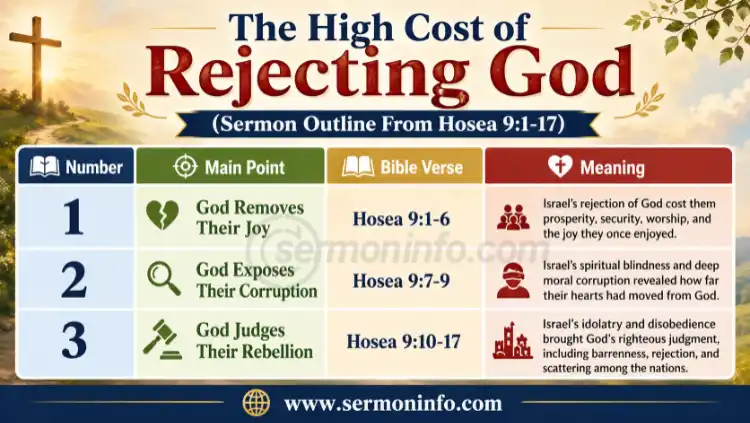
| Sermon Outline From Hosea 9:1-17 – Sermon Outlines From Hosea | |||
|---|---|---|---|
| Number | Main Point | Bible Verse | Meaning |
| 1 | God Removes Their Joy | Hosea 9:1–6 | Israel’s rejection of God cost them prosperity, security, worship, and the joy they once enjoyed. |
| 2 | God Exposes Their Corruption | Hosea 9:7–9 | Israel’s spiritual blindness and deep moral corruption revealed how far their hearts had moved from God. |
| 3 | God Judges Their Rebellion | Hosea 9:10–17 | Israel’s idolatry and disobedience brought God’s righteous judgment, including barrenness, rejection, and scattering among the nations. |
Source Material
William MacDonald, Believer’s Bible Commentary, rev. ed. (Nashville: Thomas Nelson, 1995), 1101-1102
John MacArthur, The MacArthur Bible Commentary (Nashville: Thomas Nelson, 2005), 978
John F. Walvoord and Roy B. Zuck, eds., The Bible Knowledge Commentary: Old Testament (Colorado Springs, CO: David C. Cook, 1985), 1398-1400