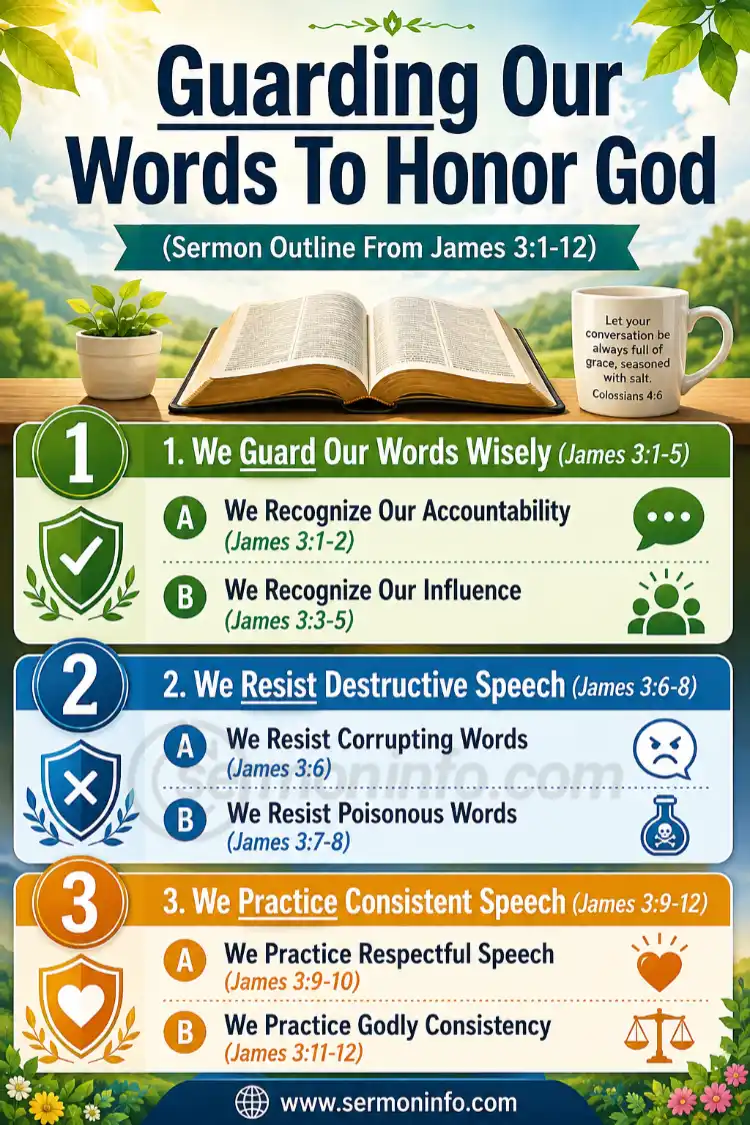
Guarding Our Words To Honor God means using speech with wisdom, self control, and consistency because our words carry great power. The Sermon Outline From James 3:1–12 teaches believers to resist destructive speech and speak in ways that reflect God’s truth, grace, and character.

Key Takeaways – Sermon From James 3:1-12
- Guard your words wisely. James 3:1–5 teaches that our words carry great influence, so we should speak with care and responsibility.
- Resist destructive speech. James 3:6–8 warns that corrupt and poisonous words can spread harm quickly and damage lives and relationships.
- Practice consistent speech. James 3:9–12 calls believers to speak with respect, grace, and godly consistency that reflects a heart devoted to God.
Sermon Outline From James 3:1-12
Words can encourage a hurting heart, guide a confused person, or damage a relationship in seconds. James reminds us that no person can tame the tongue alone (James 3:8). We need God’s wisdom and transforming work within us. Wise believers therefore think before speaking and ask God to shape words that reflect His grace.
James 3:1–12 shows why our words deserve careful attention. We will see their great influence, their destructive potential, and their need for godly consistency. As we study this passage, we will learn to guard our words wisely, resist destructive speech, and practice consistent speech that honors God.
1. We Guard Our Words Wisely (James 3:1–5)
Our words carry great responsibility and influence, so we must use them carefully to honor God. (Summary Statement)
A. We Recognize Our Accountability (James 3:1–2)
James warns, “My brethren, let not many of you become teachers, knowing that we shall receive a stricter judgment” (James 3:1). God takes our words seriously because words teach, guide, encourage, and influence others. Those who teach Scripture carry greater responsibility because people may shape their lives around what they hear.
James also reminds us that “we all stumble in many things” (James 3:2). None of us speaks perfectly every time. Yet spiritual maturity shows itself when we learn to control our words. Before we speak, we should ask whether our words are true, gracious, helpful, and pleasing to God.
B. We Recognize Our Influence (James 3:3–5)
James compares the tongue to a bit in a horse’s mouth and a rudder on a ship. Both objects are small, yet they direct something much larger. In the same way, a few words can shape a conversation, guide a decision, restore hope, or damage a relationship.
Our words often travel farther than we expect. A kind sentence can encourage someone through a difficult week. A careless remark can remain in a person’s memory for years. James teaches us to respect the influence God has placed within our speech. Therefore, we should use our words to guide others toward truth, grace, and Christ. (Source Material: William MacDonald, Believer’s Bible Commentary, pp. 2230-2233)
This material provides some ideas and thoughts for a sermon outline from James 3:1-12 (Guarding Our Words To Honor God).
2. We Resist Destructive Speech (James 3:6–8)
We must resist sinful speech because uncontrolled words can spread damage like a destructive fire. (Summary Statement)
A. We Resist Corrupting Words (James 3:6)
James says, “the tongue is a fire, a world of iniquity” (James 3:6). Fire can spread quickly beyond its starting point. In the same way, corrupt words can spread anger, gossip, bitterness, and division. A careless sentence may last only seconds, yet its damage can continue for years.
That warning speaks directly to us today. Words spoken at home, at work, or online can reach many people quickly. We should ask God to help us stop sinful speech before it spreads. Ephesians 4:29 urges us to speak words that build others up and give grace to those who hear.
B. We Resist Poisonous Words (James 3:7–8)
James describes the tongue as “an unruly evil, full of deadly poison” (James 3:8). Poison may enter quietly, but it can cause deep harm. Cruel words, insults, slander, and angry speech can wound hearts long after the conversation ends. We must never underestimate the pain our words can cause.
This truth calls us to guard both our hearts and our mouths. Jesus taught that our words flow from what fills the heart (Matthew 12:34). When Christ shapes our hearts, He also changes our speech. We should choose words that heal, encourage, correct gently, and point people toward God’s grace. (Source Material: John MacArthur, The MacArthur Bible Commentary, pp. 1889-1890)
3. We Practice Consistent Speech (James 3:9–12)
Our daily speech should consistently reflect our worship of God and our growing relationship with Him. (Summary Statement)
A. We Practice Respectful Speech (James 3:9–10)
James exposes a painful contradiction in our speech. We bless God, yet we may curse people made in His likeness. James says, “My brethren, these things ought not to be so” (James 3:10). We honor God when we speak about others with respect, grace, and truth.
This truth reaches into our homes, workplaces, friendships, and online conversations. Every person bears God given dignity as His creation. We may disagree strongly, but we must not speak with contempt. Colossians 4:6 tells us to let our speech always be gracious and wise.
B. We Practice Godly Consistency (James 3:11–12)
James asks whether a spring can produce both fresh and bitter water. He also points to trees that produce fruit according to their nature. His message is clear. Our speech should consistently reflect a heart that seeks to honor God in every part of life.
Godly consistency does not mean we never fail. It means we keep bringing our hearts and words under God’s truth. Jesus said, “out of the abundance of the heart the mouth speaks” (Matthew 12:34). As God shapes our hearts, our words should increasingly reflect His grace, holiness, and love. (Source Material: John F. Walvoord and Roy B. Zuck, The Bible Knowledge Commentary: New Testament, pp. 827-828)
Conclusion
James reminds us that our words carry power, reveal danger, and expose our hearts. We must guard our words wisely, resist destructive speech, and practice consistent speech. God calls us to speak with truth, grace, restraint, and respect. Our words should increasingly reflect the character of Christ in every relationship.
God’s Word does more than warn us about careless speech. It shows us how deeply we need His wisdom and transforming grace. As we obey Scripture, we should ask God to shape both our hearts and our words. Then our speech can encourage others, protect relationships, and bring honor to Him.
Closing Prayer
Heavenly Father, thank You for Your Word and its wisdom for our daily lives. Guard our hearts and guide our tongues. Help us resist harmful words and speak with grace, truth, and kindness. May everything we say honor You and encourage those around us.
Lord, give us wisdom before we speak and humility when we fail. Shape our hearts through Your Word so our speech reflects Christ. Use our words to bring hope, healing, and blessing to others. May our lives and conversations always bring glory to You. We prayer in Jesus’ name, Amen.
Frequently Asked Questions (FAQ)
Q: What does James 3:1–12 teach about the power of words?
A: TJames 3:1–12 teaches that words carry tremendous influence. James compares the tongue to a horse’s bit, a ship’s rudder, and a small fire. Our words can guide, encourage, wound, or destroy. Believers should therefore guard their speech carefully and use words that honor God.
Q: Why does James say no one can tame the tongue?
A: James 3:8 teaches that human strength alone cannot completely control the tongue. Sin affects our speech and makes careless words dangerous. Believers need God’s wisdom and transforming grace to grow in self control and develop speech that reflects truth, kindness, purity, and spiritual maturity.
Q: Why does James compare the tongue to a fire?
A: James compares the tongue to fire because small words can cause enormous damage. Like a spark spreading through dry ground, gossip, anger, slander, and careless speech can quickly damage relationships and reputations. James warns believers to recognize this danger and resist destructive speech before it spreads.
Q: What does James mean by blessing God and cursing people?
A: James exposes the inconsistency of praising God while speaking contemptuously about people made in His likeness. Such speech contradicts genuine devotion. James says, “these things ought not to be so” (James 3:10). Believers should speak respectfully because every person bears God given dignity.
Q: How can Christians guard their words according to James 3?
A: Christians guard their words by recognizing their accountability, resisting destructive speech, and practicing godly consistency. James teaches that mature faith affects everyday conversation. Believers should think before speaking, reject words that wound others, and pursue speech that agrees with their worship and reflects God’s transforming work.
BONUS: Why will Bible teachers receive stricter judgment?
Bible teachers receive stricter judgment because their words shape the faith and conduct of others. James warns, “we shall receive a stricter judgment” (James 3:1). God entrusts teachers with His Word, so He expects them to handle Scripture faithfully, speak truthfully, and avoid misleading those who listen.
This warning should produce humility, prayer, and careful preparation rather than fear. Teachers must “rightly divide the word of truth” (2 Timothy 2:15). They should guard their doctrine, motives, and speech because God holds them accountable for how they represent His truth and influence His people.
BONUS: What does “a perfect man” mean in James 3:2?
In James 3:2, “a perfect man” means a spiritually mature believer, not a sinless person. James says everyone stumbles in many things. Yet the person who controls his speech shows unusual maturity because he also demonstrates greater self control throughout life (James 3:2).
James uses the tongue as a test of spiritual growth. Mature believers do not speak perfectly, but they increasingly submit their words to God’s truth. They think before speaking, reject harmful words, and choose speech that reflects wisdom, grace, and Christlike character (Colossians 4:6).
BONUS: What do the bit and rudder illustrate in James 3?
James uses the bit and rudder to show how something small can control something much larger. A small bit directs a powerful horse, while a small rudder guides a large ship (James 3:3–4). In the same way, our tongue can influence the direction of our lives and relationships.
These illustrations remind us never to underestimate the power of our words. A few words can encourage, guide, wound, or divide. James says, “the tongue is a little member and boasts great things” (James 3:5). Therefore, believers should speak carefully and use their words to honor God.
BONUS: What does “a world of iniquity” mean in James 3:6?
“A world of iniquity” means the tongue can express many forms of human sin. James says the tongue “defiles the whole body” and spreads evil like fire (James 3:6). Through gossip, lies, anger, slander, and pride, sinful speech can reveal and multiply the corruption of the heart.
James warns us because words rarely remain small. One sinful comment can damage trust, stir conflict, and influence others toward wrong choices. Jesus taught that the mouth speaks from the abundance of the heart (Matthew 12:34). Therefore, believers should ask God to purify their hearts and guide their speech.
BONUS: Why does James call the tongue “deadly poison”?
James calls the tongue “deadly poison” because harmful words can injure deeply and spread damage quickly. James describes the tongue as “an unruly evil, full of deadly poison” (James 3:8). Lies, slander, insults, and cruel speech can poison relationships, destroy trust, and leave lasting wounds.
Poison often works quietly, and destructive words can do the same. Believers must guard their speech and refuse words that tear others down. Ephesians 4:29 calls us to speak words that build others up and give grace. God wants our speech to bring healing, truth, encouragement, and honor to Him.
BONUS: What do the spring and tree illustrations teach in James 3?
James uses a spring to show that one source should not produce both fresh and bitter water. In the same way, believers should not bless God and curse others (James 3:9–11). Our speech should consistently reflect a heart that honors God and respects people made in His likeness.
James also points to fig trees, olive trees, and grapevines (James 3:12). Each tree produces fruit according to its nature. Likewise, godly speech should grow from a heart shaped by God’s truth. Our words reveal what fills us, so believers should pursue speech that reflects grace, truth, and spiritual maturity.
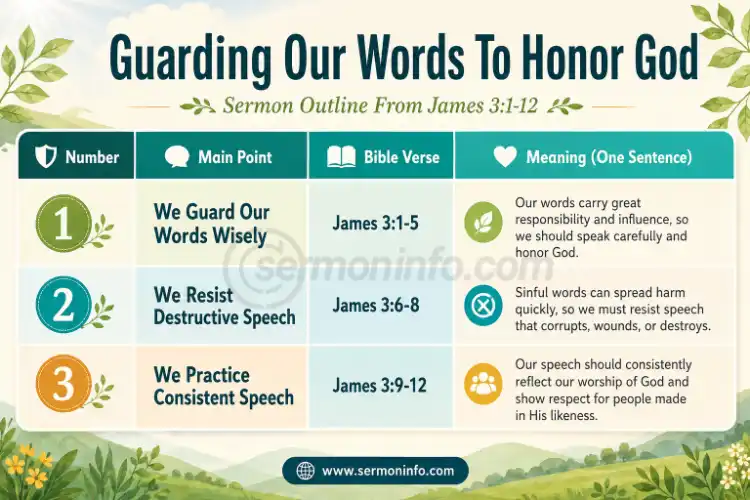
| Sermon Outline From James 3:1-12 – Sermon Outlines From James | |||
|---|---|---|---|
| Number | Main Point | Bible Verse | Meaning |
| 1 | We Guard Our Words Wisely | James 3:1–5 | Our words carry great responsibility and influence, so we should speak carefully and honor God. |
| 2 | We Resist Destructive Speech | James 3:6–8 | Sinful words can spread harm quickly, so we must resist speech that corrupts, wounds, or destroys. |
| 3 | We Practice Consistent Speech | James 3:9–12 | Our speech should consistently reflect our worship of God and show respect for people made in His likeness. |
Source Material
William MacDonald, Believer’s Bible Commentary, rev. ed. (Nashville: Thomas Nelson, 1995), 2230-2233
John MacArthur, The MacArthur Bible Commentary (Nashville: Thomas Nelson, 2005), 1889-1890
John F. Walvoord and Roy B. Zuck, eds., The Bible Knowledge Commentary: New Testament (Colorado Springs, CO: David C. Cook, 1985), 827-828