Rapture vs Second Coming: What’s the Difference? The Rapture and the Second Coming describe two distinct phases of Christ’s return. In the Rapture, Jesus comes for His Church before the Tribulation to gather believers to Himself (1 Thess. 4:16–17). In the Second Coming, He returns visibly after the Tribulation to judge the world and establish His kingdom (Matt. 24:29–30).

Key Takeaways – Rapture vs Second Coming
- The Rapture and the Second Coming are two distinct events. Jesus comes for His Church before the Tribulation (1 Thess. 4:16–17), and He returns with His saints after the Tribulation to judge and reign (Matt. 24:29–30).
- The difference lies in timing and purpose. The Rapture rescues believers from coming wrath (1 Thess. 5:9). The Second Coming brings judgment on evil and establishes Christ’s kingdom on earth.
- One event is imminent; the other follows signs. The Rapture can happen at any moment. The Second Coming occurs after clear prophetic events unfold (Matt. 24:21, 29).
- This truth calls believers to live ready and faithful. Because Christ could come at any time, we should walk in holiness, watchfulness, and hope (Titus 2:13). God’s plan assures both deliverance and victory.
Rapture vs Second Coming: What’s the Difference?
Many believers ask whether the Rapture and the Second Coming are the same event. Scripture shows important distinctions. While both involve Christ’s return, they differ in timing, purpose, visibility, participants, and judgment context. Understanding these differences strengthens prophetic clarity and protects sound doctrine.
1. Timing
Scripture distinguishes the Rapture and the Second Coming by showing that one occurs before the Tribulation and the other occurs after it.
A. Rapture
- Occurs before the Tribulation (1 Thessalonians 4:16–17; Revelation 3:10).
- Imminent — no prophetic signs required (Titus 2:13).
B. Second Coming
- Occurs after the Tribulation (Matthew 24:29–30).
- Follows specific prophetic signs (Matthew 24:21, 29).
C. Emphasis
The Rapture is signless and imminent; the Second Coming follows identifiable events.
2. Purpose
The Bible reveals that Christ comes first to rescue His Church and later to judge the world and establish His kingdom.
A. Rapture
- To gather the Church to Christ (John 14:1–3).
- To deliver believers from coming wrath (1 Thessalonians 5:9).
B. Second Coming
- To judge the nations (Matthew 25:31–32).
- To establish Christ’s earthly kingdom (Zechariah 14:9).
C. Emphasis
The Rapture rescues; the Second Coming reigns.
3. Visibility
God’s Word shows that the Rapture is described as Christ coming for His saints, while the Second Coming is a visible, global event.
A. Rapture
- Christ comes for His saints (1 Thessalonians 4:17).
- No description of global visibility.
B. Second Coming
- Christ comes with His saints (Revelation 19:14).
- Every eye will see Him (Revelation 1:7).
C. Emphasis
The Second Coming is publicly visible and globally undeniable.
4. Participants
Each event involves different groups, with the Church gathered at the Rapture and the nations confronted at the Second Coming.
A. Rapture
- Church-age believers only (1 Corinthians 15:51–52).
- Dead in Christ rise first.
B. Second Coming
- Christ, glorified saints, angels (2 Thessalonians 1:7).
- Surviving nations gathered for judgment.
C. Emphasis
The Church is removed before judgment and returns with Christ later.
5. Judgment Context
The Rapture is followed by the evaluation of believers’ works, while the Second Coming brings judgment upon the nations and the beginning of Christ’s earthly reign.
A. Rapture
- Followed by the Judgment Seat of Christ (2 Corinthians 5:10).
- Tribulation unfolds on earth afterward.
B. Second Coming
- Includes judgment of the nations (Matthew 25:31–46).
- Leads into the Millennial Kingdom (Revelation 20:1–6).
C. Emphasis
One event evaluates believers’ works; the other judges the world.
Conclusion
Understanding the difference between the Rapture and the Second Coming protects sound doctrine and strengthens biblical hope. Scripture shows that Christ first comes for His Church (1 Thess. 4:16–17) and later returns in visible glory to judge and reign (Matt. 24:30). God reveals these truths so believers may stand firm in confidence and clarity.
This doctrine calls us to live ready, faithful, and watchful. Because the Rapture is imminent, we pursue holiness and devotion (Titus 2:13). Because the Second Coming is certain, we trust Christ’s coming kingdom (Rev. 19:11–16). Our King is returning. Let that promise shape our priorities and steady our hope.
Frequently Asked Questions (FAQ)
Q: Is the Rapture the same as the Second Coming?
A: No. The Rapture removes the Church before the Tribulation (1 Thess. 4:16–17), while the Second Coming occurs after the Tribulation to judge the world and establish Christ’s kingdom (Matt. 24:29–30).
Q: Where is the Rapture found in the Bible?
A: The clearest passage is 1 Thessalonians 4:16–17. Paul also explains the transformation of believers in 1 Corinthians 15:51–52.
Q: Does Matthew 24 describe the Rapture?
A: Matthew 24 primarily describes events surrounding Christ’s visible Second Coming after the Tribulation, not the Rapture.
Q: Why do some Christians separate the Rapture and the Second Coming?
A: Because Scripture presents differences in timing, purpose, participants, and visibility, many dispensational interpreters understand them as two distinct phases of Christ’s return.
Q: What is the “Blessed Hope” in Titus 2:13?
A: The “Blessed Hope” refers to the anticipated appearing of Christ for His Church, commonly associated with the Rapture.
Believer’s Bible Commentary by William MacDonald
BONUS: Where did the term “rapture” come from?
The term “rapture” comes from the Latin word rapturo, which means “to seize” or “to snatch away.” It appears in the Latin translation of 1 Thessalonians 4:17, where believers are “caught up” to meet the Lord in the air. The Greek word harpazō carries the same meaning—“to take suddenly.”
Although English Bibles use “caught up” instead of “rapture,” the doctrine comes directly from Scripture. Paul teaches that Christ will gather His Church suddenly and powerfully (1 Thess. 4:16–17; 1 Cor. 15:51–52). The term explains the event, but the truth stands firmly on God’s Word.
BONUS: How many times is the rapture mentioned in the Bible?
The Bible does not use the word “rapture,” but it clearly teaches the event. The most direct passage is 1 Thessalonians 4:16–17, where believers are “caught up” to meet the Lord in the air. Paul also describes this sudden transformation in 1 Corinthians 15:51–52.
Several other passages support this promise. Jesus speaks of receiving believers to Himself in John 14:1–3. Paul calls it the “blessed hope” in Titus 2:13. While Scripture does not count the event repeatedly, it affirms the doctrine clearly and consistently.
BONUS: Why does everyone talk about the rapture?
Many people talk about the rapture because it speaks to hope, urgency, and the future. Paul calls it the believer’s “blessed hope” (Titus 2:13). In 1 Thessalonians 4:16–18, he commands believers to “comfort one another” with this promise. The teaching stirs both anticipation and serious reflection.
The rapture also raises questions about end times, judgment, and readiness. Jesus tells believers to watch, for they do not know the hour (Matthew 24:42). The promise that Christ could return at any moment keeps the Church alert, prayerful, and focused on holy living.
BONUS: What are the signs for the rapture and the second coming?
Scripture presents no specific signs for the Rapture. Paul teaches that Christ will come suddenly to catch up His Church (1 Thess. 4:16–17). He calls it the “blessed hope” (Titus 2:13). Because no prophecy must occur first, believers should live ready and watchful at all times.
The Second Coming follows clear, visible signs. Jesus describes tribulation, cosmic disturbances, and global distress before He appears in glory (Matt. 24:21, 29–30). Revelation also records dramatic judgments before His return (Rev. 19:11–16). These signs signal that Christ’s public return to judge and reign draws near.
BONUS: What are the main difference between the rapture and the second coming?
The main difference between the Rapture and the Second Coming is timing and purpose. In the Rapture, Jesus comes for His Church and catches believers up to meet Him in the air (1 Thess. 4:16–17). He rescues them from coming wrath (1 Thess. 5:9).
In the Second Coming, Jesus returns visibly to earth after the Tribulation (Matt. 24:29–30). Every eye will see Him (Rev. 1:7). He judges the nations and establishes His kingdom (Matt. 25:31–32). One event gathers believers; the other judges the world and inaugurates His reign.
BONUS: What is the purpose of Jesus’ second coming in relation to the Millennial Kingdom?
Jesus returns at His Second Coming to judge evil and establish His righteous rule on earth. After the Tribulation, He appears in power and great glory (Matt. 24:29–30). He defeats His enemies (Rev. 19:11–16) and judges the nations (Matt. 25:31–32).
Following His return, Christ inaugurates the Millennial Kingdom described in Revelation 20:1–6. He binds Satan and reigns for a thousand years. Old Testament prophecy anticipates this earthly reign (Zech. 14:9). His coming fulfills God’s covenant promises and displays His righteous authority before the world.
BONUS: How does the Old Testament anticipate Jesus’ earthly reign?
The Old Testament anticipates Jesus’ earthly reign through clear covenant promises. God pledged David an enduring throne (2 Sam. 7:12–13). Isaiah foretold a child who would rule with justice and peace (Isa. 9:6–7). These prophecies point to a future, literal kingdom under Messiah’s authority.
The prophets also describe a restored earth under the Lord’s rule. Zechariah declares that the Lord will be King over all the earth (Zech. 14:9). Psalm 2 portrays Messiah reigning from Zion. These promises anticipate Christ’s visible, righteous reign in the Millennial Kingdom (Rev. 20:1–6).
BONUS: What is the difference between Jesus’ first coming and second coming?
Jesus’ first coming focused on redemption. He came in humility, born in Bethlehem (Mic. 5:2), to seek and save the lost (Luke 19:10). He gave His life as a ransom for many (Mark 10:45). He fulfilled prophecy by suffering for sin (Isa. 53:5).
Jesus’ second coming will focus on judgment and reign. He will return in power and great glory (Matt. 24:30). Every eye will see Him (Rev. 1:7). He will judge the nations and establish His kingdom (Matt. 25:31–32). The first coming brought salvation; the second brings righteous rule.
BONUS: Why are there different views concerning the rapture and second coming?
Christians hold different views about the rapture and Second Coming because they interpret prophetic passages differently. Some read texts like 1 Thessalonians 4:16–17 and Matthew 24:29–30 as one event. Others distinguish them based on timing, purpose, and audience. Apocalyptic language in Daniel and Revelation also invites varied interpretations.
Believers also differ in how they understand the Tribulation and the Millennium (Rev. 20:1–6). Some see symbolic fulfillment, while others expect a literal future kingdom. Faithful Christians affirm Christ’s return (Acts 1:11), yet they disagree on the sequence of events surrounding it.
BONUS: How should believers respond to one another when they differ on the rapture and second coming?
Believers should respond with humility, patience, and love when they differ on prophetic details. Paul urges Christians to maintain unity in the Spirit (Eph. 4:2–3). We must speak the truth in love (Eph. 4:15). While we hold convictions firmly, we treat one another with grace and respect.
Scripture calls us to pursue peace and mutual edification (Rom. 14:19). We should avoid quarrels that divide the body (2 Tim. 2:23–24). All faithful believers affirm that Christ will return (Acts 1:11). We unite around that hope while allowing charity in secondary differences.
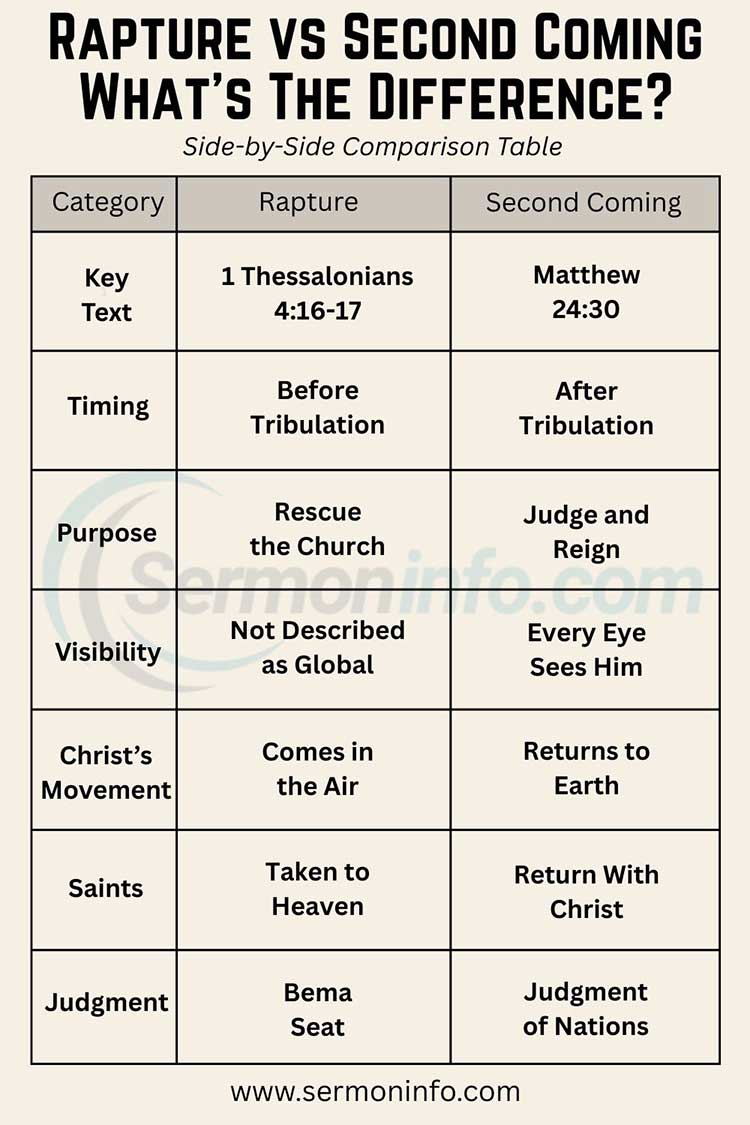
| Rapture vs Second Coming | Side-by-Side Comparison Table | ||
|---|---|---|
| Category | Rapture | Second Coming |
| Key Text | 1 Thessalonians 4:16–17 | Matthew 24:30 |
| Timing | Before Tribulation | After Tribulation |
| Purpose | Rescue the Church | Judge and Reign |
| Visibility | Not described as global | Every eye sees Him |
| Christ’s Movement | Comes in the air | Returns to earth |
| Saints | Taken to heaven | Return with Christ |
| Judgment | Bema Seat | Judgment of Nations |