How To Write a Sermon 101: I have been asked many times by students how do you write multiple weekly sermons for such a long time (nearly three decades now) and still enjoy doing it?
I learned very early in ministry to write a sermon in manageable parts. I study the text from which I craft the sermon outline. I write content to the sermon outline with appropriate illustrations and applications. I write the conclusion and then I write the introduction.

How To Write a Sermon 101
Let me say at the outset, preparing sermons is never easy but it does get easier once you put in place steps that you follow on a weekly basis.
Here are the five steps I have put in place so that I can write multiple sermons per week.
1. Study the Scriptures
I usually preach through the books of the Bible. I never waste time and energy looking for a passage of Scripture to preach because the next sermon is the next portion of Scripture to preach.
I study the Scriptures in order to grasp the details presented by observing the words and their relationships to each other. I look for grammatical, logical and contextual relationships.
Once I grasp the details of the Scriptures, I then seek the meaning of these words and their relationships to each other in order to form a structure to the Scriptures.
For example in 2 Timothy 3:16-17, I could see that God’s word was a key element of these two verses. Also I could see that God’s word is linked to inspiration, profitability and dependability. I could see a structure that I could begin shaping.
2. Sketch the Sermon Outline
Once I have the details, meaning and structure of the Scriptures, I begin the process of sketching the sermon outline.
It is important to note that the sermon outline is the body of the sermon and therefore it becomes the roadmap for what you want to share with your audience.
When I sketch a sermon outline, I break it down into four parts, the main preaching point, the sub-points, the incidental points and the key word.
The Main Preaching Point: For example in 2 Timothy 3:16-17, the main preaching point is “Why we need to embrace the power of God’s word.”
Why did I craft this as my main preaching point? I crafted this because it covered all that I wanted to share from 2 Timothy 3:16-17. In other words, it was the umbrella statement for the sermon and the portion of Scripture at hand.
The Sub-Points: I crafted three sub-points from 2 Timothy 3:16-17. We need to embrace the power of God’s word because it is inspired, profitable and dependable. These sub-points simply flowed from the Scripture themselves. These three sub-points expand and explain the main preaching point.
The Incidental Points: The incidental points expand and explain the sub-points in the same way the sub-points expand and explain the main preaching point. God’s word is profitable. How is God’s word profitable? God’s word is profitable because it establishes a right belief (doctrine) and a right behaviour (instruction in righteousness). I crafted the sermon outline around the details of the Scriptures.
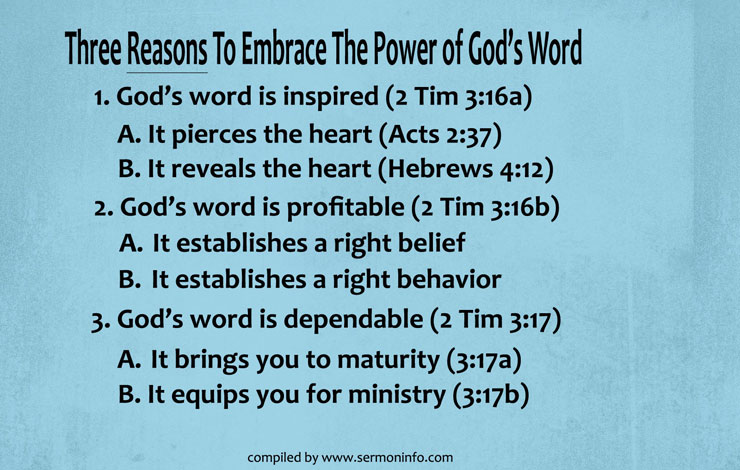
Wait a minute, what about the incidental points under the first sub-point? I drew these incidental points from the context of the Scriptures. God’s word brought Timothy to salvation and nurtured him in his spiritual journey (2 Timothy 3:14-15). Therefore, I sought information outside the text to explain how God’s word was inspired in light of Timothy’s experience.
The Key Word: The key word is a plural noun that I employ to swing all the sub-points from the main preaching point. The key must be a plural noun. There are three REASONS why we need to embrace the power of God’s word. The first reason is because God’s word is inspired. The second reason is because God’s word is profitable and the third is reason is because God’s word is dependable.
The key word helps the audience follow the structure of your sermon. The key word provides a natural flow from sub-point to sub-point.
By the way, this is a deductive method of sermon preparation.
3. Support the Sermon Outline with Content
I never write a sermon without first sketching a sermon outline. Once the sermon outline is completed, I simply put content to the outline.
Personally, I tend to spend the biggest portion of my time sketching and tweaking the sermon outline. Once the sermon outline is finished, it takes very little time to write the content because the sermon outline determines the content, the illustrations and the applications.
I spend about six hours studying and sketching the sermon outline. I would spend about two hours writing the content, the conclusion and the introduction.
Getting the sermon outline just right will expedite the content, illustrations, applications, conclusion and introduction.
4. Shape the Conclusion
Now that you know what you are going to preach and what you are going to say about what you are going to preach, you can shape your conclusion to drive your points home and motivate your audience to action.
There are various ways to conclude the sermon. I tend to finish many of my sermons with a memorable statement and a call to action. It takes time to craft a memorable statement and a call to action but it is definitely worth it.
You may use a story to conclude your message and drive home the point. You may simply summarise your main points with an application. You may conclude your message with vision casting by giving your audience a picture of what could be if your audience put your message into practice.
You may conclude your message with an appeal or you could just vary the ways that you draw your message to a conclusion.
Spending time shaping a good conclusion will help your audience (and you) to practice what you preach.
5. Shape the Introduction
When I follow these five steps on how to write a sermon 101, I find it is very easy to write a sermon introduction. I already know what the introduction must introduce. It must introduce the main preaching point. I never make the introduction too long. I usually keep it precise and to the point.
When I write a sermon introduction, I seek to include the following four features: get the attention of the audience, raise an appropriate need, draw the audience to the main preaching point and state the purpose of the sermon.
How do I do this? I may tell a story that leads into the main preaching point or I may create tension with a paradoxical statement or I may use a startling fact or statistic to get people’s attention and focus or I may simply start with a rhetorical question and built to the main preaching point from there.
Concluding Statements
I find writing multiple weekly sermons hard work but if I follow the five steps above I find the work and results enjoyable and rewarding.
The most important point from “how to write a sermon 101” is breaking the sermon process into manageable parts.