The Sermon Outline From Malachi 3:8–12 teaches why faithful giving mattered under Israel’s covenant. God confronted withheld tithes, commanded complete giving, and promised covenant blessings. Believers today do not claim those national promises, but the passage still teaches faithful stewardship, generous giving, and obedience that honors God.

Key Takeaways – Sermon From Malachi 3:8-12
- Faithful giving reveals the heart. Malachi 3:8–9 shows that unfaithful giving exposed Israel’s deeper spiritual problem before God.
- Faithful giving requires obedience. Malachi 3:10a teaches that Israel needed to bring the complete tithe and honor God’s clear command.
- Faithful giving reflects trust in God. Malachi 3:10b–12 records covenant blessings for obedient Israel, while believers today can trust God’s faithful care and provision.
Sermon Outline From Malachi 3:8-12
Malachi spoke to people who had returned to their land but had drifted from faithful obedience to God. Their withheld giving revealed a deeper problem within their hearts. God called Israel to return and trust His covenant faithfulness. Today, our giving can also reveal what we value, trust, and treasure most.
Malachi 3:8–12 shows us why faithful giving matters. God confronts unfaithful giving, commands faithful giving, and promises covenant blessings to Israel. These verses remind us that giving involves more than money. It reflects the heart. As we open this passage, let us consider whether our stewardship truly honors the God who provides everything we have.
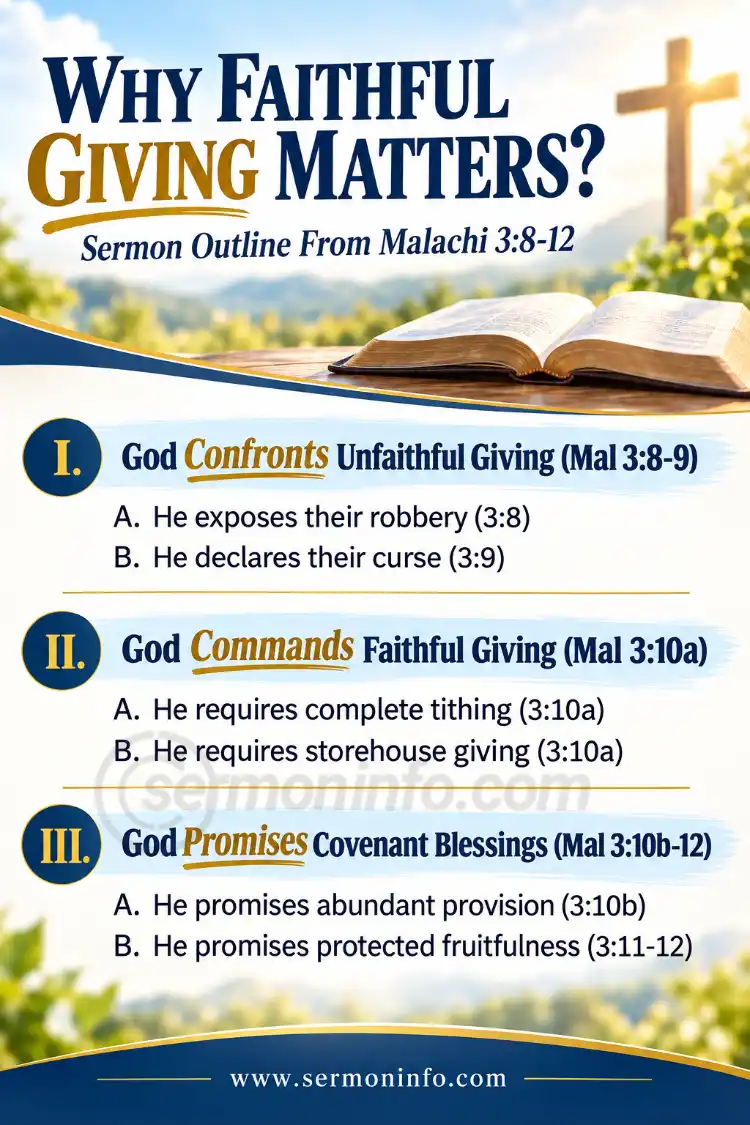
1. God Confronts Unfaithful Giving (Mal 3:8–9)
God confronts Israel because withholding their tithes and offerings revealed serious unfaithfulness toward Him. (Summary Statement)
A. He Exposes Their Robbery (Malachi 3:8)
God asked Israel, “Will a man rob God?” Yet they had withheld the tithes and offerings He required. Their giving revealed something deeper than empty storehouses. It revealed hearts unwilling to honor God fully. They treated as their own what God had commanded them to give.
Israel lived under the Mosaic Covenant, so these tithes were specific covenant requirements. Believers today live under grace, yet God still cares about our stewardship. Everything we possess comes from Him. Therefore, our giving should express gratitude, worship, and willing devotion. As 2 Corinthians 9:7 teaches, God loves a cheerful giver.
B. He Declares Their Curse (Malachi 3:9)
Israel’s unfaithfulness carried serious consequences because they had violated their covenant responsibilities. God declared, “You are cursed with a curse” (Malachi 3:9). Their hardship was not random misfortune. God was disciplining His covenant nation because they continued withholding what He had commanded.
We should not place Israel’s covenant curse directly upon believers today. However, their experience warns us never to treat disobedience lightly. God lovingly disciplines His children for their spiritual good (Hebrews 12:6). When money controls our hearts, we should examine our priorities and return to faithful, grateful obedience. (Source Material: William MacDonald, Believer’s Bible Commentary, p. 1176)
This material provides some ideas and thoughts for a sermon outline from Malachi 3:8-12 (Why Faitful Giving Matters?).
2. God Commands Faithful Giving (Mal 3:10a)
God commands Israel to demonstrate renewed covenant obedience by faithfully bringing their required tithes. (Summary Statement)
A. He Requires Complete Tithing (Malachi 3:10a)
God commanded Israel, “Bring all the tithes into the storehouse” (Malachi 3:10). He did not ask for partial obedience. Israel had withheld what God required under the Mosaic Covenant. Complete tithing showed that they trusted His authority and took His commands seriously.
Believers today do not live under Israel’s tithing laws, yet God still calls us to generous giving. Our giving should never come from pressure or fear. Instead, we should give willingly and purposefully. Second Corinthians 9:7 teaches us to give from the heart because “God loves a cheerful giver.”
B. He Requires Storehouse Giving (Malachi 3:10a)
God also directed Israel where to bring their tithes. The storehouse supported the ministry connected with the temple and provided needed resources. God said there should “be food in My house” (Malachi 3:10). Their giving helped sustain the work God had established among His people.
This principle still challenges us today. Biblical giving should support gospel ministry, faithful teaching, and the needs connected with God’s work. Our gifts become tools in His hands. When believers give faithfully, they help others hear God’s Word, receive practical care, and grow in Christ. (Source Material: John MacArthur, The MacArthur Bible Commentary, pp. 1085-1086)
3. God Promises Covenant Blessings (Mal 3:10b–12)
God promises obedient Israel abundant covenant blessings that would display His faithfulness before the nations. (Summary Statement)
A. He Promises Abundant Provision (Malachi 3:10b)
God promised obedient Israel that He would “open for you the windows of heaven” (Malachi 3:10). He would pour out blessing beyond their ability to contain it. This promise reflected Israel’s covenant relationship with God. Their obedience would bring the material blessings He had promised His nation.
Believers today should not treat this verse as a guarantee of wealth. God does promise to care for His children faithfully. Philippians 4:19 reminds us that God supplies our needs through Christ. Therefore, we can give generously and trust Him, even when finances feel uncertain.
B. He Promises Protected Fruitfulness (Malachi 3:11–12)
God promised to “rebuke the devourer” and protect Israel’s crops from destruction. Their vines would produce fruit instead of failing early. Then the nations would call Israel blessed because their land would display God’s covenant favor. His protection would make their restored fruitfulness visible to others.
These promises belonged directly to Israel under the Mosaic Covenant, yet they reveal God’s faithful character. We may face seasons when resources seem fragile. Still, we can trust His care. God may not remove every hardship, but He remains faithful and uses our obedience to produce lasting spiritual fruit. (Source Material: John F. Walvoord and Roy B. Zuck, The Bible Knowledge Commentary: Old Testament, pp. 1584-1585)
Conclusion
Malachi 3:8–12 shows us why faithful giving matters to God. He confronted Israel’s unfaithful giving and commanded them to bring the complete tithe. Then God promised covenant blessings when they returned to obedience. Their giving revealed their hearts, and God called them to trust His faithful provision.
We must understand these promises within God’s covenant relationship with Israel. Yet the passage still teaches powerful truths about stewardship today. Everything we possess comes from God, so our giving should honor Him. Let us give willingly, generously, and thankfully. Above all, let our stewardship reveal hearts that trust God and treasure Him above everything else.
Closing Prayer
Heavenly Father, thank You for every good gift You provide. Help us remember that everything we possess comes from Your gracious hand. Give us thankful hearts that honor You through faithful, willing, and generous giving.
Lord, teach us to trust You when resources seem uncertain. Guard our hearts from selfishness and fear. May our stewardship show that You are our greatest treasure. Help us live faithfully for Your glory. We pray in Jesus’ name, Amen.
Frequently Asked Questions (FAQ)
Q: What does Malachi 3:8–12 mean?
A: Malachi 3:8–12 confronts Israel for withholding required tithes and offerings. God calls the nation to bring the full tithe into His storehouse and promises covenant blessing for obedience. The passage shows that faithful giving reveals trust, obedience, and honor toward God.
Q: What does it mean to rob God in Malachi 3:8?
A: In Malachi 3:8, Israel robbed God by withholding the tithes and offerings He required under the Mosaic Covenant. Their failure was more than financial neglect; it revealed spiritual unfaithfulness. God used their giving to expose whether they truly honored His authority and covenant commands.
Q: What is the storehouse in Malachi 3:10?
A: The storehouse in Malachi 3:10 referred to temple chambers where tithes and offerings were stored for Levites, priests, and ministry needs. God commanded Israel to bring the whole tithe there so His house had provision. The verse emphasizes complete, purposeful obedience in giving.
Q: What does “test Me” mean in Malachi 3:10?
A: God told Israel to “test Me” by obeying His command and seeing whether He would fulfill His covenant promise. This was not permission to test God selfishly. It was a specific invitation for Israel to trust His faithfulness concerning covenant blessing and provision.
Q: Does Malachi 3:10 apply to Christians today?
A: Malachi 3:10 directly addressed Israel under the Mosaic Covenant, so its agricultural blessings should not be treated as guaranteed prosperity for Christians. Believers today can still learn important principles of generous stewardship, faithful obedience, and trust in God’s provision, as taught in 2 Corinthians 9:6–8.
BONUS: Does Malachi 3:8–10 Apply to Believers Today?
Malachi 3:8–10 directly addressed Israel under the Mosaic Covenant. God required Israel to bring tithes into the storehouse. Therefore, believers should not claim Israel’s covenant promises as automatic guarantees of material prosperity.
However, believers can apply the passage’s principles of obedience, stewardship, and trust. 2 Corinthians 9:7 calls believers to give willingly and cheerfully. God still desires generous hearts that honor Him with the resources He provides.
BONUS: What Are the Blessings of Tithing From Malachi 3:8–10?
God promised obedient Israel that He would open “the windows of heaven” and pour out abundant blessing (Malachi 3:10). These blessings reflected Israel’s covenant relationship and included agricultural provision.
The passage shows that God faithfully keeps His promises. Believers should not interpret Malachi 3:10 as guaranteed financial prosperity. Instead, we can trust God to provide our needs as Philippians 4:19 teaches.
BONUS: What Can We Learn About Giving From Malachi 3:8–12?
Malachi 3:8–12 teaches that giving reveals our attitude toward God. Israel withheld what God required, and He confronted their disobedience. Faithful giving showed obedience, gratitude, and trust in His covenant promises.
Believers today should give willingly, generously, and purposefully. Second Corinthians 9:6–7 connects generous giving with a cheerful heart. Biblical giving should flow from love for God, not pressure, fear, or selfish gain.
BONUS: What Does Giving Say About the Giver in Malachi 3:8–10?
Israel’s giving revealed the condition of their hearts. By withholding tithes and offerings, they showed spiritual unfaithfulness and disregard for God’s commands. Their financial choices exposed their deeper priorities.
Our giving can also reveal what we treasure. Jesus said, “where your treasure is, there your heart will be also” (Matthew 6:21). Generous giving can express gratitude, trust, obedience, and love for God.
BONUS: What Are the Benefits of Tithing From Malachi 3:8–12?
God promised Israel provision, protection, fruitful crops, and visible blessing among the nations (Malachi 3:10–12). These benefits belonged to Israel within the covenant God had established with them.
Believers should not turn these promises into a formula for wealth. Yet generous giving develops gratitude, strengthens trust, and supports God’s work. Acts 20:35 reminds us, “It is more blessed to give than to receive.”
BONUS: What Is the Difference Between Giving Today and in Malachi?
In Malachi, Israel gave required tithes under the Mosaic Covenant. God directed those tithes toward the storehouse and connected obedience with specific covenant blessings and discipline.
Believers today give under grace rather than Israel’s covenant law. The New Testament emphasizes willing, generous, planned giving (1 Corinthians 16:2; 2 Corinthians 9:7). We give because God has graciously given to us through Christ.
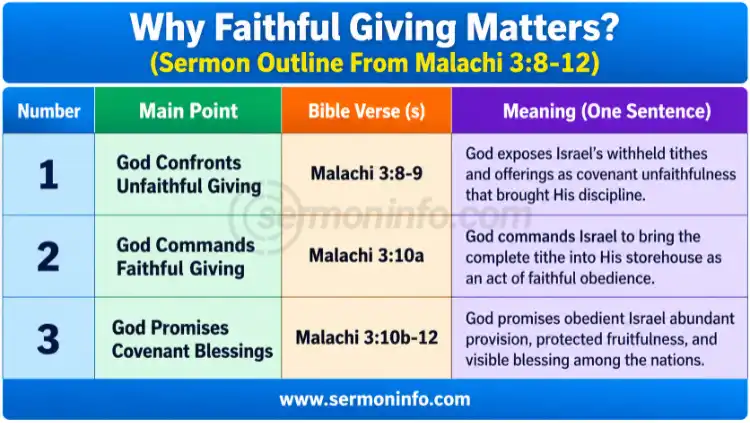
| Sermon Outline From Malachi 3:8-12 – Sermon Information | |||
|---|---|---|---|
| Number | Main Point | Bible Verse | Meaning |
| 1 | God Confronts Unfaithful Giving | Malachi 3:8–9 | God exposes Israel’s withheld tithes and offerings as covenant unfaithfulness that brought His discipline. |
| 2 | God Commands Faithful Giving | Malachi 3:10a | God commands Israel to bring the complete tithe into His storehouse as an act of faithful obedience. |
| 3 | God Promises Covenant Blessings | Malachi 3:10b–12 | God promises obedient Israel abundant provision, protected fruitfulness, and visible blessing among the nations. |
Source Material
William MacDonald, Believer’s Bible Commentary, rev. ed. (Nashville: Thomas Nelson, 1995), 1176
John MacArthur, The MacArthur Bible Commentary (Nashville: Thomas Nelson, 2005), 1085-1086
John F. Walvoord and Roy B. Zuck, eds., The Bible Knowledge Commentary: Old Testament (Colorado Springs, CO: David C. Cook, 1985), 1584-1585