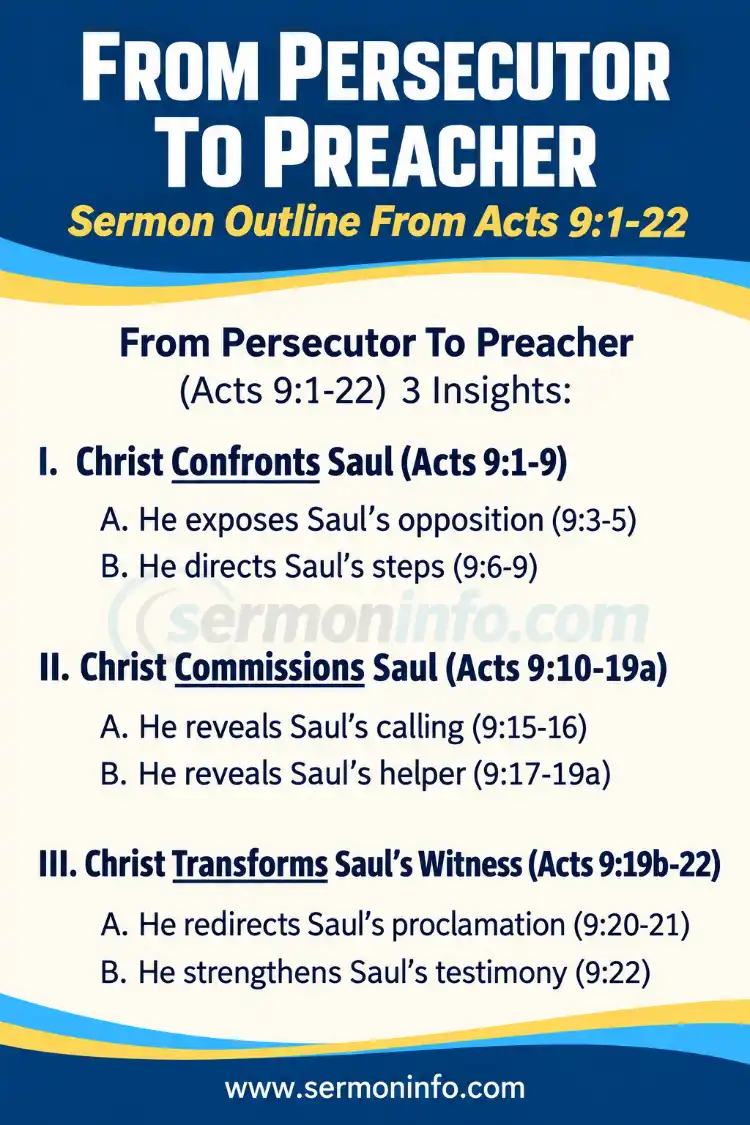
Semon Outline From Acts 9:1-22 traces Saul’s conversion and calling (From Persecutor To Preacher). Jesus confronts Saul, reveals his mission through Ananias, and changes his message. Saul begins proclaiming Jesus as God’s Son and demonstrating that He is the Messiah, revealing the fruit of Christ’s transforming grace.

Key Takeaways – Sermon From Acts 9:1-22
- Christ confronts Saul (Acts 9:1–9): Jesus exposes Saul’s opposition and redirects his steps. Let God’s Word correct your heart and guide your choices.
- Christ commissions Saul (Acts 9:10–19a): Jesus chooses Saul to carry His name before others. Serve Christ faithfully, even when obedience brings hardship.
- Christ transforms Saul’s witness (Acts 9:19b–22): Saul begins proclaiming Jesus as God’s Son and the promised Messiah. Grow in Scripture and share the gospel with courage and kindness.
Sermon Outline From Acts 9:1-22
Have you ever wondered whether someone could truly change? Jesus Christ can reach a hardened heart and give life a new direction. Our past never places us beyond His saving grace. Saul set out to arrest believers, but he soon began proclaiming the Savior he opposed. His story invites us to trust Christ’s power to transform lives.
In Acts 9:1–22, we will see how Christ confronts Saul, commissions him, and transforms his witness. Each movement reveals the Lord’s authority, grace, and purpose. As we follow Saul from persecutor to preacher, let us examine our own response to Jesus. We begin on the Damascus road, where Christ confronts a man traveling in the wrong direction.
1. Christ Confronts Saul (Acts 9:1–9)
Jesus interrupts Saul’s mission of persecution and reveals Himself as the risen Lord whom Saul opposes. (Summary Statement)
A. He exposes Saul’s opposition (Acts 9:3–5)
Saul approaches Damascus, determined to arrest those who follow Jesus. Suddenly, light from heaven surrounds him, and he falls to the ground. Jesus asks, “Saul, Saul, why are you persecuting Me?” (Acts 9:4). Saul targets believers, but Jesus takes their suffering personally. The risen Lord identifies closely with His people.
What comfort this brings when others mock your faith or reject you because you follow Jesus. Your Savior sees every wound and understands every struggle. He does not overlook your suffering. Saul’s encounter also challenges us to examine our hearts. Strong religious feelings never excuse opposing Christ or mistreating His people.
B. He directs Saul’s steps (Acts 9:6–9)
Jesus commands Saul to rise and enter Damascus, where he will receive further instructions (Acts 9:6). When Saul opens his eyes, he cannot see. His companions take his hand and guide him into the city. For three days, he remains blind and neither eats nor drinks. The determined persecutor now depends on others for help.
Sometimes obedience means taking the next step without knowing what will follow. Saul receives a clear command, but he must wait for further direction. We should not expect his unique experience, yet we can follow God’s written Word through uncertainty. When trouble clouds tomorrow, trust Christ and obey what Scripture makes clear today. (Source Material: William MacDonald, Believer’s Bible Commentary, pp. 1608-1611)
This material provides some ideas and thoughts for a sermon outline from Acts 9:1-22 (From Persecutor To Preacher).
2. Christ Commissions Saul (Acts 9:10–19a)
Jesus chooses Saul to carry His name to others and sends Ananias to help him begin this calling. (Summary Statement)
A. He reveals Saul’s calling (Acts 9:15–16)
Ananias knows Saul’s violent reputation, but Jesus reveals a purpose beyond that painful history. He calls Saul “a chosen vessel of Mine” (Acts 9:15). Saul will carry Christ’s name before Gentiles, kings, and the children of Israel. However, this calling includes suffering for Jesus’ sake. Christ promises meaningful service, not an easy road.
Saul’s commission reminds us that Christ’s grace can change the direction of a life. Our past does not place us beyond His saving power. Although Saul’s apostolic calling was unique, every believer can serve Christ faithfully. When obedience brings hardship, remember that difficulty does not mean failure. Trust the Savior whose grace sustains His servants.
B. He sends Saul’s helper (Acts 9:17–19a)
Ananias obeys Jesus, enters the house, and places his hands on Saul. He greets the former persecutor with the welcoming words, “Brother Saul” (Acts 9:17). Jesus sends Ananias so Saul can regain his sight and receive the Holy Spirit’s fullness. Saul immediately sees again, receives baptism, and eats food that restores his strength.
Notice how Jesus uses a willing disciple to help someone begin a new life. Ananias moves past his fear and offers Saul a warm welcome. We can offer practical care, prayer, and biblical encouragement to new believers. A visit or shared meal may bring comfort during uncertain days. Your quiet obedience can help another believer move forward in faith. (Source Material: John MacArthur, The MacArthur Bible Commentary, pp. 1452-1454)
3. Christ Transforms Saul’s Witness (Acts 9:19b–22)
Christ’s transforming work becomes evident as Saul begins proclaiming the Savior he once opposed. (Summary Statement)
A. He redirects Saul’s proclamation (Acts 9:20–21)
Saul enters the synagogues with a message his listeners never expected. He immediately proclaims that Jesus “is the Son of God” (Acts 9:20). The man who hunted believers now declares the truth they believe. His listeners express amazement because they remember his violent mission. Meeting the risen Jesus changes both Saul’s allegiance and his message.
Christ’s grace gives us a new reason to speak, even when others remember our past. Saul’s message centers on Jesus, not simply his remarkable experience. We can share what Christ has done while explaining who He is. When a friend questions your faith, speak with kindness and point to the Savior who died and rose again.
B. He strengthens Saul’s testimony (Acts 9:22)
Luke tells us that Saul “increased all the more in strength” (Acts 9:22). His growing strength becomes clear as he demonstrates that Jesus is the promised Messiah. Saul does more than express personal enthusiasm; he presents a convincing case for Jesus’ identity. His arguments confound the Jewish hearers in Damascus who oppose his message.
We grow as witnesses when we deepen our understanding of Scripture and depend on Christ. You may struggle to explain your faith today, but you can keep learning. Study God’s Word, ask thoughtful questions, and practice explaining the gospel clearly. When others challenge you, trust Christ for courage and answer with gentleness and respect (1 Peter 3:15). (Source Material: John F. Walvoord and Roy B. Zuck, The Bible Knowledge Commentary: New Testament, pp. 375-377)
Conclusion
Christ confronted Saul, commissioned him, and transformed his witness. The man who once persecuted believers began proclaiming Jesus as the Son of God. His story displays the Lord’s authority and the wonder of His grace. Christ gave Saul a new direction, and his life began pointing others to the Savior.
As we read God’s Word, let us welcome its correction, trust its promises, and obey its commands. Saul’s calling was unique, but his response encourages us to follow Christ faithfully. If you have never trusted Jesus, turn from sin and believe in Him. If you know Him, keep growing in Scripture and sharing His gospel. God’s grace can transform lives, including yours.
Closing Prayer
Heavenly Father, thank You for Your saving grace through Jesus Christ. You changed Saul from a persecutor into a preacher. Search our hearts, expose our sin, and guide us through Your Word. Help us turn from wrong paths and trust Your direction. Give us willing hearts to obey You, even when the road brings hardship.
Lord, strengthen our faith and help us speak clearly about Jesus. Give us courage to share the gospel and compassion to encourage others. Help those who do not know You repent and trust Christ’s finished work. May our words and actions honor Your Son and show the power of Your grace. We pray in Jesus’ name, amen.
Frequently Asked Questions (FAQ)
Q: What is the main message of Acts 9:1–22?
A: Acts 9:1–22 shows how Jesus transforms Saul from a persecutor into a preacher. Christ confronts his opposition, commissions him for service, and changes his witness. The passage highlights God’s saving grace and encourages believers to obey Christ and proclaim Him faithfully.
Q: How did Saul change from a persecutor to a preacher?
A: Saul changed after the risen Jesus confronted him on the Damascus road. Through Ananias, he regained his sight and received the Holy Spirit’s fullness. Saul then began proclaiming Jesus as God’s Son. His transformation reveals Christ’s grace and power, rather than human achievement (Acts 9:3–22).
Q: Why was Saul going to Damascus?
A: HSaul traveled to Damascus to arrest followers of Jesus and bring them bound to Jerusalem. He carried letters from the high priest authorizing his mission. However, Jesus interrupted his journey and exposed his persecution as opposition to the Lord Himself (Acts 9:1–5).
Q: What role did Ananias play in Saul’s conversion?
A: Ananias obeyed Jesus by visiting Saul despite fearing his violent reputation. He laid hands on Saul and explained Christ’s purpose for sending him. Saul regained his sight, received the Holy Spirit’s fullness, and underwent baptism. Ananias models courageous obedience and compassionate welcome (Acts 9:10–19).
Q: What did Saul preach after his conversion?
A: Saul immediately preached in the Damascus synagogues that Jesus is the Son of God. As he grew stronger, he demonstrated that Jesus is the promised Messiah. His hearers marveled because the former persecutor now proclaimed the Savior he had opposed (Acts 9:20–22).
BONUS: What does Saul’s conversion teach us about God’s grace?
Saul’s conversion shows that God extends grace to people who fiercely oppose Him. Saul pursued believers, yet Jesus confronted him and redirected his life (Acts 9:1–6). He could never earn such mercy through religious effort. His salvation displays Christ’s patience and the power of undeserved grace (1 Timothy 1:13–16).
We should never assume that someone’s past places them beyond Christ’s saving reach. God saves sinners by grace through faith, not through personal achievement (Ephesians 2:8–9). Keep praying for those who resist the gospel. Saul’s story encourages us to share Christ with hope and trust God to change hearts.
BONUS: Why did God send Ananias to Saul?
God sent Ananias so Saul could regain his sight and experience the Holy Spirit’s fullness (Acts 9:17). Ananias obeyed the Lord, entered the house, and greeted him as “Brother Saul.” His visit brought personal care and a warm welcome. Saul regained his sight, received baptism, and ate to restore his strength (Acts 9:18–19).
Ananias initially feared Saul because he knew his violent reputation (Acts 9:13–14). However, he trusted Christ’s command and helped the former persecutor. His example encourages us to welcome new believers with wisdom and compassion. God can use our visits, prayers, and biblical encouragement to strengthen someone beginning the Christian life.
BONUS: What does Acts 9:15 mean when Saul is called a chosen vessel?
In Acts 9:15, Jesus describes Saul as His chosen instrument for carrying His name before Gentiles, kings, and Israel. The image of a vessel emphasizes Christ’s ownership and purpose. Jesus appoints Saul to a specific ministry that includes suffering for His name (Acts 9:16). This calling rests on divine grace, not Saul’s achievements.
Saul’s commission belongs to his unique apostolic ministry, so we should not claim his specific calling as our own. However, his example reminds us that Christ gives His people meaningful service. We can use our gifts to serve others and proclaim the gospel faithfully (1 Peter 4:10–11). Our goal should center on honoring Him.
BONUS: Did Saul become Paul when he was converted?
Saul did not receive the name Paul at his conversion. Acts 13:9 identifies him as “Saul, who also is called Paul.” He already had both names. Saul was his Hebrew name, while Paul was his Roman name. Luke begins using Paul consistently as the account follows his ministry among Gentiles.
The important change involved Saul’s heart and allegiance, rather than his name. He stopped persecuting believers and began proclaiming Jesus as God’s Son (Acts 9:20). His story reminds us that conversion brings a new relationship with Christ. God’s grace changes our direction and gives us a new purpose.
BONUS: Why was Saul baptized?
Saul received baptism after meeting the risen Jesus and regaining his sight through Ananias’s visit (Acts 9:17–18). His baptism publicly identified him with the Savior he once opposed. This obedient response followed his encounter with Christ and marked his entrance into fellowship with other believers.
Baptism does not earn salvation or replace faith in Christ. God saves us by grace through faith, apart from works (Ephesians 2:8–9). Baptism expresses our identification with Christ in His death and resurrection (Romans 6:3–4). Like Saul, believers should respond to the gospel with faith and willing obedience.
BONUS: How does Acts 9 apply today?
Acts 9 encourages us to trust Christ’s power to change lives. Saul’s conversion shows that even fierce opposition cannot place someone beyond God’s saving grace (Acts 9:1–22). We can pray for resistant loved ones, share the gospel patiently, and let Scripture correct our own hearts.
Ananias teaches us to obey Christ and welcome new believers, while Saul models a clear witness about Jesus. We do not share Saul’s unique apostolic commission, but we can serve Christ faithfully. Study God’s Word, encourage someone starting the Christian life, and speak about the Savior with courage and kindness.
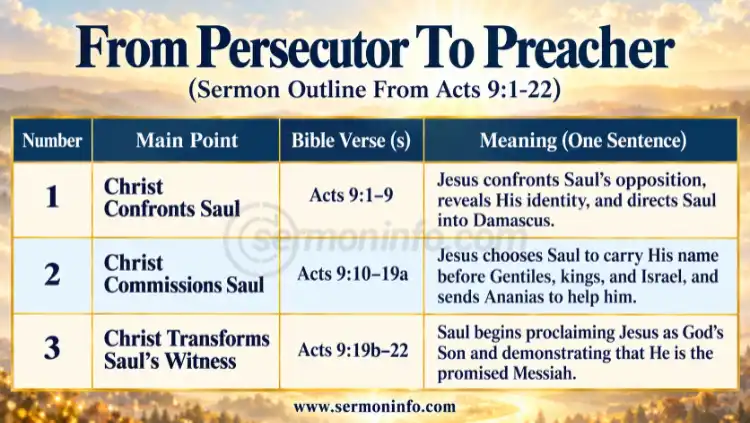
| Sermon Outline From Acts 9:1-22 – Sermons From Actss | |||
|---|---|---|---|
| Number | Main Point | Bible Verse | Meaning |
| 1 | Christ Confronts Saul | Acts 9:1–9 | Jesus confronts Saul’s opposition, reveals His identity, and directs Saul into Damascus. |
| 2 | Christ Commissions Saul | Acts 9:10–19a | Jesus chooses Saul to carry His name before Gentiles, kings, and Israel, and sends Ananias to help him. |
| 3 | Christ Transforms Saul’s Witness | Acts 9:19b–22 | Saul begins proclaiming Jesus as God’s Son and demonstrating that He is the promised Messiah. |
Source Material
William MacDonald, Believer’s Bible Commentary, rev. ed. (Nashville: Thomas Nelson, 1995), 1608-1611
John MacArthur, The MacArthur Bible Commentary (Nashville: Thomas Nelson, 2005), 1452-1454
John F. Walvoord and Roy B. Zuck, eds., The Bible Knowledge Commentary: New Testament (Colorado Springs, CO: David C. Cook, 1985), 375-377