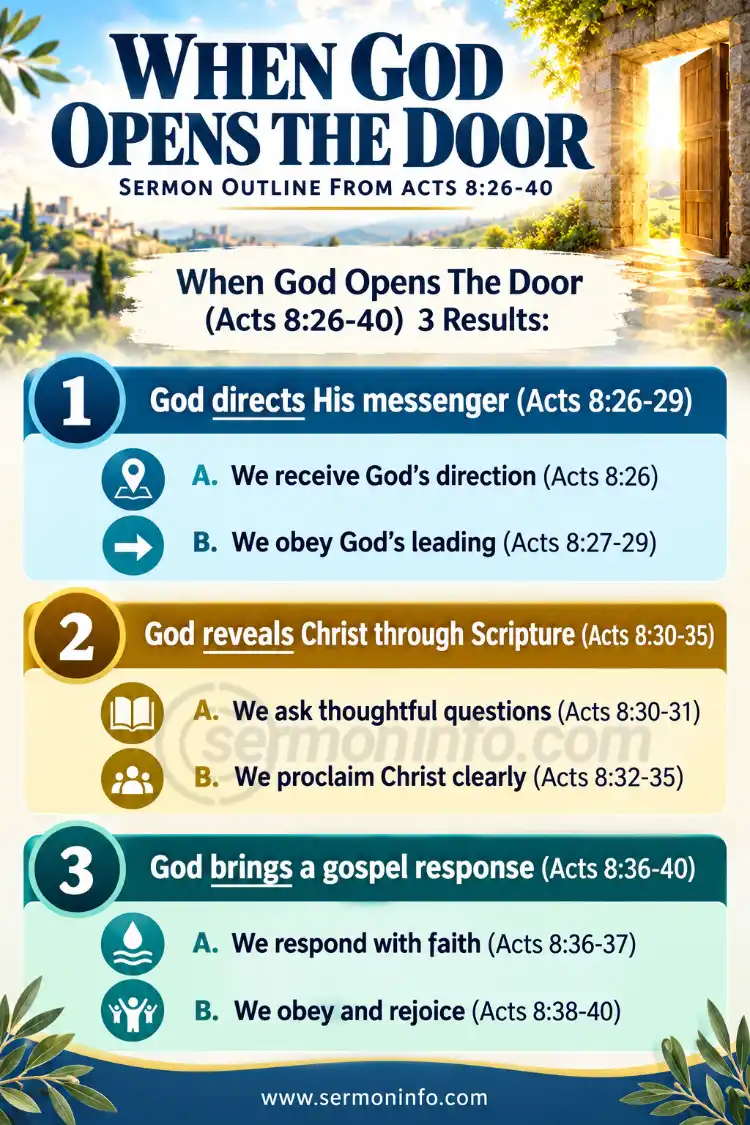
The Sermon Outline From Acts 8:26–40 shows a clear pattern for gospel witness (When God Opens the Door). God directs Philip, Scripture reveals Jesus, and the Ethiopian responds in faith. The passage teaches believers to follow God’s direction, understand His Word, proclaim Christ clearly, and trust God with the results.

Key Takeaways – Sermon From Acts 8:26-40
- Follow God’s Direction: God guided Philip to the right person at the right time. Stay available and obey when God opens gospel opportunities.
- Proclaim Christ Clearly: Philip used Scripture to explain Jesus Christ. Keep the gospel centered on God’s Word and Christ’s saving work.
- Trust God With the Response: The Ethiopian believed, obeyed through baptism, and rejoiced. Share the gospel faithfully and trust God to work in hearts.
Sermon Outline From Acts 8:26-40
Opportunities to share the gospel often come when we least expect them. God placed Philip on a desert road for one man. Philip stayed available, listened to God’s direction, and stepped toward the opportunity before him. God still places people across our path today. The question is whether we remain ready to speak about Christ when He opens the door.
Acts 8:26–40 shows us how God works through an available and obedient servant. God directs Philip, reveals Christ through Scripture, and brings a gospel response. This passage reminds us that successful witnessing begins with God, centers on Jesus, and requires our faithful obedience. When God opens the door, we must be ready to walk through it.
1. God Directs His Messenger (Acts 8:26–29)
God sovereignly guides Philip to the right place and person so he can faithfully share the gospel. (Summary Statement)
A. We Receive God’s Direction (Acts 8:26)
God initiated this encounter when His angel directed Philip toward the desert road leading from Jerusalem to Gaza. Philip did not arrange the meeting or know what awaited him. God already knew an Ethiopian traveler needed to hear about Jesus. Before Philip saw the opportunity, God was preparing the way.
God’s command reminds us to welcome His direction and remain available for His purposes. Today, God directs us through His Word and orders circumstances through His providence. We may not always understand where obedience will lead. Yet we can trust His wisdom and remain ready when He provides an opportunity to serve Christ.
B. We Obey God’s Leading (Acts 8:27–29)
Philip did not debate God’s command or demand the complete plan. Acts 8:27 simply says, “So he arose and went.” Then Philip saw the Ethiopian reading Scripture in his chariot. The Spirit directed Philip, saying, “Go near and overtake this chariot” (Acts 8:29). Philip obeyed each instruction God gave him.
Notice the pattern: Philip obeyed, and God provided further direction. We often want to see the entire road before taking the first step. Yet God calls us to obey what His Word has already made clear. As we walk faithfully, He can place gospel opportunities before us. Available believers become useful servants in God’s hands. (Source Material: William MacDonald, Believer’s Bible Commentary, pp. 1607-1608)
This material provides some ideas and thoughts for a sermon outline from Acts 8:26-40 (When God Opens The Door).
2. God Reveals Christ Through Scripture (Acts 8:30–35)
God uses His written Word to reveal Jesus Christ and explain the message of salvation clearly. (Summary Statement)
A. We Ask Thoughtful Questions (Acts 8:30–31)
Philip heard the Ethiopian reading Isaiah and asked, “Do you understand what you are reading?” (Acts 8:30). His question exposed a real need. The man admitted, “How can I, unless someone guides me?” (Acts 8:31). A thoughtful question opened the door for biblical explanation.
We can learn from Philip’s approach. Good questions help us discover what people understand, fear, or misunderstand about spiritual truth. We do not need to begin every conversation with a speech. Sometimes one sincere question creates the opportunity to explain Scripture and point someone toward Christ.
B. We Proclaim Christ Clearly (Acts 8:32–35)
The Ethiopian was reading Isaiah 53, a passage describing the suffering Servant. Philip began with that very Scripture and “preached Jesus to him” (Acts 8:35). He did not wander into speculation. He showed how God’s Word points directly to Christ and His saving work.
Our message must remain just as clear today. We should explain who Jesus is, why He died, and how sinners receive salvation by faith. Scripture gives us the message, and Christ gives us the focus. When God opens a door, we should not hide the gospel behind vague religious language. (Source Material: John MacArthur, The MacArthur Bible Commentary, p. 1452)
3. God Brings a Gospel Response (Acts 8:36–40)
God uses the proclaimed gospel to call people toward faith, obedience, and joyful identification with Christ. (Summary Statement)
A. We Respond With Faith (Acts 8:36–37)
As they traveled, the Ethiopian saw water and asked what prevented him from being baptized. Philip pointed first to genuine faith. The man responded, “I believe that Jesus Christ is the Son of God” (Acts 8:37). His response was personal, clear, and centered on Christ.
The gospel always calls for a personal response. Knowing facts about Jesus is not enough. We must place our faith in Him as Savior and Lord. Salvation comes by grace through faith, not through baptism or religious effort. Each person must answer the question, “What will I do with Jesus Christ?”
B. We Obey and Rejoice (Acts 8:38–40)
After confessing faith, the Ethiopian followed Christ through baptism. Philip baptized him, and the man “went on his way rejoicing” (Acts 8:39). His joy flowed from salvation, not from ceremony alone. Baptism publicly expressed the faith he had already placed in Christ.
Philip then continued his gospel ministry in other cities until he reached Caesarea (Acts 8:40). The Ethiopian rejoiced, and Philip kept serving. This reminds us that salvation produces joyful obedience, while faithful witnesses keep proclaiming Christ. God may close one opportunity, but He often opens another. (Source Material: John F. Walvoord and Roy B. Zuck, The Bible Knowledge Commentary: New Testament, pp. 374-375)
Conclusion
Acts 8:26–40 reminds us that God directs His messenger, reveals Christ through Scripture, and brings a gospel response. Philip received God’s direction and obeyed His leading. He asked a thoughtful question and clearly proclaimed Jesus. The Ethiopian responded with faith, followed Christ in baptism, and continued his journey with joy.
God’s Word still prepares us for gospel opportunities today. We must listen to Scripture, obey what God has revealed, and remain available for His purposes. When God opens a door, we should speak about Christ with clarity and compassion. Trust God with the opportunity, faithfully share His Word, and leave the results with Him.
Closing Prayer
Heavenly Father, thank You for the gospel of Jesus Christ and for the opportunities You place before us. Give us willing hearts to follow Your direction and courage to speak about Christ. Help us remain available, obedient, and sensitive to the opportunities You provide.
Lord, open our eyes to people who need to hear about Jesus. Help us explain Your Word clearly and share the gospel faithfully. May people place their faith in Christ and experience the joy of salvation. Use our lives for Your purposes and Your glory. We pray in Jesus’ name, Amen.
Frequently Asked Questions (FAQ)
Q: What is the main message of Acts 8:26–40?
A: Acts 8:26–40 shows God directing Philip to an Ethiopian official who needs help understanding Scripture. Philip explains Isaiah 53 and proclaims Jesus Christ. The man responds in faith, receives baptism, and rejoices. The passage highlights God’s guidance, Christ centered evangelism, and obedient gospel response.
Q: What does Acts 8:26–40 teach about evangelism?
A: Acts 8:26–40 teaches that effective evangelism begins with availability and obedience. Philip follows God’s direction, listens carefully, asks a thoughtful question, and explains Scripture clearly. His example encourages believers to recognize gospel opportunities, speak about Jesus with compassion, and trust God to work in the hearer’s heart.
Q: Why was the Ethiopian reading Isaiah 53?
A: The Ethiopian was reading Isaiah 53:7–8, a prophecy describing the suffering Servant. He understood the words but needed help identifying the person Isaiah described. His question gave Philip the opportunity to begin with that Scripture and explain that the passage ultimately points to Jesus Christ.
Q: What did Philip explain to the Ethiopian?
A: Philip explained the good news about Jesus by beginning with the Ethiopian’s passage from Isaiah 53. He connected Scripture to Christ and showed that Jesus fulfilled the suffering Servant prophecy. Philip’s approach teaches believers to keep Scripture central and explain the person and saving work of Christ clearly.
Q: Why did the Ethiopian eunuch get baptized?
A: The Ethiopian asked for baptism after hearing Philip proclaim Jesus. His response showed personal faith and a desire to obey Christ publicly. In the passage, baptism follows belief rather than producing salvation. The Ethiopian then continued his journey rejoicing, showing the joy that accompanies genuine faith in Christ.
BONUS: Who was Philip the evangelist in the Bible?
Philip served among the seven men whom the believers selected to oversee practical needs (Acts 6:1–6). He later proclaimed Christ in Samaria, where many received his message (Acts 8:5–12). Scripture distinguishes Philip the evangelist from Philip the apostle.
God also directed Philip to explain the gospel to an Ethiopian official (Acts 8:26–35). Years later, Philip welcomed Paul into his home in Caesarea (Acts 21:8–9). His example encourages us to serve faithfully, share Christ clearly, and welcome others generously.
BONUS: Who was the Ethiopian eunuch in Acts 8?
The Ethiopian eunuch served as a senior official who managed the treasury of Candace, queen of the Ethiopians. He travelled to Jerusalem to worship God. During his return journey, he read Isaiah’s prophecy but needed help understanding its message (Acts 8:27–31).
Philip explained how Isaiah’s passage pointed to Jesus, and the official responded with faith and baptism (Acts 8:35–38). He continued his journey with joy. His experience reminds us that status and religious activity cannot replace personal faith in Jesus Christ.
BONUS: What happened to Philip after he baptised the Ethiopian eunuch?
After the baptism, the Spirit of the Lord carried Philip away, and the Ethiopian continued his journey rejoicing (Acts 8:39). Philip then appeared at Azotus. Luke describes God’s remarkable action without explaining exactly how the Spirit moved Philip.
Philip continued proclaiming the gospel through the towns until he reached Caesarea (Acts 8:40). Years later, he still lived there (Acts 21:8). His continuing ministry encourages us to remain faithful beyond one encouraging encounter and welcome further opportunities to share Christ.
BONUS: How can Christians prepare to share the gospel with others?
Christians prepare to share the gospel by understanding its central truths: Christ died for our sins and rose again (1 Corinthians 15:3–4). Study Scripture so you can explain salvation by grace through faith, apart from works (Ephesians 2:8–9). Keep Jesus central in every gospel conversation.
Pray for opportunities, practise explaining your faith simply, and listen carefully to people’s questions. Philip asked a thoughtful question before explaining Scripture (Acts 8:30–35). Follow his example with patience and kindness. First Peter 3:15 calls believers to answer others with gentleness and respect.
BONUS: What role does prayer play in personal evangelism?
Prayer expresses our dependence on God as we share the gospel. Paul asked believers to pray for opportunities and clear speech (Colossians 4:3–4). We can ask God to prepare hearts, guide conversations, and help us explain Christ faithfully.
Prayer also strengthens our courage when fear threatens to silence us. Early believers prayed for boldness and continued speaking God’s Word (Acts 4:29–31). Pray regularly for people by name, then take opportunities to speak. Trust God’s power as you share His message with love.
BONUS: How should Christians respond when someone rejects the gospel?
Christians should respond to gospel rejection with gentleness, patience, and respect. Second Timothy 2:24–25 calls the Lord’s servant to avoid quarrels and teach kindly. Listen carefully, answer sincere questions, and avoid pressuring people. Their response does not excuse harsh words or an unloving attitude.
Continue praying and showing kindness while respecting the person’s decision to end the conversation. Paul planted, Apollos watered, and God gave the increase (1 Corinthians 3:6–7). Trust God with the outcome. Remain ready for future conversations and continue sharing Christ with others.
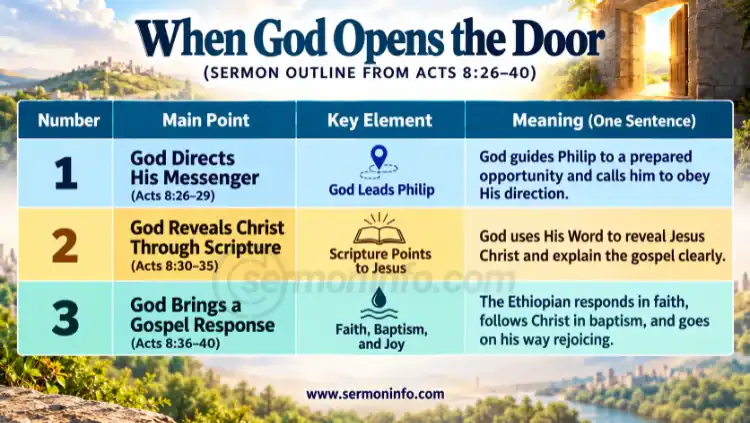
| Sermon Outline From Acts 8:26-40 – Sermon Outlines From Acts | |||
|---|---|---|---|
| Number | Main Point | Bible Verse | Meaning |
| 1 | God Directs His Messenger | Acts 8:26–29 | God guides Philip toward a prepared opportunity and calls him to respond with willing obedience. |
| 2 | God Reveals Christ Through Scripture | Acts 8:30–35 | God uses His Word to reveal Jesus Christ and equips Philip to proclaim the gospel clearly. |
| 3 | God Brings a Gospel Response | Acts 8:36–40 | The Ethiopian responds with faith, follows Christ through baptism, and continues his journey rejoicing. |
Source Material
William MacDonald, Believer’s Bible Commentary, rev. ed. (Nashville: Thomas Nelson, 1995), 1607-1608
John MacArthur, The MacArthur Bible Commentary (Nashville: Thomas Nelson, 2005), 1452
John F. Walvoord and Roy B. Zuck, eds., The Bible Knowledge Commentary: New Testament (Colorado Springs, CO: David C. Cook, 1985), 374-375