The danger of divided hearts (Sermon Outline From Hosea 10:1-17) appears when God’s people receive His blessings but give their loyalty to other things. Hosea 10 shows that divided hearts misuse blessings, trust false security, and invite God’s discipline. God therefore calls His people to repent, seek Him, and trust Him wholeheartedly.

Key Takeaways – Sermon From Hosea 10:1-15
- Divided hearts can corrupt God’s blessings. Receive His gifts with gratitude, and use them to honor Him rather than replace Him.
- Divided hearts invite God’s correction. False security cannot save us, so place your confidence in God rather than possessions, people, or human strength.
- Divided hearts need repentance. “Seek the LORD” (Hosea 10:12), turn from misplaced trust, and return to wholehearted devotion.
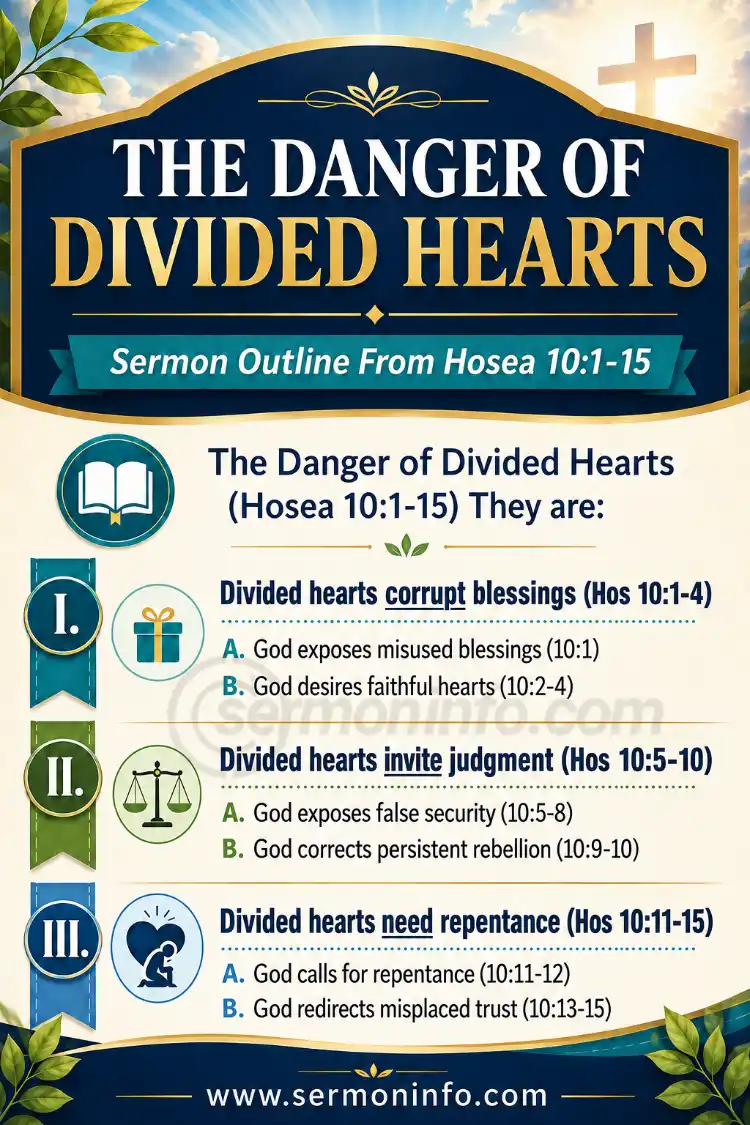
Sermon Outline From Hosea 10:1-15
A divided heart tries to hold God with one hand and the world with the other. Israel enjoyed God’s blessings, yet their hearts turned toward idols and false security. Hosea declared, “Their heart is divided” (Hosea 10:2, NKJV). Divided loyalty weakened their worship, distorted their choices, and eventually brought God’s judgment.
Hosea 10 shows us where divided hearts lead and how God calls us back. We will see how divided hearts corrupt blessings, invite judgment, and need repentance. Yet God graciously says, “It is time to seek the LORD” (Hosea 10:12). That call reaches our hearts today. God desires wholehearted trust, faithful worship, and sincere devotion.
1. Divided Hearts Corrupt Blessings (Hosea 10:1–4)
A divided heart can turn God’s good gifts into opportunities for selfishness, idolatry, and spiritual compromise. (Summary Statement)
A. God Exposes Misused Blessings (Hosea 10:1)
Israel prospered, but prosperity did not deepen their devotion to God. Instead, they used greater fruitfulness to multiply altars for false worship. Hosea says, “According to the multitude of his fruit he has increased the altars” (Hosea 10:1). God gave blessings, but Israel used those blessings to pursue idols.
We can misuse God’s blessings in similar ways today. Money, success, possessions, and opportunities can slowly capture our hearts. God wants His gifts to strengthen our gratitude and deepen our worship. James reminds us that “every good gift” comes from above (James 1:17). Therefore, enjoy God’s blessings, but always honor the Giver above the gift.
B. God Desires Faithful Hearts (Hosea 10:2–4)
Israel’s outward worship revealed a deeper spiritual problem. Hosea declares, “Their heart is divided; now they are held guilty” (Hosea 10:2). Their divided loyalty produced empty words, false promises, and corrupt choices. God wanted more than religious activity. He desired sincere hearts that belonged completely to Him.
God still desires wholehearted devotion from His people. A divided heart tries to serve God while protecting another master. Jesus warns, “No one can serve two masters” (Matthew 6:24). Therefore, we should examine our priorities, ambitions, and relationships. God deserves first place because faithful hearts produce faithful lives. (Source Material: William MacDonald, Believer’s Bible Commentary, p. 1102)
This material provides some ideas and thoughts for a sermon outline from Hosea 10:1-15 (The Danger of Divided Hearts).
2. Divided Hearts Invite Judgment (Hosea 10:5–10)
Persistent divided loyalty eventually brings God’s righteous discipline upon those who refuse to turn from their rebellion. (Summary Statement)
A. God Exposes False Security (Hosea 10:5–8)
Israel trusted the calf at Beth Aven, but that idol could not protect them. Their priests mourned because their false god faced removal. Hosea shows how quickly false security collapses when judgment comes. What they trusted became a source of fear instead of strength.
We can also trust money, position, people, or plans more than God. Those things may help us, but they cannot replace Him. Psalm 20:7 says, “Some trust in chariots, and some in horses.” Lasting security comes from the Lord, especially when life becomes uncertain.
B. God Corrects Persistent Rebellion (Hosea 10:9–10)
Israel’s rebellion reached back to the days of Gibeah, and the pattern continued. God says, “When it is My desire, I will chasten them” (Hosea 10:10). His patience did not mean approval. His holiness required Him to deal with deliberate and repeated sin.
God still takes persistent sin seriously. Hebrews 12:6 says, “For whom the LORD loves He chastens.” His discipline aims to turn His people back to faithful obedience. We should never treat His patience as permission to continue in sin. His correction calls us back to holiness and fellowship with Him. (Source Material: John MacArthur, The MacArthur Bible Commentary, pp. 978-979)
3. Divided Hearts Need Repentance (Hosea 10:11–15)
God calls divided hearts to abandon sinful ways, seek Him sincerely, and return to wholehearted dependence upon Him. (Summary Statement)
A. God Calls For Repentance (Hosea 10:11–12)
God called Israel to “break up your fallow ground” and “seek the LORD” (Hosea 10:12, NKJV). Their hearts had become hard through repeated sin. God urged them to sow righteousness and pursue mercy. Repentance meant more than regret. It required a genuine return to faithful obedience.
God still calls us to examine hard areas within our hearts. Sin can make the soul like dry ground that resists good seed. We must confess our sin and seek the Lord sincerely. First John 1:9 assures us that God forgives and cleanses those who confess their sins.
B. God Redirects Misplaced Trust (Hosea 10:13–15)
Israel trusted “in your own way” and “in your numerous mighty men” (Hosea 10:13). Their confidence rested in human plans and military strength. God exposed how powerless those things became under judgment. Their misplaced trust could not provide the security they expected.
We can also trust our abilities, finances, experience, or plans more than God. These things cannot carry the weight of our deepest confidence. Proverbs 3:5 commands, “Trust in the LORD with all your heart.” God invites us to place our confidence in Him, especially when circumstances feel uncertain. (Source Material: John F. Walvoord and Roy B. Zuck, The Bible Knowledge Commentary: Old Testament, pp. 1400-1402)
Conclusion
Hosea 10 warns us that divided hearts corrupt blessings, invite judgment, and need repentance. Israel misused God’s gifts, trusted false security, and resisted correction. Yet God still called them to seek Him. His message remains clear. He desires faithful hearts that worship Him, trust Him, and return to Him.
God’s Word calls us to examine our hearts before divided loyalties shape our choices. We must receive His blessings with gratitude and trust His wisdom above our own strength. When God exposes sin, we should respond with repentance, not resistance. “It is time to seek the LORD” (Hosea 10:12).
Closing Prayer
Heavenly Father, guard our hearts from divided loyalties. Help us receive Your blessings with gratitude and use them for Your glory. Expose every false security that competes for our trust. Give us humble hearts that seek You faithfully and obey Your Word.
Lord, lead us to genuine repentance when we wander from You. Teach us to trust Your wisdom rather than our strength. May our hearts remain faithful, our worship sincere, and our lives pleasing to You. We pray in the precious name of Jesus Christ, Amen.
Frequently Asked Questions (FAQ)
Q: What does a divided heart mean in Hosea 10:2?
A: A divided heart gives God partial loyalty while pursuing other objects of trust and affection. Israel claimed to worship God but also followed idols. Hosea 10:2 warns that God desires wholehearted devotion. We cannot faithfully serve Him while allowing competing loyalties to control our hearts.
Q: Why did Israel misuse God’s blessings in Hosea 10:1?
A: Israel enjoyed increasing prosperity but used that prosperity to multiply altars and strengthen false worship. Their blessings did not draw them closer to God. Hosea 10:1 warns us that prosperity becomes spiritually dangerous when God’s gifts become more important than honoring the God who provides them.
Q: What does “break up your fallow ground” mean in Hosea 10:12?
A: “Break up your fallow ground” pictures hardened soil that needs preparation before planting. Spiritually, God called Israel to soften hardened hearts, abandon sin, and seek Him sincerely. Genuine repentance prepares the heart to receive God’s truth and pursue the righteousness He desires.
Q: What does “sow for yourselves righteousness” mean in Hosea 10:12?
A: Sowing righteousness describes choosing obedience to God and pursuing what pleases Him. Like seed planted in good soil, righteous choices produce spiritual fruit. Hosea called Israel to stop sowing wickedness, seek the Lord, and experience His mercy rather than continue harvesting the consequences of rebellion.
Q: What does Hosea 10:13 teach about trusting ourselves?
A: Hosea 10:13 warns against trusting our own plans, abilities, and human strength instead of God. Israel trusted its own way and powerful warriors, but those securities failed. God calls us to depend upon Him, follow His Word, and place our deepest confidence in His faithful character.
BONUS: What does “empty vine” mean in Hosea 10:1?
In Hosea 10:1, Israel is called an “empty vine” because it produced fruit for itself rather than for God. The nation enjoyed prosperity, but increased blessings led to increased altars and idolatry. Israel became fruitful materially while becoming barren spiritually. Their prosperity did not produce faithful worship or gratitude.
The warning still speaks clearly today. God gives blessings so we can honor Him, not replace Him with His gifts. Jesus said, “By this My Father is glorified, that you bear much fruit” (John 15:8). True fruitfulness means a life that reflects obedience, worship, and devotion to God.
BONUS: How can prosperity become spiritually dangerous?
Prosperity becomes spiritually dangerous when blessings replace the God who gave them. Israel became prosperous, but “according to the multitude of his fruit he has increased the altars” (Hosea 10:1). Wealth can create pride, self reliance, and false security when we forget the Lord.
God warns us not to let success control our hearts. Deuteronomy 8:18 says, “You shall remember the LORD your God, for it is He who gives you power to get wealth.” Prosperity becomes safe when gratitude, generosity, and obedience keep God first in our lives.
BONUS: Why did God destroy Israel’s altars?
God destroyed Israel’s altars because they had become centers of false worship. Israel used God’s blessings to multiply altars, and their divided hearts turned from Him (Hosea 10:1–2). God would break down those altars because they encouraged idolatry instead of faithful devotion.
God still calls His people to remove anything that competes with Him for first place. Idols today may include money, success, possessions, or approval. First John 5:21 says, “Little children, keep yourselves from idols.” God desires wholehearted worship and faithful hearts.
BONUS: What does “hemlock” mean in Hosea 10:4?
In Hosea 10:4, “hemlock” pictures poisonous growth that springs from corrupt judgment. Israel made empty promises and dishonest agreements, so injustice spread like a toxic plant in a field. Sin poisoned their public life because their hearts had already turned from God.
The image warns us that wrong choices rarely stay small. When people reject truth, bitterness and injustice can spread quickly. Galatians 6:7 reminds us, “Whatever a man sows, that he will also reap.” God calls us to sow truth, righteousness, and faithful obedience.
BONUS: What does Hosea 10:10 teach about discipline?
Hosea 10:10 teaches that God disciplines persistent rebellion at the right time. Israel had continued in sin since “the days of Gibeah” (Hosea 10:9). God says, “When it is My desire, I will chasten them” (Hosea 10:10). His patience never means approval.
God disciplines because He is holy and because sin brings serious consequences. Hebrews 12:6 says, “For whom the LORD loves He chastens.” His correction calls His people back to obedience. We should respond with humility, repentance, and renewed faithfulness instead of resisting His loving discipline.
BONUS: How can believers avoid divided hearts?
Believers avoid divided hearts by giving God first place in every area of life. Hosea 10:2 warns, “Their heart is divided.” Jesus also said, “You cannot serve God and mammon” (Matthew 6:24). Wholehearted devotion requires clear priorities, faithful worship, and daily obedience to God’s Word.
We also avoid divided hearts by examining our motives and seeking the Lord continually. Psalm 86:11 says, “Unite my heart to fear Your name.” Prayer, Scripture, confession, and obedience help keep our loyalty focused on God. When other desires compete for our hearts, we must choose Him again.
BONUS: What are the two transgressions in Hosea 10:10?
Hosea 10:10 says God would discipline Israel for their “two transgressions.” Scripture does not identify them with certainty. Many interpreters connect them with Israel’s two golden calves at Bethel and Dan (1 Kings 12:28–30). These idols represented Israel’s deliberate rejection of God’s appointed worship.
Other interpreters understand the phrase as Israel’s apostasy from the Lord and rejection of David’s royal line. Hosea 3:5 points toward Israel eventually seeking “the LORD their God and David their king.” Either way, Hosea stresses persistent rebellion. God patiently warns His people, but continued sin eventually brings righteous discipline.
BONUS: Why does Hosea use agricultural terms in verse 12?
Hosea uses farming language because Israel understood the cycle of preparing soil, planting seed, and gathering a harvest. “Sow for yourselves righteousness; reap in mercy; break up your fallow ground” (Hosea 10:12). God calls them to break hardened hearts, choose righteousness, and seek Him sincerely.
The picture also teaches that spiritual choices produce results. Israel had “plowed wickedness” and “reaped iniquity” (Hosea 10:13). God now calls them to plant a different crop. Repentance prepares the heart, obedience plants righteousness, and God graciously brings mercy. What we sow spiritually will shape what we eventually harvest.
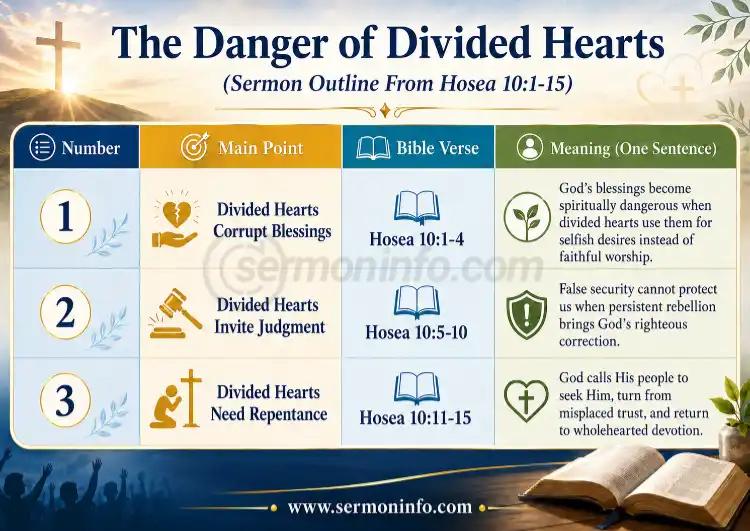
| Sermon Outline From Hosea 10:1-15 – Sermon Outlines From Hosea | |||
|---|---|---|---|
| Number | Main Point | Bible Verse | Meaning |
| 1 | Divided Hearts Corrupt Blessings | Hosea 10:1–4 | God’s blessings become spiritually dangerous when divided hearts use them for selfish desires instead of faithful worship. |
| 2 | Divided Hearts Invite Judgment | Hosea 10:5–10 | False security cannot protect us when persistent rebellion brings God’s righteous correction. |
| 3 | Divided Hearts Need Repentance | Hosea 10:11–15 | God calls His people to seek Him, turn from misplaced trust, and return to wholehearted devotion. |
Source Material
William MacDonald, Believer’s Bible Commentary, rev. ed. (Nashville: Thomas Nelson, 1995), 1102
John MacArthur, The MacArthur Bible Commentary (Nashville: Thomas Nelson, 2005), 978-979
John F. Walvoord and Roy B. Zuck, eds., The Bible Knowledge Commentary: Old Testament (Colorado Springs, CO: David C. Cook, 1985), 1400-1402