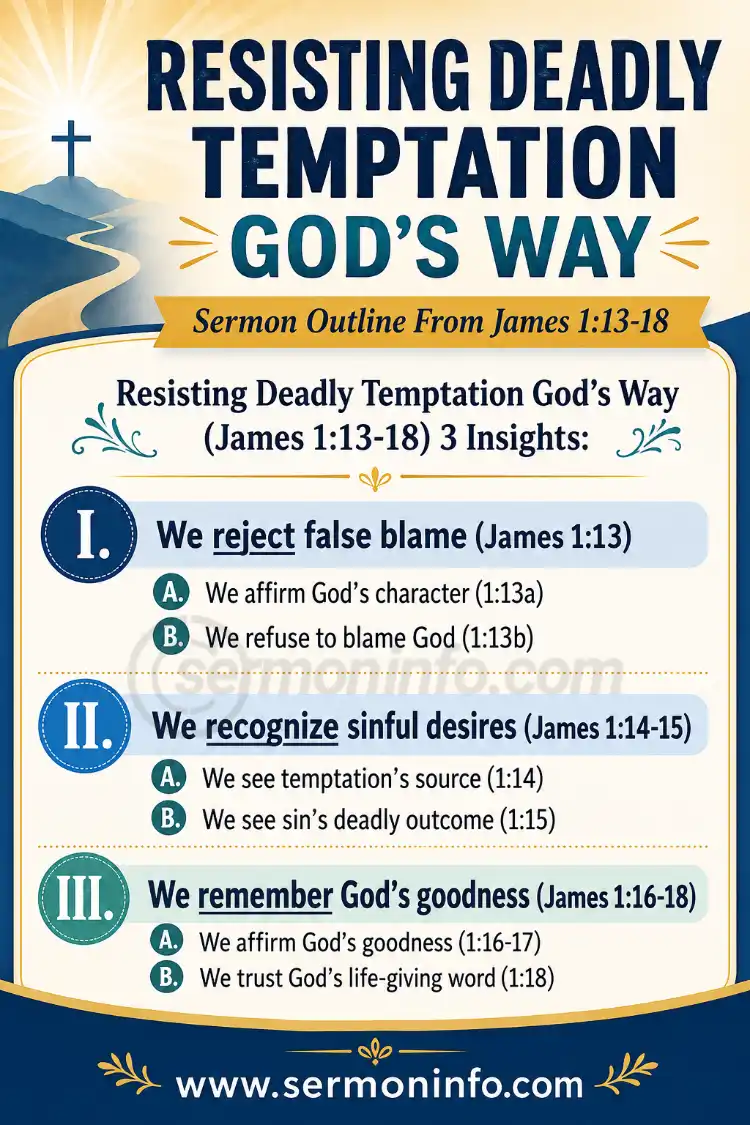
Resisting deadly temptation God’s way (Sermon Outline From James 1:13-18) means rejecting false blame, recognizing sinful desires, and remembering God’s goodness provides a way of escape (1 Corinthians 10:13). Believers resist sin by accepting personal responsibility, trusting God’s unchanging character, and obeying His life giving Word (1 Corinthians 10:13).

Key Takeaways – Sermon From James 1:13-18
- We reject false blame. God never tempts anyone, so accept responsibility and seek His strength when temptation comes.
- We recognize sinful desires. Temptation grows when unchecked desires draw us from God, produce sin, and lead toward death.
- We remember God’s goodness. Trust God’s unchanging character and obey His life giving Word, which guides believers toward holiness.
Sermon Outline From James 1:13-18
Temptation touches every life, regardless of age, maturity, or experience. Yet we often misunderstand where temptation begins and how we should resist and overcome it. James exposes its inward source and deadly direction. He also directs us toward God’s unchanging goodness. We must understand both the danger and God’s solution.
Today, we will learn how to resist deadly temptation God’s way. First, we must reject false blame. Next, we must recognize the sinful desires within us. Finally, we must remember God’s goodness and trust His life giving Word to help us resist and overcome temptation. This passage moves us from excuses toward responsibility, truth, and confident faith in God.
1. We Reject False Blame (James 1:13)
“Let no one say when he is tempted, ‘I am tempted by God’; for God cannot be tempted by evil, nor does He Himself tempt anyone” (James 1:13).
A. We Affirm God’s Character (James 1:13a)
James begins by correcting a dangerous misunderstanding. Some believers faced severe trials and wrongly concluded that God tempted them to sin. James firmly rejects that idea. God remains perfectly holy, and evil never attracts or influences Him. His pure nature makes temptation impossible because He cannot desire anything contrary to His own righteous character.
This truth gives us confidence during difficult seasons. God may allow trials to strengthen our faith, but He never entices us to sin. First John 1:5 declares, “God is light and in Him is no darkness at all.” When temptation comes, we should look to our faithful Father for wisdom and strength instead of questioning His goodness.
B. We Refuse to Blame God (James 1:13b)
James also reminds us to accept personal responsibility for our choices. Temptation does not originate with God because He never tempts anyone with evil. Our sinful nature provides the doorway that temptation enters. Therefore, blaming God only hides the real problem and prevents genuine spiritual growth.
Consider Adam in the Garden of Eden. He blamed both Eve and God after his sin, yet God held Adam accountable for his disobedience (Genesis 3:12, 17). We can make the same mistake today when we blame our circumstances instead of confessing our sin. God invites us to seek His forgiveness, depend on His grace, and walk in obedience through the power of His Word. (Source Material: William MacDonald, Believer’s Bible Commentary, pp. 2220-2222)
This material provides some ideas and thoughts for a sermon outline from James 1:13-18 (Resisting Deadly Temptation God’s Way).
2. We Recognize Sinful Desires (James 1:14–15)
“But each one is tempted when he is drawn away by his own desires and enticed. Then, when desire has conceived, it gives birth to sin; and sin, when it is full-grown, brings forth death (James 1:14-15).
A. We See Temptation’s Source (James 1:14)
James traces temptation to the sinful desires within us. These desires draw us away from God’s will and entice us with false promises. Like bait hiding a hook, temptation offers pleasure while concealing pain. It grows stronger when we entertain desires that oppose God’s truth.
Therefore, we must guard our hearts before desire controls our choices. Proverbs 4:23 says, “Keep your heart with all diligence.” We should identify sinful thoughts early, reject them through Scripture, and seek God’s strength. The Lord always provides a faithful way to resist and overcome temptation (1 Corinthians 10:13).
B. We See Sin’s Deadly Outcome (James 1:15)
James describes sin’s growth with the picture of conception and birth. Sinful desire conceives when we willingly embrace it. That desire then gives birth to sinful actions. When sin reaches maturity, it produces destruction, broken relationships, deep sorrow, and death.
Sin often begins quietly, but it never remains small. A hidden spark can become a consuming fire. Romans 6:23 warns, “The wages of sin is death.” Therefore, we should confess sin quickly, turn from it sincerely, and trust Christ’s cleansing grace (1 John 1:9). (Source Material: John MacArthur, The MacArthur Bible Commentary, pp. 1883-1884)
3. We Remember God’s Goodness (James 1:16–18)
“Do not be deceived, my beloved brethren. Every good gift and every perfect gift is from above, and comes down from the Father of lights, with whom there is no variation or shadow of turning. Of His own will He brought us forth by the word of truth, that we might be a kind of firstfruits of His creatures” (James 1:16-18).
A. We Affirm God’s Goodness (James 1:16–17)
James warns believers not to let temptation deceive them about God’s character. Every good and perfect gift comes from above. God gives what strengthens, guides, and blesses His children. He never changes like shifting shadows. His holiness, love, and faithfulness remain constant through every season.
This truth steadies us when trials feel overwhelming and temptation promises quick relief. God never withholds anything truly good from His people. Psalm 84:11 declares, “No good thing will He withhold.” Therefore, we can trust His timing, reject sin’s false promises, and thank Him for His faithful care.
B. We Trust God’s Life Giving Word (James 1:18)
James explains that God brought believers forth through the word of truth. The gospel announces Christ’s death and resurrection, and the Spirit uses that message to give life. God saves us according to His gracious will, not through human effort or personal merit.
God also sets believers apart as “a kind of firstfruits of His creatures.” We belong to Him and represent His saving work. His Word gave us life, and His Word now shapes our lives. Therefore, we should receive Scripture gladly, obey it faithfully, and display Christ’s character daily. God in His goodness always provides a faithful way to resist and overcome temptation (1 Corinthians 10:13). (Source Material: John F. Walvoord and Roy B. Zuck, The Bible Knowledge Commentary: New Testament, p. 822)
Conclusion
We resist deadly temptation by rejecting false blame, recognizing sinful desires, and remembering God’s goodness. God never tempts us to sin. Our desires can draw us away, and unchecked sin brings death. Yet every good gift comes from our faithful Father, whose character never changes.
Therefore, we must receive God’s Word with humble hearts and obey it each day. Scripture exposes false excuses, reveals hidden desires, and reminds us of God’s truth (1 Corinthians 10:13). When temptation comes, let us reject sin’s lies, trust God’s goodness, and follow His Word with confident faith (James 4:7).
Closing Prayer
Heavenly Father, thank You for Your perfect goodness and unchanging love. Thank You for reminding us that You never tempt us to sin. Help us recognize sinful desires before they grow, and give us wisdom to reject every temptation that draws us away from You. Strengthen us through Your Holy Spirit to walk in holiness each day.
Lord, fill our hearts with a deeper love for Your Word. Let its truth guide our thoughts, guard our choices, and shape our lives. When temptation comes, help us trust Your promises instead of sin’s empty lies. May our lives honor Jesus Christ and reflect Your grace until He returns. In His precious name we pray. Amen.
Frequently Asked Questions (FAQ)
Q: Does God tempt us to sin?
A: God never tempts anyone to sin because evil cannot attract His holy nature. James places responsibility within us, where sinful desires draw and entice us. God may test faith through trials, but He never urges His children to disobey His revealed will.
Q: What is the source of temptation?
A: James teaches that temptation gains influence through our own sinful desires. Those desires attract us with false promises and pull us away from obedience. Temptation becomes sin when we welcome its appeal, dwell upon it, and choose what opposes God’s revealed will.
Q: What does “sin brings forth death” mean?
A: James describes a deadly progression: desire conceives, gives birth to sin, and mature sin produces death. Sin damages fellowship, enslaves the heart, spreads sorrow, and brings destructive consequences. Therefore, believers should confront sinful desire early and seek God’s cleansing grace.
Q: How can Christians resist temptation?
A: Believers resist temptation by accepting responsibility, guarding their desires, and remembering God’s goodness. Scripture exposes deception and renews the mind. God provides strength and a way to endure, so Christians can reject sin, flee dangerous situations, and choose faithful obedience.
Q: What is the “word of truth” in James 1:18?
A: The “word of truth” refers to the gospel message God uses to give believers spiritual life. Through faith in Christ, God brings sinners into His family and sets them apart as firstfruits. His Word then guides their growth, obedience, worship, and witness.
BONUS: Why is temptation so difficult to resist?
Temptation feels difficult because it appeals to desires already present within us. James 1:14 says our desires draw and entice us. Temptation promises quick pleasure, hides future pain, and often meets us when we feel tired, lonely, angry, or discouraged.
Our sinful nature, the world, and the devil all increase the pressure. Jesus warned, “The spirit indeed is willing, but the flesh is weak” (Matthew 26:41). Therefore, we must watch, pray, use Scripture, and seek God’s promised way of escape (1 Corinthians 10:13).
BONUS: When does temptation become sinful?
Temptation becomes sinful when we welcome its appeal, dwell upon it, and choose what opposes God’s will. Jesus faced temptation yet remained without sin (Hebrews 4:15). Therefore, the first pull of temptation does not make us guilty.
James 1:14–15 shows the turning point. Sinful desire “conceives” when we consent to it, and it then produces sinful action. We should reject tempting thoughts quickly, replace them with Scripture, and obey God before desire gains control.
BONUS: How does the devil use temptation?
The devil uses temptation by disguising sin, questioning God’s Word, and promising satisfaction apart from God. He followed this pattern with Eve (Genesis 3:1–6) and Jesus (Matthew 4:1–11). Satan cannot force us to sin, but he exploits sinful desires and presents attractive opportunities (James 1:14).
Therefore, believers must recognize his lies, resist him, and submit to God (James 4:7). Scripture exposes deception, prayer strengthens our hearts, and obedience closes dangerous doors. First Peter 5:8–9 calls us to remain watchful and steadfast in faith, trusting Christ for victory.
BONUS: What is the root cause of temptation?
Temptation takes root in our own sinful desires, not in God. James 1:14 says each person faces temptation when desire draws and entices them. The heart begins to crave something outside God’s will, and that desire offers pleasure while hiding the cost.
Therefore, we must guard our hearts and confront sinful desires early. Jesus said evil thoughts and actions come from within the human heart (Mark 7:21–23). God’s Word exposes those desires, and His Spirit strengthens us to reject them before they produce sin (James 1:15).
BONUS: What are the three ways to overcome temptation?
First, reject false blame because God never tempts anyone (James 1:13). Second, recognize sinful desires before they grow into sinful actions (James 1:14–15). Honest confession exposes temptation’s true source and helps us seek God’s strength instead of making excuses.
Third, remember God’s goodness and trust His life giving Word (James 1:16–18). God gives every good gift, renews our minds, and provides a way to endure temptation (1 Corinthians 10:13). Therefore, resist sin early, obey Scripture, and walk closely with Christ each day.
BONUS: What are the steps in temptation?
Temptation begins when sinful desire draws us away from God’s will. It then entices us by promising pleasure while hiding pain. When we entertain the desire, we move closer to sinful consent. James 1:14 compares temptation to bait that attracts its target.
Next, desire conceives and produces sinful action. Repeated sin grows, matures, and brings sorrow, destruction, and death (James 1:15). Therefore, we must reject temptation early, guard our hearts, and obey God’s Word. First Corinthians 10:13 assures us that God provides strength to endure.
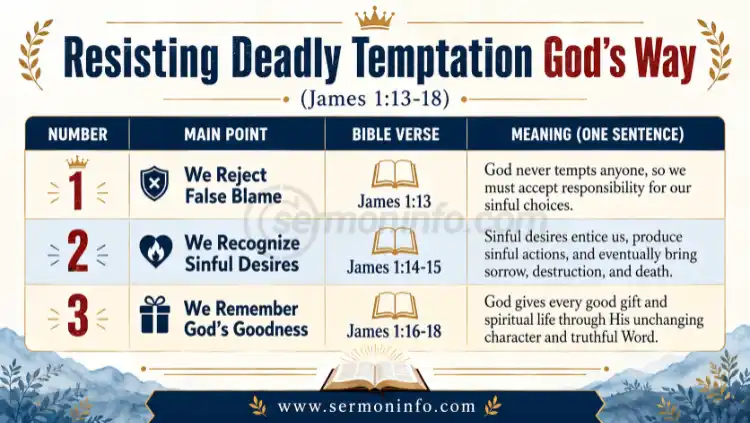
| Sermon Outline From James 1:13-18 – Sermon Outlines That Work | |||
|---|---|---|---|
| Number | Main Point | Bible Verse | Meaning |
| 1 | We Reject False Blame | James 1:13 | God never tempts anyone, so we must accept responsibility for our sinful choices. |
| 2 | We Recognize Sinful Desires | James 1:14–15 | Sinful desires entice us, produce sinful actions, and eventually bring sorrow, destruction, and death. |
| 3 | We Remember God’s Goodness | James 1:16–18 | God gives every good gift and spiritual life through His unchanging character and truthful Word. |
Source Material
William MacDonald, Believer’s Bible Commentary, rev. ed. (Nashville: Thomas Nelson, 1995), 2220-2222
John MacArthur, The MacArthur Bible Commentary (Nashville: Thomas Nelson, 2005), 1883-1884
John F. Walvoord and Roy B. Zuck, eds., The Bible Knowledge Commentary: New Testament (Colorado Springs, CO: David C. Cook, 1985), 822