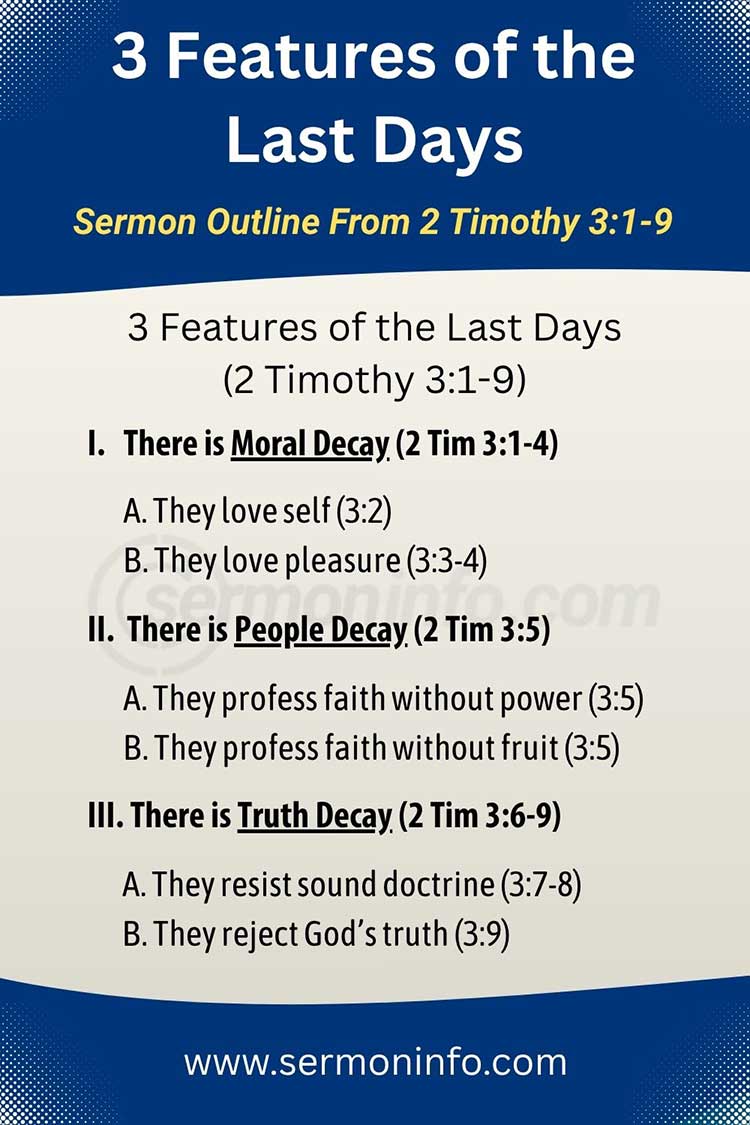
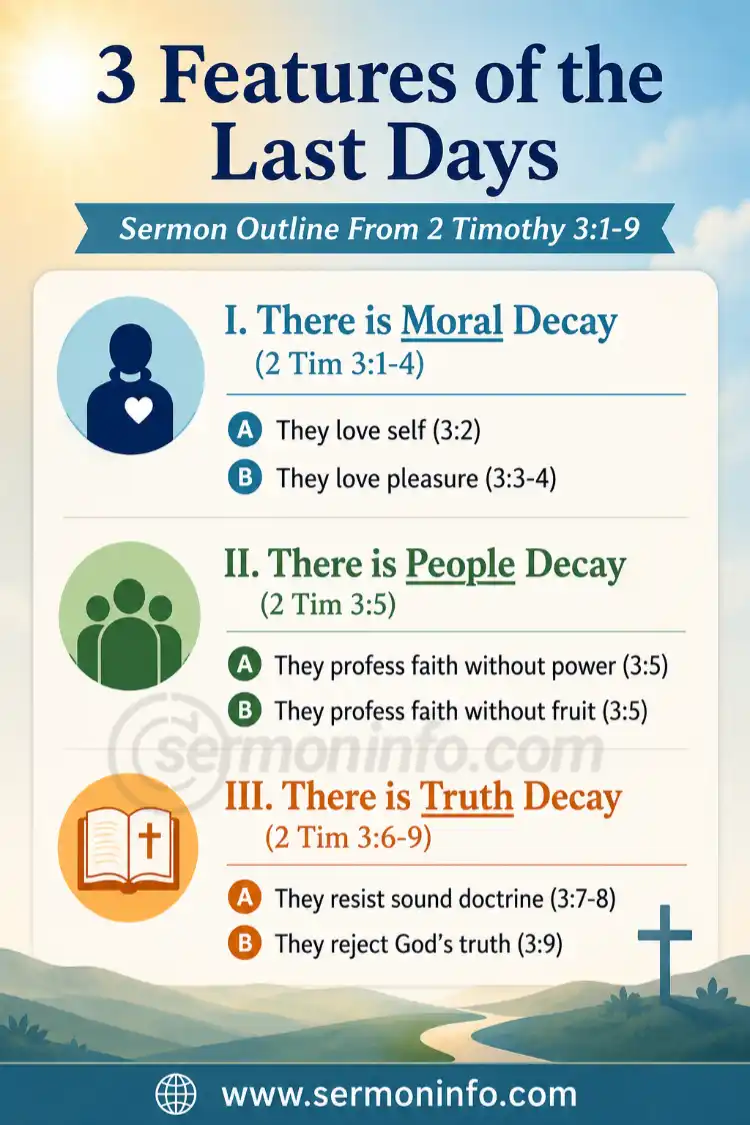
The “3 Features of the Last Days” explain how sin affects life in three areas. Morally, people love self and pleasure. Spiritually, they profess faith without real change. Doctrinally, they reject truth. This passage teaches believers to discern the times and stay rooted in sound biblical teaching (Sermon Outline From 2 Timothy 3:1-9).

Key Takeaways – 3 Features of the Last Days
- We need to recognize the signs of the last days. Scripture shows moral decay, empty faith, and rejection of truth (2 Timothy 3:1–9), so stay alert and grounded in God’s Word.
- We need to pursue genuine faith and spiritual growth. Do not settle for outward religion; seek the Holy Spirit’s transforming power and produce fruit that reflects a changed life (Galatians 5:22–23).
- We need to stand firm in God’s truth daily. Resist false teaching, obey Scripture, and trust Christ as your Savior and Lord, knowing His truth will always prevail (John 8:32).
3 Features of the Last Days
The Bible reminds us that we live in perilous times, and we feel it more each day. We see confusion grow, truth questioned, and sin celebrated. As believers, we sense the pressure around us. Paul warned that “perilous times will come” (2 Timothy 3:1 NKJV). This moment should not surprise us, but it should awaken us to stay true to God.
This message will guide us through 2 Timothy 3:1–9 and reveal three clear features of the last days. We will see moral decay, people decay, and truth decay. Each truth will help us understand our times and strengthen our walk. As we open God’s Word, He will steady our hearts and lead us forward with confidence.
1. There is Moral Decay (2 Timothy 3:1–4)
This passage reveals that the last days will be marked by widespread sin as people turn from God and pursue selfish and ungodly desires (Summary Statement).
A. They love self (3:2)
Paul begins with the root sin of the last days. People place themselves above God and others. They pursue their own desires and ignore God’s authority. This selfish focus produces pride, disobedience, and broken relationships. Scripture warns that “all seek their own, not the things which are of Christ Jesus” (Philippians 2:21 NKJV).
This truth speaks to our daily lives. We see it in a culture that celebrates self first and truth last. Yet Jesus calls us to deny ourselves and follow Him (Luke 9:23). When we put Christ first, He reshapes our hearts. He teaches us to love God and serve others with humility.
B. They love pleasure (3:3–4)
Paul also shows that people will choose pleasure over God. They chase sinful enjoyment and ignore eternal truth. Their hearts crave what feels good instead of what is right. He says they are “lovers of pleasure rather than lovers of God” (2 Timothy 3:4 NKJV). This reveals a deep spiritual problem.
This challenge confronts us today. Many choose comfort, entertainment, and indulgence instead of obedience. Yet God calls us to a higher path. Hebrews 11:25 reminds us that sin offers pleasure for a season, but it never satisfies. True joy comes when we walk with God and treasure His truth above all.
This material provides some ideas and thoughts for a sermon outline from 2 Timothy 3:1-9 (3 Features of the Last Days).
2. There is People Decay (2 Timothy 3:5)
This verse teaches that many will appear religious outwardly while lacking genuine spiritual life and transformation (Summary Statement).
A. They profess faith without power (3:5)
Paul describes people who hold a form of godliness but deny its power. They speak religious words and follow outward practices, yet they resist the Spirit’s work. The Holy Spirit changes hearts and produces new life (2 Corinthians 5:17). When that power is rejected, faith becomes empty and lifeless.
This truth calls us to examine our own walk. It is easy to speak about God yet avoid surrender. Real faith invites the Spirit to rule our lives. Romans 8:11 reminds us that God’s power lives in believers. When He works within us, He transforms our thoughts, desires, and daily choices.
B. They profess faith without fruit (3:5)
Paul also reveals lives that show no evidence of true faith. These people claim to know God, yet their actions contradict their words. Jesus said we know a tree by its fruit (Matthew 7:16). Genuine salvation produces visible change, not perfection, but a growing pattern of righteousness.
This speaks clearly to our generation. Many claim faith, yet their lives show no spiritual growth. Galatians 5:22–23 describes the fruit of the Spirit as love, joy, and peace. When Christ saves us, He produces this fruit within us. A fruitful life points others to the reality of God’s work.
Biblical Preaching by Haddon W Robinson
3. There is Truth Decay (2 Timothy 3:6–9)
This section warns that truth will be rejected as people embrace deception and oppose God’s revealed Word (Summary Statement).
A. They resist sound doctrine (3:7–8)
Paul describes people who always learn but never come to the knowledge of the truth. They hear Scripture, yet they refuse to accept it. Like Jannes and Jambres opposed Moses, they resist God’s message (Exodus 7:11). This reveals hearts that reject authority and refuse to submit to God’s Word.
This speaks to our day. Many listen to sermons and read Scripture, yet they refuse to obey. James 1:22 says, “be doers of the word.” Truth must move from the mind to the heart. When we receive God’s Word with humility, it changes our lives and anchors our faith.
B. They reject God’s truth (3:9)
Paul shows that some move beyond resistance to open rejection. They oppose truth and promote error, yet their progress will not last. God promises their folly will be revealed to all (2 Timothy 3:9). Just as false magicians failed before Moses, error cannot stand against God’s truth.
This encourages us in difficult times. False teaching may spread, but God remains in control. Jesus said, “You shall know the truth, and the truth shall make you free” (John 8:32). We must hold fast to Scripture. God will expose error and uphold His truth in His perfect time.
Conclusion
As we close, remember the clear warning from 2 Timothy 3:1–9. We saw moral decay as people love self and pleasure; and we saw people decay as many profess faith without power or fruit. We also saw truth decay as some resist sound doctrine and reject God’s truth. These marks reveal the last days and call us to stay alert.
Now the call comes to us. We must stand firm, love truth, and walk with God each day. Do not follow the crowd. Turn your heart fully to Christ. Acknowledge your sin, believe in His finished work, confess Him as Lord, and dedicate your life to Him. Trust Him today as your personal Savior and Lord.
Closing Prayer
Heavenly Father, we thank You for Your Word that speaks truth in these perilous times. You have shown us the dangers of moral decay, people decay, and truth decay. Guard our hearts from these patterns. Help us love You above self and pleasure. Fill us with Your Spirit so our lives reflect true faith and righteous fruit.
Lord Jesus, draw us closer to You each day. Strengthen us to stand firm in truth and walk in obedience. We confess our need for You and trust in Your finished work on the cross. Lead us to live for Your glory. Help us point others to You as Savior and Lord. We pray in Jesus’ Name. Amen.
Frequently Asked Questions (FAQ)
Q: What are the signs of the last days according to 2 Timothy 3?
A: 2 Timothy 3:1–9 identifies clear signs of the last days: moral decay, empty religion, and rejection of truth. People love self and pleasure, claim faith without change, and resist sound doctrine. These signs reveal a growing departure from God and His Word.
Q: What does “perilous times” mean in 2 Timothy 3:1?
A: “Perilous times” refers to spiritually dangerous seasons marked by intense sin, deception, and opposition to truth. It describes conditions that threaten faith and godly living. Paul warns believers to expect these realities and remain strong in Christ during such challenging days.
Q: How can believers stay faithful in the last days?
A: Believers stay faithful by grounding their lives in Scripture, obeying God’s Word, and relying on the Holy Spirit. Daily prayer, sound doctrine, and godly fellowship strengthen faith. 2 Timothy 3:14–17 urges believers to continue in the truth they have learned and trusted.
Q: What does it mean to have a form of godliness but deny its power?
A: It means a person appears religious outwardly but lacks true spiritual transformation. They follow rituals or traditions but reject the Holy Spirit’s work within. Genuine faith produces change, while empty religion remains external and powerless to transform the heart and life.
Q: Why do people reject truth in the last days?
A: People reject truth because sin hardens their hearts and draws them toward deception. They prefer ideas that match their desires rather than God’s Word. 2 Timothy 3 shows that rejecting truth leads to error, but God will ultimately expose falsehood and uphold His truth.
BONUS: How does 2 Timothy 3:1–9 describe human behavior in the last days?
2 Timothy 3:1–4 describes human behavior in the last days as deeply self-centered and sinful. People love themselves, money, and pleasure more than God. They become proud, disobedient, and unloving. Paul shows that sin controls their actions. This passage reveals hearts turned from God and driven by selfish desires.
2 Timothy 3:5–9 shows that many will appear religious but lack true faith. They hold a form of godliness but deny its power. They resist truth and follow deception. Like Jannes and Jambres opposed Moses, they reject God’s Word. Yet God promises to expose their error and uphold His truth (3:9).
BONUS: What examples of sin are listed in 2 Timothy 3:2–4?
2 Timothy 3:2–4 lists clear examples of sin that mark the last days. People become lovers of self, lovers of money, boastful, proud, and blasphemers. They disobey parents, show ingratitude, and live without holiness. Paul shows that these sins flow from hearts that reject God and exalt self above Him.
The passage continues with unloving, unforgiving, and slanderous behavior. People lack self control, act brutally, and despise what is good. They become traitors, headstrong, and haughty. Paul concludes that they love pleasure rather than God (3:4). These sins reveal lives driven by desire instead of obedience to God’s truth.
BONUS: How does Paul describe false teachers in 2 Timothy 3:6–7?
Paul describes false teachers as those who secretly enter homes and deceive vulnerable people. They target those weighed down with sin and led by various desires (2 Timothy 3:6 NKJV). These teachers do not guide others to truth. Instead, they manipulate emotions and exploit spiritual weakness for their own influence.
He also says they are “always learning and never able to come to the knowledge of the truth” (3:7 NKJV). They hear truth but refuse to accept it. This shows a restless mind without submission to God. True teaching leads to truth, but false teaching keeps people trapped in confusion.
BONUS: What can we learn from Jannes and Jambres in 2 Timothy 3:8?
Paul uses Jannes and Jambres as examples of those who oppose God’s truth. These men resisted Moses in Egypt by imitating miracles (Exodus 7:11). Paul says they are “men of corrupt minds, disapproved concerning the faith” (2 Timothy 3:8 NKJV). They show how false teachers actively oppose truth while appearing powerful.
We learn that error may look convincing for a time, but it cannot stand against God. Paul says their folly will be revealed (2 Timothy 3:9). This encourages us to trust God’s truth and remain faithful. When we stand on Scripture, God exposes deception and strengthens our confidence in Him.
BONUS: How does 2 Timothy 3 connect to end-times prophecy in the Bible?
2 Timothy 3 connects to end times prophecy by describing conditions that match other prophetic passages. Paul says perilous times will come (3:1). Jesus spoke of similar conditions in Matthew 24:12, where lawlessness increases and love grows cold. Both passages show moral decline and spiritual darkness before Christ’s return.
This chapter also aligns with warnings about deception in the last days. Paul describes people who resist truth and follow error (2 Timothy 3:7–8). Jesus warned that false teachers would arise and deceive many (Matthew 24:11). These connections remind us to stay alert, grounded in Scripture, and ready for Christ’s coming.
BONUS: What practical steps can Christians take to discern false teaching today?
Christians discern false teaching by testing everything against Scripture. God’s Word is the final authority (2 Timothy 3:16–17 NKJV). Believers must read, study, and know the Bible well. Like the Bereans, they should examine teachings daily (Acts 17:11). Truth protects the heart from deception and guides wise decisions.
Christians also rely on the Holy Spirit and pursue obedient lives. Jesus said the Spirit guides us into all truth (John 16:13). Believers must reject error and hold fast to sound doctrine (Titus 1:9). As they walk closely with Christ, He sharpens their discernment and strengthens their faith.
BONUS: When did the “Last Days” begin?
The “last days” began with the first coming of Jesus Christ. Scripture shows that God has spoken “in these last days by His Son” (Hebrews 1:2 NKJV). Peter also declared at Pentecost, “this is what was spoken by the prophet Joel” about the last days (Acts 2:16–17). These passages place the beginning in the early church era.
The last days continue through the present age and will culminate in Christ’s return. Paul warned Timothy that perilous times would come (2 Timothy 3:1). This shows an ongoing period marked by increasing sin and deception. Believers live in these days now and must remain faithful while awaiting the Lord’s coming.
BONUS: Which Bible verses refer to the last days in the New Testament?
The New Testament clearly speaks about the last days in several passages. Hebrews 1:2 says God has spoken “in these last days” through His Son. Acts 2:17 quotes Joel, declaring the last days began with Christ’s coming. These verses show that the last days started in the early church era.
Other passages describe the character of these days. 2 Timothy 3:1 warns of perilous times marked by sin and deception. 2 Peter 3:3 speaks of scoffers walking in their own desires. James 5:3 mentions the last days in connection with judgment. These verses call believers to remain faithful and watchful.
BONUS: What’s the relationship between 2 Timothy 3:1 and 1 John 2:18?
2 Timothy 3:1 warns that perilous times will come in the last days, marked by sin and spiritual danger. 1 John 2:18 confirms this reality by declaring, “it is the last hour,” and noting the presence of many antichrists. Together, these verses show that the last days include both moral decline and rising opposition to Christ.
This relationship helps us understand the times we live in. The presence of false teachers and antichrist figures reveals that the last days are already active. 1 John 2:18 calls believers to stay alert. We must hold to truth, remain grounded in Scripture, and stay faithful to Christ.
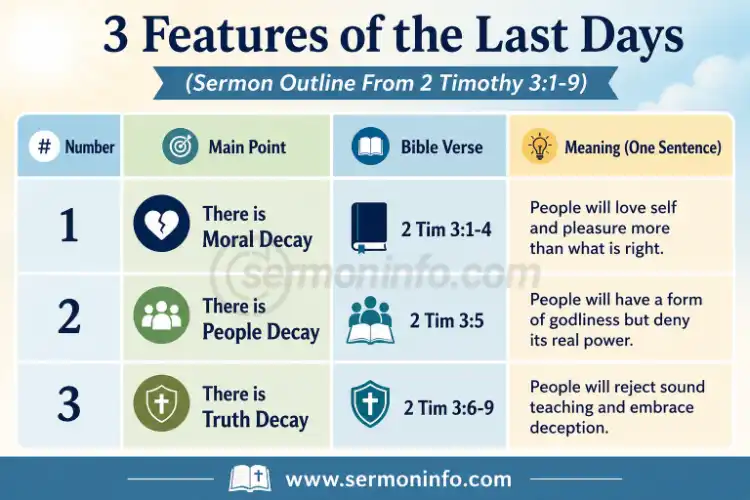
| Sermon Outline From 2 Timothy 3:1-9 – Free Topical Sermon Outlines | |||
|---|---|---|---|
| Number | Main Point | Bible Verse | Meaning |
| 1 | There is Moral Decay | 2 Timothy 3:1–4 | People turn from God and pursue selfish desires, choosing sin and pleasure over obedience to Him. |
| 2 | There is People Decay | 2 Timothy 3:5 | People maintain an outward form of faith but lack true spiritual power and transformation in their lives. |
| 3 | There is Truth Decay | 2 Timothy 3:6–9 | People resist and reject God’s truth, following deception until God exposes their error. |