A powerful Sermon Outline From 2 Timothy 3:1-9 on the last days, revealing how to live faithfully amid perilous times.

Key Takeaways – 3 Characteristics of the Last Days
- The Bible warns of moral decay in the last days, where people love themselves and pleasure more than God.
- Paul highlights people decay, showing outward religion without inward transformation or fruit of the Spirit.
- Truth is under attack through truth decay, where deception spreads easily and knowledge increases without true wisdom.
- These warnings remind believers to stand firm in Christ, live holy lives, and anchor their faith in God’s Word.
- The last days are not meant to bring fear but to prepare us for faithfulness, discernment, and bold witness.
Sermon Outline From 2 Timothy 3:1-9
We live in a time that feels darker by the day. News headlines remind us of violence, confusion, and shifting morality. Yet the Bible reminds us that none of this should surprise us—Paul told Timothy perilous days would come.
Imagine standing on a road covered in fog. You cannot see clearly ahead, and danger hides just around the bend. That’s how these last days look: uncertainty, deception, and temptation pressing in on every side.
But here’s the good news: God has not left us blind. He gave us His Word to describe what these days look like and how His people should stand strong. Today, let’s look together at three clear characteristics of the last days.
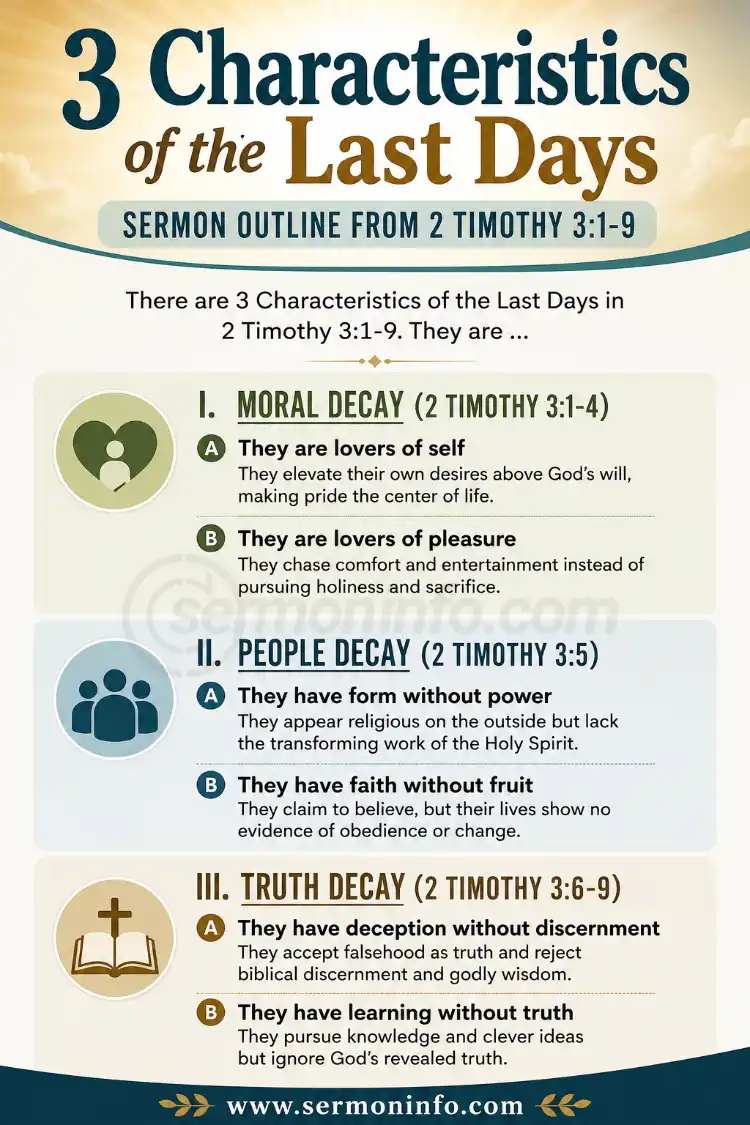
1. Moral Decay (2 Tim 3:1-4)
“But know this, that in the last days perilous times will come: For men will be lovers of themselves, lovers of money, boasters, proud, blasphemers, disobedient to parents, unthankful, unholy, unloving, unforgiving, slanderers, without self-control, brutal, despisers of good, traitors, headstrong, haughty, lovers of pleasure rather than lovers of God.” (2 Timothy 3:1-4)
A. They are lovers of self
When people put themselves first, God always ends up second. Pride becomes the throne of the heart, and selfish ambition directs every decision. Paul warned that such self-centeredness would mark the last days. We see it today in the constant push to “do what feels right” instead of following God’s Word (Philippians 2:3-4).
Think about the Pharisee in Luke 18 who prayed, not to glorify God, but to exalt himself. That same spirit thrives in our culture. When life is lived with self at the center, Christ gets pushed aside. True joy comes not from serving self but from surrendering fully to Christ and serving others.
B. They are lovers of pleasure
The world says, “You deserve happiness,” but Scripture says, “Be holy, for I am holy” (1 Peter 1:16). Pleasure in itself is not sinful, but when pleasure takes God’s place, it becomes idolatry. In the last days, people chase comfort and entertainment while ignoring the narrow road of sacrifice and obedience.
Consider Esau, who traded his birthright for a single meal (Genesis 25:34). He valued temporary satisfaction over eternal blessing. That same spirit surrounds us—people craving the quick thrill, the next escape, instead of eternal treasures. Beloved, pleasure fades, but holiness brings lasting joy. Christ calls us to choose the eternal over the temporary.
To All My Students: This material provides some ideas and thoughts for a message from 2 Timothy 3:1-9 (3 Characteristics of the Last Days).
2. People Decay (2 Tim 3:5)
“Having a form of godliness but denying its power. And from such people turn away!” (2 Timothy 3:5)
A. They have form without power
Paul described people who have “a form of godliness, but deny its power.” Outwardly religious, inwardly empty. It is possible to attend church, sing hymns, and know all the right words, yet miss the transforming work of the Spirit. Ritual without relationship leaves us powerless against sin and compromise.
Think of Samson. God had gifted him with great strength, but when he traded obedience for sin, he was left powerless (Judges 16:20). Religion without the Spirit is the same—it looks strong but cannot stand. God calls us not just to look religious but to walk in the power of Christ daily.
B. They have faith without fruit
Faith that never changes behavior is not real faith. James reminds us that “faith without works is dead” (James 2:17). People decay when they claim Christianity but show no evidence of obedience. They may say the right words, but their lives tell another story.
Jesus cursed the fig tree because it had leaves but no fruit (Mark 11:13-14). It looked alive but was empty inside. The same danger threatens believers who talk of faith but never bear fruit. God wants living faith—faith that produces love, obedience, and visible Christlike character in daily life.
3. Truth Decay (2 Tim 3:6-9)
“For of this sort are those who creep into households and make captives of gullible women loaded down with sins, led away by various lusts, always learning and never able to come to the knowledge of the truth. Now as Jannes and Jambres resisted Moses, so do these also resist the truth: men of corrupt minds, disapproved concerning the faith; but they will progress no further, for their folly will be manifest to all, as theirs also was.” (2 Timothy 3:6-9)
A. They have deception without discernment
Paul warned of false teachers who creep into homes and capture the vulnerable. When truth is abandoned, deception always fills the gap. Without strong biblical grounding, people fall for smooth words and empty promises. Discernment comes only when we anchor our hearts in God’s Word and test everything by Scripture.
Think of Eve in the garden. Satan twisted God’s Word, and without discernment she believed the lie (Genesis 3:1-6). That same strategy works today. People believe half-truths because they do not know the whole truth. We must cling to the Word, for it alone equips us to recognize and resist deception.
B. They have learning without truth
Paul said people are “always learning but never able to come to the knowledge of the truth.” Knowledge increases, but wisdom decreases. Our world boasts of education, yet rejects the Author of truth. Without Christ, the more they learn, the further they drift.
Think of the magicians who opposed Moses in Pharaoh’s court (Exodus 7:11-12). They knew much, but their knowledge was powerless against God’s truth. Today, we see universities filled with information yet empty of truth. Beloved, truth is not found in endless theories but in Jesus Christ, who said, “I am the truth” (John 14:6).
Conclusion
Paul’s warning to Timothy is not meant to frighten us but to prepare us. God wants His children ready. These perilous times show us that moral decay, people decay, and truth decay are not future issues—they are present realities.
So what do we do? We fix our hearts on Christ, hold firmly to His Word, and walk daily in Spirit-filled obedience. We refuse to imitate the world’s corruption and instead shine as lights in the darkness.
Remember, though the last days are dangerous, our Lord is victorious. We are not abandoned—we are equipped, empowered, and called. Let us rise as faithful witnesses, living boldly for Christ until He returns.
Frequently Asked Questions (FAQ)
Q: What does the Bible mean by “perilous times” in 2 Timothy 3:1?
A: Perilous times refer to spiritually dangerous times when evil grows stronger, morality declines, and people turn away from God.
Q: How do we see moral decay in today’s world?
A: We see it in the celebration of sin, rejection of God’s standards, and a culture focused on self and temporary pleasure.
Q: What does it mean to have “a form of godliness but denying its power”?
A: It describes people who look religious outwardly but lack the Spirit’s power to truly transform their hearts and lives.
Q: How can Christians guard against truth decay?
A: By studying Scripture faithfully, testing all teachings against God’s Word, and walking in discernment through the Holy Spirit.
Q: Why is 2 Timothy 3:1-9 relevant for believers today?
A: It equips us to recognize the spiritual climate of the last days and encourages us to remain faithful and steadfast in Christ.
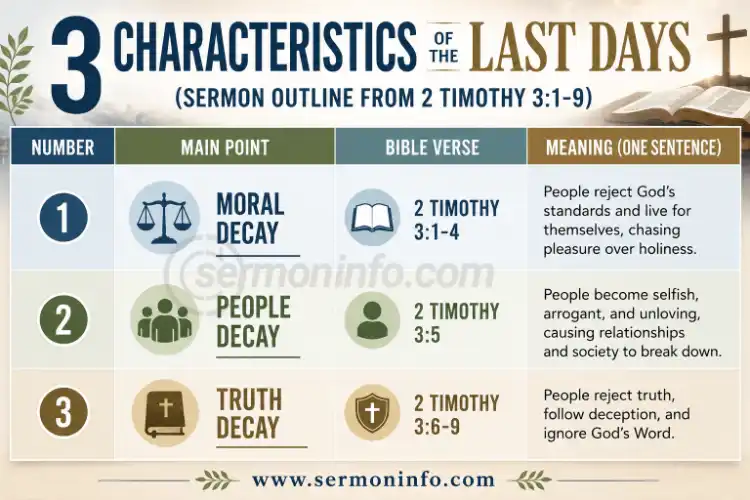
| Sermon Outline From 2 Timothy 3:1-9 – Sermons That Work | |||
|---|---|---|---|
| Number | Main Point | Bible Verse | Meaning |
| 1 | Moral Decay | 2 Timothy 3:1-4 | People love themselves and pleasure more than God, showing pride and selfish pursuits. |
| 2 | People Decay | 2 Timothy 3:5 | Many display outward religion but lack the Spirit’s power and the fruit of true faith. |
| 3 | Truth Decay | 2 Timothy 3:6-9 | False teaching spreads, people lack discernment, and knowledge increases without real truth or wisdom in Christ. |
Source Material
Believer’s Bible Commentary by William MacDonald
The MacArthur Bible Commentary by John MacArthur
Wiersbe Bible Commentaries by Warren Wiersbe