How To Write An Expository Sermon: When I first heard the phrase “expository preaching,” I wasn’t quite sure what that implied. As I studied the characteristics of expository preaching in seminary and began preaching in the ministry, I learned how to write expository sermons.
In its simplest terms, expository sermons teach the Scriptures verse by verse in a sermon outline or preaching outline. Students often ask: how do you do that? I simply explain to them that I am always mindful of the characteristics of an expository sermon and the six steps I use for writing an expository sermon.

How To Write An Expository Sermon
Before I could write an expository sermon, I needed to understand and embrace the main characteristics of an expository sermon.
The expository sermon starts with a passage of Scripture which you interpret in order to discover the meaning of the passage for the original hearers and the meaning and application for hearers today. You take this information in order to form the structure of the expository sermon outline which consists of a series of progressive ideas centered around the main idea of the passage of Scripture.
Therefore, the characteristics of an expository sermon include a portion of Scripture, the original meaning and contemporary application and the preaching outline which consists of the main preaching point, sub-points and incidental points.
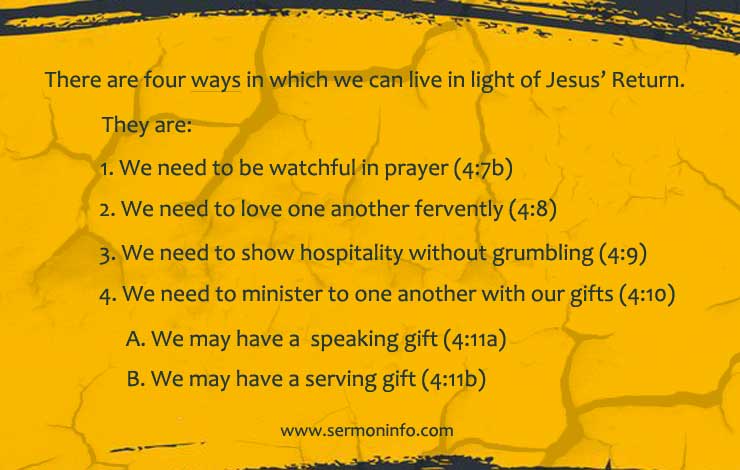
For example in 1 Peter 4:7-11, Peter alerted his hearers to the nearness of Jesus’ return. In light of Jesus’ return, Peter encourages his readers to be watchful and alert in prayer (4:7b), to love one another fervently (4:8), to be hospitable to one another without grumbling (4:9) and to minister to one another with the gifts God had given to them (4:10-11). With this information, you simply need to form a sermon outline, add content, illustrations, applications to the sermon outline, craft an introduction and conclusion and you have an expository sermon (see full sermon outline below).
Let me explain the six steps I take to write an expository sermon!
1. I begin with prayer
Prayer is the best place to start in order to prepare your heart to study God’s word (1 Peter 2:1-2) and to seek clarity and insight into God’s word (Psalm 119:18).
2. I study the passage of Scripture
I preach through books of the Bible and the next sermon is always the next passage of Scripture. I only preach a portion of Scripture that covers one main idea or topic. If the main idea or topic covers a large portion of Scripture, I will divide the material into two sermons.
When I study the passage of Scripture, I sketch a mechanical layout of the passage. I do this because it highlights the thought patterns and their relationships to each other in the passage of Scripture.
In 1 Peter 4:7-11, the mechanical layout highlights the nearness of Jesus’ return (4:7a) and what we must do in light of that, be watchful and alert in prayer (4:7b), be fervent in love for one another (4:8), be hospitable without grumbling (4:9) and minister to one another (4:10) with speaking and serving gifts (4:11). Once I analyze this information, I put my thoughts into a logical structure on paper.
In Ephesians 4:25-32, the mechanical layout highlights godly qualities reflected in our new life in Christ. They include speaking the truth (4:25), resolving anger (4:26-27), working hard (4:28), speaking gracefully (4:29-30) and forgiving others (4:31-32). Again, once I analyze this information, I put my thoughts into a logical structure on paper.
3. I read commentaries
I read commentaries to make sure that I am on the right track and also it helps me to see the way other people interpret the passage.
I usually read about ten different commentaries relating to the passage. These commentaries may also help me with different insights to the passage of Scripture.
At this stage I continue to add insights and information to my notes which I have already penned on paper. All this information becomes the springboard to the expository sermon outline.
4. I craft the expository sermon outline
The sermon outline for me has three parts, the main preaching point, the sub-points and incidental points and the key word or hinge word.
With 1 Peter 4:7-11, I decided that the main preaching point would be: Living in Light of Jesus’ Return. The four sub-points would be: prayer, love, hospitality and ministry. I formed two incidental points under ministry: speaking ministry and serving ministry. The key word or hinge word was “ways.” There are four ways in which we can live in light of Jesus’ return. They involve prayer, love, hospitality and ministry. The key word is a plural noun that swings all the sub-points from the main preaching point (see complete sermon outline below).
With Ephesians 4:25-32, I decided that the main preaching point would be: The Godly Qualities Reflected in Our New Life in Christ. The five sub-points were: we speak the truth, we resolve anger, we work hard, we speak graciously and we forgive other. The key word or hinge word was “qualities.” There are five godly qualities reflected in our new life in Christ. (see the complete sermon outline below).
Introduction:
There are five godly QUALITIES reflected in our New Life in Christ. They are:
1. We speak the truth (4:25)
2. We resolve anger (4:26-27)
3. We work hard (4:28)
4. We speak gracefully (4:29-30)
- We speak to build up each other (4:29)
- We speak to please God (4:30)
5. We forgive each other (4:31-32)
- We lay aside six vices (4:31)
- We embrace three commands (4:32)
Conclusion:
5. I write the expository sermon
I never write the expository sermon until I have crafted and formed the expository sermon outline.
Once I have the expository sermon outline, I add content, illustrations and applications to the outline.
Once I have done that, I write the introduction and then I write the conclusion. The introduction introduces the main preaching point or topic of the expository sermon and the conclusion concludes the sermon with summary and a call to action.
6. I mark-up the expository sermon
Once I finish writing the expository sermon, I spent about an hour or so marking up the sermon for preaching. I usually do this before I preach the expository sermon because it gives me a fresh look at my sermon notes.