The 7 “I AM” Statements of Jesus are seven powerful declarations in John’s Gospel that reveal Jesus’ divine identity, saving mission, and personal relationship with believers. Through these statements, Jesus shows that He alone gives salvation, eternal life, spiritual nourishment, guidance, protection, and lasting fruitfulness to everyone who trusts in Him.
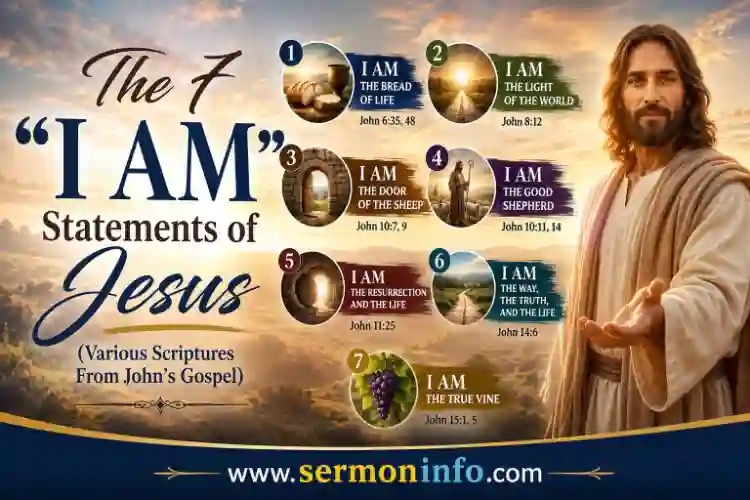
Key Takeaways – The 7 “I AM” Statements of Jesus
- Know who Jesus is. The seven “I AM” statements reveal that Jesus is the eternal Son of God, the promised Messiah, and the only Savior. Trust Him alone for forgiveness, eternal life, and a personal relationship with the Father (John 14:6).
- Depend on Christ every day. Jesus is your Bread of Life, Light, Good Shepherd, and True Vine. Look to Him daily for spiritual strength, wisdom, guidance, protection, and fruitfulness as you walk by faith (John 15:5).
- Respond with faith and obedience. The seven “I AM” statements call every believer to follow Christ wholeheartedly, remain in His Word, and share His gospel with confidence. As you abide in Him, your life will display His truth, love, and glory.
The 7 “I AM” Statements of Jesus
Jesus asked many important questions, but in John’s Gospel He also made seven remarkable declarations about Himself. Each statement begins with the words, “I AM,” reminding us of God’s self revelation in Exodus 3:14. These powerful truths still speak directly to us today. They reveal who Jesus is, why He came, and how He alone meets our deepest spiritual needs through His saving grace.
Today we will discover what each “I AM” statement teaches about Christ’s person and work. We will see that He is the Bread of Life, the Light of the World, the Door, the Good Shepherd, the Resurrection and the Life, the Way, the Truth and the Life, and the True Vine. As we study these truths together, may our faith deepen, our hope grow stronger, and our devotion to Christ become more wholehearted.
1. I Am the Bread of Life (John 6:35, 48)
“And Jesus said to them, “I am the bread of life. He who comes to Me shall never hunger, and he who believes in Me shall never thirst” (John 6:35).
A. Summary Explanation
Jesus declared, “I am the bread of life” to reveal that He alone satisfies our deepest spiritual need. Physical food sustains the body for a time, but Christ gives eternal life to everyone who believes in Him (John 6:35). Only He can fill the empty places of the heart.
Every person searches for lasting joy, peace, and purpose. Many pursue success, possessions, or pleasure, yet remain unsatisfied. Jesus alone gives abundant life that never fades (John 10:10). When we receive Him by faith, He nourishes our souls and strengthens us each day.
B. Historical and Biblical Context
Jesus spoke these words after feeding more than five thousand people with five loaves and two fish (John 6:1-14). The crowd wanted more physical bread, but Jesus directed their attention to a greater gift. He revealed Himself as the true bread sent from heaven.
The manna in Moses’ day sustained Israel only for a season (Exodus 16:15). Those who ate it eventually died. Jesus declared that whoever believes in Him receives eternal life (John 6:49-51). He is greater than the manna because He gives life that never ends.
C. Practical Theological Application
Life often leaves us tired, discouraged, and searching for hope. Jesus invites us to come to Him every day because He alone satisfies the soul. As we spend time in His Word and prayer, He renews our strength and directs our steps (Matthew 4:4).
Imagine a traveler finding fresh water after crossing a dry desert. Christ refreshes the weary heart in the same way. Therefore, trust Him daily through every trial. He faithfully supplies the grace, peace, and strength needed for each new day (Philippians 4:19).
This material provides some ideas and thoughts for a message about the 7 “I AM” Statements of Jesus (The 7 “I AM” Statements of Jesus From John’s Gospel).
2. I Am the Light of the World (John 8:12; 9:5; 12:46)
“Then Jesus spoke to them again, saying, ‘I am the light of the world. He who follows Me shall not walk in darkness, but have the light of life'” (John 8:12).
A. Summary Explanation
Jesus declared, “I am the light of the world,” because He alone reveals God’s truth and leads people out of spiritual darkness (John 8:12). He exposes sin, reveals righteousness, and gives eternal life to everyone who believes in Him. No other light can accomplish what Christ does.
Darkness often pictures confusion, fear, and separation from God. Christ shines into every heart that trusts Him. His Word reveals the right path and gives wisdom for daily living (Psalm 119:105). Those who follow Him no longer walk in darkness but enjoy the light of life.
B. Historical and Biblical Context
Jesus spoke these words during the Feast of Tabernacles, when large lamps illuminated the temple courts. Those lights reminded Israel how God guided His people through the wilderness with the pillar of fire (Exodus 13:21). Against that setting, Jesus declared Himself to be God’s true light.
The temple lamps burned only for a short time, but Christ’s light never fades. He came into the world so believers would not remain in darkness (John 12:46). Later, Jesus confirmed this truth by giving sight to the man born blind, displaying both physical and spiritual illumination (John 9:5-7).
C. Practical Theological Application
Our world often promotes ideas that oppose God’s truth. Jesus calls us to follow Him faithfully because His truth guides every decision we make. As we read Scripture and obey His voice, He directs our steps with wisdom and grace (Psalm 119:105).
Picture a lighthouse guiding ships safely through a dark storm. Christ faithfully leads His people through life’s uncertainties in the same way. Therefore, keep your eyes on Him each day. His light brings hope, confidence, and clear direction until we see Him face to face.
3. I Am the Door of the Sheep (John 10:7)
“Then Jesus said to them again, “Most assuredly, I say to you, I am the door of the sheep” (John 10:7).
A. Summary Explanation
Jesus declared, “I am the door of the sheep,” to show that He alone provides secure access to God and His saving grace (John 10:7, 9). No person, religion, or good work can open the way into God’s family. Christ alone welcomes sinners into His care.
A strong door protects those inside from danger and offers safety to everyone who enters. Jesus does even more for His people. He forgives sin, gives eternal life, and provides lasting security for all who trust Him (John 10:28).
B. Historical and Biblical Context
Jesus used the picture of a sheepfold because His listeners understood the work of a shepherd. At night, sheep entered through one opening, and the shepherd guarded that entrance. Jesus declared that He alone is the true doorway through which His sheep safely enter (John 10:7-9).
This illustration also exposed the false shepherds who misled God’s people. Jesus described them as thieves and robbers who sought their own gain (John 10:8). Unlike them, Christ came so His sheep might have life and enjoy His abundant provision (John 10:10).
C. Practical Theological Application
Many voices promise peace, purpose, and salvation, yet only Jesus can truly save. Scripture declares, “Nor is there salvation in any other” (Acts 4:12). Therefore, we place our faith in Christ alone because He is God’s appointed Savior for every believer.
Imagine seeking shelter during a violent storm. One secure doorway offers protection while every other entrance fails. Christ is that secure doorway for every sinner. Trust Him with confidence, and rest in His grace because He faithfully keeps all who come to Him by faith (John 6:37).
4. I Am the Good Shepherd (John 10:11, 14)
“I am the good shepherd. The good shepherd gives His life for the sheep” (John 10:11).
A. Summary Explanation
Jesus declared, “I am the good shepherd,” to reveal His sacrificial love for His people (John 10:11). Unlike every other shepherd, He willingly laid down His life to save His sheep from sin and eternal judgment. His death secured our salvation forever.
A faithful shepherd knows every sheep and cares for each one personally. Jesus knows every believer by name and never forgets His own (John 10:14). His love remains constant through every season, and His care never fails those who trust Him.
B. Historical and Biblical Context
Jesus contrasted Himself with hired men who fled when danger appeared. The hireling protected himself instead of the sheep (John 10:12-13). Jesus fulfilled God’s promise to shepherd His people faithfully, just as Ezekiel foretold (Ezekiel 34:23).
The religious leaders often failed to care for God’s people with truth and compassion. Jesus came as the promised Shepherd who sought the lost, healed the broken, and gathered His flock (Ezekiel 34:11-16). He perfectly fulfilled the Father’s will through His faithful ministry.
C. Practical Theological Application
Life often brings uncertainty, hardship, and difficult decisions. The Good Shepherd never abandons His people during those moments. He guides us by His Word, strengthens us through His Spirit, and surrounds us with His faithful care (Psalm 23:1-4).
Picture a shepherd leading sheep along a rocky mountain path. The sheep safely follow because they trust their shepherd’s voice. Jesus calls us to follow Him with the same confidence (John 10:27). As we obey Him daily, He protects, provides, and leads us safely home.
5. I Am the Resurrection and the Life (John 11:25)
“Jesus said to her, ‘I am the resurrection and the life. He who believes in Me, though he may die, he shall live'” (John 11:25).
A. Summary Explanation
Jesus declared, “I am the resurrection and the life,” to reveal that He alone has power over death (John 11:25). He not only gives physical resurrection but also grants eternal life to everyone who believes in Him. His promise rests on His divine authority and saving work.
Death brings sorrow and reminds us of life’s brokenness. Yet Christ offers hope that reaches beyond the grave. Because He lives, every believer has the assurance of everlasting life (John 14:19). His victory over death removes fear and fills our hearts with confident expectation.
B. Historical and Biblical Context
Jesus spoke these words to Martha before raising her brother Lazarus from the dead (John 11:23 to 25). Martha expected a future resurrection, but Jesus directed her faith toward Himself. He showed that resurrection is not merely an event but is found in His person.
Moments later, Jesus called Lazarus from the tomb, and the dead man came out alive (John 11:43-44). This miracle demonstrated Christ’s divine power over death and pointed forward to His own resurrection. It confirmed that His words were completely true and trustworthy.
C. Practical Theological Application
Every believer faces loss, grief, and the certainty of physical death. Yet we do not live without hope. Christ promises resurrection and eternal life to all who trust Him (1 Thessalonians 4:13-18). His promise gives comfort in sorrow and courage for each new day.
Imagine the sunrise after a long and dark night. The light reminds us that darkness never has the final word. Christ’s resurrection assures us that death does not have the final victory (1 Corinthians 15:54-57). Therefore, we live with confidence as we await His glorious return.
6. I Am the Way, the Truth, and the Life (John 14:6)
“Jesus said to him, ‘I am the way, the truth, and the life. No one comes to the Father except through Me'” (John 14:6).
A. Summary Explanation
Jesus declared, “I am the way, the truth, and the life,” to reveal that He alone brings sinners to God (John 14:6). He is not merely a guide who points the way. He is the only way to the Father through His death and resurrection.
Jesus also perfectly reveals God’s truth because He is God the Son in human flesh (John 1:14). He gives eternal life to everyone who believes in Him (John 3:16). No one else can provide forgiveness, reconciliation, and everlasting life as Christ alone does.
B. Historical and Biblical Context
Jesus spoke these comforting words during the Upper Room discourse before His crucifixion. His disciples felt troubled because He had announced His departure (John 14:1-5). Thomas asked how they could know the way, and Jesus answered by pointing them to Himself.
Jesus assured His followers that He was preparing a place for them in the Father’s house (John 14:2-3). Through His coming death, resurrection, and ascension, He would open the way into God’s presence. His promise gave the disciples lasting hope during a difficult time.
C. Practical Theological Application
Our world offers many beliefs and philosophies that claim to lead to God. Jesus clearly declared that He alone is the way to the Father (John 14:6). Therefore, we place our complete trust in Christ because no other path brings reconciliation with God (2 Corinthians 5:18-19).
Imagine crossing a deep canyon where only one secure bridge reaches the other side. Christ is that bridge for every sinner separated from God by sin. Trust Him with confidence each day. His truth guides your life, and His life gives hope that will never fail.
7. I Am the True Vine (John 15:1)
“I am the true vine, and My Father is the vinedresser” (John 15:1).
A. Summary Explanation
Jesus declared, “I am the true vine,” to teach that spiritual life and fruitfulness come only through Him (John 15:1, 5). Just as a branch depends on the vine for life, every believer depends on Christ for strength, growth, and faithful service.
Apart from Christ, we cannot produce fruit that pleases God (John 15:5). As we remain in fellowship with Him through His Word and prayer, His life works within us. The Holy Spirit produces Christlike character that glorifies the Father (Galatians 5:22-23).
B. Historical and Biblical Context
In the Old Testament, Israel was often pictured as God’s vine, yet the nation failed to produce the fruit God desired (Isaiah 5:1-7). Jesus contrasted Himself with unfaithful Israel by declaring that He is the true vine who perfectly fulfills the Father’s purpose.
Jesus spoke these words on the night before His crucifixion as He prepared His disciples for His departure (John 15:1-4). He assured them that although He would soon leave physically, they could continue to bear lasting fruit by remaining in close fellowship with Him.
C. Practical Theological Application
Many people try to live the Christian life through personal effort alone. Jesus teaches that lasting spiritual fruit comes only through a close relationship with Him. As we abide in Christ, His Word shapes our hearts, and His strength enables faithful obedience (John 15:7).
Think of a branch separated from a healthy vine. It quickly withers because it has lost its source of life. In the same way, we remain closely connected to Christ each day. As we walk with Him, His life produces love, joy, peace, and lasting fruit for God’s glory (John 15:8).
Conclusion
As we conclude, the seven “I AM” statements reveal the glory and sufficiency of Jesus Christ. He is the Bread of Life who satisfies, the Light of the World who guides, the Door who saves, the Good Shepherd who cares, the Resurrection and the Life who conquers death, the Way, the Truth, and the Life who brings us to the Father, and the True Vine who produces lasting fruit.
These truths call us to know Christ more deeply and trust Him more fully each day. As we read God’s Word, let us believe His promises, obey His commands, and remain close to Him. If you have never trusted Jesus as your Savior, come to Him today by faith. He alone gives forgiveness, eternal life, and the sure hope of living forever in His presence.
Closing Prayer
Heavenly Father, we thank You for revealing Your Son through the wonderful “I AM” statements in John’s Gospel. Thank You that Jesus is our Bread of Life, our Light, our Door, our Good Shepherd, our Resurrection and Life, our Way, our Truth, our Life, and our True Vine. Help us to know Him more deeply, trust Him more completely, and follow Him more faithfully each day. Fill our hearts with confidence as we rest in His unfailing love and saving grace.
Lord, strengthen us to live according to Your Word and to reflect Christ in our daily lives. Guide our steps by Your truth, produce lasting spiritual fruit through us, and give us courage to share the good news with others. For those who have never trusted Christ, draw them to Yourself today and grant them the gift of eternal life through faith in Him alone. May everything we say and do bring glory and honor to Your holy name. In Jesus’ name we pray. Amen.
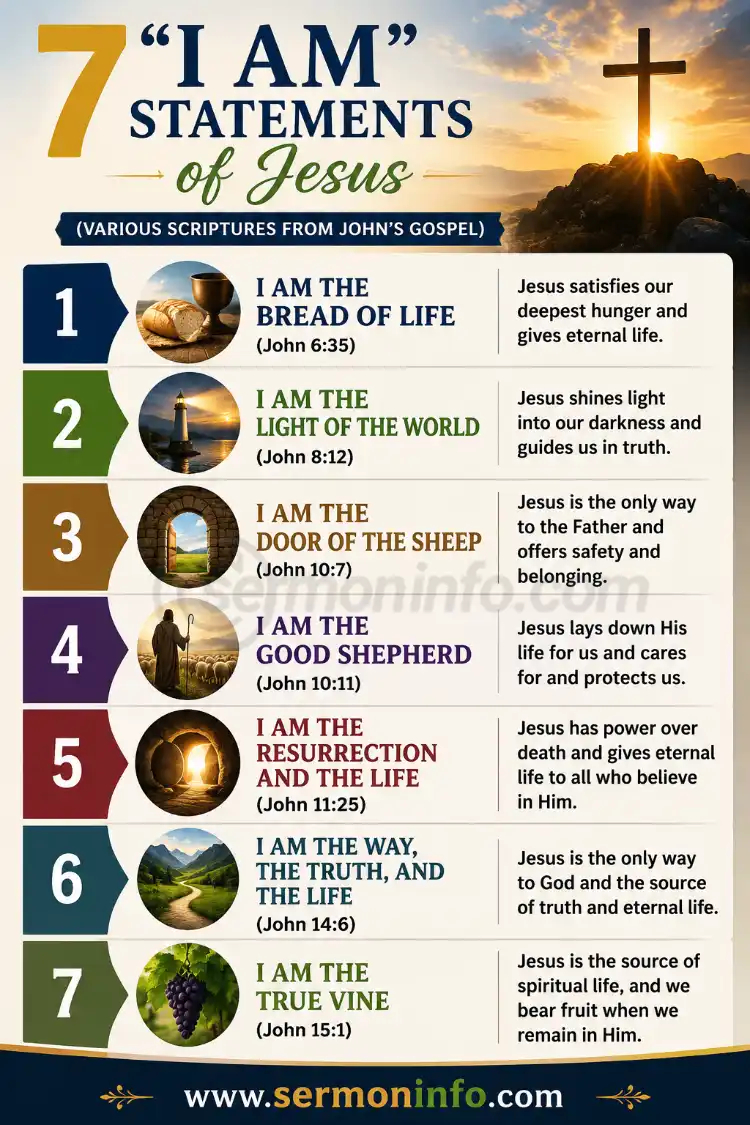
Frequently Asked Questions (FAQ)
Q: What are the seven “I AM” statements of Jesus?
A: The seven “I AM” statements are Jesus’ declarations in John’s Gospel that reveal His divine identity and saving mission: the Bread of Life, the Light of the World, the Door, the Good Shepherd, the Resurrection and the Life, the Way, the Truth and the Life, and the True Vine.
Q: Why did Jesus use the words “I AM”?
A: Jesus used the words “I AM” to reveal His divine identity and connect Himself with God’s self revelation in Exodus 3:14. These statements show that Jesus is the eternal Son of God and the promised Messiah who alone provides salvation and eternal life.
Q: What is the purpose of the seven “I AM” statements?
A: The seven “I AM” statements reveal who Jesus is, explain His saving work, and invite people to believe in Him. John recorded these truths so readers would recognize Jesus as the Christ, the Son of God, and receive eternal life through faith in His name (John 20:31).
Q: Are the seven “I AM” statements unique to John’s Gospel?
A: Yes. The seven metaphorical “I AM” statements appear only in the Gospel of John. Together they present a unified picture of Jesus as the only Savior, Shepherd, Provider, and Source of eternal life, emphasizing His deity and His relationship with those who trust Him.
Q: How should believers apply the seven “I AM” statements today?
A: Believers should trust Jesus completely because every “I AM” statement reveals a different aspect of His care and sufficiency. He satisfies spiritual hunger, guides through truth, protects His people, grants eternal life, and produces lasting fruit in everyone who remains in Him.
BONUS: What does “I AM” mean when Jesus used it in the Gospel of John?
When Jesus used the words “I AM,” He revealed far more than His name. He identified Himself with the eternal God who spoke to Moses from the burning bush, saying, “I AM WHO I AM” (Exodus 3:14). In John 8:58, Jesus declared, “Before Abraham was, I AM,” clearly affirming His eternal existence and divine nature.
John’s Gospel records seven “I AM” statements that reveal Christ’s person and saving work. Jesus is the Bread of Life, the Light of the World, the Good Shepherd, and more. These declarations invite people to believe in Him as the promised Messiah and the Son of God, who gives eternal life to all who trust Him (John 20:31).
BONUS: How do the seven “I AM” statements prove that Jesus is God?
Jesus’ seven “I AM” statements reveal His divine identity because they echo God’s self revelation in Exodus 3:14, where the Lord declared, “I AM WHO I AM.” Jesus also said, “Before Abraham was, I AM” (John 8:58). His listeners understood this claim and attempted to stone Him for blasphemy because He identified Himself with God.
Each “I AM” statement reveals an attribute that belongs to God alone. Jesus gives eternal life as the Bread of Life, guides the world as the Light, raises the dead as the Resurrection and the Life, and alone brings people to the Father as the Way (John 6:35; John 11:25; John 14:6). Together, these declarations affirm that Jesus is fully God and fully man.
BONUS: Where are the seven “I AM” statements found in the Bible?
The seven “I AM” statements are found exclusively in the Gospel of John. They appear in John 6:35, 48; 8:12; 10:7, 11; 11:25; 14:6; and 15:1. Through these declarations, John presents Jesus as the promised Messiah and the eternal Son of God who alone provides salvation and eternal life.
Each statement reveals a different aspect of Christ’s person and ministry. Jesus is the Bread of Life, the Light of the World, the Door, the Good Shepherd, the Resurrection and the Life, the Way, the Truth and the Life, and the True Vine. John recorded these truths so people would believe in Christ and have life through His name (John 20:31).
BONUS: Why is the statement “I am the way, the truth, and the life” so important?
Jesus’ statement, “I am the way, the truth, and the life” (John 14:6), is important because it declares that He alone brings sinners to the Father. Jesus did not claim to be one way among many. He revealed Himself as the only Savior who provides forgiveness, reconciliation, and eternal life through His death and resurrection.
Jesus spoke these words to comfort His disciples before His crucifixion and to strengthen their faith. His promise still encourages believers today because salvation is found in Christ alone (Acts 4:12). Those who trust Him receive eternal life, walk in God’s truth, and enjoy a personal relationship with the Father through Him.
BONUS: How do the seven “I AM” statements help Christians grow in their faith?
The seven “I AM” statements help Christians grow by revealing who Jesus is and what He provides for every believer. He satisfies our souls, guides us in truth, protects us, gives eternal life, and produces spiritual fruit. As we know Christ more deeply, our faith becomes stronger and more confident (John 15:5).
These declarations also encourage believers to trust Christ in every season of life. We feed on the Bread of Life, follow the Light of the World, and rest in the care of the Good Shepherd. As we remain in Him, His Word transforms our lives and helps us grow into Christlike maturity (Colossians 2:6–7; John 8:12).
BONUS: What can believers learn about Jesus from the seven “I AM” statements?
The seven “I AM” statements reveal that Jesus is the eternal Son of God, the promised Messiah, and the only Savior. He is the Bread of Life who satisfies, the Light of the World who guides, the Good Shepherd who protects, and the Resurrection and the Life who conquers death (John 6:35; John 8:12; John 10:11; John 11:25).
These declarations also teach believers to trust Christ completely in every season of life. As we abide in the True Vine, He produces spiritual fruit through us (John 15:5). As we follow the Way, the Truth, and the Life, we grow in faith, obey His Word, and glorify God through lives shaped by His grace (John 14:6; John 20:31).
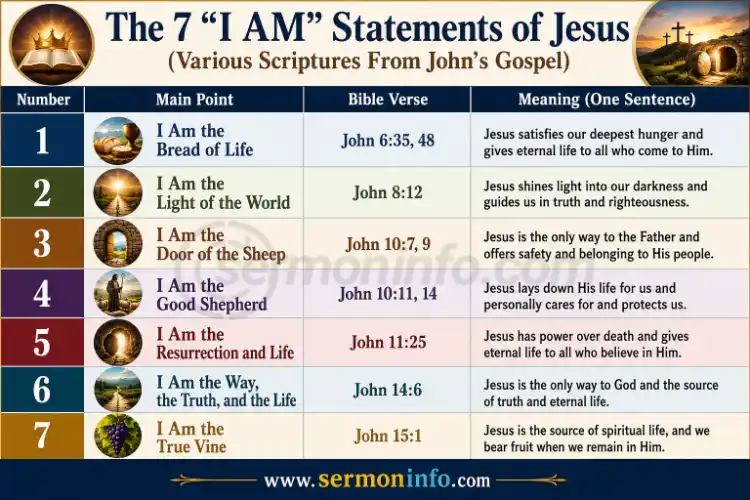
| The 7 “I AM” Statements of Jesus | |||
|---|---|---|---|
| Number | Main Point | Bible Verse | Meaning |
| 1 | I am the Bread of Life | John 6:35, 48 | Jesus alone satisfies our deepest spiritual hunger and gives eternal life to everyone who believes in Him. |
| 2 | I am the Light of the World | John 8:12; 9:5; 12:46 | Jesus reveals God’s truth, overcomes spiritual darkness, and leads people to salvation. |
| 3 | I am the Door of the Sheep | John 10:7, 9 | Jesus is the only entrance into God’s family and the only way to salvation. |
| 4 | I am the Good Shepherd | John 10:11, 14 | Jesus lovingly leads, protects, and sacrificially cares for His people. |
| 5 | I am the Resurrection and Life | John 11:25 | Jesus has authority over death and gives eternal life to all who believe in Him. |
| 6 | I am the Way, the Truth, and the Life | John 14:6 | Jesus is the only way to the Father and the complete revelation of God’s truth. |
| 7 | I am the True Vine | John 15:1, 5 | Jesus is the source of spiritual life, growth, and lasting fruitfulness in Him. |