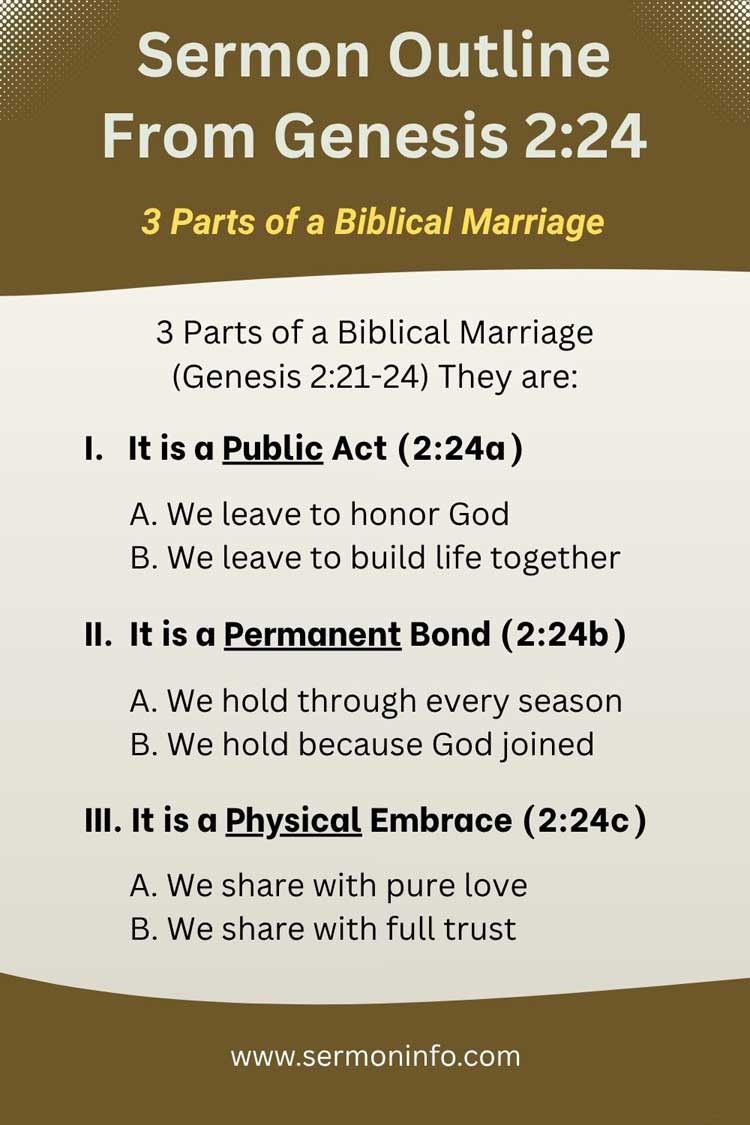
The 3 Parts of a Biblical Marriage describe God’s design for marriage as a public commitment, a permanent covenant, and a personal union, reflecting His love, faithfulness, and purpose.
Key Takeaways – Sermon Outline From Genesis 2:24
- Marriage is a Public Act: God calls couples to make their covenant known before Him and others, declaring their love and commitment openly.
- Marriage is a Permanent Bond: A biblical marriage reflects lifelong faithfulness, where husband and wife remain united through every season under God’s covenant.
- Marriage is a Physical Embrace: God designed intimacy as a sacred expression of love, trust, and unity within the safety of marriage.
- God’s Design for Marriage: These three parts—public, permanent, and personal—reveal marriage as a divine covenant that honors God and reflects His enduring love.
- Biblical Marriage Meaning: A Christ-centered marriage mirrors God’s faithfulness, strengthens family foundations, and demonstrates the beauty of His plan for love and unity.
3 Parts of a Biblical Marriage
Today we gather not only to witness a wedding, but to celebrate something sacred—God’s beautiful design for marriage. From the very beginning, in Genesis 2:24, God set the pattern for what marriage is meant to be: public, permanent, and personal. It’s not just two lives coming together, but two hearts becoming one under the loving hand of their Creator.
I’m reminded of how Adam first saw Eve and said, “This is now bone of my bones.” He recognized that God had done something holy and intentional. In that moment, marriage wasn’t man’s idea—it was God’s gift.
As we celebrate this union today, we’re reminded that a biblical marriage stands on three timeless truths: it begins with a public act, is strengthened by a permanent bond, and finds joy in a physical embrace that reflects the unity of heart and spirit God intended.
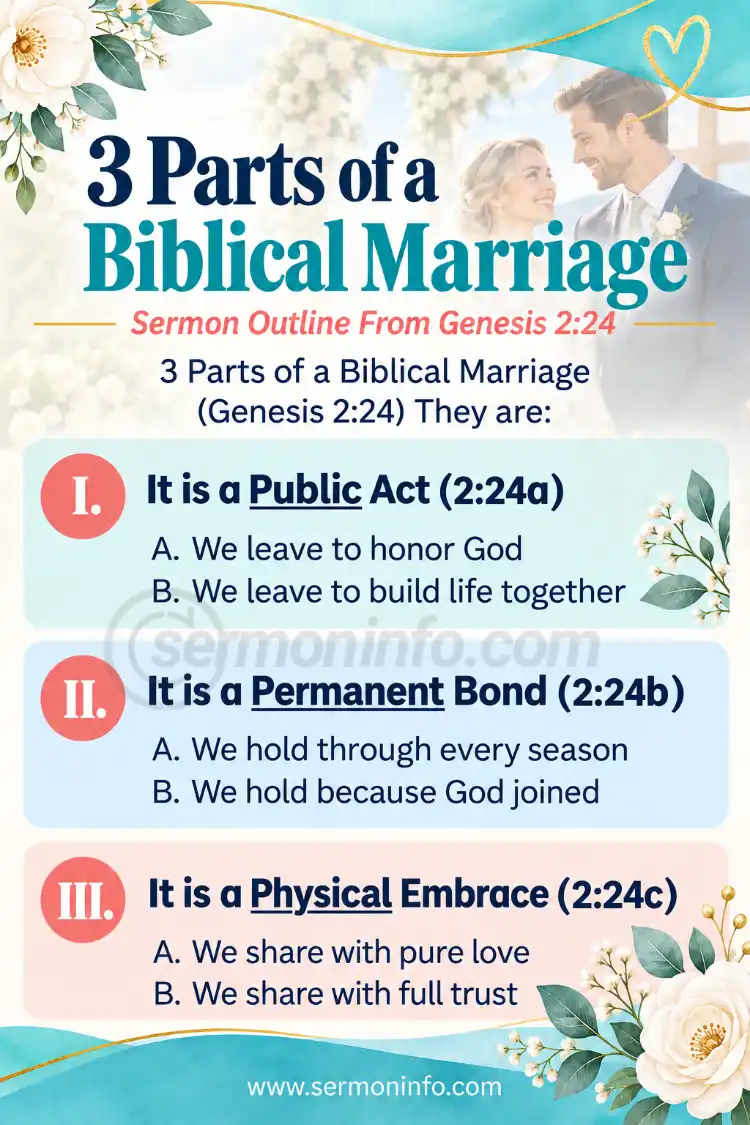
1. It Is a Public Act (Genesis 2:24a)
“Therefore a man shall leave his father and mother.” (Genesis 2:24a)
Marriage begins with a moment that everyone can see—a public act of faith, love, and commitment. It’s God’s way of saying that love is not meant to hide in the shadows but to shine in the open. When we stand before God and witnesses, we declare that this union honors His design, not the world’s ever-changing definition of love.
A. We Leave to Honor God
When we “leave” to marry, we make a public statement that God’s way is best. The world often treats marriage as temporary or convenient, but God calls it holy and enduring. By saying “I do” before Him, we honor His design for love—faithful, pure, and lifelong (Hebrews 13:4).
Leaving also means stepping out in obedience. Just as Ruth left her home to follow Naomi’s God (Ruth 1:16–17), we too leave what’s familiar to follow God’s calling in marriage. It’s an act of faith that says, “Lord, we trust Your plan more than our comfort.” That’s how we begin to honor Him together.
B. We Leave to Build Together
Leaving isn’t just walking away—it’s walking toward something new. God calls every couple to begin a new household where faith, trust, and shared responsibility grow strong. It’s no longer two families competing for influence but one couple learning to live under Christ’s lordship together (Ephesians 5:31).
This is where love matures. We build a home where prayer is normal, forgiveness is practiced, and grace fills the air. It takes teamwork, humility, and laughter. When we build together on God’s Word, our marriage becomes more than a relationship—it becomes a testimony of His faithfulness and design.
To All My Students: This material provides some ideas and thoughts for a wedding message from Genesis 2:24 (3 Parts of a Biblical Marriage).
2. It Is a Permanent Bond (Genesis 2:24b)
“And be joined to his wife.” (Genesis 2:24b)
Marriage is more than a promise—it’s a covenant. The phrase “be joined” means to be glued or held fast. It describes a lifelong commitment that weathers every storm. God designed marriage not as something to escape when life gets hard but as something to cherish and protect through every season of change.
A. We Hold Through Every Season
Every marriage faces seasons of joy and challenge. Yet God calls us to hold on, not give up. Just as He remains faithful to us, we remain faithful to each other (Malachi 2:16). Real love isn’t proven in easy moments—it’s shown in how we respond when life gets hard.
When the storms come, we choose grace instead of pride. We pray instead of blame. We forgive instead of quit. Each test becomes an opportunity to deepen our trust in God and one another. That’s how couples grow stronger—not by avoiding storms, but by walking through them hand in hand with Christ.
B. We Hold Because God Joined
This bond exists because God Himself joins a husband and wife. Jesus said, “What God has joined together, let no one separate” (Mark 10:9). That truth reminds us marriage isn’t just between two people—it’s a divine partnership established by God’s own hand.
Because He joins us, we don’t rely on feelings alone. We rely on His faithfulness that never fails. When we remember who brought us together, we find strength to stay together. The same God who joined us gives grace to keep us united, growing, and anchored in His love every single day.
3. It Is a Physical Embrace (Genesis 2:24c)
“And they shall become one flesh.” (Genesis 2:24c)
God designed marriage to include physical intimacy, not as something shameful, but as a sacred expression of unity and trust. This oneness reflects the closeness between Christ and His church—pure, committed, and full of grace (Ephesians 5:32). It’s more than physical; it’s emotional, spiritual, and deeply personal.
A. We Share With Pure Love
In a biblical marriage, physical love is a gift from God. It’s meant to be protected, not exploited. When we share love within God’s covenant, it strengthens trust and honors the purity He calls us to keep (1 Corinthians 7:3–5). Love becomes an act of worship when it reflects God’s heart.
Pure love also means selfless love. It’s not about taking, but giving. It’s choosing to see intimacy as a way to serve one another in grace and tenderness. When we approach this part of marriage with respect and care, it brings peace and joy to the relationship God designed.
B. We Share With Full Trust
True intimacy grows in the safety of trust. We give ourselves freely, knowing this closeness is sacred and safe in God’s plan. It’s a picture of the complete unity He intended—a bond that goes deeper than words (Song of Solomon 6:3).
That kind of trust builds over time. It’s nurtured by honesty, kindness, and mutual respect. As we grow closer physically, emotionally, and spiritually, our oneness becomes a living reflection of God’s love—faithful, devoted, and secure in Him.
Conclusion
Marriage, from God’s view, is far more than a contract—it’s a covenant. It begins when two people publicly declare, “We belong to each other under God.” It continues as they commit to stay together through every season, trusting the Lord who joined them.
And it deepens as they share life intimately, not just in body, but in heart, purpose, and faith. Every day becomes another opportunity to reflect Christ’s love—faithful, forgiving, and forever.
So today, as this couple begins their journey, we pray their marriage will shine with God’s glory—public in its witness, permanent in its promise, and personal in its love. May their union always point others to the One who joined them and who holds them fast.
Frequently Asked Questions (FAQ)
Q: What does it mean that marriage is a public act (Genesis 2:24)?
A: Marriage as a public act means the couple declares their commitment before God, family and community, thereby honouring the design God gave for marriage in which two become one visible unit.
Q: Why is marriage described as a permanent bond in the Bible?
A: Because the Bible frames marriage as a covenant relationship “until death” where the couple remain joined by God’s design, and not simply a temporary contract.
Q: What does “one flesh” mean in the context of biblical marriage?
A: “One flesh” signifies that husband and wife become a unified whole in body, mind, emotion and spirit — not just physically but relationally and spiritually.
Q: Can Christians be married in God’s eyes without a government license?
A: Whether a couple is considered married in God’s eyes without a government license depends on the interpretation of Christian teachings. Some believe that a marriage is a covenant made before God, and a government license is not necessary for that spiritual bond to be valid. Others argue that since the Bible instructs Christians to obey governing authorities, they should obtain a license as required by law.
Q: How does physical intimacy fit into the biblical view of marriage?
A: Physical intimacy in marriage reflects the “one flesh” union God established, intended to deepen trust, unify the couple and honour His design for the marital embrace.
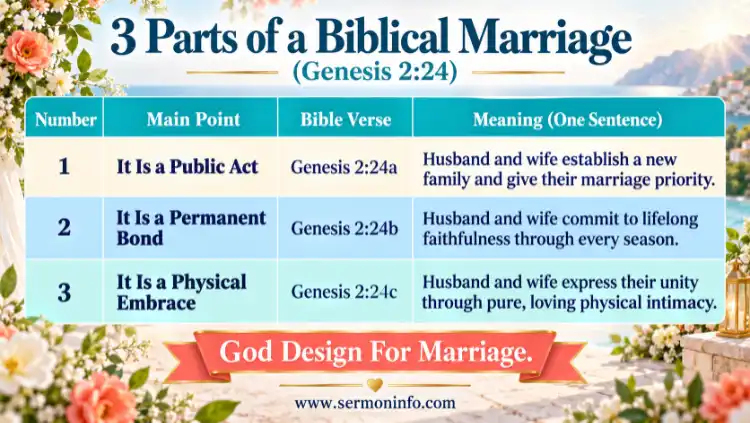
| Number | Main Point | Bible Verse | Meaning |
|---|---|---|---|
| 1 | It Is a Public Act | Genesis 2:24a | Marriage begins with a visible, public declaration honoring God and His design. |
| 2 | It Is a Permanent Bond | Genesis 2:24b | Marriage is a lifelong covenant, reflecting faithfulness and unity under God. |
| 3 | It Is a Physical Embrace | Genesis 2:24c | Marriage includes intimacy that expresses love, trust, and oneness as God intended. |
Source Material
Free Wedding Message From a Biblical Perspective – This article has used material from “MoreFreeOnlineSermons.com” with permission from the original author.
Believer’s Bible Commentary by William MacDonald (Commentary on the Whole Bible)
The MacArthur Bible Commentary by John MacArthur (Commentary on the Whole Bible)
Wiersbe Bible Commentaries by Warren Wiersbe (Commentary on the Whole Bible)