From Shared Flesh to One Flesh means God unites two lives in covenant love, forming one spiritual and physical union. This is a sermon outline from Genesis 2:21-24.

Key Takeaways – From Shared Flesh to One Flesh
- “Flesh of my flesh” reveals shared essence and nature, showing that both man and woman bear God’s image and stand the same in worth before Him.
- “One flesh” expresses divine purpose, demonstrating God’s intention for lifelong companionship, mutual love, and covenant faithfulness in marriage.
- True oneness grows through shared faith, trust, and commitment, not just emotional connection — it is sustained by God’s grace and His design.
- Biblical marriage mirrors God’s relationship with His people, reflecting Christ’s self-giving love and unity with the Church (Ephesians 5:31–32).
- God designed marriage as a covenant of unity, where man and woman move from shared humanity to spiritual and physical oneness (Genesis 2:24).
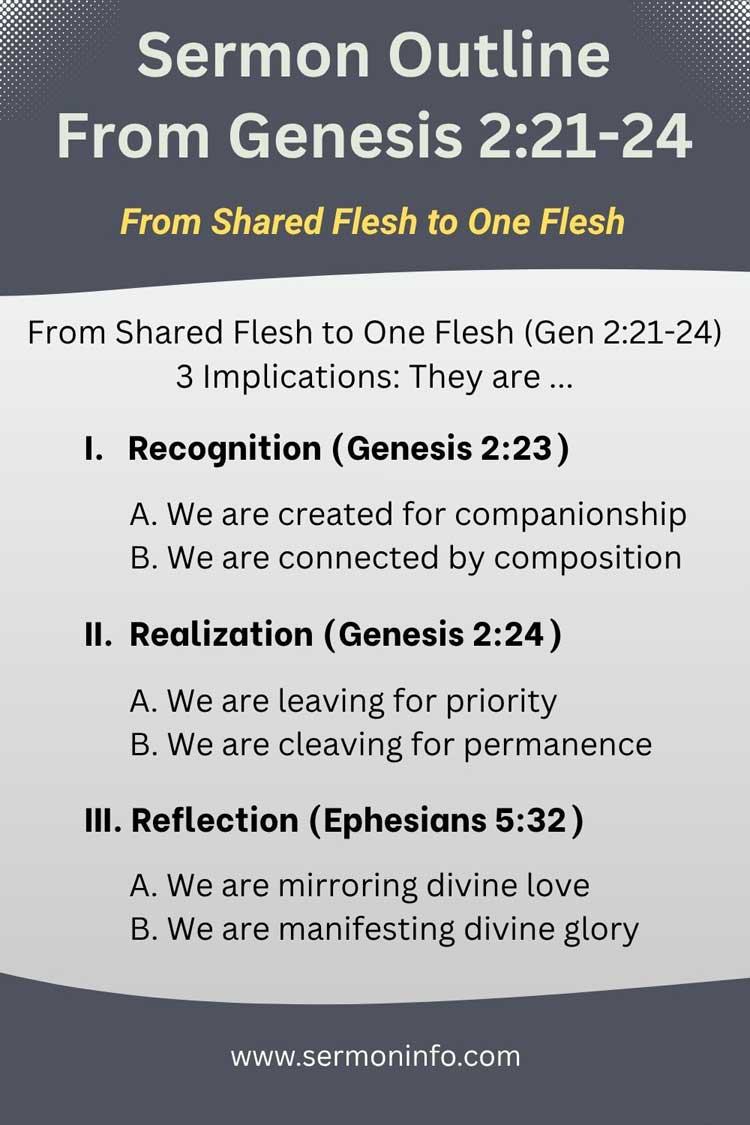
Sermon Outline From Genesis 2:21-24
When God brought Eve to Adam, he exclaimed, “This is flesh of my flesh.” That recognition revealed shared identity and equality, the foundation of all human relationships. Marriage begins in God’s design, not human preference, and invites us into covenantal companionship rooted in His wisdom.
Genesis 2:21–24 shows a divine pattern: shared flesh becomes one flesh. God moves from recognition of shared nature to the reality of covenantal oneness. This pattern guides every biblical marriage and reflects His eternal purpose for humanity.
Today, we will explore three truths: recognition of shared humanity, realization of covenantal unity, and reflection of Christ’s love. Together, we will see how God’s design for marriage is both practical and profoundly spiritual.
1. Recognition (Genesis 2:23)
And Adam said: ‘This is now bone of my bones and flesh of my flesh; She shall be called Woman, Because she was taken out of Man.'” (Genesis 2:23)
A. We Are Created for Companionship
When God looked at Adam alone in the garden, He said, “It is not good for the man to be alone” (Genesis 2:18). From the beginning, God designed us for relationship, not isolation. We were made to share life, laughter, burdens, and purpose with others. Companionship is God’s gift, not a human invention, and through it we discover joy and wholeness.
God didn’t create Eve as an accessory to Adam’s life but as his perfect companion — someone equal in value and purpose. In marriage, friendship, and community, we reflect God’s own relational nature. When we walk together in love and unity, we mirror His image and find fulfillment that isolation can never provide.
B. We Are Connected by Composition
Adam’s first words after seeing Eve were full of wonder: “This is now bone of my bones and flesh of my flesh.” He recognized they shared the same divine imprint — both created in God’s image. In that moment, Adam understood that equality, not superiority, defined their relationship. Both stood before God with equal dignity and worth.
Today, we affirm that truth again. In God’s eyes, men and women share the same spiritual DNA and the same calling to honor Him. Marriage was never meant to be a contest but a covenant of unity. When we celebrate our shared humanity, competition gives way to cooperation, and love flourishes where pride once ruled.
To All My Students: This material provides some ideas and thoughts for a message from Genesis 2:21-24 about God’s design for marriage (From Shared Flesh to One Flesh).
2. Realization (Genesis 2:24)
“Therefore a man shall leave his father and mother and be joined to his wife, and they shall become one flesh.” (Genesis 2:24)
A. We Are Leaving for Priority
When Scripture says, “A man shall leave his father and mother,” it isn’t dismissing family — it’s declaring a new priority. Marriage begins when two people form a new household, placing one another above every other earthly relationship. That kind of leaving isn’t abandonment; it’s maturity. It’s the decision to build life together under God’s direction.
We live in a culture that often blurs those boundaries. But God’s Word reminds us that marriage thrives when husband and wife are each other’s first commitment after Christ. Prioritizing your spouse means giving time, attention, and affection where it matters most. It’s saying, “You come first — because God has made us one.”
B. We Are Cleaving for Permanence
The word “cleave” means to hold fast — not out of fear, but out of covenant love. Marriage was never designed for temporary comfort; it was built for lifelong commitment. God calls us to stay faithful, not because it’s always easy, but because it’s holy. His covenant with us sets the pattern for ours with one another.
When challenges arise, cleaving means standing together, not pulling apart. It means choosing forgiveness when pride wants distance. As Paul wrote, “Love never fails” (1 Corinthians 13:8). Our marriages reflect God’s faithfulness when we remain steadfast. Every time we hold on through trials, we preach the gospel of grace to a watching world.
3. Reflection (Ephesians 5:32)
“This is a great mystery, but I speak concerning Christ and the church.” (Ephesians 5:32)
A. We Are Mirroring Divine Love
Paul calls marriage a “great mystery” because it points beyond itself — to Christ and His Church (Ephesians 5:32). When we love our spouse selflessly, we mirror Jesus’ love that gives, serves, and forgives. The cross teaches us that real love sacrifices for another’s good, even when it costs something deeply personal.
We reflect Christ’s love best when we serve without condition and forgive without record. Every act of patience, every word of grace, becomes a small sermon about our Savior. When husbands and wives love this way, marriage moves from ordinary to sacred, revealing to the world that Christ’s love is real and redeeming.
B. We Are Manifesting Divine Glory
Marriage is more than private happiness; it’s a public testimony of God’s glory. When believers walk in unity, < a href="https://www.sermoninfo.com/7-bible-verses-about-humility.html" title="7 Bible Verses About Humility">humility, and holiness, the watching world sees a living picture of the gospel. Our marriages become windows through which others glimpse the beauty and faithfulness of God Himself.
Jesus said, “By this all will know that you are My disciples, if you have love for one another” (John 13:35). That love, lived out at home, is a powerful witness. When our homes reflect God’s peace and our hearts display His grace, the glory of Christ shines brightly — and the world takes notice.
Conclusion
Marriage reflects God’s design when shared flesh becomes one flesh. Recognition, realization, and reflection show us how unity grows from equality, covenant, and Christlike love.
Husbands and wives are called to honor their shared identity, commit to lifelong covenant, and model Christ’s selfless love to the world. God’s purpose in marriage is revealed through faithful, active partnership.
As believers in Christ, we must help couples understand that biblical marriage is relational, covenantal, and divine. What God joins together in love demonstrates His wisdom, grace, and redeeming power in everyday life.
Source Material
Believer’s Bible Commentary by William MacDonald (Commentary on the Whole Bible)
The MacArthur Bible Commentary by John MacArthur (Commentary on the Whole Bible)
Wiersbe Bible Commentaries by Warren Wiersbe (Commentary on the Whole Bible)
Systematic Theology by Wayne Grudem
Christian Theology by Millard J. Erickson
The Moody Handbook of Theology by Paul Enns
Biblical Doctrine by John MacArthur and Richard Mayhue
Frequently Asked Questions (FAQ)
Q: What does “one flesh” mean in Genesis 2:24?
A: “One flesh” means that God unites husband and wife in a lifelong covenant, making them one in body, spirit, and purpose. It reflects divine design for intimacy, unity, and faithfulness in marriage (Genesis 2:24).
Q: How does “flesh of my flesh” relate to “one flesh”?
A: “Flesh of my flesh” recognizes shared humanity and nature; “one flesh” completes that bond through God’s covenant of unity. Together they reveal God’s perfect order for marriage — shared essence leading to complete oneness.
Q: Why did God create Eve from Adam’s rib?
A: God formed Eve from Adam’s side to show partnership and completeness. She wasn’t made from his head to rule him, nor his feet to be ruled, but from his side to walk beside him and complete him (Genesis 2:21–22).
Q: How does the “one flesh” union reflect Christ and the Church?
A: The one-flesh union mirrors Christ’s relationship with the Church (Ephesians 5:31–32). As husband and wife unite in covenant love, they display Christ’s sacrificial love, unity, and grace to a watching world.
Q: What does “from shared flesh to one flesh” teach about marriage today?
A: It teaches that biblical marriage is between a man and woman. Also, it’s not just emotional or physical, but spiritual — a God-ordained covenant rooted in shared identity and divine purpose. True oneness grows through faith, love, and obedience to God’s Word.
| Number | Main Point | Bible Verse | Meaning |
|---|---|---|---|
| 1 | Recognition — “Flesh of My Flesh” | Genesis 2:23 | We recognize that God created man and woman with shared essence and equal worth, designed for companionship and unity. |
| 2 | Realization — “Joined Together by God” | Genesis 2:22–23 | We realize that God Himself establishes the covenant of marriage, uniting two lives into one divine relationship. |
| 3 | Reflection — “They Shall Become One Flesh” | Genesis 2:24; Ephesians 5:32 | We reflect God’s image through a one-flesh union that demonstrates His love, faithfulness, and covenant purpose in marriage. |