Find out what 5 Hebrew Words For Love In The Bible teach us about God’s covenant love, compassion, mercy, and marital intimacy.
Key Takeaways – 5 Hebrew Words for Love in the Bible
- Ahav / Ahavah (אָהַב / אַהֲבָה) – The most common Hebrew word for love, covering God’s love for His people, human affection, and covenant love (Deuteronomy 6:5).
- Chesed (חֶסֶד) – A rich covenant word often translated as lovingkindness, steadfast love, or mercy. It describes God’s loyal, faithful love (Psalm 136).
- Dod (דּוֹד) – Used in Song of Solomon, it expresses romantic or physical love between a husband and wife.
- Racham / Rachamim (רָחַם / רַחֲמִים) – Compassionate, tender love, often linked with parental mercy or the love of God as a Father (Isaiah 49:15).
- Dodi (דוֹדִי) – A personal, intimate form of Dod, meaning “my beloved,” found in Song of Solomon. It shows relational closeness, intimacy, and delight.
- Together, these words show us the fullness of love in God’s design—from covenant loyalty to family affection, romantic intimacy, and merciful compassion.
5 Hebrew Words for Love in the Bible
Love is a word we use every day, but the Bible shows us it runs much deeper than emotion or feeling. Scripture paints a bigger picture, one that reveals the very heart of God and His design for His people.
In Hebrew, the Old Testament uses several words for love, each capturing a unique expression of God’s truth. From covenant loyalty to tender mercy, from family devotion to marital intimacy, these words help us see love through God’s eyes.
Think of how a diamond shines differently as it turns. Each facet reflects the same light but from a new angle. Today, we’ll explore five Hebrew words for love that together reveal God’s brilliance and call us to live in His love.
1. Love that Commits (Ahav)
“You shall love the Lord your God with all your heart, with all your soul, and with all your strength.” (Deuteronomy 6:5)
A. Love that obeys fully
To love God is to give Him our whole selves. Deuteronomy 6:5 commands us to love Him with heart, soul, and strength. This calls for surrender in every area of life. True obedience is not partial but complete. God desires all of us, not just parts of us.
Obedience flows from devotion, not duty. Jesus said, “If you love me, keep my commands” (John 14:15). When we obey, we show that our love is real. A life surrendered to Him demonstrates trust in His wisdom and goodness.
B. Love that chooses daily
Love for God is not a momentary feeling but a daily decision. Every day brings opportunities to choose His way over ours. Joshua declared, “Choose for yourselves this day whom you will serve” (Joshua 24:15). Love expresses itself through choices made one day at a time.
When we choose to follow God consistently, our faith grows stronger. Daily choices build habits that reflect true devotion. Over time, these decisions shape a life that honors God and reveals His love to others.
2. Love that Covenants (Chesed)
“Give thanks to the Lord, for he is good. His love endures forever. (Psalm 136:1)
A. Love that endures always
Chesed speaks of God’s steadfast love that never fails. Psalm 136 repeats, “His steadfast love endures forever.” That refrain is not empty. It is a promise that God’s covenant love does not waver, even when His people stumble. His love outlasts our failures.
This enduring love gives us confidence in uncertain times. Unlike human love, which can fade, God’s chesed remains steady. We can rest in the assurance that His love will never end or abandon us.
B. Love that promises faithfully
Chesed is not only enduring but also faithful. God binds Himself to His promises, showing that His love is unbreakable. Abraham experienced this covenant love when God swore by Himself to bless His descendants (Genesis 22:16–18).
His covenant love is the anchor for our souls. When everything else shifts, God’s faithful love holds us steady. We can trust Him completely because His Word never fails.
This material provides some ideas and thoughts for a message about God’s love (5 Hebrew Words for Love in the Bible).
3. Love that Celebrates (Dod)
“Let him kiss me with the kisses of his mouth—for your love is more delightful than wine.” (Song of Solomon 1:2)
A. Love that delights purely
Dod refers to the romantic love expressed in marriage. Song of Solomon begins, “Let him kiss me with the kisses of his mouth” (1:2). This is a picture of delight and intimacy within God’s design. Romantic love is not sinful but sacred when kept pure.
God gave the gift of marital intimacy to be enjoyed. Within marriage, this love deepens trust and joy between husband and wife. It is a reflection of God’s good creation, meant to be celebrated.
B. Love that unites deeply
Dod also points to the oneness created in marriage. Genesis 2:24 reminds us, “The two will become one flesh.” This union is more than physical. It is emotional, spiritual, and covenantal.
In marriage, romantic love fosters unity that mirrors God’s covenant with His people. When kept within His design, dod creates a bond that is both beautiful and enduring.
4. Love that Cares (Racham)
“Can a mother forget the baby at her breast and have no compassion on the child she has borne? Though she may forget, I will not forget you!” (Isaiah 49:15)
A. Love that shows compassion
Racham expresses tender, parental compassion. Isaiah 49:15 asks, “Can a mother forget the baby at her breast?” God answers with assurance that His compassion is even greater than a mother’s. His mercy runs deep and personal.
This compassionate love meets us in weakness. God does not turn away when we hurt. Instead, He draws near with care that comforts and restores.
B. Love that forgives freely
Racham is tied to mercy that forgives. Nehemiah 9:17 says, “You are a forgiving God, gracious and compassionate.” God’s compassion moves Him to pardon rather than punish. His love is both just and merciful.
When we repent, His compassion opens the door to forgiveness. He delights to show mercy. Through Christ, His forgiveness flows freely to all who believe.
5. Love that Cherishes (Dodi)
“My beloved is mine, and I am his. He feeds his flock among the lilies.” (Song of Solomon 2:16)
A. Love that delights personally
Dodi is an intimate word meaning “my beloved.” Song of Solomon 2:16 says, “My beloved is mine and I am his.” This is the joy of being personally cherished. God’s design for love includes intimacy, delight, and belonging.
Such love brings security and joy. When we feel treasured, our hearts rest. Dodi shows us that God cares for closeness in relationships.
B. Love that belongs securely
Dodi also reflects covenant security. To say, “My beloved is mine” is to declare mutual belonging. In Christ, we share that same secure relationship with God.
Nothing can separate us from His love (Romans 8:38–39). His love claims us as His own, and in that belonging we find lasting peace.
Conclusion
When we put these Hebrew words together, we see a complete picture of love—faithful, compassionate, intimate, enduring, and covenantal. God does not just talk about love; He shows it in every way possible.
His covenant love holds us, His compassionate mercy heals us, and His intimate care calls us to trust Him fully. Whether in family, friendship, or marriage, His love becomes our example and strength.
So as we close, remember this: love is not man’s idea but God’s gift. And when we live in His love, we reflect His heart to a world that desperately needs it.
Source Material
Vine’s Expository Dictionary of the Old and New Testament Words by W. E. Vine
Theological Wordbook of the Old Testament by R Laird Harris, Gleason L Archer Jr., Bruce Waltke
Believer’s Bible Commentary by William MacDonald
The MacArthur Bible Commentary by John MacArthur
Wiersbe Bible Commentaries by Warren Wiersbe
Frequently Asked Questions (FAQ)
Q: 1: What is the meaning of the Hebrew word ‘chesed’?
A: Chesed means steadfast love, covenant loyalty, mercy, and compassionate faithfulness—God’s enduring and faithful love.
Q: 2: What does ‘ahavah’ mean in the Bible?
A: Ahavah (from the root ahav) means love in deep, emotional, and covenantal contexts—ranging from devotion to God to familial and romantic affection.
Q: 3: How is ‘chesed’ different from ordinary love?
A: Unlike emotion-based love, chesed involves loyal, covenantal action—it is God’s faithful love that acts on behalf of His people.
Q: 4: What does the Hebrew word ‘rachamim’ convey?
A: Rachamim expresses deep compassion and mercy, reflecting tenderness similar to a parent’s love and God’s merciful care.
Q: 5: What role do words like ‘dod’ and ‘dodi’ play in the Bible?
A: These words appear in Song of Solomon to express romantic intimacy—dod meaning beloved and dodi meaning “my beloved,” showing deep mutual affection.
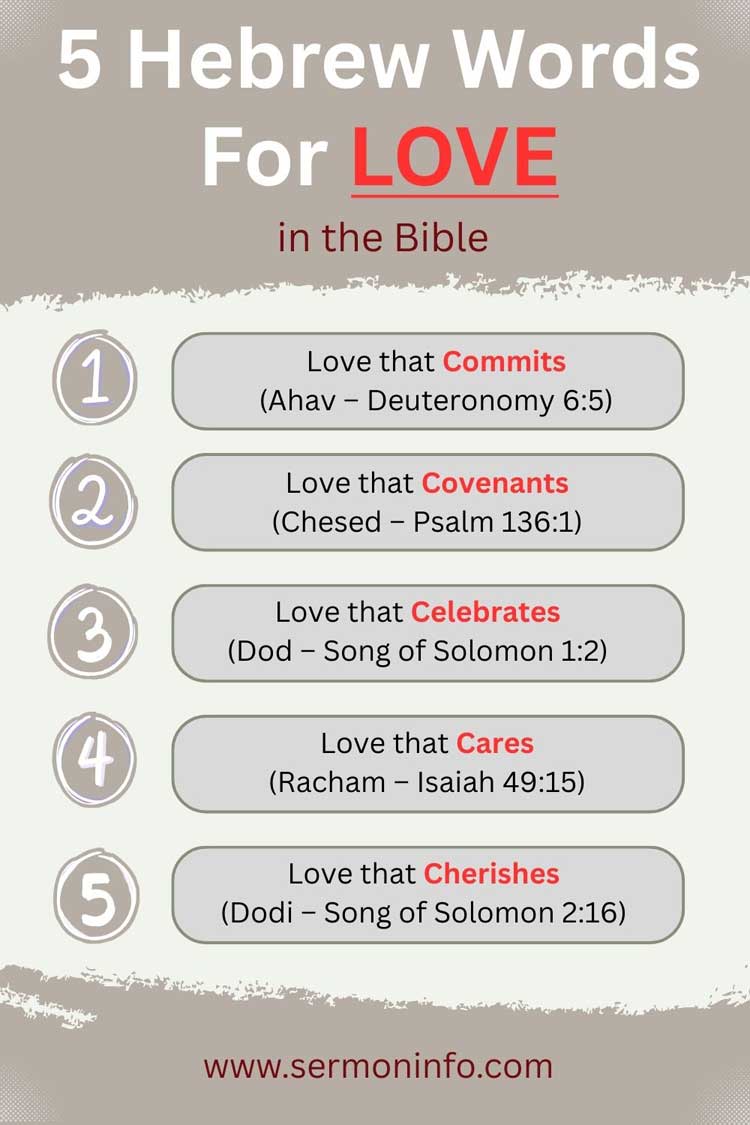
| Number | Main Point | Bible Verse | Meaning |
|---|---|---|---|
| 1 | Love that Commits (Ahav) | Deuteronomy 6:5 | All-in love for God expressed through wholehearted devotion. |
| 2 | Love that Covenants (Chesed) | Psalm 136:1 | God’s loyal, merciful, covenantal love that endures forever. |
| 3 | Love that Celebrates (Dod) | Song of Solomon 1:2 |
Romantic love within marriage that brings joy and unity. |
| 4 | Love that Cares (Racham) | Isaiah 49:15 | Tender, compassionate love that comforts and restores. |
| 5 | Love that Cherishes (Dodi) | Song of Solomon 2:16 |
Intimate belonging and security in mutual affection. |