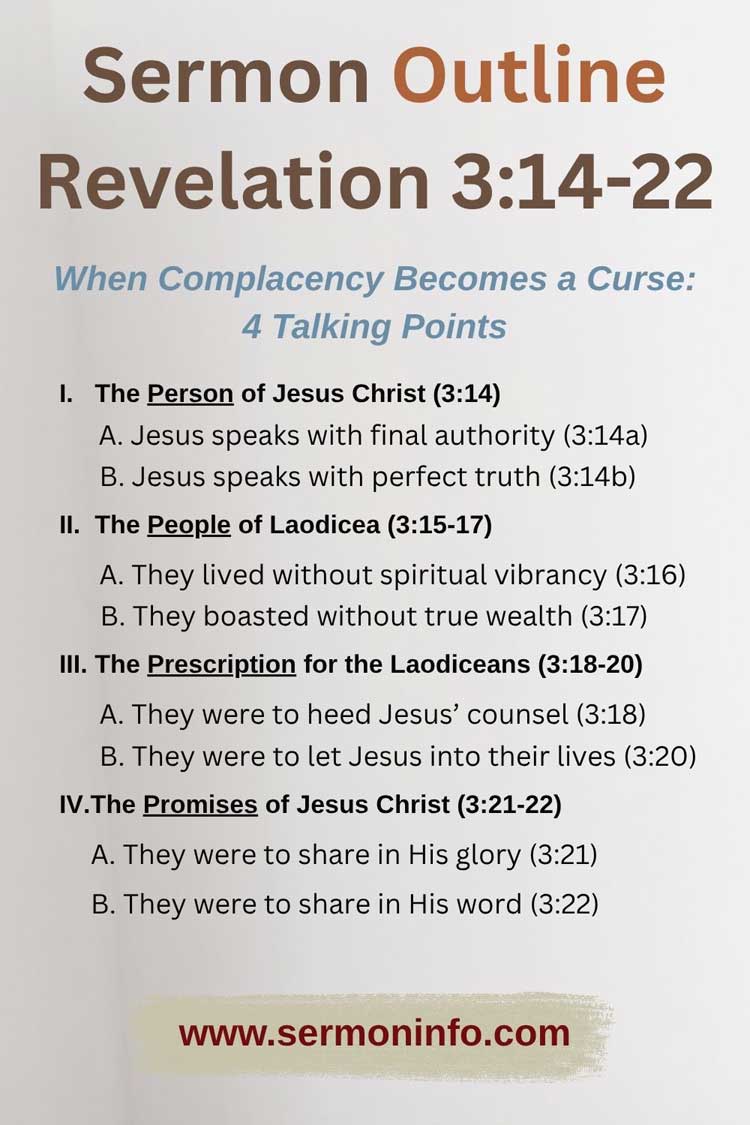
When Complacency Becomes a Curse (Revelation 3:14–22), spiritual blindness convinces us we’re rich, while Jesus says we’re naked, poor, and in desperate need.

Sermon From Revelation 3:14-22 (Laodicea)
Imagine a church that had everything money could buy—but not what Christ came to give. That was Laodicea. Wealthy, proud, and self-sufficient, they thought they were doing fine. But Jesus saw the truth—they were lukewarm, spiritually blind, and about to be spit out.
That’s the danger we face too. Complacency doesn’t shout; it whispers. It lets us go to church without change, pray without passion, and serve without fire. Slowly, it hardens the heart.
When Complacency Becomes a Curse (Revelation 3:14–22), Jesus calls us to wake up, open the door, and let Him back in.
1. The Person of Jesus Christ
“And to the [i]angel of the church [j]of the Laodiceans write, ‘These things says the Amen, the Faithful and True Witness, the Beginning of the creation of God.'” (Revelation 3:14)
A. Jesus Speaks with Final Authority
When Jesus calls Himself “the Amen” (Revelation 3:14), He is claiming to be the last word on everything that matters. He is not just someone who says “Amen”—He is the Amen. His words are settled, sure, and eternal. What He says stands. We may waver, but He never changes (Hebrews 13:8).
In a world full of opinions, shifting truths, and spiritual confusion, Christ’s voice cuts through the noise. His word is absolute and reliable, not open to debate. If He says we are lukewarm, then we are. And when He offers counsel, we must listen. The One who speaks cannot lie (Titus 1:2), and He will not lead us wrong.
B. Jesus Sees with Perfect Truth
Jesus calls Himself “the faithful and true witness,” meaning He sees everything as it really is. Nothing escapes His eye. He doesn’t flatter, and He doesn’t guess. He speaks what is true, even when it’s hard to hear. Jesus told Laodicea they were poor and blind, though they felt rich and well-off.
That same Jesus sees our condition too—with grace and truth. He reveals not to condemn but to correct and restore. Like a good doctor, He tells the truth so healing can begin. We can trust Him completely, because He never misjudges and never misleads. His diagnosis is honest, but His goal is always redemption.
“This material provides some ideas and thoughts for a message from Revelation 3:14-22 with the title: “When Complacency Becomes a Curse.”
2. The People of Laodicea
“I know your works, that you are neither cold nor hot. I could wish you were cold or hot. So then, because you are lukewarm, and neither cold nor hot, I will vomit you out of My mouth. Because you say, ‘I am rich, have become wealthy, and have need of nothing’—and do not know that you are wretched, miserable, poor, blind, and naked.” (Revelation 3:15–17)
A. They lived without spiritual vibrancy
Jesus says, “you are neither cold nor hot . . . I will spit you out” (v.16). This is not mild frustration—it’s divine disgust. The Laodiceans weren’t completely dead in faith, but they weren’t alive either. They had no spiritual fire. They had enough religion to feel safe, but not enough passion to make a difference.
Lukewarmness is spiritual apathy. It is dangerous because it feels comfortable. You may go to church, say the right words, and still drift away from Christ. When we lose our zeal, our effectiveness dies. Paul urged, “Never be lacking in zeal, but keep your spiritual fervor” (Romans 12:11). Jesus is worth a faith that burns hot.
B. They boasted without true wealth
Jesus says, “You say, ‘I am rich . . .’ but you do not realize you are wretched, pitiful, poor, blind and naked” (v.17). The city of Laodicea was wealthy, proud, and self-sufficient—but spiritually, they were bankrupt. They confused physical prosperity with spiritual blessing.
That same danger threatens us today. It’s easy to trust in what’s in the bank or how life looks on the outside. But Jesus sees through it all. He’s not impressed by titles, buildings, or budgets. What He values is a heart that depends on Him. Our greatest poverty is thinking we have no need of God.
3. The Prescription for the Laodiceans
“I counsel you to buy from Me gold refined in the fire, that you may be rich; and white garments, that you may be clothed, that the shame of your nakedness may not be revealed; and anoint your eyes with eye salve, that you may see. As many as I love, I rebuke and chasten. Therefore be zealous and repent. Behold, I stand at the door and knock. If anyone hears My voice and opens the door, I will come in to him and dine with him, and he with Me.” (Revelation 3:18–20)
A. They were to heed Jesus’ counsel
Jesus lovingly says, “I counsel you to buy from me . . .” (v.18). He offers what they lack—true riches, righteousness, and spiritual sight. They didn’t need more gold or garments. They needed Christ. He alone supplies what the soul truly craves.
This isn’t a harsh command—it’s a tender invitation. Christ tells us how to return. He doesn’t leave us in our brokenness. Isaiah 55:1 says, “Come, buy without money.” His grace is free, but it must be received. He knows our need better than we do—and He offers the cure.
B. They were to let Jesus into their lives
“I stand at the door and knock…” (v.20). What a powerful picture. Jesus wasn’t inside the church—He was outside, waiting to be welcomed in. That’s how far they had drifted. But He hadn’t given up. He still pursued them.
That same Jesus still knocks on hearts today. He doesn’t force His way in—He waits for us to respond. He wants relationship, not routine. If we open the door, He promises intimacy: “I will come in and eat with him, and he with me.” That’s fellowship. That’s revival.
4. The Promises of Jesus Christ
“To him who overcomes I will grant to sit with Me on My throne, as I also overcame and sat down with My Father on His throne. He who has an ear, let him hear what the Spirit says to the churches.” (Revelation 3:21–22)
A. They were to share in His glory
Jesus ends with hope: “To the one who overcomes, I will give the right to sit with me on my throne” (v.21). From lukewarm failure to heavenly glory—what a promise! Jesus doesn’t just restore; He exalts those who turn back to Him.
This is grace beyond imagination. He doesn’t just forgive us—He includes us in His reign. Just as He overcame and sat with the Father, we are called to endure and finish strong. Romans 8:17 reminds us: “If we suffer with Him, we shall also be glorified with Him.” That’s our future in Christ.
B. They were to share in His word
Jesus ends with these words: “He who has an ear, let him hear what the Spirit says . . .” (v.22). This isn’t just about Laodicea—it’s for every church, every believer, in every generation. The Spirit still speaks. Are we listening?
Hearing requires humility. It means we stop defending ourselves and start responding to the Spirit’s voice. The Word of God is living and active (Hebrews 4:12), but it must be received. Complacency silences the soul. Revival begins when we tune back in to what God is saying.
Conclusion
The church at Laodicea had everything—except the one thing that mattered most: Jesus at the center. That’s the danger of complacency.
It doesn’t crash in like a storm. It creeps in quietly—through pride, comfort, and self-reliance—until we no longer notice Jesus is outside.
But He still knocks. He still calls. His rebuke is love, and His promise is glory. So wake up, people. Open the door. Let Him in. Trust Him. He’s worth everything.
Source Material
7 Churches of Revelation Explained Written Article Summarizing the 7 Churches of Revelation
Believer’s Bible Commentary by William MacDonald
The MacArthur Bible Commentary by John MacArthur
You Can Understand the Book of Revelation by Skip Heitzig
40 Days Through Revelation by Ron Rhodes
Revelation by Charles C. Ryrie
Key Takeaways: Sermon From Revelation 3:14-22
- Jesus speaks with absolute authority and unwavering truth. As “the Amen,” His Word is final, faithful, and completely trustworthy. (Revelation 3:14)
- Complacency leads to spiritual blindness and self-deception. The Laodicean church mistook material success for spiritual health—and Jesus exposed the truth. (Revelation 3:17)
- Lukewarm faith is dangerous and offensive to God. Christ would rather we be cold or hot—but never spiritually indifferent. (Revelation 3:16)
- Jesus lovingly calls the lukewarm to repent and return. He offers real righteousness, healing, and restored fellowship for those who listen and respond. (Revelation 3:18–20)
- Those who overcome will share Christ’s eternal glory. Jesus invites faithful believers to reign with Him and hear the Spirit’s voice. (Revelation 3:21–22)
These takeaways offer a clear summary of the message, highlight major spiritual truths, and are structured for easy scanning by both search engines and readers. Would you like a version formatted for bulletins, slides, or blog posts as well?
Frequently Asked Question (FAQ)
- What was Jesus’ message to the church in Laodicea in Revelation?
- What does it mean that Laodicea was “lukewarm”?
- What did Jesus counsel the Laodiceans to do?
Jesus sternly rebuked them for their lukewarm faith—neither spiritually hot nor cold—and warned He would “spit them out,” calling them to repent and return to wholehearted devotion.
Lukewarm describes spiritual apathy—a faith comfortable but ineffective. Jesus valued zeal or honest conviction over indifferent, diluted devotion.
He urged them to seek true riches and righteousness from Him, to open the door when He knocked, and to restore intimate fellowship through repentance.