Up Close With The Eternal Word shows that Jesus Christ, the eternal Son of God, truly came in the flesh and revealed Himself clearly. John heard Him, saw Him, and touched Him. This sermon highlights Christ’s real incarnation and His personal, life-changing nearness to believers.

Key Takeaways – Sermon From 1 John 1:1-2
- Jesus speaks God’s truth clearly. The Eternal Word became audible, and Jesus still guides us through the truth of Scripture (1 John 1:1a).
- Jesus shows us how to live. The Eternal Word became visible, revealing God and giving us a faithful pattern to follow (1 John 1:1b–2).
- Jesus came near to save us. The Eternal Word became touchable, entered our broken world, and calls us to trust Him personally (1 John 1:1–2).
Up Close With The Eternal Word
Have you ever met someone famous? I have—and I froze. I didn’t know what to say, just stood there awkwardly. But imagine meeting someone not just famous—but eternal, divine, the very Word of Life. That’s exactly what happened to John.
He didn’t just hear Jesus preach; he heard His voice up close. He didn’t just read about Him; he saw Him, touched Him, walked with Him. That changes a person. And it should change us too.
Today, I want to take you into those first two verses of 1 John and show you what John never got over.
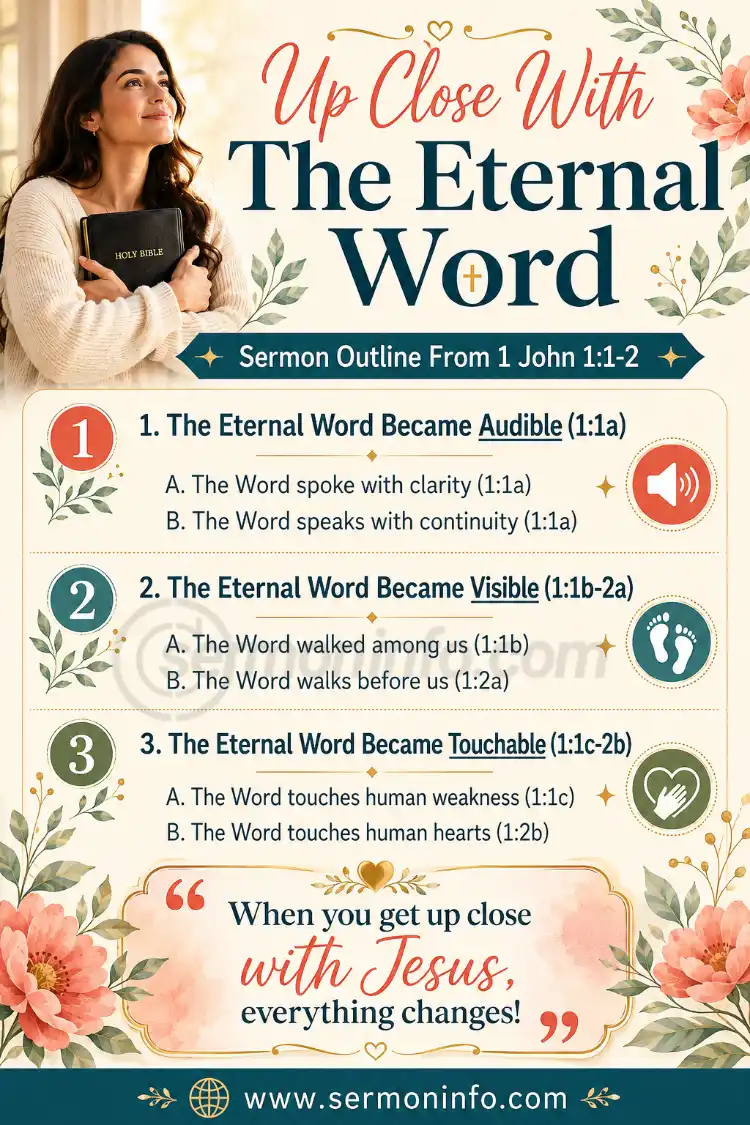
1. The Eternal Word Became Audible
“which we have heard”(1 John 1:1a)
A. The Word Spoke with Clarity (1:1a)
John said, “That which was from the beginning, which we have heard…” That’s not just poetry—that’s eyewitness stuff. Jesus spoke, and it was unmistakable. His words carried weight. People didn’t leave wondering what He meant—they either followed Him or walked away.
When Jesus spoke, demons trembled, storms listened, and crowds leaned in. No confusion. No fluff. Just truth, straight from God’s mouth (John 7:46). That same clarity cuts through our chaos today. His voice still brings peace to the noisy mess around us—if we’re willing to listen.
B. The Word speaks with Continuity (1:1a)
Here’s the good news—Jesus didn’t stop speaking when He ascended. He still speaks today, clearly and powerfully, through His Word (Hebrews 1:1-2). The same voice that calmed the sea now calls us through Scripture.
So if you’ve ever said, “I just wish God would speak to me,” open your Bible. His Word still heals, still convicts, still comforts. The voice John heard—we can hear too. But let’s not just read words. Let’s listen to the Living Word.
“This sermon material provides some ideas and thoughts for preaching through 1 John 1:1-2.”
2. The Eternal Word Became Visible
“which we have seen with our eyes…the life was manifested, and we have seen.”(1 John 1:1b-2a)
A. The Word Walked Among Us (1:1b)
John said, “which we have seen with our eyes…” In other words, Jesus wasn’t an idea or a spiritual blur—He was visible. They saw Him eat, sleep, cry, and laugh. He wore sandals, not halos.
Jesus showed up in person, not just sermons. He walked dusty roads, sat with sinners, and hugged children (John 1:14). He wasn’t distant—He was with us. That’s how far God went to be known. Real flesh, real footsteps and real love.
B. The Word Walks Before Us (1:2a)
Now here’s the beauty—Jesus didn’t just show up; He showed how to live. His life wasn’t just a rescue—it was a roadmap. John saw it. We can follow it (1 Peter 2:21).
Jesus walked in obedience, love, humility, and truth. That’s not just a goal—it’s our guide. When we’re unsure how to live, we don’t guess—we look to Him. He still walks before us through His Word, His Spirit, and His example.
3. The Eternal Word Became Touchable
“and our hands have handled…and bear witness, and declare to you that eternal life which was with the Father and was manifested to us” (1 John 1:1c-2b)
A. The Word Touched Human Weakness (1:1c)
John said, “our hands have handled…”—and that’s huge. Jesus wasn’t untouchable; He entered our mess with open hands and a tender heart.
He felt pain, fatigue, hunger, sorrow—all of it (Hebrews 4:15). He didn’t run from our brokenness; He embraced it. That’s how He rescued us—by stepping into our weakness and offering Himself in our place.
B. The Word Touches Human Hearts (1:2b)
Jesus didn’t just touch lepers’ skin—He touched people’s souls. He didn’t stop doing that. Jesus still reaches into hearts, one life at a time.
The gospel is personal. It’s not just truth to know—it’s love to receive (Revelation 3:20). Jesus still knocks. And when He touches a heart, everything changes—peace, purpose, forgiveness, forever.
Conclusion
So here’s the question—how close are you to the Eternal Word? Not just in your theology, but in your everyday life?
John didn’t write this to impress us—he wrote it to invite us. He’s saying, “I saw Him, I heard Him, I touched Him—and you can know Him too.”
Jesus still speaks clearly, still shows up visibly through His people, and still reaches out to touch hearts—yours included.
If you’ve never trusted Him, today’s the day. Don’t just admire Jesus from a distance—come close. Come clean. Come home.
And if you already know Him, let’s walk a little closer. Hear Him better. See Him more clearly. Follow Him more boldly. Because when you get up close with Jesus, everything changes.
Frequently Asked Questions (FAQ)
Q: What does 1 John 1:1–2 mean?
A: 1 John 1:1–2 teaches that Jesus Christ truly came in human flesh. John personally heard, saw, and touched Him. These eyewitness details confirm the reality of Christ’s incarnation and His eternal nature. Jesus did not begin at Bethlehem; He existed eternally with the Father.
Q: What does “the Word of life” mean in 1 John 1:1?
A: “The Word of life” refers to Jesus Christ, the eternal Son of God who gives eternal life. John connects Jesus with the eternal Word revealed in John 1:1–14. Christ came from the Father, entered human history, and made God’s life and truth known.
Q: Why does John say he heard, saw, and touched Jesus?
A: John stresses these physical experiences because he witnessed the real, incarnate Christ. Jesus was not an idea, vision, or spiritual appearance. John heard His voice, saw Him personally, and touched Him. His testimony gives strong eyewitness evidence for the historical reality of Jesus.
Q: What does “from the beginning” mean in 1 John 1:1?
A: “From the beginning” points to Christ’s eternal existence before His earthly birth. Jesus did not come into existence at Bethlehem. He existed with the Father before creation and later entered the world in human flesh. This truth strongly affirms the deity and eternality of Christ.
Q: How does 1 John 1:1–2 prove that Jesus really became human?
A: John describes Jesus through ordinary human senses: hearing, seeing, looking, and touching. These details show that Christ possessed a genuine human body. The eternal Son truly entered our world, lived among people, and revealed Himself personally so sinners could know Him and receive eternal life.

BONUS: Why is John’s eyewitness testimony important?
John’s eyewitness testimony matters because he personally heard, saw, and touched Jesus Christ (1 John 1:1–2). He did not repeat rumors. He testified about the real, incarnate Son of God. His firsthand witness strengthens our confidence that Jesus truly entered human history.
John also proclaimed what he witnessed so others could believe and enjoy fellowship with God (1 John 1:3). His testimony supports the historical truth of the gospel. Therefore, we can trust Christ confidently and share His message with assurance.
BONUS: What does “the life was manifested” mean in 1 John 1:2?
“The life was manifested” means that Jesus Christ, the eternal Son of God, entered human history and revealed Himself openly (1 John 1:2). John saw Him, heard Him, and knew Him personally. Jesus did not remain unseen; He came in the flesh and made eternal life visible.
This truth gives us confidence because eternal life centers in Christ, not in human effort. John declared the One “which was with the Father” and appeared to them (1 John 1:2). When we trust Jesus, we receive the eternal life that He alone gives (John 3:16).
BONUS: How should 1 John 1:1–2 shape our daily witness?
1 John 1:1–2 should shape our daily witness by keeping Jesus at the center of what we share. John spoke about the Christ he had heard, seen, and touched. Likewise, we should speak clearly about who Jesus is and what He has done.
Our witness should also sound personal and confident. We may not have seen Jesus physically, but we know Him through Scripture and faith. As Acts 4:20 says, “we cannot but speak the things which we have seen and heard.” Daily life should support the message we proclaim.
| Sermon Outline From 1 John 1:1-2 – Free Expository Sermon Outlines | |||
|---|---|---|---|
| Number | Main Point | Bible Verse | Meaning |
| 1 | The Eternal Word Became Audible | 1 John 1:1a | Jesus clearly revealed God’s truth, and He still speaks to us through His written Word. |
| 2 | The Eternal Word Became Visible | 1 John 1:1b–2a | Jesus truly came in human flesh and gave us a clear pattern for faithful Christian living. |
| 3 | The Eternal Word Became Touchable | 1 John 1:1c–2b | Jesus entered our world personally so we could know Him, trust Him, and receive eternal life. |
Source Material
The MacArthur New Testament Commentary 1-3 John By John F. MacArthur
The Epistles of John by Donald W. Burdick