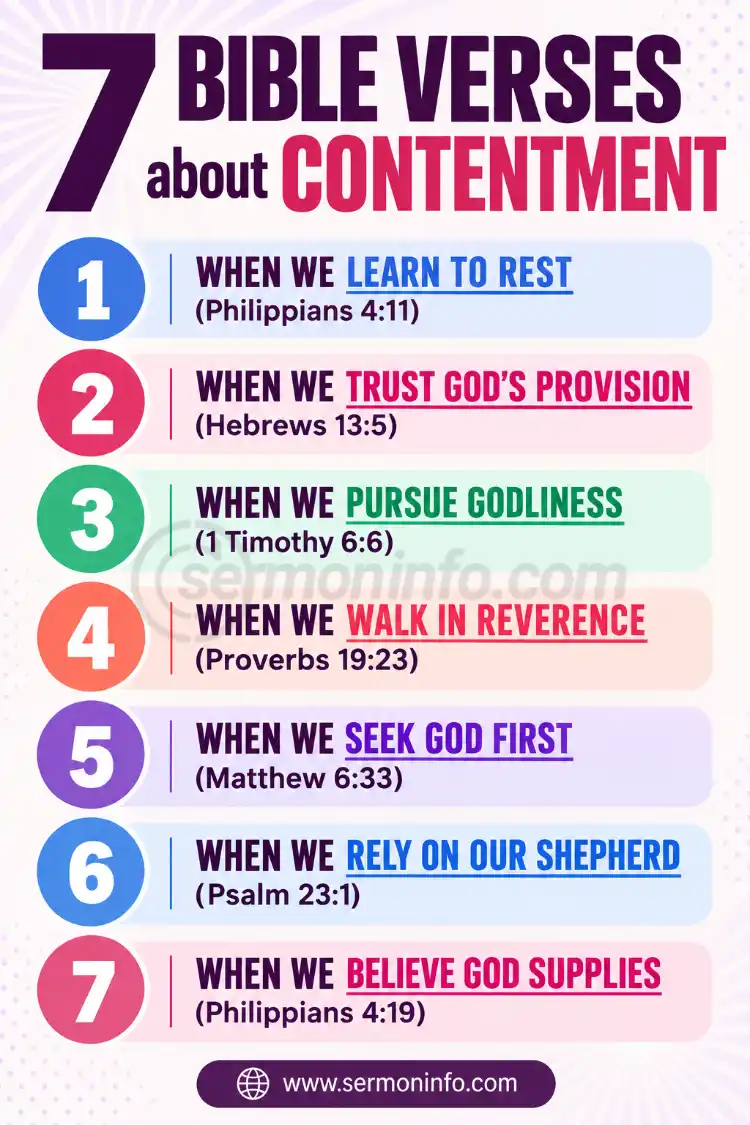
These 7 Bible verses about contentment teach us to find satisfaction in God’s presence and trust His faithful provision. Biblical contentment grows as we depend on Christ through changing circumstances and pursue godliness rather than possessions.

Key Takeaways – Finding Contentment in the Lord
- Contentment is Learned Through Trusting God’s Control – Philippians 4:11 reminds us that true peace grows as we rest in God’s sovereignty over every circumstance.
- Contentment Flows from God’s Presence and Promises – Hebrews 13:5 teaches that when we trust His faithful provision and nearness, we stop craving what the world can’t give.
- Contentment Comes with Godliness – 1 Timothy 6:6 shows that spiritual maturity brings greater satisfaction than material gain because Christ Himself is our greatest treasure.
- Contentment Grows from Reverence – Proverbs 19:23 calls us to live in awe of God, finding safety, peace, and satisfaction under His authority.
- Contentment Follows When We Seek God First – Matthew 6:33 encourages us to prioritize His kingdom and righteousness, trusting Him to meet every need.
- Contentment Is Found in the Shepherd’s Care – Psalm 23:1 reminds us that when the Lord is our Shepherd, we lack nothing essential for joy and peace.
- Contentment Trusts God’s Generous Supply – Philippians 4:19 assures us that God provides richly and faithfully according to His glorious abundance in Christ Jesus.
7 Bible Verses About Contentment
Contentment is one of those words we love to hear but struggle to live. In a world that constantly whispers, “You need more,” God invites us to discover peace in what we already have. True contentment doesn’t come from possessions or positions—it comes from a Person. The Apostle Paul learned this secret in every circumstance, finding joy because his heart rested in Christ.
I remember hearing about a farmer who complained his land wasn’t good enough. He sold it, bought another, and soon discovered his old farm was sitting on rich oil deposits. That’s how discontentment works—it blinds us to blessings already under our feet.
Today, we will examine seven verses in the Bible that teach us how to live fully satisfied in God’s care, confident that He provides all we need.
1. When We Learn to Rest
“I have learned, in whatsoever state I am, therewith to be content.” (Philippians 4:11)
A. We Rest in God’s Control
There’s real freedom when we stop trying to control everything and start trusting the One who already does. Paul didn’t learn contentment overnight—it came through surrender. When we believe God is sovereign over every detail, peace replaces panic, and trust silences worry. (Romans 8:28)
Sometimes God allows the unexpected to remind us He’s still in charge. When life doesn’t go our way, He’s working in ways we can’t see. Like a child resting in a father’s arms, we learn to stop striving and start believing that His control is enough.
B. We Rest in God’s Purpose
When we know our lives belong to Christ, even hard moments have meaning. Paul saw his prison chains as part of God’s greater plan. Every trial becomes a tool for shaping our faith and revealing His goodness. (Philippians 1:12)
Resting in God’s purpose means we stop asking, “Why me?” and start asking, “What now, Lord?” Each season holds a divine assignment. God wastes nothing. Even our waiting seasons prepare us for His next work in and through us.
2. When We Trust God’s Provision
“Be content with what you have, for He has said, ‘I will never leave you nor forsake you.'” (Hebrews 13:5)
A. We Trust God’s Presence
Contentment grows when we remember God never walks away. People may fail us, but He never does. His presence fills every empty space and calms every anxious heart. (Joshua 1:9)
When we stop measuring security by what we own and start resting in who walks with us, peace returns. God’s nearness is worth more than anything this world offers.
B. We Trust God’s Promise
God’s promises are not fragile—they are firm. When He says He will not forsake us, He means it. Every promise carries the full weight of His faithfulness. (2 Corinthians 1:20)
We trust that His Word is stronger than our worry. When we hold onto His truth, we find steady ground even when life shakes beneath us.
This material provides some ideas and thoughts for a message about finding contentment in the Lord (7 Bible Verses About Contentment).
3. When We Pursue Godliness
“But godliness with contentment is great gain.” (1 Timothy 6:6)
A. We Pursue Eternal Values
The world says, “Get more.” God says, “Become more.” True gain is not what fills our hands but what fills our hearts. (Matthew 6:20)
When we chase eternal things—faith, love, integrity—we discover that godliness always produces peace. What we store in heaven can never be lost or stolen.
B. We Pursue Spiritual Growth
We grow content when we grow closer to Christ. The more we know Him, the less this world can tempt or trouble us. (2 Peter 3:18)
Every day is a new chance to deepen our roots in His Word. As spiritual maturity grows, our dependence on temporary things fades.
4. When We Walk in Reverence
“The fear of the Lord leads to life; then one rests content, untouched by trouble.” (Proverbs 19:23)
A. We Walk in Awe of God
When we see God for who He is—holy, mighty, and merciful—our hearts settle into peace. Awe leads to assurance. (Psalm 33:8)
Reverence keeps us grounded. The more we respect His authority, the more we trust His care. Fear of the Lord is not dread—it’s deep devotion.
B. We Walk in Right Priorities
When God is first, everything else finds its place. Contentment follows order, and order follows reverence. (Matthew 6:21)
We stop chasing what doesn’t last and start investing in what does. Reverence realigns our hearts to live for what pleases Him, not just us.
5. When We Seek God First
“But seek first the kingdom of God and His righteousness, and all these things shall be added to you.”
A. We Seek His Kingdom Above All
When God’s kingdom becomes our priority, anxiety loses its grip. We live with purpose, not panic. (Colossians 3:2)
Seeking God first means trusting Him to provide what we truly need. When our hearts are focused on His rule, our minds find rest.
B. We Seek His Righteousness Daily
Contentment grows when holiness becomes our goal. Each day we choose righteousness over restlessness. (Psalm 37:4)
We don’t chase peace—it comes when we chase Christ. As we walk in obedience, our hearts experience the deep satisfaction of pleasing God.
6. When We Rely on Our Shepherd
“The Lord is my Shepherd; I shall not want.”
A. We Rely on His Care
The Shepherd knows what His sheep need. He leads us to still waters and restores our souls when life feels dry. (Psalm 23:2–3)
We don’t have to figure it all out. When we trust His care, we rest in the assurance that His guidance never fails.
B. We Rely on His Sufficiency
When the Lord is our Shepherd, we never walk empty. He provides not always what we want, but what we truly need. (Philippians 4:19)
Relying on His sufficiency means living like He is enough—because He is. His presence fills every gap and satisfies every longing.
7. When We Believe God Will Supply
“And my God shall supply all your need according to His riches in glory by Christ Jesus.” (Philippians 4:19)
A. We Believe God Is Able
God’s ability is not limited by our resources. His supply flows from His riches, not our reserves. (Ephesians 3:20)
We can rest easy knowing His hands are never empty. Faith sees beyond the lack and trusts His limitless power to provide.
B. We Believe God Is Generous
Our Father delights in giving good gifts to His children. His generosity is measured not by scarcity but by abundance. (James 1:17)
When we believe He gives from love, not obligation, contentment grows. Every blessing reminds us that His heart is kind and His grace is enough.
Conclusion
When we rest in God’s control, trust His provision, and seek His kingdom first, we discover contentment that no circumstance can steal. Each of these truths reminds us that peace doesn’t depend on what we hold—it depends on who holds us.
We can live content because Christ is enough. He is our Shepherd, our Provider, our Source of every good thing. The more we pursue Him, the more we find that joy follows obedience, and peace follows trust.
So, whatever season you’re in today, stop chasing the temporary and start embracing the eternal. Contentment isn’t the absence of need—it’s the presence of Christ in every need. And when we have Him, we truly have all.
Frequently Asked Questions (FAQ)
Q: What does the Bible say about contentment?
A: The Bible teaches that contentment is being satisfied with what we have, who we are, and where we’re going—in Christ rather than circumstances. Scripture includes clear commands like, “Keep your life free from the love of money, and be content with what you have” (Hebrews 13:5), showing that contentment is rooted in trusting God’s provision.
Q: Why is contentment important for a Christian life?
A: Contentment matters because it guards us from greed, anxiety, and chasing after what the world calls “more.” It aligns our hearts with God’s sufficiency, keeps our focus on eternal values, and enables us to live with peace even in difficult seasons.
Q: How can a believer cultivate contentment in practice?
A: A believer cultivates contentment by remembering who God is (sovereign, good), trusting His promises, practicing gratitude, renewing the mind in Scripture, and aligning with God’s purpose. It isn’t just a decision but a process of transformation through God’s grace.
Q: Can I be content and still have desires for change or improvement?
A: Yes. Being content does not mean the absence of any desire for more or change—it means our ultimate satisfaction lies in Christ, not our circumstances. We remain grateful for what is, hopeful for what will be, while trusting God in the meantime.
Q: What are some common obstacles to contentment for Christians?
A: Common obstacles include the love of money or possessions, comparison with others, fear of lacking, and forgetting God’s presence and promises. When we trust in things instead of Christ, contentment slips away.
BONUS: Is contentment a work of grace?
Yes, biblical contentment grows through God’s gracious work in our lives. Paul learned contentment through Christ’s strength, not through personal resolve alone (Philippians 4:11–13). God’s grace sustains us in weakness and teaches us to depend on Him. We cannot earn this grace; we receive His help through faith.
However, grace does not make us passive. We practice gratitude, reject greed, and trust God’s promises as He strengthens us. His grace trains us to reject worldly desires and live godly lives (Titus 2:11–12). Contentment grows as we respond to His gracious care with daily obedience.
BONUS: What is biblical contentment?
Biblical contentment means finding satisfaction in God while trusting His wisdom and provision through every circumstance. Paul learned this attitude through both abundance and need (Philippians 4:11–12). Contentment does not deny hardship or forbid improvement. It frees us from making possessions or comfort the foundation of our peace.
We express contentment when we thank God, use His gifts faithfully, and seek His kingdom first (Matthew 6:33). Hebrews 13:5 connects this attitude with His promise never to leave us. We can acknowledge unmet desires while trusting our Father’s care. His presence gives us security that possessions cannot provide.
BONUS: Why is the world so discontent?
The world’s discontent often grows from seeking lasting satisfaction in temporary things. Sin directs our desires toward possessions, recognition, and pleasure instead of God. Comparison fuels envy, while greed keeps demanding more. Ecclesiastes 5:10 explains that those who love money never find satisfaction in money.
Advertising and social pressure can strengthen these desires, but the deeper problem lies within our hearts. Jesus warned against greed because possessions cannot define a meaningful life (Luke 12:15). Through repentance and faith in Christ, we begin to pursue lasting treasure. Gratitude and generosity help us practice contentment (1 Timothy 6:6–8, 17–19).
BONUS: What is an example of contentment in the Bible?
Paul offers a clear example of biblical contentment. While imprisoned, he explained that he had learned contentment in every circumstance (Philippians 4:11–12). He knew both hunger and plenty, yet he trusted Christ through each experience. His satisfaction rested in his Savior rather than his surroundings.
Paul’s example teaches us that contentment grows through daily dependence on Christ. We can bring our needs to God without demanding easier circumstances. Christ gives us strength to remain faithful through hardship and abundance (Philippians 4:13). We practice contentment when we thank Him and trust His care.
BONUS: What did Jesus say about contentment?
Jesus taught that life does not consist in the abundance of possessions (Luke 12:15). He warned against greed because wealth cannot secure our lives or satisfy our deepest needs. His teaching directs our hearts toward God and challenges the belief that owning more always brings greater happiness.
Jesus also taught His followers to seek God’s kingdom and righteousness first (Matthew 6:33). Our heavenly Father knows our needs and cares for us. We cultivate contentment when we pursue His priorities, pray for daily provision, and trust Him with tomorrow (Matthew 6:11, 34).
BONUS: What is the secret of contentment in the Bible?
The secret of biblical contentment is dependence on Christ rather than changing circumstances. Paul learned to face both plenty and hunger through Christ’s strength (Philippians 4:12–13). Contentment does not require comfort or wealth. It grows as we trust our Savior to sustain us through whatever we face.
We nurture this trust through prayer, gratitude, and obedience to God’s Word. Hebrews 13:5 connects contentment with God’s promise never to leave His people. His presence gives us lasting security. As we pursue godliness, we learn to value fellowship with Him above material gain (1 Timothy 6:6).
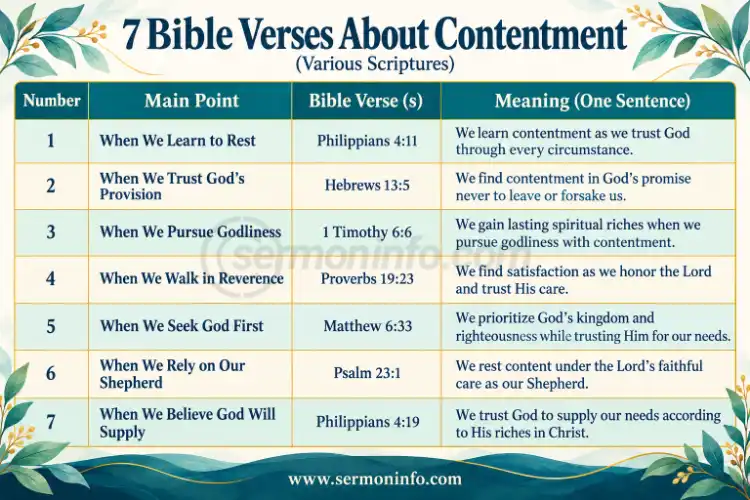
| Number | Main Point | Bible Verse | Meaning |
|---|---|---|---|
| 1 | We Learn to Rest | Philippians 4:11 | True contentment comes as we accept every circumstance and trust God’s sovereignty in our lives. |
| 2 | We Trust God’s Provision | Hebrews 13:5 | Contentment grows when we rely on God’s promises and His constant presence rather than worldly resources. |
| 3 | We Pursue Godliness | 1 Timothy 6:6 | Spiritual growth and godliness bring lasting satisfaction that money or possessions cannot provide. |
| 4 | We Walk in Reverence | Proverbs 19:23 | Reverence for the Lord cultivates peace and stability, helping us remain content amid life’s challenges. |
| 5 | We Seek God First | Matthew 6:33 | Prioritizing God’s kingdom and righteousness ensures our needs are met and our hearts find satisfaction. |
| 6 | We Rely on Our Shepherd | Psalm 23:1 | Recognizing the Lord as our Shepherd allows us to rest confidently, knowing we lack nothing essential. |
| 7 | We Believe God Will Supply | Philippians 4:19 | Trusting God’s generous provision brings peace and assurance that He will meet all our needs. |
Source Material
Believer’s Bible Commentary by William MacDonald (Commentary on the Whole Bible)
The MacArthur Bible Commentary by John MacArthur (Commentary on the Whole Bible)
Wiersbe Bible Commentaries by Warren Wiersbe (Commentary on the Whole Bible)
