Find encouragement in 7 Bible Verses About Confession of Sins that show God’s mercy, forgiveness, and the power of honest repentance.

Key Takeaways – 7 Bible Verses About Confession
- Confession brings forgiveness – 1 John 1:9 reminds us that when we confess our sins, God forgives and cleanses us completely.
- Confession restores fellowship – Psalm 32:5 shows that admitting sin removes barriers and brings renewed closeness with God.
- Confession strengthens community – James 5:16 teaches that confessing to one another builds accountability, prayer, and healing.
- Confession leads to mercy – Proverbs 28:13 declares that hiding sin brings ruin, but honest confession brings God’s mercy.
- Confession seeks renewal – Psalm 51 reveals that confession not only cleanses but also creates a new and pure heart.
- Confession requires humility – Daniel 9:20 shows that confession humbles us and even leads us to intercede for others.
- Confession shows sincerity – Psalm 38:18 reminds us that true confession carries sorrow for sin and sincerity to turn back to God.
7 Bible Verses About Confession
Sin has a way of piling up in our hearts like heavy stones in a backpack. It slows us down spiritually. David knew that weight when he cried, “My sin is ever before me” (Psalm 51:3). Unconfessed sin robs us of joy, blinds us to God’s presence, and leaves us restless in spirit.
But confession opens the floodgates of God’s mercy. It is not about shame but about freedom, not about hiding but about healing. When we confess, God is faithful and just to forgive us and cleanse us. That’s His promise in Christ.
Today, we will examine seven powerful verses that show why confession is not optional—it is essential for forgiveness, renewal, and fellowship.
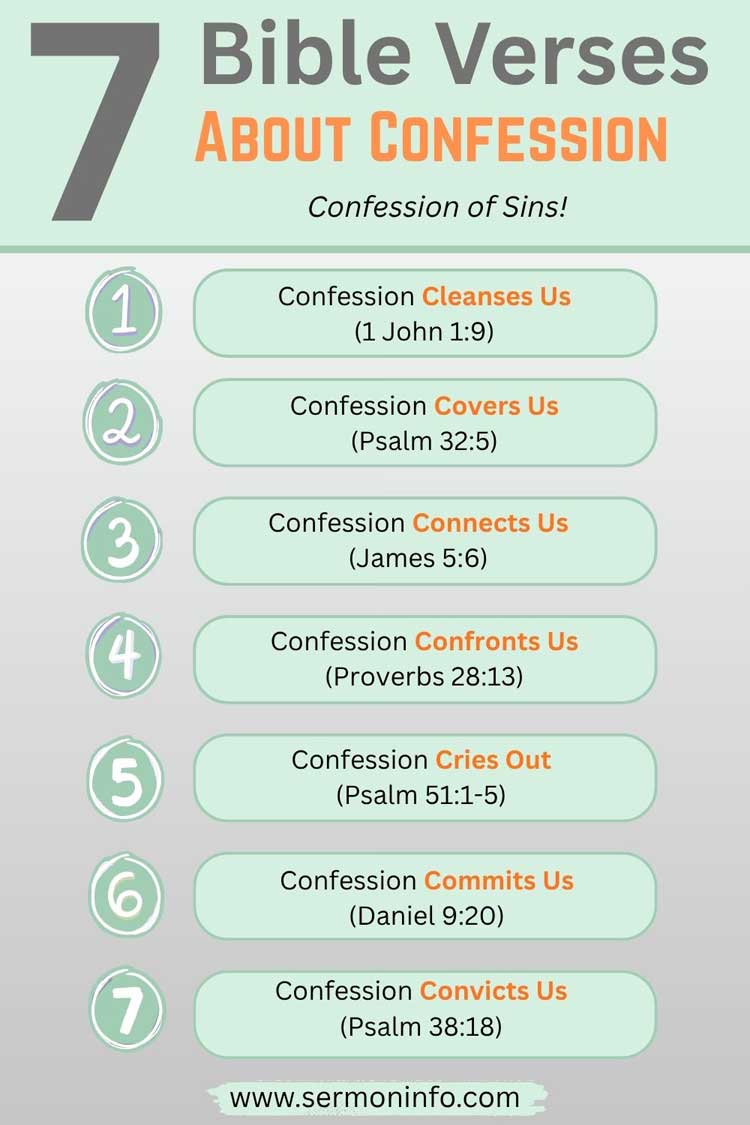
1. Confession Cleanses Us
“If we confess our sins, He is faithful and just to forgive us our sins and to cleanse us from all unrighteousness.” (1 John 1:9)
A. We receive God’s forgiveness
When we confess, God wipes our record clean through the blood of Jesus. Forgiveness is not earned but freely given. John says He is faithful and just to forgive us, meaning God never breaks His promise. He forgives because Christ’s sacrifice has already satisfied the penalty for sin.
Think about a chalkboard covered in mistakes. The moment we confess, God erases the record and writes His mercy over it. Psalm 103:12 says, “As far as the east is from the west, so far hath He removed our transgressions from us.” Confession allows us to live with a clear conscience.
B. We regain God’s fellowship
Unconfessed sin is like a wall between us and the Lord. The relationship remains, but the closeness is hindered. When we confess, that barrier crumbles, and intimacy is restored. We can once again walk in the light of His presence with peace and confidence.
Adam and Eve hid in the garden after sin entered. But when we come clean before God, He restores communion. 1 John 1:7 reminds us that if we walk in the light, we enjoy fellowship with Him and one another. Confession brings us back into unhindered relationship with God.
2. Confession Covers Us
“I acknowledged my sin to You, And my iniquity I have not hidden. I said, ‘I will confess my transgressions to the Lord,’ And You forgave the iniquity of my sin.” (Psalm 32:5)
A. We admit our failures
David stopped hiding his sin and confessed openly before God. He discovered that covering sin with excuses only deepened his guilt. Confession is the opposite of denial. It is honesty before the Lord who already knows our hearts.
When we try to cover sin ourselves, it festers. But when we admit our failures, God responds with grace. David said, “I acknowledged my sin unto thee … and thou forgavest” (Psalm 32:5). Confession is our admission ticket to mercy.
B. We accept God’s pardon
The beauty of confession is that forgiveness always follows. God never leaves true repentance unanswered. He covers what we could never cover. The burden of guilt is lifted because the debt has been paid in full.
Isaiah 1:18 assures us, “Though your sins be as scarlet, they shall be as white as snow.” Confession is the door to God’s pardon, and it restores joy to our hearts.
3. Confession Connects Us
“Confess your trespasses to one another, and pray for one another, that you may be healed. The effective, fervent prayer of a righteous man avails much.” (James 5:16)
A. We strengthen God’s people
Confession is not only vertical but also horizontal. James tells us to confess our faults one to another. Why? Because honesty builds accountability and trust. When we admit struggles, we invite others to walk with us in prayer.
The church is not a showcase for saints but a hospital for sinners. When we confess to one another, walls come down and relationships grow stronger. Confession becomes a pathway to encouragement.
B. We share God’s healing
James links confession with prayer and healing. Sometimes our hidden sins weigh on our bodies and souls. Confession invites God’s healing touch through the prayers of His people. Healing may be physical, emotional, or spiritual, but it flows through openness.
The Bible says, “The effectual fervent prayer of a righteous man availeth much.” When we confess, we allow others to pray boldly, and God often brings renewal and strength.
This material provides some ideas and thoughts for a message about confession (7 Benefits of the Confession of Sins).
4. Confession Confronts Us
“He who covers his sins will not prosper, But whoever confesses and forsakes them will have mercy.” (Proverbs 28:13)
A. We face our sin honestly
The one who hides sin will not prosper. That’s not a threat but a truth. Covering sin leads to misery and brokenness. Confession forces us to confront our sin for what it truly is, not what we excuse it to be.
David learned this the hard way. When he tried to cover his sin, his strength dried up (Psalm 32:3). But confession brought life again. Facing sin honestly is the beginning of healing.
B. We find God’s mercy
When we confess and forsake sin, God gives mercy. Mercy means God does not give us the judgment we deserve. Instead, He shows compassion.
Think of the prodigal son. He returned, confessing his sin, and the father ran to embrace him. Proverbs 28:13 promises the same. God’s mercy is greater than our worst failures.
5. Confession Cries Out
“Have mercy upon me, O God, According to Your lovingkindness; According to the multitude of Your tender mercies, Blot out my transgressions. Wash me thoroughly from my iniquity, And cleanse me from my sin. For I acknowledge my transgressions, And my sin is always before me. Against You, You only, have I sinned, And done this evil in Your sight—That You may be found just when You speak, And blameless when You judge. Behold, I was brought forth in iniquity, And in sin my mother conceived me.” (Psalm 51:1-5)
A. We cry for cleansing
David cried out, “Wash me thoroughly from mine iniquity, and cleanse me from my sin.” Confession is not casual. It is a cry for cleansing. We recognize sin has stained us, and only God can wash it away.
When we cry for cleansing, God responds with grace. 1 Corinthians 6:11 reminds us that we are washed, sanctified, and justified in Christ.
B. We cry for renewal
David also cried, “Create in me a clean heart, O God” (Psalm 51:10). Confession seeks not only forgiveness but renewal. We long for a heart that beats after God.
Confession brings transformation. God does not just forgive us; He changes us from the inside out. We cry for renewal because sin wears us down, but God restores strength and purity.
6. Confession Commits Us
“Now while I was speaking, praying, and confessing my sin and the sin of my people Israel, and presenting my supplication before the Lord my God for the holy mountain of my God.” (Daniel 9:20)
A. We commit to humility
Daniel prayed and confessed not only his own sins but also the sins of Israel. Confession begins with humility. We bow before God, admitting our desperate need. Humility opens the door for God’s favor.
James 4:6 says, “God resisteth the proud, but giveth grace unto the humble.” Confession keeps us small before God so He can be great in us.
B. We commit to interceding
Daniel confessed his people’s sins as though they were his own. True confession is never selfish. It leads us to intercede for others. We bring the sins of family, church, and nation before the throne.
This is powerful. God often works through intercessors who confess and pray. Confession becomes not only personal but communal, drawing others into God’s mercy.
7. Confession Convicts Us
“For I will declare my iniquity; I will be in anguish over my sin.” (Psalm 38:18)
A. We confess with sorrow
David declared, “I will be sorry for my sin.” True confession is never flippant. It carries the weight of genuine sorrow. Sin offends God and damages us, and confession means we feel the grief of that truth.
Paul described this as godly sorrow that produces repentance (2 Corinthians 7:10). Confession with sorrow leads to real change.
B. We confess with sincerity
Confession must be sincere, not mechanical. God sees the heart. He knows when words are empty or when repentance is real. Sincerity means we confess with a desire to turn from sin.
God honors sincerity. Isaiah 66:2 says He looks to the one who is humble and contrite in spirit. True confession convicts us and draws us closer to God’s holiness.
Concluding Summary
Confession is not a one-time act; it is a daily invitation to walk close with the Lord who forgives and restores. Sin may whisper, “Hide it,” but God says, “Bring it into the light.” Only there can mercy flow freely.
When we confess, we experience cleansing, renewal, healing, and freedom that no worldly substitute can ever provide. We rediscover fellowship with God and with others. Confession is not weakness—it is strength because it keeps us humble and dependent on Jesus.
So fellow believers in Jesus Christ, don’t carry that burden another step. Lay it down at the cross today. Confess, be cleansed, and walk in the joy of God’s forgiveness and fellowship.
Source Material
Believer’s Bible Commentary by William MacDonald (Commentary on the Whole Bible)
The MacArthur Bible Commentary by John MacArthur (Commentary on the Whole Bible)
Wiersbe Bible Commentaries by Warren Wiersbe (Commentary on the Whole Bible)
Systematic Theology by Wayne Grudem
Christian Theology by Millard J. Erickson
The Moody Handbook of Theology by Paul Enns
Biblical Doctrine by John MacArthur and Richard Mayhue
Frequently Asked Questions (FAQ)
Q: What does the Bible say about confessing sins?
A: The Bible teaches that confession is essential for receiving God’s forgiveness and cleansing. 1 John 1:9 assures us that if we confess our sins, God is faithful and just to forgive and purify us. Confession restores our fellowship with God and brings healing to our souls.
Q: Why is confessing sins important in Christianity?
A: Confession is vital because it acknowledges our wrongdoing and aligns our hearts with God’s will. Proverbs 28:13 warns that hiding sins leads to no prosperity, but confessing and forsaking them brings mercy. It opens the door to forgiveness, healing, and spiritual renewal.
Q: Does God forgive all sins if we confess?
A: Yes, God forgives all confessed sins. Psalm 103:12 states that as far as the east is from the west, so far has God removed our transgressions from us. Confession is the pathway to experiencing God’s boundless mercy and grace.”
Q: How should we confess our sins to God?
A: Confession should be sincere, specific, and humble. Psalm 51:17 emphasizes that God desires a broken spirit and a contrite heart. Approach God with honesty, acknowledging your sins, and seeking His forgiveness and restoration.
Q: Is confessing sins to others necessary?
A: James 5:16 encourages confessing sins to one another and praying for each other so that we may be healed. While God forgives us directly, confessing to trusted fellow believers fosters accountability, healing, and strengthens the body of Christ.
| Number | Main Point | Bible Verse | Meaning |
|---|---|---|---|
| 1 | Confession Cleanses Us | 1 John 1:9 | Confessing sin brings God’s forgiveness and purifies our hearts through Christ’s blood. |
| 2 | Confession Covers Us | Psalm 32:5 | Admitting sin openly removes guilt and allows us to receive God’s mercy. |
| 3 | Confession Connects Us | James 5:16 | Confession to others builds accountability, encourages prayer, and promotes spiritual healing. |
| 4 | Confession Confronts Us | Proverbs 28:13 | Facing and confessing sin honestly leads to mercy, while hiding sin leads to ruin. |
| 5 | Confession Cries Out | Psalm 51:1-5 | Confession expresses sorrow for sin and pleads for God’s cleansing and heart renewal. |
| 6 | Confession Commits Us | Daniel 9:20 | Confession humbles us and strengthens our commitment, including interceding for others. |
| 7 | Confession Convicts Us | Psalm 38:18 | Sincere confession shows true remorse and leads to turning away from sin toward God. |