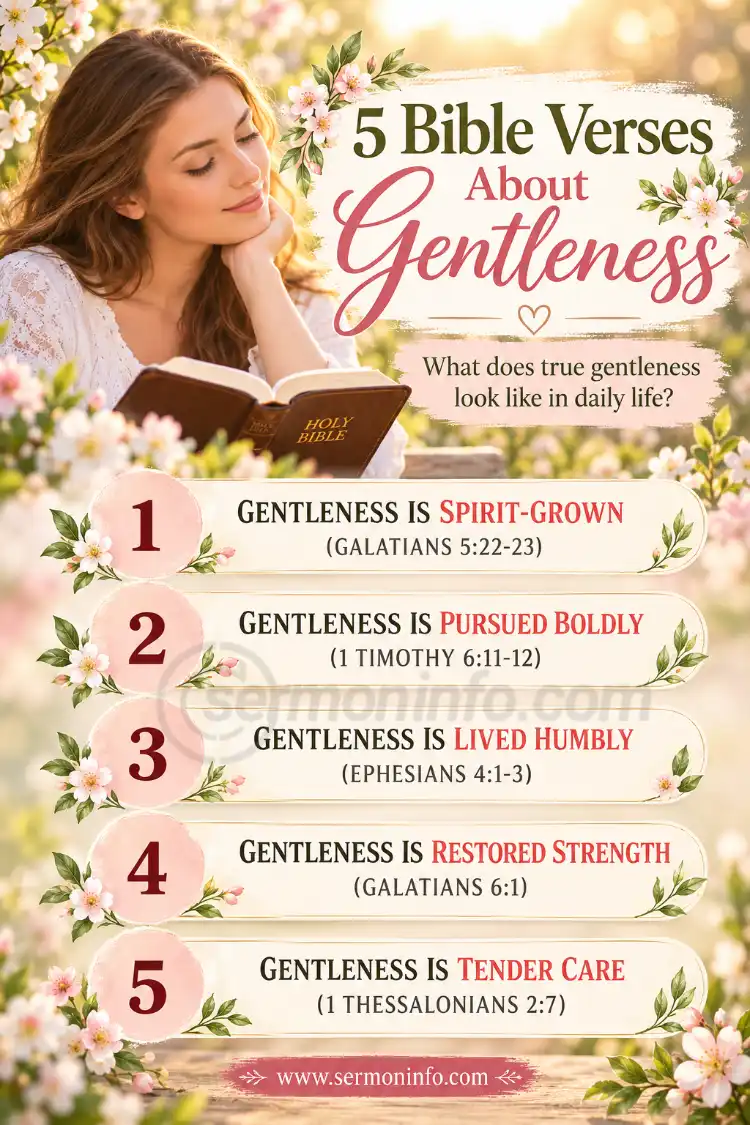
The 5 Bible Verses About Gentleness teach that biblical gentleness is Spirit-empowered strength expressed through humility, patience, and love. Gentleness does not mean weakness. It reflects Christlike character through self-control, compassionate correction, and tender care. God calls believers to pursue gentleness and demonstrate His grace in everyday relationships (Galatians 5:22–23; Ephesians 4:2).

Key Takeaways – 5 Bible Verses About Gentleness
- Gentleness is a fruit of the Holy Spirit (Galatians 5:22–23), developed in a surrendered heart through daily spiritual growth.
- Gentleness must be pursued with intention (1 Timothy 6:11–12), showing that it requires strength, discipline, and courage in the Christian life.
- True gentleness flows from humility (Ephesians 4:1–3) and plays a vital role in maintaining unity and peace in relationships.
- Gentleness restores others with grace (Galatians 6:1), offering correction with compassion and remembering our shared need for mercy.
- Biblical gentleness reflects Christlike care (1 Thessalonians 2:7), especially when we respond with patience and love in everyday interactions.
NOTE: These five Bible verses about gentleness reveal that gentleness is not weakness, but Spirit-empowered strength that transforms how we lead, speak, and love.
5 Bible Verses About Gentleness
Have you ever noticed how rare gentleness has become in a world that often celebrates the loudest voice and the harshest opinion? We live in a culture that rewards strength, but often forgets that gentleness is strength under control. It’s the quiet force that calms storms, softens hearts, and reflects the character of Jesus in our daily lives.
When Paul told Timothy to pursue gentleness, he wasn’t suggesting weakness. He was calling him to spiritual maturity and relational wisdom. Whether you’re raising kids, resolving conflict, or simply walking through your day, gentleness matters deeply. It shapes how we love, how we serve, and how we restore broken people.
So today, we’re going to explore 5 Bible Verses About Gentleness—not as a soft suggestion, but as a powerful invitation. These verses aren’t just for pastors or peacemakers; they’re for every one of us who wants to follow Jesus well in our relationships.
1. Gentleness Is Spirit-Grown
“But the fruit of the Spirit is love, joy, peace, longsuffering, kindness, goodness, faithfulness, gentleness, self-control. Against such there is no law.” (Galatians 5:22–23)
A. Grown by the Spirit
Gentleness isn’t something we grit our teeth and force. It’s not a natural personality trait, like being quiet or shy. It’s supernatural. Paul tells us in Galatians 5 that gentleness is part of the fruit the Holy Spirit grows in us when we walk with Him. It’s not manufactured—it’s cultivated through surrender.
The closer we stay to Jesus, the more His character becomes our own. You can’t fake real gentleness—it’s the Spirit’s work in a yielded heart. Just like a tree doesn’t strain to bear fruit, we simply abide, and He produces gentleness in us (John 15:4–5). So if you’re struggling with harshness, don’t try harder—draw closer to the Lord.
B. Guarded by Self-Control
It’s no accident Paul pairs gentleness with self-control. These two go hand in hand like a bridle and bit on a strong horse. True gentleness doesn’t mean we’re weak—it means we have strength that’s been submitted to the Spirit and guided by wisdom.
Self-control is what keeps gentleness steady when emotions want to take over. Proverbs 16:32 says, “He who rules his spirit is better than one who takes a city.” Anyone can lash out, but it takes Spirit-empowered self-control to respond with calm strength. That’s not natural—it’s spiritual maturity. And it’s exactly what the world needs more of today.
“This material provides some ideas and thoughts for a message on Godly Gentleness from 5 Bible Verses.
2. Gentleness Is Pursued Boldly
“But you, O man of God, flee these things and pursue righteousness, godliness, faith, love, patience, gentleness. Fight the good fight of faith, lay hold on eternal life, to which you were also called and have confessed the good confession in the presence of many witnesses.” (1 Timothy 6:11–12)
A. Pursued as a Calling
Paul doesn’t tell Timothy to “feel gentle”—he says, pursue it. That word means to chase after it with intention and urgency. Gentleness isn’t optional or automatic. It’s something believers must seek as part of our calling to godliness, especially in a culture that applauds aggression and pride.
Pursuing gentleness takes effort, just like pursuing righteousness, faith, or love. But it’s worth the fight. In your workplace, your family, or even online, make gentleness your aim. Ask the Lord each day, “Help me walk in Your gentleness today.” He honors that kind of desire with grace and power.
B. Paired with Courage
Gentleness and courage may seem like opposites, but they belong together in the life of a disciple. Paul tells Timothy to fight the good fight, right after telling him to pursue gentleness. That’s no mistake. Being gentle doesn’t mean backing down from truth—it means standing firm with a Christlike spirit.
Jesus was bold in truth but tender in tone. He spoke hard things with soft hands. Courage speaks the truth; gentleness delivers it with grace. Whether you’re correcting, confronting, or just holding the line, let your strength be clothed in gentleness. That’s spiritual maturity in action.
3. Gentleness Is Lived Humbly
“I, therefore, the prisoner of the Lord, beseech you to walk worthy of the calling with which you were called, with all lowliness and gentleness, with longsuffering, bearing with one another in love, endeavoring to keep the unity of the Spirit in the bond of peace.” (Ephesians 4:1–3)
A. Lived Through Lowliness
Paul urges us to walk in a manner worthy of our calling—with all humility and gentleness. You can’t have one without the other. Gentleness flows from lowliness of heart. It shows up when we stop thinking more of ourselves than we should. It takes humility to stay calm when pride wants to be loud.
The humble heart listens more, demands less, and values others. That’s where gentleness lives. It’s not about thinking less of yourself—it’s about thinking of yourself less. When you view people as God sees them, you respond with grace instead of dominance. That’s the way of Jesus (Philippians 2:3–5).
B. Linked with Unity
Gentleness is a bridge-builder. Paul says gentleness helps us keep the unity of the Spirit in the bond of peace. Without it, relationships fracture. In any group—church, family, friendships—gentleness helps us bear with one another in love and walk through tension with peace instead of pride.
Want to preserve unity in your marriage or your church? Stay gentle. Gentleness diffuses arguments and de-escalates drama. When you choose to answer softly instead of sharply, you keep the door open for reconciliation. That’s where unity lives—in the quiet strength of a gentle spirit.
4. Gentleness Is Restorative Strength
“Brethren, if a man is overtaken in any trespass, you who are spiritual restore such a one in a spirit of gentleness, considering yourself lest you also be tempted.” (Galatians 6:1)
A. Restores with Compassion
When someone falls, the world often cancels or condemns. But Paul says, restore them in a spirit of gentleness. That’s God’s way. Gentleness doesn’t ignore sin—it just approaches it with mercy. It seeks healing, not humiliation. It speaks truth, but with tears in its eyes.
Jesus restored Peter gently, not harshly, after his denial. He didn’t shame him—He met him with grace and invited him back into service (John 21:15–17). We’re called to do the same. When someone stumbles, don’t just point to the fall—offer a hand to lift them back up.
B. Remembers Our Own Weakness
Paul reminds us to consider ourselves when restoring others. Why? Because we’re just as human. Gentleness comes when we remember we’re all capable of falling. When we forget that, we become judgmental instead of redemptive. But humility gives birth to gentle correction.
Instead of standing above others, gentleness kneels beside them. It says, “I’ve needed grace too.” That’s what makes restoration possible. The most powerful ministry often flows from the most broken, healed hearts—hearts that remember mercy and pass it on.
5. Gentleness Is Tender Care
“But we were gentle among you, just as a nursing mother cherishes her own children.” (1 Thessalonians 2:7)
A. Reflects Deep Affection
Paul says he cared for the Thessalonians like a nursing mother cherishes her child. That’s gentleness rooted in deep, sacrificial love. It’s not mechanical—it’s relational. It nurtures, protects, and patiently walks alongside others in love. That kind of gentleness isn’t weak—it’s tender-hearted strength.
Think about how a mother calms her child. That’s how Paul ministered. That’s how Jesus meets us. And that’s how we’re called to love one another. Whether you lead, parent, teach, or serve, let love fuel your gentleness—it makes your care unforgettable.
B. Responds with Patience
Gentleness shows itself most when people are at their worst—when they’re slow, stubborn, hurting, or needy. In those moments, gentleness doesn’t push. It waits. It doesn’t demand change—it walks patiently through the process. That’s the heart of Christ.
2 Timothy 2:24–25 says the Lord’s servant must be gentle, patiently instructing those in opposition. Why? Because God may grant them repentance. Gentleness makes room for transformation. And sometimes, the most powerful thing you can do is simply stay kind when it would be easier not to.
Conclusion
Gentleness may seem small in a loud world, but it carries the quiet power of Christ into every relationship we touch. When we walk in the Spirit, pursue it boldly, live it humbly, restore others with it, and care deeply through it—lives change.
Jesus, gentle and lowly in heart, invites us to follow His way (Matthew 11:29). He never yelled His love—He lived it. So this week, let’s choose gentleness. At home, at work, and with strangers—reflect Christ through kindness that speaks louder than words
Frequently Asked Questions (FAQ)
Q: What does the Bible say about gentleness?
A: The Bible describes gentleness (Greek prautēs) as humble, compassionate strength—an essential fruit of the Spirit that tempers power with grace.
Q: Is gentleness a sign of weakness?
A: No. Scripture makes it clear that gentleness isn’t weakness. It involves self-control and restrained behavior toward others, showing real inner strength.
Q: How can I cultivate gentleness?
A: Gentleness grows through daily surrender to the Holy Spirit, intentional pursuit, humility, and patience—all reinforced by regular Scripture study and prayer.

BONUS: What is a good Bible verse for gentleness?
Galatians 5:22–23 gives a strong verse for gentleness. Paul lists gentleness as part of the fruit of the Spirit. That verse shows that gentleness does not grow from self-effort alone. God produces it in believers as they walk with Him and obey His truth.
Matthew 11:29 also gives a beautiful verse for gentleness. Jesus said, “I am gentle and lowly in heart.” That verse points us directly to Christ. He not only teaches gentleness, but He also shows us what gentle strength looks like in everyday life.
BONUS: What are examples of gentleness in the Bible?
Jesus gives the clearest example of gentleness. He welcomed children, restored sinners, and dealt kindly with the weak. In John 8:1–11, He confronted sin without cruelty. In Matthew 21:5, He entered Jerusalem in humility. His gentleness always worked together with truth.
Moses also showed gentleness. Numbers 12:3 calls him very meek. Abigail acted gently when she calmed David’s anger in 1 Samuel 25:23–35. Paul urged believers to restore others gently in Galatians 6:1. These examples show gentleness in speech, actions, and correction.
BONUS: What is a good definition of biblical gentleness?
Biblical gentleness means humble strength under God’s control. It does not mean weakness or compromise. It describes a heart that submits to God and treats others with patience and care. Galatians 5:23 and Ephesians 4:2 connect gentleness with Spirit-filled character and loving relationships.
Biblical gentleness speaks truth without harshness and corrects others without pride. Proverbs 15:1 says a soft answer turns away wrath. Second Timothy 2:24–25 tells the Lord’s servant to correct opponents with gentleness. Gentleness reflects Christ and seeks another person’s good.
Source Material
Believer’s Bible Commentary by William MacDonald
The MacArthur Bible Commentary by John MacArthur
