When Judgment Is Not Final (Sermon Outline From Hosea 13:1–16) teaches that God judges idolatry and rebellion with holiness and justice. Yet He remains sovereign over nations, death, and the grave. The passage warns against resisting God while reminding us that He alone has the final word.

Key Takeaways – Sermon From Hosea 13:1-16
- God exposes false worship. Hosea 13 warns us not to replace God with money, success, approval, or anything else. Give Him first place in your heart.
- Rebellion brings real consequences. Israel harmed itself by rejecting God and resisting His correction. Respond quickly when God’s Word exposes sin, and return to Him with humility.
- God still has the final word. Judgment is serious, but God remains sovereign over nations, death, and the grave. Trust His authority, receive His warnings, and rest in His ultimate victory through Christ.
Sermon Outline From Hosea 13:1-6
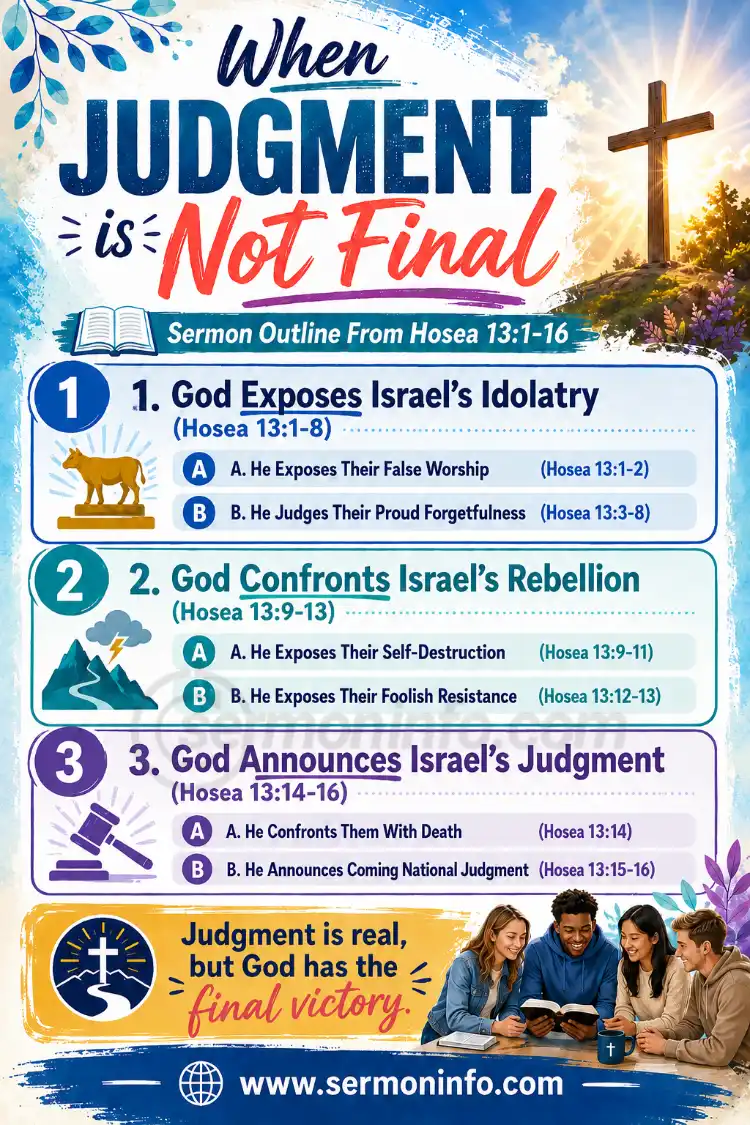
Judgment is real, and Hosea 13 never treats sin lightly. Israel’s idolatry and rebellion brought painful consequences under God’s holy hand. Yet even in judgment, God remains sovereign. He still rules over nations, death, and the grave. God has the final word, and Scripture ultimately reveals His victory through Jesus Christ.
In this message, we will see God expose Israel’s idolatry, confront their rebellion, and announce coming judgment. Each movement warns us against replacing God, resisting His correction, or trusting human strength. Yet Hosea also reminds us that God remains sovereign when judgment falls. Therefore, we should hear His warnings, return to Him, and trust His saving power.
1. God Exposes Israel’s Idolatry (Hosea 13:1–8)
Israel abandoned the Lord for idols, and God exposed the pride and spiritual decline that followed. (Summary Statement)
A. He Exposes Their False Worship (Hosea 13:1–2)
Ephraim once commanded respect, but Baal worship brought spiritual ruin (Hosea 13:1). Israel kept sinning and made silver idols (13:2). Their own craftsmen shaped gods that could neither speak nor save. Israel exchanged the living God for lifeless objects. False worship always takes our hearts away from the Lord.
We may never bow before a silver calf, but modern idols still compete for our hearts. Money, success, pleasure, possessions, or approval can become more important than God. First John 5:21 warns, “keep yourselves from idols.” Ask yourself what receives your deepest affection and trust. Give God the place that belongs to Him alone.
B. He Judges Their Proud Forgetfulness (Hosea 13:3–8)
God reminded Israel that He delivered them from Egypt and cared for them in the wilderness (Hosea 13:4–5). Yet abundance changed their attitude. “They were filled and their heart was exalted” (13:6). Instead of thanking God for His provision, they forgot Him. Their blessings became a doorway to pride rather than gratitude.
Therefore, God warned that Israel would disappear like morning mist and windblown chaff (Hosea 13:3). His judgment would come with the force of a lion and bear (13:7–8). Prosperity can make us forget how much we need God. Receive every blessing with gratitude, remember the Giver, and keep trusting Him in every season. (Source Material: William MacDonald, Believer’s Bible Commentary, pp. 1103-1104)
This material provides some ideas and thoughts for a sermon outline from Hosea 13:1-16 (When Judgment is Not Final).
2. God Confronts Israel’s Rebellion (Hosea 13:9–13)
Israel’s rebellion brought self-destruction because they rejected the God who alone could help them. (Summary Statement)
A. He Exposes Their Self-Destruction (Hosea 13:9–11)
God told Israel, “O Israel, you are destroyed, but your help is from Me” (Hosea 13:9). Their greatest problem came from rejecting the One who could save them. They trusted kings and rulers instead of God. Human leadership could not rescue a nation that had turned its heart away from the Lord.
We can make the same mistake when we trust people, plans, or power more than God. Good leaders have value, but they cannot replace Him. Psalm 118:9 says, “It is better to trust in the Lord than to put confidence in princes.” Real security begins when we return our confidence to God.
B. He Exposes Their Foolish Resistance (Hosea 13:12–13)
Israel’s sin had accumulated before God. Hosea said, “The iniquity of Ephraim is bound up; his sin is stored up” (Hosea 13:12). Yet Israel still resisted repentance. Verse 13 compares them to an unwise child who refuses to move forward at the time of birth. Their delay only increased their danger.
God still calls people to respond when He exposes sin through His Word. Delayed repentance can strengthen a stubborn heart. Proverbs 28:13 teaches that whoever confesses and forsakes sin “will have mercy.” When God corrects us, we should respond quickly, humbly, and honestly. His correction calls us back to fellowship and faithful obedience. (Source Material: John MacArthur, The MacArthur Bible Commentary, pp. 980-981)
3. God Announces Israel’s Judgment (Hosea 13:14–16)
God announced severe judgment because Israel continued to rebel against Him without repentance. (Summary Statement)
A. He Confronts Them With Death (Hosea 13:14)
God brings Israel face to face with death and the grave in Hosea 13:14. Neither power operates outside His sovereign rule. Israel could not escape judgment by human strength or national pride. God alone holds authority over life and death. His words remind us that sin carries serious consequences before a holy God.
Yet Scripture later shows that God also has final victory over death. Paul echoes Hosea in 1 Corinthians 15:55, saying, “O Death, where is your sting?” Through Christ’s resurrection, believers have eternal hope. Death remains an enemy, but it cannot defeat God’s saving purpose. Therefore, we can trust Him even when life feels uncertain.
B. He Announces Coming National Judgment (Hosea 13:15–16)
God warned that an east wind would come and strip Ephraim of its treasures (Hosea 13:15). This pictured the coming Assyrian invasion. Samaria faced destruction because “she has rebelled against her God” (13:16). Israel had resisted repeated warnings, so God allowed severe national judgment to fall upon them.
This warning teaches us never to treat persistent rebellion lightly. God remains patient, but His patience never cancels His holiness. Galatians 6:7 warns, “whatever a man sows, that he will also reap.” When God corrects us, we should respond with humility. His warnings call us to repentance, renewed trust, and faithful obedience. (Source Material: John F. Walvoord and Roy B. Zuck, The Bible Knowledge Commentary: Old Testament, pp. 1405-1406)
Conclusion
Hosea 13 shows us the tragic path from idolatry to rebellion and finally judgment. God exposed Israel’s false worship and proud forgetfulness. He confronted their self destruction and foolish resistance. Finally, God announced judgment and confronted them with death. Yet God remained sovereign through it all, and He alone had the final word.
This passage calls us to examine our hearts and take God’s warnings seriously. We must reject modern idols, remember God’s goodness, and respond quickly when His Word exposes sin. Judgment is real, but God has the final victory. Through Christ, believers can face even death with hope because God gives victory through our Lord Jesus Christ (1 Corinthians 15:57).
Closing Prayer
Heavenly Father, thank You for Your holiness, mercy, and sovereign authority. Guard our hearts from idols, pride, and stubborn rebellion. Help us remember Your goodness and respond quickly when Your Word corrects us. Give us humble hearts that trust You, obey You, and honor You each day.
Lord Jesus, thank You that judgment and death do not have the final victory. You conquered death through Your resurrection and give us eternal hope. Help us live faithfully, trust You in difficult times, and proclaim Your saving grace. May our lives bring glory to Your name. We pray this in Jesus’ name, Amen.
Frequently Asked Questions (FAQ)
Q: What is the main message of Hosea 13?
A: Hosea 13 teaches that Israel’s idolatry, pride, and rebellion brought God’s judgment. The nation forgot the Lord who had delivered and provided for them. Yet God remained sovereign over rulers, nations, death, and the grave. The chapter warns us to reject idols and trust God alone.
Q: Why did God judge Israel in Hosea 13?
A: God judged Israel because they turned to Baal, trusted handmade idols, became proud, and forgot Him. Their rebellion continued despite repeated warnings. Hosea 13 shows that God takes persistent sin seriously. His judgment flowed from His holiness and Israel’s refusal to return to Him.
Q: What does Hosea 13:14 mean?
A: Hosea 13:14 declares God’s sovereign authority over death and the grave. In the immediate context, Israel faces severe judgment, and God will not overlook persistent rebellion. Paul later uses Hosea’s death language in 1 Corinthians 15:54–55 to celebrate Christ’s ultimate victory over death.
Q: What does Hosea 13 teach about idolatry?
A: Hosea 13 shows that idolatry begins when people give something God’s rightful place. Israel trusted Baal and silver idols instead of the Lord. Modern idols may include money, success, comfort, or approval. God calls us to give Him our deepest worship, confidence, and devotion.
Q: How can Hosea 13 encourage believers today?
A: Hosea 13 encourages believers to take God’s warnings seriously while trusting His sovereign authority. Sin brings consequences, but God never loses control. He rules over nations, circumstances, death, and the grave. Believers can respond through repentance, faithful obedience, and confidence in Christ’s final victory.
BONUS: Who is Ephraim in Hosea 13, and why was he exalted in Israel?
Ephraim was one of Joseph’s sons and became a leading tribe in northern Israel. Jacob gave Ephraim a prominent blessing in Genesis 48:19–20. By Hosea’s day, “Ephraim” often represented the northern kingdom. Hosea 13:1 says Ephraim once commanded respect and held great influence among the tribes.
Yet Ephraim abused that privileged position. The people turned from the Lord to Baal, and their idolatry brought spiritual ruin (Hosea 13:1–2). Their story warns us that influence and blessing never replace faithful obedience. God desires grateful hearts that honor Him rather than pride that forgets Him.
BONUS: What does “they forgot Me” in Hosea 13:6 teach about pride and prosperity?
“They forgot Me” in Hosea 13:6 shows how prosperity fed Israel’s pride. God had cared for them in the wilderness and supplied their needs (Hosea 13:5). Yet abundance lifted their hearts, and they stopped depending on Him. Blessing became dangerous when gratitude disappeared and self confidence replaced trust in God.
Prosperity can still tempt believers to forget the Giver. Deuteronomy 8:11 warns, “Beware that you do not forget the Lord your God.” God’s gifts should deepen worship, not weaken it. When life goes well, thank Him, remember His provision, and keep your heart humble before Him.
BONUS: What does the unwise son picture mean in Hosea 13:13?
The “unwise son” in Hosea 13:13 pictures Israel refusing to respond when the moment demanded action. Hosea compares Ephraim to a child who will not move through the birth canal. The crisis had arrived, yet Israel resisted repentance. Their foolish delay increased the danger instead of bringing deliverance.
The picture warns us not to resist God when He exposes sin. Proverbs 28:13 says those who confess and forsake sin receive mercy. Delayed repentance can deepen stubbornness. When God corrects us through His Word, we should respond quickly, humbly, and sincerely.
BONUS: Why does God use lion, leopard, and bear imagery in Hosea 13:7–8?
God uses lion, leopard, and bear imagery in Hosea 13:7–8 to show the severity of His judgment. Israel had forgotten the Lord and trusted its own strength. God therefore pictured Himself as a fierce predator confronting stubborn rebellion. The images warn that His holiness cannot ignore persistent sin.
These animals also show that judgment would come suddenly and powerfully. Hosea says God would meet them “like a bear deprived of her cubs” (Hosea 13:8). The warning calls us to take sin seriously. God shows patience, but He also acts with justice when people continually reject Him.
BONUS: Why could Israel’s kings not save them in Hosea 13:10–11?
Israel’s kings could not save them because the nation trusted human rulers instead of God. Hosea 13:10 asks, “Where is any other, that he may save you?” Israel had demanded kings, but political power could not rescue them from divine judgment. Only the Lord possessed the power to deliver His people.
God says, “I gave you a king in My anger, and took him away in My wrath” (Hosea 13:11). Israel learned that human leadership cannot replace dependence on God. Leaders have limits, but God does not. We should respect human authority while placing our deepest confidence in the Lord alone.
BONUS: What does the east wind symbolize in Hosea 13:15?
The “east wind” in Hosea 13:15 symbolizes God’s coming judgment through Assyria. This hot, destructive wind came from the desert and dried up springs and wells. Hosea uses the image to show how Assyria would sweep across Israel, destroy its prosperity, and carry away its treasures.
Israel appeared fruitful, but rebellion made its security temporary. Hosea 13:15 warns that “the east wind shall come” and “his spring shall become dry.” God’s blessings never give us permission to ignore Him. The verse calls us to reject false security, obey God, and trust Him above material success.
| Sermon Outline From Hosea 13:1-16 – Sermon Outlines From Hosea | |||
|---|---|---|---|
| Number | Main Point | Bible Verse | Meaning |
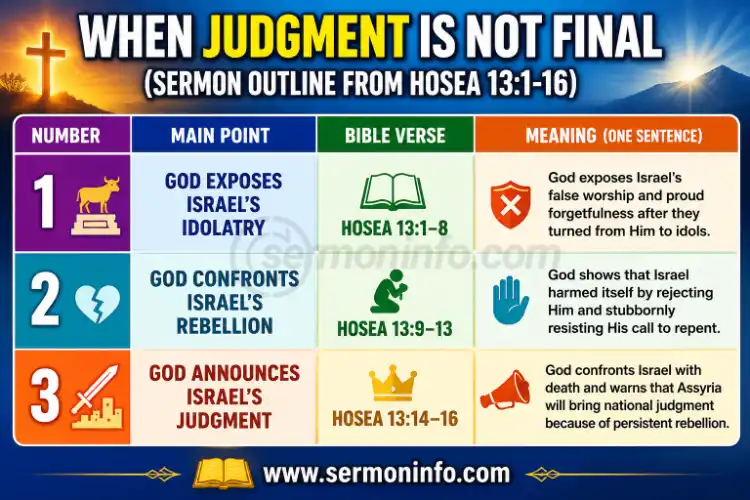
| 1 | God Exposes Israel’s Idolatry | Hosea 13:1–8 | God exposes Israel’s false worship and proud forgetfulness after they turned from Him to idols. |
| 2 | God Confronts Israel’s Rebellion | Hosea 13:9–13 | God shows that Israel harmed itself by rejecting Him and stubbornly resisting His call to repent. |
| 3 | God Announces Israel’s Judgment | Hosea 13:14–16 | God confronts Israel with death and warns that Assyria will bring national judgment because of persistent rebellion. |
Source Material
William MacDonald, Believer’s Bible Commentary, rev. ed. (Nashville: Thomas Nelson, 1995), 1103-1104
John MacArthur, The MacArthur Bible Commentary (Nashville: Thomas Nelson, 2005), 980-981
John F. Walvoord and Roy B. Zuck, eds., The Bible Knowledge Commentary: Old Testament (Colorado Springs, CO: David C. Cook, 1985), 1405-1406