The 7 Churches of Revelation in Order are seven historical congregations addressed by Christ in Revelation 2–3. Each message includes commendation, correction, warning, or promise. Together, they teach believers about doctrine, holiness, perseverance, repentance, spiritual discernment, and faithful service while pointing forward to Christ’s return.

Key Takeaways – 7 Churches of Revelation
- Christ sees our true spiritual condition. Revelation 2–3 shows that Jesus knows our faithfulness, failures, motives, and need for repentance.
- Believers must reject compromise and remain faithful. Christ calls us to love Him, obey His Word, endure trials, and pursue holiness.
- Christ rewards those who overcome through faith. The seven messages encourage believers to stand firm, serve faithfully, and live ready for His return.
7 Churches of Revelation In Order
Jesus spoke to seven real congregations in Asia, and each one faced a different spiritual condition. Some showed love, courage, faithfulness, and endurance, while others tolerated compromise, sin, pride, or spiritual coldness. Christ saw beyond reputation and outward success. He praised what pleased Him, confronted what dishonoured Him, and called His people to repent and remain faithful.
These seven messages still place a mirror before believers today. We will follow Christ’s words from Ephesus to Laodicea and examine each warning, encouragement, and promise. As we listen, we should ask God to search our hearts. His truth can strengthen our devotion, correct our failures, and help us live faithfully until Christ comes.
1. The Loveless Church — Ephesus (Rev 2:1–7)
Jesus commended the Ephesian believers for their hard work and sound doctrine but rebuked them for leaving their first love. (Summary Statement)
A. Key Points for Ephesus
Jesus praised Ephesus for its hard work, perseverance, and careful rejection of false teachers. They tested those claiming spiritual authority and exposed false apostles (Revelation 2:2). They also hated the deeds of the Nicolaitans, which Christ hated (Revelation 2:6). Their doctrine remained strong, and their discernment protected them from serious error.
Yet Jesus saw a deeper problem beneath their faithful service. He said, “you have left your first love” (Revelation 2:4). Their hands remained busy, but their hearts had cooled toward Christ. Jesus called them to remember, repent, and return to their former works (Revelation 2:5). Strong service never replaces warm devotion to Jesus.
B. Key Lessons For Life
Believers must guard biblical truth while keeping their love for Christ fresh and wholehearted. Paul urged believers to speak “the truth in love” (Ephesians 4:15). Sound doctrine protects us from error, but love keeps our obedience personal. We can defend every right belief and still lose the joy of walking closely with Jesus.
Our relationship with Christ needs regular attention, just like a fire needs fresh fuel. Remember His grace, confess spiritual coldness, and return to loving obedience. Jesus said, “If you love Me, keep My commandments” (John 14:15). Truth and love belong together. Christ wants faithful minds, willing hands, and hearts that delight in Him.
This material provides some ideas and thoughts for a lessons outline for the 7 churches of Revelation (7 Churches of Revelation in Order).
2. The Persecuted Church — Smyrna (Rev 2:8–11)
Jesus encouraged the suffering believers in Smyrna to remain faithful through persecution because eternal reward awaited them. (Summary Statement)
A. Key Points for Smyrna
Jesus knew the suffering, poverty, and opposition facing the believers in Smyrna. Yet He declared, “but you are rich” (Revelation 2:9). Their earthly resources were small, but their spiritual treasure was great. Christ measured their lives by faithfulness, not comfort, wealth, or public approval.
Jesus warned that more suffering would come, including imprisonment and severe testing (Revelation 2:10). Still, He told them, “Do not fear.” Their trials remained under His sovereign control. The Lord who conquered death stood with them, strengthened them, and called them to remain faithful.
B. Key Lessons For Life
Believers today can face suffering with courage because Christ remains Lord over every trial. Trouble may touch our health, work, family, or reputation. Yet nothing escapes His knowledge or authority. Romans 8:35 reminds us that suffering cannot separate us from the love of Christ.
Jesus promised, “Be faithful until death, and I will give you the crown of life” (Revelation 2:10). Our trials may feel long, but they are temporary. Eternal life with Christ will never end. Therefore, we can trust Him, stand firm, and keep serving faithfully when life becomes difficult.
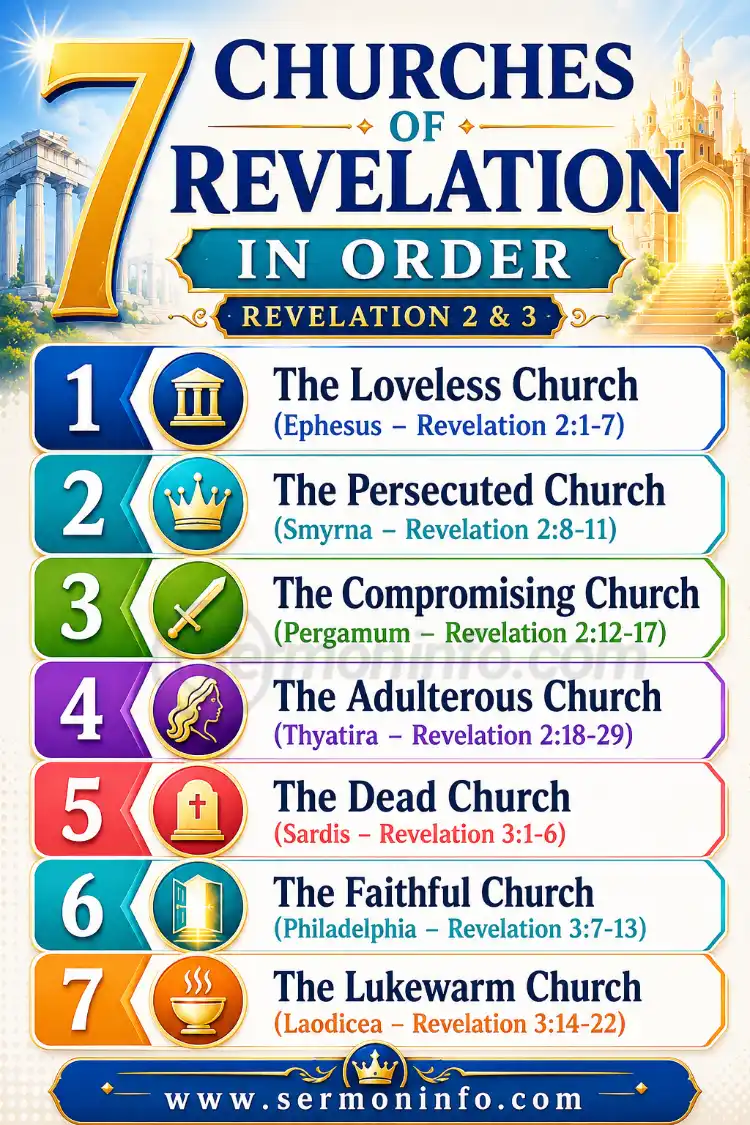
3. The Compromising Church — Pergamum (Rev 2:12–17)
Jesus praised Pergamum for holding His name but confronted those who tolerated false teaching and sinful compromise. (Summary Statement)
A. Key Points for Pergamum
Jesus praised Pergamum because they held firmly to His name under intense spiritual pressure. Even when Antipas died for his faith, they did not deny Christ (Revelation 2:13). Their public confession remained strong. Yet serious compromise had entered the congregation.
Some followed the teaching of Balaam and the Nicolaitans, which encouraged idolatry and sexual immorality (Revelation 2:14–15). Jesus commanded them to repent before compromise spread further. Pergamum shows how believers can defend Christ publicly while tolerating sin privately.
B. Key Lessons For Life
Believers must reject compromise because faithful words must produce faithful lives. Jesus said, “If you love Me, keep My commandments” (John 14:15). We cannot confess Christ on Sunday while accepting sinful values during the week. Loyalty to Jesus touches every area of life.
Compromise often begins with small choices that slowly weaken our convictions. God calls us to test everything by His Word and reject what dishonors Christ. Romans 12:2 tells us not to conform to this world. When pressure rises, we can stand firm because Christ remains worthy of our obedience.
4. The Adulterous Church — Thyatira (Rev 2:18–29)
Jesus commended Thyatira’s love and service but condemned its tolerance of false teaching that encouraged spiritual and moral unfaithfulness. (Summary Statement)
A. Key Points for Thyatira
Jesus praised Thyatira for its love, service, faith, patience, and growing works (Revelation 2:19). Their ministry showed real progress and active devotion. Yet they tolerated a false teacher called “Jezebel,” who encouraged sexual immorality and idolatry (Revelation 2:20). Their loving service did not excuse their lack of discernment.
Christ gave this false teacher time to repent, but she refused (Revelation 2:21). He warned that judgment would follow continued rebellion. Jesus searches “the minds and hearts” and judges each person according to their works (Revelation 2:23). Thyatira reminds us that Christ values love, but He also demands holiness.
B. Key Lessons For Life
Believers must combine loving service with spiritual discernment. Good works cannot replace obedience to God’s truth. We should test every teaching by Scripture, as 1 Thessalonians 5:21 says, “Test all things; hold fast what is good.” Love never requires us to approve what God calls sinful.
False teaching often becomes dangerous when it makes sin seem harmless or acceptable. God calls us to speak truth with grace and pursue holiness. Jesus told the faithful in Thyatira, “hold fast what you have till I come” (Revelation 2:25). We honor Christ when love, truth, and obedience shape our daily lives.
5. The Dead Church — Sardis (Rev 3:1–6)
Jesus exposed Sardis as spiritually dead despite its strong reputation and called the believers to wake up and repent. (Summary Statement)
A. Key Points for Sardis
Sardis had a strong reputation, and people thought the congregation was spiritually alive. Yet Jesus said, “you are dead” (Revelation 3:1). Christ saw beyond appearances and exposed weakness, unfinished works, and spiritual decline. Their public image looked healthy, but their inner condition told a different story.
Jesus told them to “Be watchful, and strengthen the things which remain” (Revelation 3:2). He called them to remember, obey, and repent. A few believers had remained faithful, and Christ recognized them (Revelation 3:4). Sardis shows that spiritual decline can hide behind activity, reputation, and outward success.
B. Key Lessons For Life
Believers must value genuine spiritual life more than outward reputation. People may praise our activity, knowledge, or service, but Christ examines the heart. We need more than a good name. We need daily fellowship with Jesus, obedience to His Word, and a faith that stays alive.
Jesus warned Sardis to stay watchful because spiritual sleep can develop slowly (Revelation 3:3). We should examine our hearts, strengthen weak areas, and repent quickly when conviction comes. Like a lamp that needs oil, our walk with Christ needs regular attention. Genuine faith stays alert, humble, and responsive to Him.
6. The Faithful Church — Philadelphia (Rev 3:7–13)
Jesus praised Philadelphia for keeping His Word, refusing to deny His name, and faithfully using the opportunity He placed before them. (Summary Statement)
A. Key Points for Philadelphia
Jesus told Philadelphia, “you have a little strength,” yet He praised their faithful obedience (Revelation 3:8). They kept His Word and refused to deny His name. Christ placed before them “an open door” that no one could shut. Their weakness never prevented Christ from using them.
Philadelphia also faced opposition, but Jesus promised to honour their faithfulness and keep His purposes secure. He encouraged them, “Hold fast what you have” (Revelation 3:11). Their strength came from Christ, not human ability. They simply remained faithful with what He had given them.
B. Key Lessons For Life
Believers do not need great talent, influence, or resources to serve Christ effectively. God values faithfulness more than impressive ability. When we obey His Word and honour His name, He can open opportunities beyond our strength. As Paul reminds us, “our sufficiency is from God” (2 Corinthians 3:5).
Perhaps you feel your strength is small or your opportunities seem limited. Philadelphia reminds us that Christ controls the doors before us. No person can close a door that He chooses to open (Revelation 3:8). Keep obeying His Word, keep serving faithfully, and trust Christ with the results.
7. The Lukewarm Church — Laodicea (Rev 3:14–22)
Jesus rebuked Laodicea for spiritual complacency and self-sufficiency and called the believers to repent with renewed zeal. (Summary Statement)
A. Key Points for Laodicea
Laodicea trusted its wealth and said, “I am rich, have become wealthy, and have need of nothing” (Revelation 3:17). Yet Christ exposed their true condition. They were spiritually poor, blind, and naked. Material success had created false confidence and hidden their desperate need for Him.
Jesus described them as lukewarm and called them to repent with zeal (Revelation 3:16, 19). He urged them to receive true riches, spiritual sight, and righteousness from Him. Their greatest need was not more possessions. They needed renewed fellowship with Christ and a heart that depended fully on Him.
B. Key Lessons For LifeConclusion
The seven messages reveal love lost, persecution endured, compromise tolerated, sin excused, spiritual death, faithfulness, and lukewarm devotion. Christ praised obedience, exposed failure, warned of judgment, and promised reward. Each message shows that He sees clearly, speaks truthfully, and calls His people to remain faithful.
These lessons should move us beyond simple knowledge into honest obedience. We must receive God’s Word with humility and let it search our hearts. Sound doctrine, faithful service, holiness, endurance, and wholehearted devotion still matter. As Christ speaks through Scripture, we should listen carefully, repent quickly, and follow Him faithfully until He comes.
Frequently Asked Questions (FAQ)
Q: What are the 7 churches of Revelation in order?
A: The 7 churches of Revelation appear in this order: Ephesus, Smyrna, Pergamum, Thyatira, Sardis, Philadelphia, and Laodicea. Jesus addressed these real congregations in Asia Minor through John. Each message reveals spiritual strengths, failures, warnings, and promises that still instruct believers today.
Q: What do the 7 churches of Revelation represent?
A: The 7 churches were real first century congregations, but their messages also reveal spiritual conditions believers still face. They warn against lost love, compromise, corruption, spiritual deadness, and lukewarmness. They also encourage endurance, faithfulness, repentance, holiness, and wholehearted devotion to Christ.
Q: Why did Jesus choose these seven churches?
A: Jesus addressed these seven congregations because they faced distinct spiritual conditions and stood along an important route in Asia Minor. Their messages could circulate widely. Together, they provide a broad picture of Christ’s praise, correction, warnings, and promises for His people.
Q: What is the main message of the seven churches in Revelation?
A: The main message is that Christ knows the true spiritual condition of His people. He commends faithfulness, confronts sin, calls for repentance, and promises reward to those who overcome. Revelation 2–3 urges believers to hear His Word, obey it, and remain faithful.
Q: How do the seven churches of Revelation apply today?
A: Believers should use these seven messages as a spiritual mirror. We should examine our love for Christ, doctrine, holiness, endurance, service, and dependence on Him. When Christ exposes weakness, we should repent quickly. When He commends faithfulness, we should keep obeying His Word.
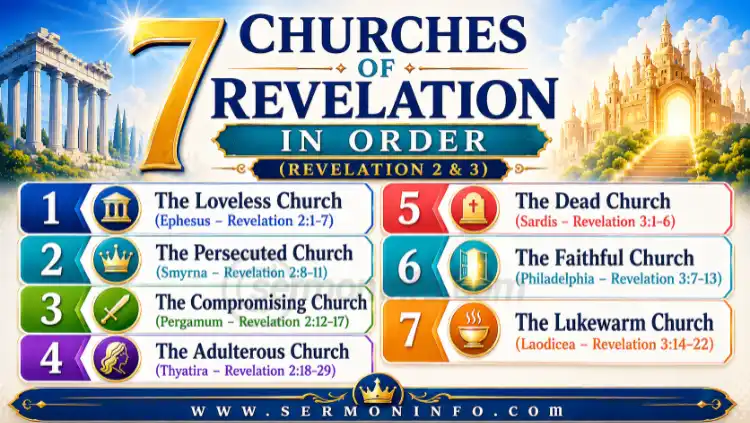
BONUS: What do the 7 Churches in Revelation Represent?
The seven congregations in Revelation 2–3 were real assemblies in Asia Minor that Christ personally addressed. Each message reveals a different spiritual condition, including love lost, persecution, compromise, faithfulness, and complacency. Revelation 1:11 names these seven places, and Christ evaluates each one with perfect knowledge and authority.
These seven messages also speak to believers today because Christ repeatedly says, “He who has an ear, let him hear” (Revelation 2:7). They warn us against spiritual drift and encourage faithful obedience. We should examine our love, doctrine, holiness, endurance, and devotion while remaining ready for Christ’s return.
BONUS: Do the 7 Churches in Revelation Still Exist?
The seven congregations of Revelation 2–3 no longer exist in their original first century form. Their ancient cities stood in what is now western Türkiye, and several archaeological sites remain today. Revelation 1:11 names Ephesus, Smyrna, Pergamum, Thyatira, Sardis, Philadelphia, and Laodicea.
Although those original assemblies disappeared, Christ’s messages still speak clearly to believers. His warnings about lost love, compromise, spiritual death, and lukewarmness remain relevant. His encouragement to endure, repent, obey, and remain faithful still matters. Revelation 2:7 repeatedly urges us to hear what the Spirit says.
BONUS: Why did God choose the 7 Churches in Revelation?
God chose seven real congregations in Asia because their spiritual conditions provided clear lessons for His people. Revelation 1:11 names Ephesus, Smyrna, Pergamum, Thyatira, Sardis, Philadelphia, and Laodicea. Through them, Christ addressed love, suffering, compromise, holiness, faithfulness, and complacency.
Scripture does not explain why God selected these seven instead of others. However, each message ends with a wider call: “He who has an ear, let him hear” (Revelation 2:7). Their struggles therefore teach believers beyond those cities. Christ uses their examples to warn, correct, encourage, and strengthen His people.
BONUS: What was the problem with the 7 Churches in Revelation?
The seven congregations faced different spiritual dangers. Ephesus lost its first love, Pergamum tolerated compromise, Thyatira allowed corrupt teaching, Sardis became spiritually dead, and Laodicea grew lukewarm (Revelation 2:4, 14, 20; 3:1, 16). Christ exposed each problem and called His people to repent.
Smyrna and Philadelphia received encouragement rather than rebuke because they remained faithful under pressure (Revelation 2:9–10; 3:8). Together, the seven messages warn believers against cold devotion, false teaching, sin, pride, and complacency. Christ calls us to remain faithful, holy, watchful, and wholehearted in our walk with Him.
BONUS: Which of the 7 Churches in Revelation did not receive a rebuke?
Jesus gave no rebuke to Smyrna or Philadelphia. Smyrna suffered persecution and poverty, yet Christ called them spiritually rich (Revelation 2:9). Philadelphia had little strength, but they kept Christ’s Word and refused to deny His name (Revelation 3:8). Both remained faithful under pressure.
Their example shows that Christ values faithfulness more than comfort, success, or human strength. Smyrna teaches believers to endure suffering faithfully (Revelation 2:10). Philadelphia teaches believers to keep obeying Christ when resources seem small (Revelation 3:11). Jesus sees faithful service and promises reward to those who remain true to Him.
BONUS: What are the key lessons for believers today from the 7 churches?
The seven messages in Revelation 2–3 teach believers to love Christ deeply, remain faithful, reject compromise, pursue holiness, and stay spiritually awake. Jesus praised endurance and obedience, but He confronted coldness, false teaching, deadness, and lukewarm devotion. His words call every believer to examine the heart honestly.
These lessons still guide daily Christian living. We should repent quickly, obey Scripture, endure trials, and depend fully on Christ. Revelation 2:10 urges faithfulness, while Revelation 3:11 says, “Hold fast what you have.” Jesus wants believers to live with love, courage, discernment, and readiness for His return.
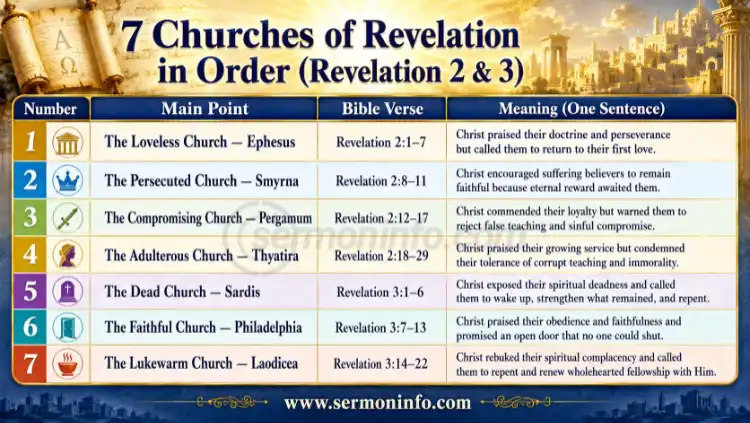
| 7 Churches of Revelation In Order | |||
|---|---|---|---|
| Number | Main Point | Bible Verse | Meaning |
| 1 | The Loveless Church — Ephesus | Revelation 2:1–7 | Christ praised their doctrine and perseverance but called them to return to their first love. |
| 2 | The Persecuted Church — Smyrna | Revelation 2:8–11 | Christ encouraged suffering believers to remain faithful because eternal reward awaited them. |
| 3 | The Compromising Church — Pergamum | Revelation 2:12–17 | Christ commended their loyalty but warned them to reject false teaching and sinful compromise. |
| 4 | The Adulterous Church — Thyatira | Revelation 2:18–29 | Christ praised their growing service but condemned their tolerance of corrupt teaching and immorality. |
| 5 | The Dead Church — Sardis | Revelation 3:1–6 | Christ exposed their spiritual deadness and called them to wake up, strengthen what remained, and repent. |
| 6 | The Faithful Church — Philadelphia | Revelation 3:7–13 | Christ praised their obedience and faithfulness and promised an open door that no one could shut. |
| 7 | The Lukewarm Church — Laodicea | Revelation 3:14–22 | Christ rebuked their spiritual complacency and called them to repent and renew wholehearted fellowship with Him. |
Source Material
William MacDonald, Believer’s Bible Commentary, rev. ed. (Nashville: Thomas Nelson, 1995), 2355-2361
John MacArthur, The MacArthur Bible Commentary (Nashville: Thomas Nelson, 2005), 1995-2001
John F. Walvoord and Roy B. Zuck, eds., The Bible Knowledge Commentary: New Testament (Colorado Springs, CO: David C. Cook, 1985), 932-943