7 Examples of Synonymous Parallelism in Psalms are seven Psalm verses that show how Hebrew poetry repeats the same truth with different words to strengthen God’s message. This literary pattern emphasizes key spiritual truths, makes Scripture easier to remember, and reveals God’s character with greater clarity and beauty.
Key Takeaways – 7 Synonymous Parallelisms
- Synonymous parallelism repeats one truth with different words to emphasize God’s message. This common feature of Hebrew poetry makes important biblical truths clearer, more memorable, and easier to apply in daily life.
- The Psalms use synonymous parallelism to reveal God’s character and strengthen faith. These repeated expressions highlight God’s glory, sovereignty, protection, forgiveness, and faithful care, encouraging believers to trust Him in every circumstance.
- Recognizing synonymous parallelism helps you understand and apply Scripture more accurately. As you identify this poetic pattern, you will read the Psalms with greater insight, appreciate their beauty, and grow in your love for God’s Word.
7 Examples of Synonymous Parallelism
Synonymous parallelism is one of the most beautiful features of Hebrew poetry. It repeats one truth with different words to strengthen God’s message and impress it on our hearts. As we recognize this pattern, we understand the Psalms more clearly and appreciate the wisdom, beauty, and authority of God’s Word. This skill helps us read Scripture with greater confidence and deeper devotion.
In this lesson, we will explore seven examples of synonymous parallelism from the Psalms. Each passage will show how repeated truths reveal God’s character, strengthen faith, and encourage obedience. As we study these verses together, we will discover how God uses inspired poetry to teach timeless truth and draw His people closer to Himself.
1. Synonymous Parallelism in Psalm 19:1
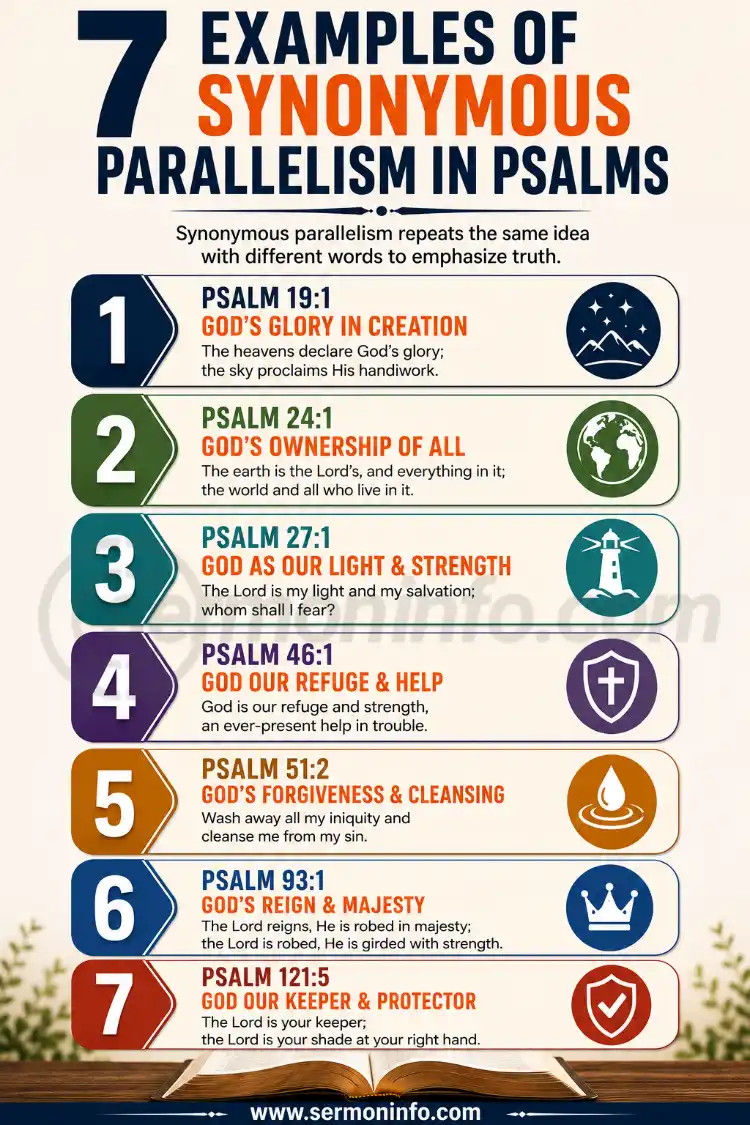
Psalm 19:1 uses synonymous parallelism to show that all creation continually declares God’s glory. (Summary Explanation)
A. Explanation
Psalm 19:1 declares, “The heavens declare the glory of God; And the firmament shows His handiwork.” Both lines express the same truth with different words. “The heavens” and “the firmament” describe the skies, while “declare” and “shows” emphasize creation’s constant witness to God’s greatness.
David used synonymous parallelism to strengthen one central message. Every sunrise, star, and cloud points to the Creator. The second line does not introduce a new idea. Instead, it deepens the first. Romans 1:20 also teaches that God’s invisible attributes are clearly seen through the things He has made.
B. Application
Synonymous parallelism helps God’s truth settle deeply into our hearts. By repeating the same truth with fresh words, God calls us to pause, reflect, and remember. Psalm 19:1 invites us to notice His glory every day. The repetition makes His message clear and unforgettable.
When trials fill our minds, creation reminds us that God still reigns over everything. A bright sunrise, a clear night sky, or a mountain view quietly proclaims His power. Psalm 121:1 and 2 directs our eyes to the Lord, our Creator and Helper. His unchanging greatness gives us confidence and hope.
2. Synonymous Parallelism in Psalm 24:1
Psalm 24:1 uses synonymous parallelism to affirm that God owns the entire world and everyone in it. (Summary Explanation)
A. Explanation
Psalm 24:1 declares, “The earth is the LORD’S, and all its fullness, The world and those who dwell therein.” This verse uses synonymous parallelism because the second line restates the first with different words. “The earth” parallels “the world,” while “all its fullness” parallels “those who dwell therein.”
David wrote this psalm to proclaim God’s universal kingship. The second line expands the first by including both creation and humanity. Everything belongs to the Lord because He created it. Psalm 24:2 explains this truth by reminding us that God founded the earth upon the seas and established it by His power.
B. Application
Synonymous parallelism reinforces God’s truth through thoughtful repetition. Psalm 24:1 leaves no doubt that God owns everything. The repeated idea helps us remember His authority over every place and every person. This poetic structure makes the message stronger and encourages us to trust His rule over every part of life.
When life feels uncertain, remember that your circumstances remain under God’s control. The One who owns the world also cares for His people. Jesus taught that our heavenly Father knows our needs before we ask Him in Matthew 6:31 to 33. We can rest confidently because everything belongs to Him, including our future.
This material provides some ideas and thoughts about synonymous parallelisms in Hebrew Poetry (7 Examples of Synonymous Parallelism in Psalms).
3. Synonymous Parallelism in Psalm 27:1
Psalm 27:1 uses synonymous parallelism to strengthen David’s confidence in God’s protection. (Summary Explanation)
A. Explanation
Psalm 27:1 declares, “The LORD is my light and my salvation; Whom shall I fear? The LORD is the strength of my life; Of whom shall I be afraid?” This synonymous parallelism repeats one central truth. The second statement restates the first with fresh words, reinforcing David’s complete confidence in the Lord.
The parallel pairs work together beautifully. “Light and my salvation” parallels “the strength of my life,” while “Whom shall I fear?” parallels “Of whom shall I be afraid?” David does not introduce a new thought. Instead, he strengthens the same truth. God gives guidance, deliverance, and security to those who trust Him.
B. Application
Synonymous parallelism helps God’s truth remain in our minds and hearts. Repeating the same message with different words gives greater emphasis and comfort. Psalm 27:1 reminds us that fear loses its power when we focus on God’s presence. The repeated truth encourages faith during every season of life.
Life often brings uncertainty, illness, loss, or opposition. Like a lighthouse guides ships through storms, the Lord guides His people through dark days. Isaiah 41:10 reminds us not to fear because God is with us. As we remember His repeated promises, our confidence grows and our hearts find lasting peace.
4. Synonymous Parallelism in Psalm 46:1
Psalm 46:1 uses synonymous parallelism to present God as both our protector and our ever present helper. (Summary Explanation)
A. Explanation
Psalm 46:1 declares, “God is our refuge and strength, A very present help in trouble.” This verse uses synonymous parallelism because the second line reinforces the first with related expressions. “Refuge and strength” corresponds with “a very present help.” Each phrase describes God’s faithful care from a different perspective.
The structure moves from who God is to what God does. He is our refuge, our place of safety. He is our strength, our source of power. Then the second line assures us that He actively helps His people in every trouble. The repeated thought magnifies God’s constant presence and dependable character.
B. Application
The synonymous parallelism in Psalm 46:1 strengthens God’s message by repeating it with richer meaning. The first line promises protection and strength. The second line assures us that God is personally present in our troubles. Together they encourage believers to trust God’s character instead of fearing difficult circumstances.
Life often feels like standing in the middle of a fierce storm. Winds blow, and everything seems uncertain. Yet God remains our safe shelter and faithful helper. Hebrews 13:5 reminds us that He will never leave us nor forsake us. Because He is always present, we can face every trial with confidence and hope.
5. Synonymous Parallelism in Psalm 51:2
Psalm 51:2 uses synonymous parallelism to express David’s desire for complete forgiveness and cleansing. (Summary Explanation)
A. Explanation
Psalm 51:2 says, “Wash me thoroughly from my iniquity, And cleanse me from my sin.” This verse uses synonymous parallelism because the second line restates the first with similar words. “Wash me” parallels “cleanse me,” while “iniquity” parallels “sin.” Together they express David’s deep desire for complete forgiveness.
David wrote this psalm after the prophet Nathan confronted him about his sin with Bathsheba. He did not ask for a partial cleansing. He pleaded for complete restoration before God. The repeated request emphasizes sincere repentance and God’s power to forgive. Verse 10 continues this theme by asking God to create a clean heart.
B. Application
The synonymous parallelism in Psalm 51:2 strengthens God’s message by repeating David’s request in different words. The repetition reveals the seriousness of sin and the completeness of God’s cleansing. It reminds us that true repentance comes from an honest heart that seeks God’s mercy instead of hiding guilt.
Sin stains the heart like mud stains clean clothing. Only God can remove what we cannot. First John 1:9 promises that if we confess our sins, He forgives us and cleanses us from all unrighteousness. Through Christ, every believer can experience forgiveness, restoration, and a fresh beginning.
6. Synonymous Parallelism in Psalm 93:1
Psalm 93:1 uses synonymous parallelism to declare God’s majestic and powerful reign. (Summary Explanation)
A. Explanation
Psalm 93:1 declares, “The LORD reigns, He is clothed with majesty; The LORD is clothed, He has girded Himself with strength.” This verse uses synonymous parallelism by repeating the same truth with related images. “Clothed with majesty” and “girded Himself with strength” together describe God’s glorious and sovereign rule.
The second line builds upon the first instead of changing the subject. God’s majesty reveals His royal dignity, while His strength reveals His unlimited power. The repeated description magnifies His kingship. The psalm celebrates the Lord as the eternal King whose throne stands secure above every earthly kingdom and every force of chaos.
B. Application
The synonymous parallelism in Psalm 93:1 strengthens God’s message by presenting His reign from two complementary perspectives. His majesty inspires our worship, and His strength builds our confidence. Together they assure us that the God we worship possesses both the authority to rule and the power to accomplish His purposes.
When the world seems uncertain, remember that God still reigns. Earthly rulers rise and fall, but His kingdom never changes. Isaiah 40:28 reminds us that the everlasting God never grows weary. Because our King rules with perfect majesty and strength, we can trust Him through every trial and every season of life.
7. Synonymous Parallelism in Psalm 121:5
Psalm 121:5 uses synonymous parallelism to assure believers of God’s constant protection and care. (Summary Explanation)
A. Explanation
Psalm 121:5 declares, “The LORD is your keeper; The LORD is your shade at your right hand.” This verse uses synonymous parallelism because the second line reinforces the first with a vivid picture. “Your keeper” parallels “your shade,” revealing God’s constant protection through complementary expressions.
Psalm 121 is a song for pilgrims traveling to Jerusalem. The journey exposed them to danger, heat, and uncertainty. The second line explains how God keeps His people. Like refreshing shade protects a traveler from the burning sun, the Lord stays near His people and faithfully guards them wherever they go.
B. Application
The synonymous parallelism in Psalm 121:5 deepens God’s message by joining His protection with His presence. God does not simply watch over us from heaven. He stays close as our Keeper and our Shade. The repeated truth encourages us to trust Him when life becomes difficult or uncertain.
When burdens seem too heavy, remember God’s promise in Isaiah 41:10. He says, “Fear not, for I am with you.” His presence gives courage for every step. Jesus also promised, “I am with you always” in Matthew 28:20. Because our Keeper never leaves us, we can walk forward with confidence and peace.
Conclusion
Throughout this lesson, we explored seven examples of synonymous parallelism in the Psalms. We saw how God repeats one truth with different words to emphasize His glory, ownership, protection, forgiveness, sovereign reign, and faithful care. Each passage revealed that Hebrew poetry does more than sound beautiful. It strengthens God’s message and helps us understand His Word more clearly.
As you read the Psalms, look for repeated truths that point your heart toward the Lord. Let these inspired patterns deepen your worship, strengthen your faith, and increase your confidence in God’s promises. Meditate on His Word each day, and allow its repeated truths to shape your thoughts, encourage your heart, and draw you into a closer walk with Jesus Christ.
Frequently Asked Questions (FAQ)
Q: What is synonymous parallelism in the Psalms?
A: Synonymous parallelism is a Hebrew poetic pattern where the second line repeats or reinforces the first line using different words. This technique emphasizes God’s truth, strengthens the main message, and helps readers remember important biblical teachings more clearly.
Q: Why did Hebrew poets use synonymous parallelism?
A: Hebrew poets used synonymous parallelism to emphasize key truths rather than create rhyme. Repeating the same idea with different words made God’s message clearer, more memorable, and more impactful for listeners. This style also added beauty and depth to Hebrew poetry.
Q: What is an example of synonymous parallelism in the Psalms?
A: Psalm 19:1 is a classic example: “The heavens declare the glory of God; And the firmament shows His handiwork.” Both lines express the same truth with different words, declaring that creation continually reveals God’s glory and creative power.
Q: How does synonymous parallelism help us understand the Bible?
A: Synonymous parallelism reinforces one central truth through repeated expressions. This poetic structure helps readers identify the main idea, appreciate the richness of biblical language, and apply God’s truth with greater confidence and understanding.
Q: How can I recognize synonymous parallelism when reading the Psalms?
A: Look for two lines that express the same idea using similar or related words. The second line usually restates, expands, or reinforces the first rather than contrasting it. Recognizing this pattern helps you interpret the Psalms more accurately and appreciate their inspired literary beauty.
BONUS: What is the difference between synonymous and antithetic parallelism in the Psalms?
Synonymous parallelism repeats the same truth with different words to strengthen one central message. For example, Psalm 19:1 says, “The heavens declare the glory of God; And the firmament shows His handiwork.” Both lines proclaim the same truth, adding emphasis, clarity, and beauty without changing the main idea.
Antithetic parallelism teaches through contrast instead of repetition. Psalm 1:6 declares, “For the LORD knows the way of the righteous, But the way of the ungodly shall perish.” The second line presents the opposite outcome, highlighting the difference between righteousness and wickedness. This contrast makes God’s truth clear and calls readers to choose His way.
BONUS: Why is Hebrew parallelism important for understanding the Book of Psalms?
Hebrew parallelism is important because it reveals how the Psalms communicate God’s truth. Instead of relying on rhyme, Hebrew poetry repeats, contrasts, or develops ideas to emphasize the main message. Psalm 19:1 repeats the glory of God through creation, helping readers recognize His greatness and remember His truth more clearly.
Understanding Hebrew parallelism also helps us interpret the Psalms accurately and avoid missing their emphasis. It highlights God’s character, promises, and purposes with clarity and beauty. Psalm 1:1 to 2 contrasts the righteous and the wicked, while Psalm 121:1 to 2 points believers to the Lord as their faithful Helper. This literary pattern deepens both understanding and worship.
BONUS: How does synonymous parallelism help communicate God’s truth more effectively?
Synonymous parallelism communicates God’s truth by repeating the same idea with different words, making the message clearer and more memorable. Instead of introducing a new thought, the second line reinforces the first. Psalm 24:1 declares that the earth belongs to the Lord, then restates that the world and everyone in it also belong to Him.
This repeated pattern encourages meditation and strengthens faith because important truths remain before our minds. Psalm 46:1 describes God as our refuge and strength, then calls Him a very present help in trouble. Together, these expressions assure believers that God both protects His people and remains with them through every trial.
BONUS: How can identifying synonymous parallelism improve Bible study and sermon preparation?
Identifying synonymous parallelism helps us recognize the main idea that the biblical writer wants to emphasize. Instead of treating each line as a separate thought, we see how the second line reinforces the first. Psalm 19:1 and Psalm 121:5 repeat one truth with complementary words, making God’s message clearer and easier to interpret.
This understanding also strengthens sermon preparation by helping teachers explain the author’s intended meaning with confidence. It prevents unnecessary speculation and keeps the message centered on Scripture. As 2 Timothy 2:15 urges, we should rightly divide the word of truth. Recognizing Hebrew parallelism leads to faithful exposition and practical application.
BONUS: What other books of the Bible use synonymous parallelism besides the Psalms?
Synonymous parallelism appears throughout the Old Testament, not only in the Psalms. The books of Proverbs, Isaiah, Job, and Amos frequently use this poetic pattern. Proverbs 19:5 repeats the certainty of judgment with different words, while Isaiah 44:22 reinforces God’s promise of forgiveness through repeated expressions.
Recognizing synonymous parallelism across these books helps us interpret Hebrew poetry more accurately. The second line often reinforces rather than changes the first. This literary pattern highlights God’s character, wisdom, justice, and grace. As we recognize these repeated truths, we understand Scripture more clearly and apply God’s Word with greater confidence and devotion.
BONUS: How does Hebrew Parallelism reveal God’s message?
Hebrew parallelism reveals God’s message by repeating, contrasting, or developing ideas to emphasize His truth. Rather than depending on rhyme, Hebrew poetry guides readers to the main point through balanced lines. Psalm 19:1 repeats the glory of God in creation, while Psalm 1:6 contrasts the destinies of the righteous and the wicked, making God’s message unmistakably clear.
This poetic structure slows us down and invites thoughtful meditation on God’s Word. Each parallel line adds clarity, emphasis, or deeper insight without changing the central truth. As Joshua 1:8 encourages us to meditate on Scripture day and night, Hebrew parallelism helps us remember God’s promises, understand His character, and apply His truth with confidence.
| 7 Examples of Synonymous Parallelism in Psalms – Hebrew Parallelisms Examples | |||
|---|---|---|---|
| Number | Main Point | Bible Verse | Meaning |
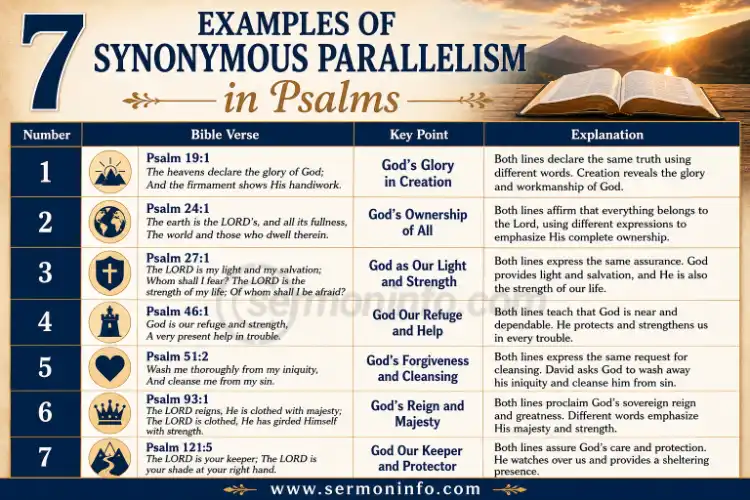
| 1 | Creation Declares God’s Glory | Psalm 19:1 | The second line repeats the first to emphasize that all creation continually reveals God’s glory and creative power. |
| 2 | God Owns Everything | Psalm 24:1 | The second line reinforces the first by declaring that the entire world and all people belong to the Lord. |
| 3 | God Removes Our Fear | Psalm 27:1 | The repeated ideas strengthen David’s confidence that God alone provides light, salvation, strength, and security. |
| 4 | God Is Our Refuge | Psalm 46:1 | The second line expands the first by showing that God is both our place of safety and our ever present helper. |
| 5 | God Cleanses the Repentant | Psalm 51:2 | The repeated request highlights David’s sincere repentance and his desire for complete forgiveness and cleansing. |
| 6 | God Reigns in Majesty | Psalm 93:1 | The second line reinforces the first by describing God’s royal majesty and unlimited strength as the eternal King. |
| 7 | God Protects His People | Psalm 121:5 | The second line illustrates God’s constant protection by comparing Him to refreshing shade beside His people. |