The 7 Different Types of Hebrew Parallelisms are literary patterns used in Hebrew poetry, especially the Psalms, to communicate God’s truth with clarity, emphasis, and beauty. These patterns show how lines relate to one another by repeating, contrasting, expanding, illustrating, or arranging ideas, helping readers understand and apply Scripture more accurately.
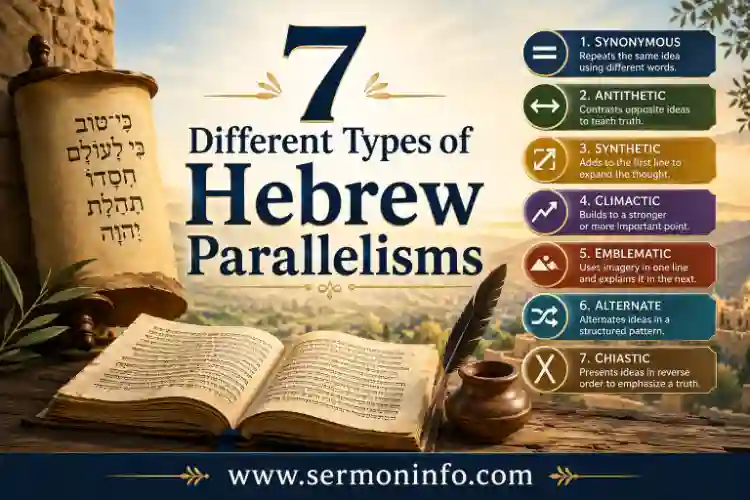
Key Takeaways – 7 Types of Hebrew Parallelisms
- Hebrew parallelism helps you understand Scripture more accurately by showing how poetic lines repeat, contrast, expand, or develop God’s truth.
- Synonymous parallelism reinforces truth by repeating the same message in different words, helping believers remember God’s unchanging promises.
- Antithetic and synthetic parallelism deepen understanding by contrasting right and wrong or expanding an idea with additional detail and application.
- Climactic and alternate parallelism build emphasis through repetition and carefully arranged thoughts, drawing attention to God’s central message.
- Emblematic and chiastic parallelism use vivid images and thoughtful structure to reveal God’s character, saving work, and faithful care for His people.
- Recognizing these seven types of Hebrew parallelism strengthens Bible study by helping readers interpret the Psalms according to their original literary design.
- Understanding Hebrew parallelism equips believers to read, teach, and apply God’s Word with greater confidence, leading to stronger faith, wiser interpretation, and deeper worship of the Lord.
7 Different Types of Hebrew Parallelisms
Hebrew parallelism forms the heartbeat of much of the Old Testament, especially the Psalms. Mastering these literary patterns helps us understand God’s Word more accurately and appreciate its beauty. As we recognize how each line relates to the next, we interpret Scripture with greater confidence and discover truths that strengthen our faith and deepen our walk with the Lord.
In this lesson, we will examine seven different types of Hebrew parallelism and see how each one communicates God’s truth in a unique way. We will explore biblical examples, learn how each pattern functions, and apply these lessons to daily life. As we study together, God’s Word will become clearer, richer, and even more meaningful to our hearts.
1. Synonymous Parallelism (Psalm 19:1)
Synonymous parallelism repeats the same truth in different words to strengthen and emphasize the message. (Summary Explanation)
A. Explanation
Psalm 19:1 says, “The heavens declare the glory of God; And the firmament shows His handiwork.” David repeats the same truth with different words. The second line strengthens the first line. Together they magnify God’s greatness and help readers grasp His glorious work in creation.
God often repeats truth because He wants His people to remember it and believe it. Scripture reinforces important lessons through repetition. As you read the Psalms, notice repeated ideas and allow them to deepen your faith. God’s truth remains constant, even when your circumstances change.
B. Examples
Psalm 19:1 proclaims God’s glory through the heavens and the firmament. Psalm 24:1 declares that the earth and everyone in it belong to the Lord; and Psalm 103:10 reminds us that God has not treated us according to our sins. Each passage repeats truth with similar words to strengthen its message.
Just as a teacher repeats an important lesson, God repeats truth so it settles in our hearts. When fear, doubt, or trials arise, return to these repeated promises. Let God’s Word renew your mind and strengthen your confidence that He remains faithful in every season of life. (Source Material: Steven J. Lawson, Preaching the Psalms (Orlando, FL: Reformation Trust Publishing, 2012), 194–201)
2. Antithetic Parallelism (Psalm 1:6)
Antithetic parallelism teaches truth by placing opposite ideas side by side for clear contrast. (Summary Explanation)
A. Explanation
Psalm 1:6 says, “For the LORD knows the way of the righteous, But the way of the ungodly shall perish.” The second line contrasts the first by using “but.” This pattern places two different paths side by side. One leads to God’s blessing, while the other ends in judgment.
These contrasts call us to examine our lives and choose God’s way each day. Jesus also spoke of two roads in Matthew 7:13 to 14. One road leads to life, and the other leads to destruction. God lovingly warns us so we will trust Him and follow His truth.
B. Examples
Psalm 1:6 contrasts the righteous with the ungodly. Psalm 37:9 teaches that evildoers will be cut off, but those who wait on the Lord will inherit the earth; and Psalm 112:10 shows the wicked frustrated while the righteous enjoy God’s blessing. These contrasts reveal God’s justice.
Life often presents two choices, just as a fork divides one road into two directions. God calls believers to walk in obedience because His way brings lasting joy. Even when evil seems to prosper, remember that the Lord keeps His promises and rewards those who faithfully follow Him. (Source Material: Allen P. Ross, A Commentary on the Psalms. Volume 1 (1–41) (Grand Rapids, MI: Kregel Academic, 2011), 85–90)
3. Synthetic Parallelism (Psalm 1:2)
Synthetic parallelism develops the first statement by adding new information that completes the thought. (Summary Explanation)
A. Explanation
Psalm 1:2 says, “But his delight is in the law of the LORD, And in His law he meditates day and night.” The second line expands the first by explaining how delight in God’s Word is expressed. True delight moves beyond feelings and grows through continual meditation on Scripture.
Synthetic parallelism develops a truth by adding detail, reason, or result. Each new line helps readers understand God’s message more fully. Like building one step upon another, Scripture strengthens our understanding. As we obey God’s Word daily, our faith grows stronger and our lives become more fruitful.
B. Examples
Psalm 1:2 begins with delight in God’s law and then explains that delight through continual meditation. Psalm 121:3 promises that God will keep your foot from slipping and then assures you that your Keeper never sleeps; and Psalm 127:1 teaches that without the Lord, human effort ends in vain.
These passages remind us that God unfolds His truth one step at a time. Like a teacher carefully explaining each lesson, He builds our understanding with every line. When trials come, trust each promise He gives, knowing His Word provides wisdom, security, and direction for every season of life. (Source Material: Steven J. Lawson, Preaching the Psalms (Orlando, FL: Reformation Trust Publishing, 2012), 194–201)
This material provides some ideas and thoughts for a message outline on Hebrew Parallelisms (7 Different Types of Hebrew Parallelisms).
4. Climactic Parallelism (Psalm 29:1)
Climactic parallelism repeats key words before bringing the thought to its fullest expression. (Summary Explanation)
A. Explanation
Psalm 29:1 says, “Give unto the LORD, O you mighty ones, Give unto the LORD glory and strength.” The second line repeats part of the first and then completes the thought with greater emphasis. The repeated words draw attention to God’s supreme worth and our responsibility to worship Him.
Climactic parallelism invites us to pause and hear God’s message with greater intensity. Like waves growing stronger as they reach the shore, each repeated phrase builds toward a powerful conclusion. As we worship God with sincere hearts, our praise rises because He alone deserves all glory and honor.
B. Examples
Psalm 29:1 repeats, “Give unto the LORD,” before calling us to give Him glory and strength. Psalm 96:7 follows the same pattern, inviting every family of the earth to worship Him; and Psalm 93:3 repeats that the floods have lifted up, building dramatic anticipation before declaring God’s greater power.
These repeated phrases remind us that God deserves wholehearted worship in every season of life. When difficulties seem overwhelming, continue giving Him praise. Repeated worship strengthens faith and lifts our eyes above our circumstances. The Lord reigns over every storm, and His voice remains greater than every fear. (Source Material: Leland Ryken, Words of Delight: A Literary Introduction to the Bible, 2nd ed. (Grand Rapids, MI: Baker Academic, 1992), 180–185)
5. Emblematic Parallelism (Psalm 42:1)
Emblematic parallelism uses a vivid picture to illustrate a corresponding spiritual truth. (Summary Explanation)
A. Explanation
Psalm 42:1 says, “As the deer pants for the water brooks, So pants my soul for You, O God.” The first line presents a familiar picture, while the second explains its spiritual meaning. The thirsty deer illustrates a heart that longs deeply for God’s presence and fellowship.
Emblematic parallelism helps us understand spiritual truth through everyday pictures. Jesus often taught with familiar illustrations because people remembered them. In the same way, the Psalms use vivid images to make God’s truth clear. They encourage us to seek the Lord with sincere hearts and unwavering devotion.
B. Examples
Psalm 42:1 compares a thirsty deer to a believer longing for God. Psalm 103:13 compares God’s compassion to a loving father caring for his children; and Psalm 125:2 compares the mountains around Jerusalem to the Lord’s constant protection surrounding His people. Each image reveals God’s faithful character.
These pictures remind us that God meets our deepest needs with His unfailing care. Like a caring father, He shows compassion. Like mountains surrounding a city, He provides constant protection. When life feels uncertain, remember these images and trust the God who never leaves His people nor fails His promises. (Source Material: Steven J. Lawson, Preaching the Psalms (Orlando, FL: Reformation Trust Publishing, 2012), 194–201)
6. Alternate Parallelism (Psalm 103:11)
Alternate parallelism arranges related ideas in an alternating pattern to present balanced truth. (Summary Explanation)
A. Explanation
Psalm 103:11 and 12 alternate between two related comparisons. David first speaks of God’s great mercy, then of His complete forgiveness. The lines move between corresponding thoughts in an orderly pattern. This structure helps readers see how God’s love and forgiveness work together for His people.
Alternate parallelism shows that God’s truth fits together like carefully placed stones in a strong wall. Each line supports the next and strengthens the whole message. As you study Scripture, notice how connected truths deepen your understanding and encourage your confidence in God’s faithful promises.
B. Examples
Psalm 103:11 and 12 alternate between God’s immeasurable mercy and His complete removal of sin. Psalm 107:8 and 9 alternate between thanksgiving and God’s satisfying goodness; and Psalm 148:7 through 10 alternates groups of creation, calling each one to praise the Lord for His greatness.
These alternating patterns remind us that every part of God’s creation and every aspect of His grace point us back to Him. When burdens seem heavy, remember that His mercy is vast and your sins are removed through His forgiveness. Therefore, respond with grateful worship and faithful obedience each day. (Source Material: Steven J. Lawson, Preaching the Psalms (Orlando, FL: Reformation Trust Publishing, 2012), 194–201)
7. Chiastic Parallelism (Psalm 124:7)
Chiastic parallelism presents ideas in reverse order to emphasize the central message. (Summary Explanation)
A. Explanation
Psalm 124:7 declares, “Our soul has escaped as a bird from the snare of the fowlers; The snare is broken, and we have escaped.” The first and last ideas describe deliverance, while the middle ideas focus on the broken snare. This reversed pattern draws attention to God’s powerful rescue.
Chiastic parallelism directs our eyes toward the central truth of God’s saving work. Like a bridge that leads travelers safely across danger, the middle thought supports the whole message. When trials surround you, remember that the Lord still delivers His people. Trust His promises, for He remains your faithful Protector. (Source Material: Steven J. Lawson, Preaching the Psalms (Orlando, FL: Reformation Trust Publishing, 2012), 194–201)
B. Examples
Psalm 124:7 highlights God’s deliverance through a reversed structure that begins and ends with escape. Psalm 91:14 reveals God’s protection for those who love Him; and Psalm 30:11 shows God turning mourning into dancing. Together these passages magnify His power to rescue, restore, and rejoice His people.
These examples remind us that God often brings victory after seasons of hardship. Romans 8:28 assures believers that God works all things together for good. First Peter 5:10 promises that after suffering, God will strengthen and establish His people. Therefore, wait on the Lord with confidence, knowing His saving work never fails.
Conclusion
We have explored 7 different types of Hebrew parallelism: synonymous, antithetic, synthetic, climactic, emblematic, alternate, and chiastic. Each pattern reveals God’s truth with clarity, beauty, and purpose. Together they show that every word of Scripture has meaning and every literary structure helps communicate God’s unchanging message to His people.
As you read and teach the Bible, look for these patterns with prayerful hearts and careful attention. Let them deepen your understanding, strengthen your confidence, and enrich your study of God’s Word. Then communicate Scripture with greater clarity, knowing that the Holy Spirit uses His inspired Word to transform lives, build faith, and glorify the Lord Jesus Christ.
Frequently Asked Questions (FAQ)
Q: What is Hebrew parallelism in the Bible?
A: Hebrew parallelism is a literary technique used in Hebrew poetry where two or more lines relate to each other through repetition, contrast, expansion, imagery, or structure. It helps communicate God’s truth with greater clarity, emphasis, and beauty, especially throughout the Psalms and Proverbs.
Q: Why is Hebrew parallelism important for Bible study?
A: Hebrew parallelism helps readers interpret Scripture according to its original design. By recognizing how poetic lines work together, believers gain a clearer understanding of God’s message, avoid misunderstanding the text, and appreciate the richness of biblical poetry.
Q: What are the seven main types of Hebrew parallelism?
A: The seven common types are synonymous, antithetic, synthetic, climactic, emblematic, alternate, and chiastic parallelism. Each type connects poetic lines differently, whether by repeating, contrasting, expanding, illustrating, or arranging ideas to strengthen the biblical message.
Q: Where is Hebrew parallelism found in the Bible?
A: Hebrew parallelism appears throughout the poetic and wisdom books, especially Psalms, Proverbs, Job, Song of Solomon, Lamentations, and many prophetic passages. These literary patterns help readers understand and remember God’s inspired truth more effectively.
Q: How does Hebrew parallelism help Christians today?
A: Hebrew parallelism helps Christians read Scripture more carefully and communicate God’s Word more accurately. Understanding these poetic patterns strengthens Bible study, enriches personal devotion, improves teaching, and builds greater confidence in the meaning and application of God’s Word.
BONUS: How can I identify Hebrew parallelism when reading the Psalms?
When reading the Psalms, compare each poetic line with the next. Ask whether the second line repeats, contrasts, expands, illustrates, or completes the first. For example, Psalm 19:1 repeats the same truth with similar words, while Psalm 1:6 contrasts the righteous with the wicked. These relationships reveal the author’s intended message.
Pray for wisdom as you study God’s Word, and read each passage in its context. The Holy Spirit illuminates Scripture as believers faithfully examine it (1 Corinthians 2:12–13). As you recognize these poetic patterns, your understanding will grow, your confidence will increase, and the Psalms will speak more clearly to your heart and daily walk.
BONUS: What is the difference between synonymous and antithetic parallelism?
Synonymous parallelism repeats the same truth using different words to strengthen its message. Psalm 19:1 declares God’s glory through “the heavens” and “the firmament,” expressing one central truth from two complementary perspectives. This pattern reinforces God’s message and helps readers remember and appreciate His inspired Word.
Antithetic parallelism teaches through contrast by placing opposite ideas side by side. Psalm 1:6 contrasts the way of the righteous with the way of the ungodly, revealing two very different outcomes. While synonymous parallelism reinforces one truth, antithetic parallelism highlights truth by showing the clear difference between obedience and rebellion.
BONUS: Which book of the Bible contains the most examples of Hebrew parallelism?
The Book of Psalms contains the greatest number of examples of Hebrew parallelism in the Bible. Nearly every psalm uses poetic lines that repeat, contrast, expand, or illustrate God’s truth. Psalm 19:1, Psalm 1:6, and Psalm 42:1 clearly demonstrate different forms of parallelism that strengthen the message of each passage.
Hebrew parallelism also appears throughout Proverbs, Job, Song of Solomon, Lamentations, and the Prophets. However, the Psalms provide the richest collection for study and application. As you read them carefully, these literary patterns will help you understand God’s Word more accurately and worship Him with greater appreciation for His inspired revelation.
BONUS: How does Hebrew parallelism improve the interpretation of biblical poetry?
Hebrew parallelism improves the interpretation of biblical poetry by showing how each line relates to the next. The second line may repeat, contrast, expand, or illustrate the first. Psalm 19:1 reinforces God’s glory through repetition, while Psalm 1:6 explains truth through contrast. These patterns clarify the author’s intended message.
Recognizing these literary structures helps believers interpret Scripture according to its original design instead of reading isolated lines. Careful study enables us to “rightly divide the word of truth” (2 Timothy 2:15, NKJV). As we understand biblical poetry more accurately, God’s truth shapes our minds, strengthens our faith, and guides our daily lives.
BONUS: Why did Hebrew poets use parallelism instead of rhyme?
Hebrew poets used parallelism because it emphasized meaning rather than sound. Instead of relying on rhyme, they connected ideas through repetition, contrast, expansion, and imagery. Psalm 19:1 repeats the same truth in different words, making God’s glory clear and memorable. This approach allowed God’s message to remain understandable across generations and languages.
Parallelism also helped God’s people remember and meditate on His Word. Psalm 1:2 encourages believers to meditate on God’s law day and night. These carefully arranged lines invited thoughtful reflection and faithful obedience. Today, Hebrew parallelism continues to help readers understand Scripture accurately and treasure the timeless truth of God’s inspired Word.
BONUS: Can one Bible verse contain more than one type of Hebrew parallelism?
Yes. One Bible verse or passage can display more than one type of Hebrew parallelism. Hebrew poets often combined literary patterns to communicate God’s truth more effectively. For example, Psalm 103:11–12 alternates related comparisons while also using vivid imagery to emphasize God’s great mercy and complete forgiveness toward those who fear Him.
Always interpret the verse within its immediate and broader context before identifying its literary pattern. Careful observation helps readers recognize how each line contributes to the overall message. As you study diligently, like the Bereans in Acts 17:11, you will gain a richer understanding of Scripture and greater confidence in God’s inspired Word.
| 7 Examples of Synonymous Parallelism in Psalms – Hebrew Parallelisms Examples | |||
|---|---|---|---|
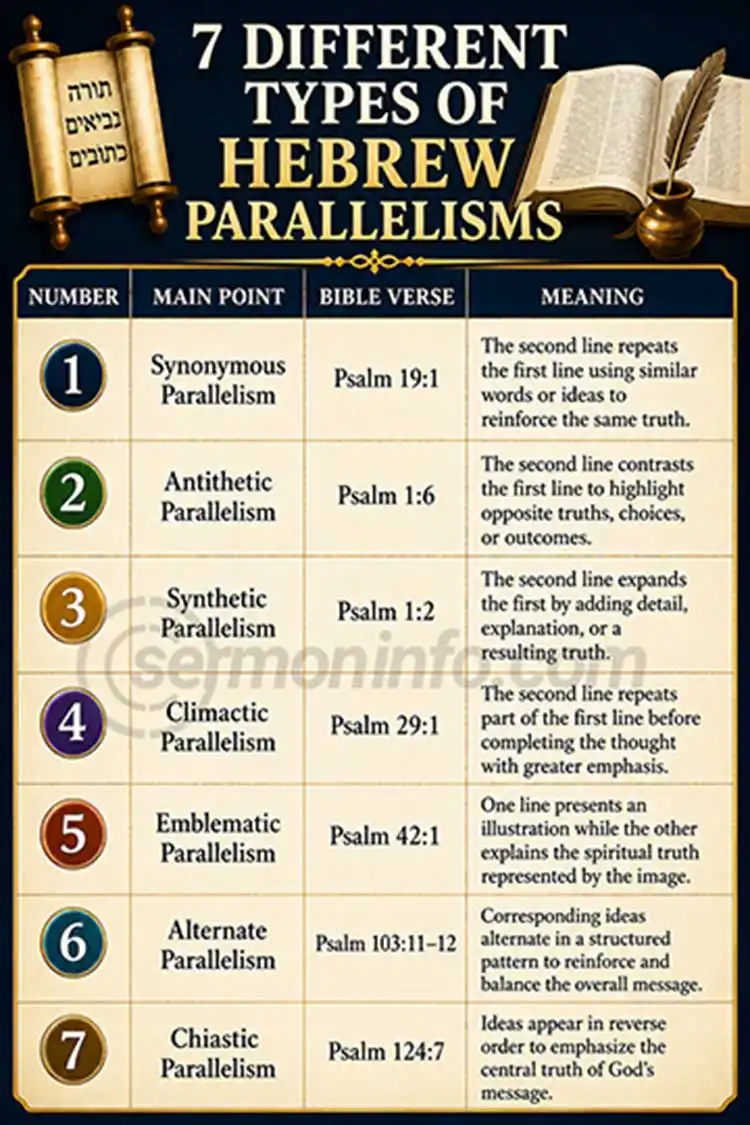
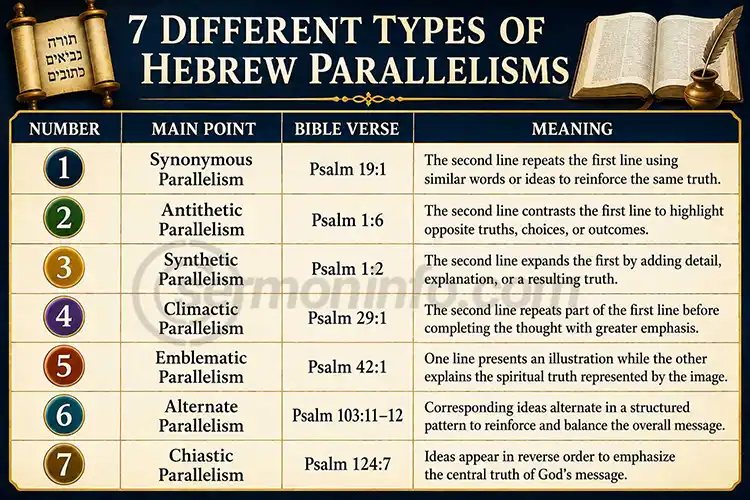
| 7 Different Types of Hebrew Parallelisms | |||
| Number | Main Point | Bible Verse | Meaning |
| 1 | Synonymous Parallelism | Psalm 19:1 | The second line repeats the first line using similar words or ideas to reinforce the same truth. |
| 2 | Antithetic Parallelism | Psalm 1:6 | The second line contrasts the first line to highlight opposite truths, choices, or outcomes. |
| 3 | Synthetic Parallelism | Psalm 1:2 | The second line expands the first by adding detail, explanation, or a resulting truth. |
| 4 | Climactic Parallelism | Psalm 29:1 | The second line repeats part of the first line before completing the thought with greater emphasis. |
| 5 | Emblematic Parallelism | Psalm 42:1 | One line presents an illustration while the other explains the spiritual truth represented by the image. |
| 6 | Alternate Parallelism | Psalm 103:11–12 | Corresponding ideas alternate in a structured pattern to reinforce and balance the overall message. |
| 7 | Chiastic Parallelism | Psalm 124:7 | Ideas appear in reverse order to emphasize the central truth of God’s message. |
Source Material Bibliography
Lawson, Steven J. Preaching the Psalms. Orlando, FL: Reformation Trust Publishing, 2012, pp. 194–201.
Ross, Allen P. A Commentary on the Psalms. Volume 1 (1–41). Grand Rapids, MI: Kregel Academic, 2011, pp. 85–90.
Ryken, Leland. Words of Delight: A Literary Introduction to the Bible. 2nd ed. Grand Rapids, MI: Baker Academic, 1992, pp. 180–185.