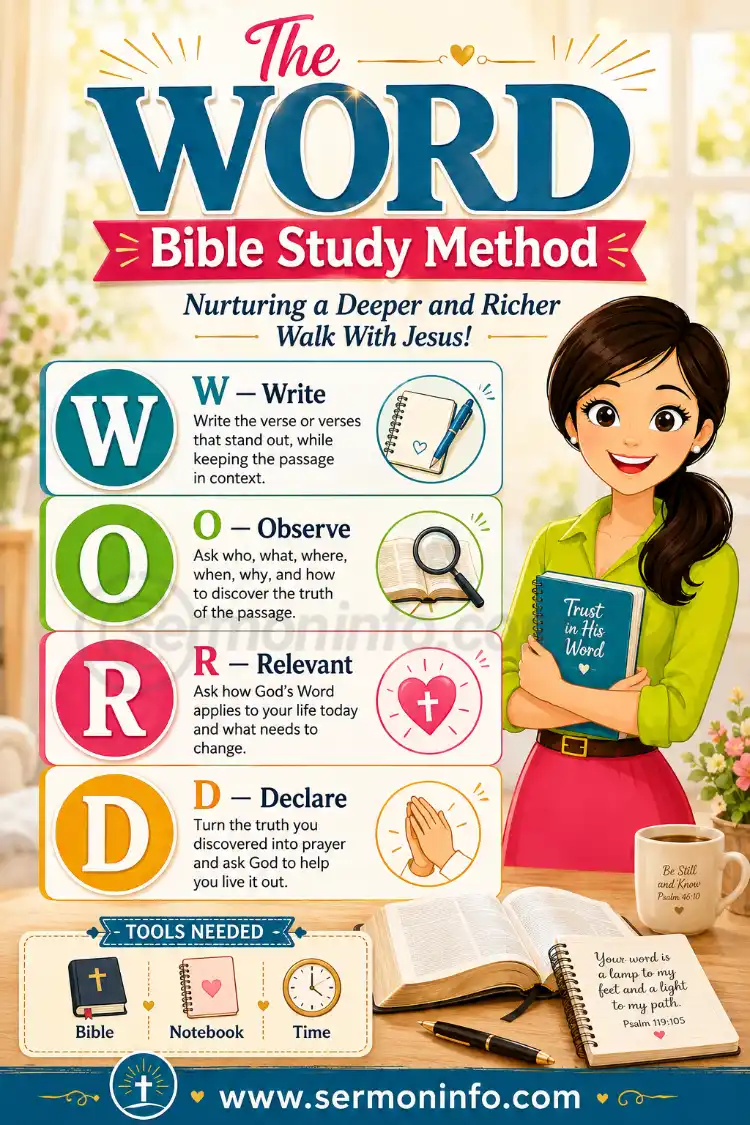
The WORD Bible Study Method is a simple four-step approach to personal Bible study: Write, Observe, Relevant, and Declare. It helps believers examine Scripture in context, apply biblical truth to daily life, and respond to God through prayer. This practical method encourages a deeper, Scripture-centered walk with Jesus.

The WORD Bible Study Method
I am a great believer in daily devotions and I am a great believer in doing daily devotions by reading and studying the Bible for yourself.
I have been writing my daily devotions in a journal since I became a Christian. I came from a non-Christian background and I had no knowledge of the Bible. I found I needed to write my daily devotions in order to understand the Bible.
The WORD Bible Study Method is a simple and practical way to dig deeper in God’s word for yourself.
By discovering principles from the word of God for yourself, you will develop a deeper and richer walk with Jesus. The psalmist said, “Your word is a lamp to my feet and a light to my path” (Psalm 119:105).
The Tools For WORD Bible Study Method
1. Bible
You will need a Bible. There are many Bibles available for you. There are life application Bibles and study Bibles. These Bibles usually have comments in the margins or footnotes relating to the Scripture verses. This can be helpful in your daily devotions.
2. Notebook
You don’t need to buy expensive notebooks for your daily devotions. You just need a notebook.
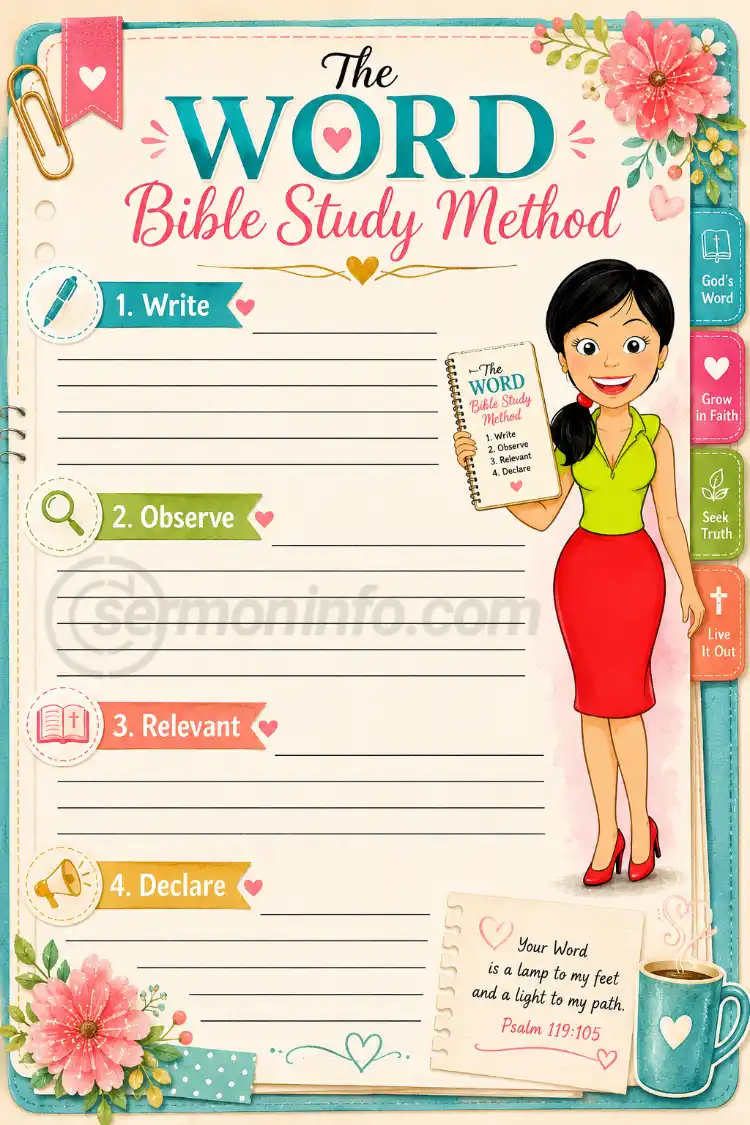
I started with a simply notebook. Overtime, I developed my own journal page in Microsoft word. It was a simple A5 worksheet. I would put that worksheet into an A5 clip binder for future reference. This way you can store your daily devotions for those moments of nostalgia.
3. Time
This is an abstract tool that you will need for your WORD Bible Study. In some ways, this is the hardest tool to find – find time to study God’s word in a devotion setting.
This needs to be your personal time with God. This is a time where you open up your life to God in a very personal way as you allow God to speak to you through his word.
You will need at least fifteen to twenty minutes of your scheduled day. I find the morning the best for me. Others find that night time is the best for them. The important thing is to find time and make it a habit.

How To Use the WORD Method
1. Write
The “W” stands for write. The first step is to write the Word of God in your notebook or journal.
I originally wrote my daily devotions in a notebook but over time I developed a journal with an A5 page placed in A5 clip binder. I developed my own A5 journal page and when the A5 binder was full, I would place those pages in book form. I have kept my A5 journal pages since I’ve been a Christian. Every now and then I look through those old journal pages to see God at work in my life.
If you read a couple of verses or several verses of Scripture, you simply need to write in your journal the verses that stood out for you. These are the verses you are going to dig deeper into while keeping in mind the context of the verses.
For example, you may have read Revelation chapter one and the verse that stands out for you is verse three: “blessed is he who reads and those who hear the words of this prophecy, and keep those things which are written in it, for the time is near.”
Or you may have read Revelation chapter and the verse that stands out for you is verse five: “remember therefore from where you have fallen: repent and do the first works…”
Always remember to keep the verse or verses you have written in your journal in context of the passage that you have read.
2. Observe
The “O” stands for observe. The second step is most important because this step will help you discover truths that will guide you through life.
I find this the most exciting part of my daily devotions – discovering the truths of Scripture. I believe that every time we open the Bible, we invite God to speak to us.
Take for example Revelation chapter two verses one to seven! We discover that Jesus has something to say to the church at Ephesus. He first commends them for their hard work, patience and discerning spirit (2:2-3). He then confronts them with their problem: they have left their first love (2:4). Then Jesus gives them a command which will help them overcome their problem. He encourages them to remember, repent and repeat (2:5).
Observation involves seven interrogatives, that is, you need to ask questions of the verses you have read. The seven interrogatives are: Who or whom, what, which, where, when, why and how.
We need to ask these questions. Who is speaking? Jesus is speaking. To whom is Jesus speaking? He is speaking to Christians. What is he speaking about? He is speaking about their problem, which is, they left their first love. Why did they leave their first? It seems they were doing lots of things for God but it seems they forgot their devotion to God. How could they fix the problem? They needed to remember their first love and turn from what they were doing and repeat the first works.
Of course, you can drill down deeper by asking other questions like: What does first love mean? What are the first works we need to repeat?
By asking observing the verses of Scripture and asking questions, you will discover their meaning and the truths that God wants to reveal to you. And you can do this for yourself!
3. Relevant
The “R” stands for relevant. This is where you asked yourself – how does this verse apply to my life today.
This is where you make God’s word personal by asking questions like: Is this verse speaking to me today? Is God asking me to take action regarding this truth? Do I need to change something in my life so that God’s light will shine in my life to a lost world?
For example, if you were reading Revelation chapter two verse five, you might ask yourself: Is God speaking to me today about my love for him? Is God asking me to make some changes in my life so that I can nurture my love for him? What actions can I take right now?
Relevance is making God’s word personal so that you can nurture a deeper walk with Jesus.
4. Declare
The “D” stands for declare. Declare is all about bringing the principle and truths you have discovered in your daily devotions to God in prayer.
You can write down the truth, you can observe the truth, you can apply the truth but it is God who works that truth in our lives and prayer is the avenue for that.
Lord, I need you to take away all the distractions in my life that hinder my relationship with you and bring me to that place where I can nurture my love for you afresh. Thank you Lord for hearing my prayer! Amen!
Pray into practice what you have learned from your daily devotions! Sometimes, you will need to ask yourself: how can I prayer this into practice in my life today? What do I need to do in order to pray this into practice?
Example of the WORD Bible Study Method
1. Write
The Scripture reading comes from Proverbs 3:5-6: “Trust in the Lord with all your heart, and lean not on your own understanding; in all your ways acknowledge him, and he shall direct your paths.”
2. Observe
When I interact with these Scripture verses, I observe that I need to trust the Lord as the all wise one, I need to obey the Lord and he will direct my paths.
Why should I trust the Lord? Why should I obey the Lord? He is the all wise one. Yes, I can be knowledgeable but God is the all wise one.
What happens if I trust and obey the Lord? He directs my paths in life.
3. Relevant
When I meditate upon this truth that God is the all wise one, I realize that I need to trust God’s word for direction in life. “Lean not on your own understand; in all your ways acknowledge him.”
When I ponder upon these verses, I realize that I need to be 100 percent committed to the Lord and I need to be 100 percent obedient to the Lord.
If I am committed and obedient to the Lord, then he will show me the way to God. “Your word is a lamp to my feet and a light to my path” (Psalm 119:105).
4. Declare
I declare the importance of trust and obedience when it comes to my walk with the Lord. Lord, I pray that you will show me today the importance of my commitment to you and my willingness to obey you in all things! Lord, remind me today when I fail to trust you and obey you in the things that I am doing! In Jesus’ name, Amen!
Key Takeaways – The WORD Bible Study Method
- The WORD Bible Study Method gives believers four simple steps: Write, Observe, Relevant, and Declare.
- Study Scripture in context, ask clear questions, and apply God’s truth to your daily life.
- Respond to God’s Word through prayer, obedience, and consistent practice to strengthen your walk with Jesus.
Frequently Asked Questions (FAQ)
Q: What does WORD stand for in Bible study?
A: The WORD Bible Study Method stands for Write, Observe, Relevant, and Declare. Write the key Scripture, observe what the passage says in context, consider how its truth applies today, and declare that truth to God in prayer. The method gives daily Bible study a simple, memorable structure.
Q: How do you use the WORD Bible Study Method?
A: Begin by writing the verse that stands out. Next, observe the passage by asking who, what, where, when, why, and how. Then consider its relevance to your life. Finally, declare the biblical truth in prayer and ask God for grace to obey His Word.
Q: Why is observation important in Bible study?
A: Observation helps you understand what Scripture actually says before deciding how it applies. Examine the author, audience, context, repeated words, commands, and main ideas. Asking who, what, when, where, why, and how protects you from careless interpretations and helps you identify the passage’s intended meaning.
Q: How do I apply a Bible passage to my life?
A: First understand the passage in its biblical context. Then identify a timeless principle that agrees with the rest of Scripture. Ask what belief, attitude, or action should change. Make the application specific and practical, then pray for God’s help to obey what His Word clearly teaches.
Q: How long should I study the Bible each day?
A: The Bible does not command a set number of daily study minutes. A practical starting point is 15–20 focused minutes each day. Consistency matters more than length. Choose a regular time, study a manageable passage carefully, and allow your study time to grow as the habit becomes established.
| The WORD Bible Study Method | |||
|---|---|---|---|
| Number | Main Point | Bible Verse | Meaning |
| 1 | Write | Psalm 119:11 | Writing key verses helps you focus on God’s Word and store His truth in your heart. |
| 2 | Observe | Acts 17:11 | Carefully examine Scripture in context to understand what God’s Word actually says and means. |
| 3 | Relevant | James 1:22 | Apply biblical truth personally by identifying how God wants you to respond in daily life. |
| 4 | Declare | Philippians 4:6 | Bring the truth you discovered to God in prayer and ask Him to help you live it out. |