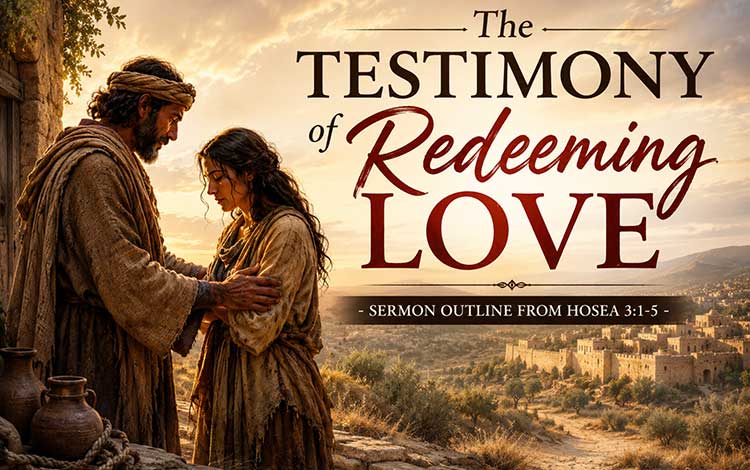
The Testimony of Redeeming Love (Sermon Outline From Hosea 3:1-5) reveals God’s faithful love toward His unfaithful people. Through Hosea’s redemption of Gomer, God illustrates His grace, discipline, and promise of future restoration. This passage highlights God’s covenant faithfulness and points to Israel’s future return to the Lord under the reign of the Messiah, Jesus Christ.
Key Takeaways – The Testimony of Redeeming Love
- God’s redeeming love pursues the unfaithful. Hosea’s redemption of Gomer demonstrates that God graciously seeks sinners and restores those who return to Him in faith and repentance.
- God’s discipline has a restoring purpose. The Lord corrects His people out of love, using discipline to produce repentance, spiritual growth, and renewed fellowship with Him (Hebrews 12:6).
- God’s promises guarantee future hope. Hosea 3:5 points to Israel’s future restoration under Jesus Christ, reminding believers that God remains faithful to every promise He has made.
Sermon Outline From Hosea 3:1-5
Many believers know the joy of being forgiven, yet we also know the pain of failure and wandering. At times, we wonder if God’s love remains when we fall short. Hosea 3 answers that question with a powerful picture of grace. Through Hosea’s pursuit of Gomer, God shows that His love reaches beyond human failure. He seeks, restores, and renews those who have strayed from Him.
As we come to Hosea 3:1-5, we will see a testimony of redeeming love in action. God used Hosea’s relationship with Gomer to illustrate His covenant relationship with Israel. The passage reveals God’s pursuit of the unfaithful, His discipline of those He loves, and His promise of future restoration. More importantly, it points us to the faithful God whose grace never fails and whose purposes always stand.
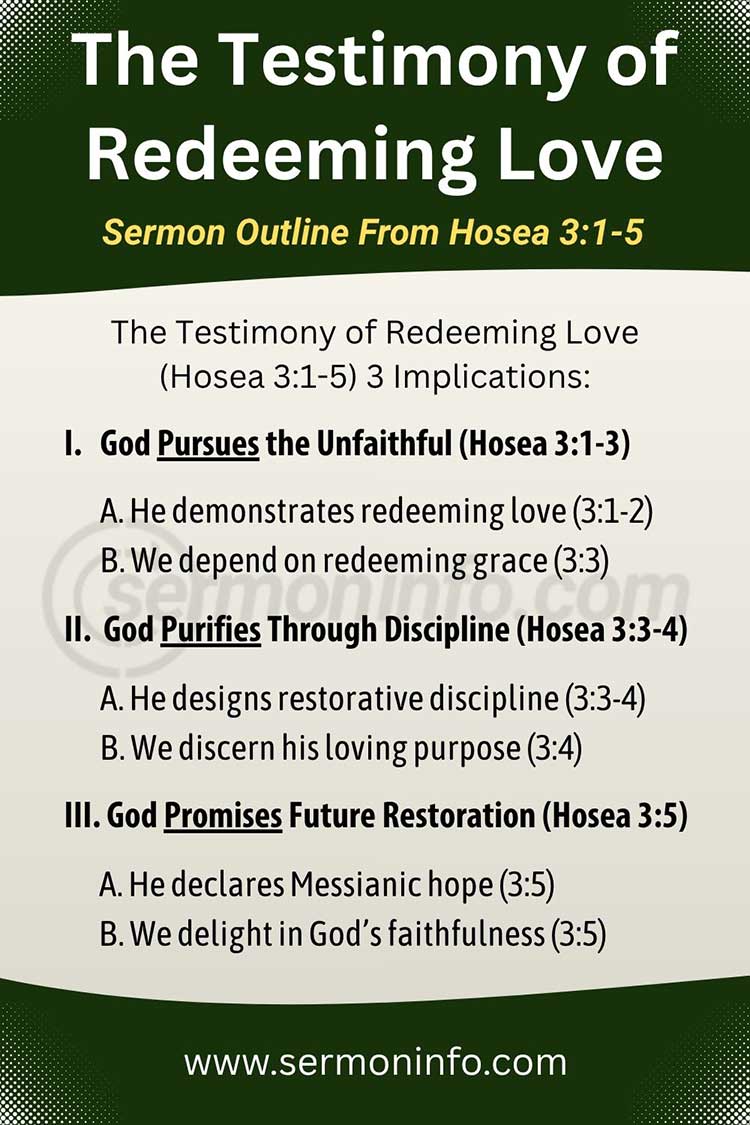
1. God Pursues the Unfaithful (Hosea 3:1-3)
“Then the Lord said to me, ‘Go again, love a woman who is loved by a lover and is committing adultery, just like the love of the Lord for the children of Israel, who look to other gods and love the raisin cakes of the pagans.’ So I bought her for myself for fifteen shekels of silver, and one and one-half homers of barley. And I said to her, ‘You shall stay with me many days; you shall not play the harlot, nor shall you have a man—so, too, will I be toward you'” (Hosea 3:1-3).
A. He Demonstrates Redeeming Love (Hosea 3:1-2)
The Lord told Hosea, “Go again, love a woman who is loved by a lover and is committing adultery” (Hosea 3:1). Gomer had been unfaithful, yet God commanded Hosea to pursue her. Hosea’s obedience reflected God’s covenant love for Israel. Though Israel chased idols, the Lord continued to seek His wandering people with mercy and compassion.
Next, Hosea paid the price to redeem Gomer and bring her home (Hosea 3:2). This redemption pictures God’s gracious pursuit of undeserving sinners. Romans 5:8 reminds us that Christ died for us while we were still sinners. God’s love does not rest on our worthiness. It rests on His faithful character and unchanging promises.
B. We Depend on Redeeming Grace (Hosea 3:3)
After redeeming Gomer, Hosea called her to remain with him in faithfulness and commitment (Hosea 3:3). Restoration involved more than rescue. It required a changed relationship. In the same way, God’s grace not only forgives sin but also transforms lives. The Lord calls His people to walk closely with Him in loving obedience.
This truth speaks clearly to believers today. When Christ saves us, He invites us into daily fellowship with Him. Repentance turns us from sin, and obedience draws us nearer to the Savior. Jesus said, “If you love Me, keep My commandments” (John 14:15). Like Gomer, we respond to redeeming grace with devotion, gratitude, and faithful commitment. (Source Material: William MacDonald, Believer’s Bible Commentary, pp. 1098–1099)
This material provides some ideas and thoughts for a sermon outline from Hosea 3:1-5 (The Testimony of Redeeming Love).
2. God Purifies Through Discipline (Hosea 3:3-4)
“And I said to her, ‘You shall stay with me many days; you shall not play the harlot, nor shall you have a man—so, too, will I be toward you.’ For the children of Israel shall abide many days without king or prince, without sacrifice or sacred pillar, without ephod or teraphim'” (Hosea 3:3-4).
A. He Designs Restorative Discipline (Hosea 3:3-4)
After redeeming Gomer, Hosea placed her under a period of separation and restraint (Hosea 3:3). This arrangement pictured God’s dealings with Israel. Because of persistent rebellion, the Lord removed certain blessings and privileges. Yet His purpose was not rejection. He disciplined His people so they would return to Him with renewed hearts.
Notice that Hosea 3:4 describes Israel living without a king, sacrifices, and national worship. God temporarily withheld these privileges to expose their need for Him. Like a loving father correcting a child, the Lord disciplines those He loves (Hebrews 12:6). His discipline aims to restore fellowship, strengthen faith, and produce repentance.
B. We Discern His Loving Purpose (Hosea 3:4)
Israel’s loss of kingship, sacrifices, and public worship revealed the serious consequences of sin. These losses reminded the nation that turning from God always carries a cost. The Lord removed what they valued so they would seek what they truly needed. Discipline became a mirror that exposed their spiritual condition.
The same principle applies today. When God allows hardship, He often works to deepen our trust and refine our character. Hebrews 12:11 teaches that discipline yields “the peaceable fruit of righteousness.” Like gold purified by fire, believers grow stronger through God’s correction. His loving purpose is holiness, maturity, and closer fellowship with Christ. (Source Material: John MacArthur, The MacArthur Bible Commentary, pp. 973-974)
3. God Promises Future Restoration (Hosea 3:5)
“Afterward the children of Israel shall return and seek the Lord their God and David their king. They shall fear the Lord and His goodness in the latter days” (Hosea 3:5).
A. He Declares Messianic Hope (Hosea 3:5)
After describing Israel’s discipline, Hosea looked beyond the judgment to a glorious future. Hosea 3:5 promises that Israel will return and seek the Lord and “David their king.” This refers to the Messiah, Jesus Christ, the greater Son of David. God had not abandoned His covenant people. He planned their future restoration and blessing.
From a dispensational perspective, this prophecy points to Israel’s national repentance and Christ’s future kingdom reign. The nation that once wandered from God will seek Him with reverence and faith. Like the sunrise after a long night, God’s promises will shine brightly. What God foretells, He always fulfills according to His perfect plan.
B. We Delight in God’s Faithfulness (Hosea 3:5)
The certainty of God’s promises fills our hearts with confidence and hope. Israel’s future restoration reminds us that God never forgets His Word. Though centuries have passed since Hosea’s prophecy, the Lord remains faithful to every covenant promise. His plans move forward exactly as He declared in Scripture.
This truth encourages believers facing uncertainty today. Circumstances change, but God’s character never changes. Second Timothy 2:13 says, “He remains faithful; He cannot deny Himself.” When life feels unstable, we can trust the Lord completely. Just as He will restore Israel, He will keep every promise He has made to His children. (Source Material: John F. Walvoord and Roy B. Zuck, The Bible Knowledge Commentary: Old Testament, pp. 1387–1389)
Conclusion
Hosea 3:1-5 stands as a powerful testimony of redeeming love. Through Hosea’s pursuit of Gomer, God reveals His heart toward His wandering people. He pursues the unfaithful with grace, purifies through loving discipline, and promises future restoration through the Messiah. This testimony reminds us that God’s love remains faithful even when His people fail.
If you have never trusted Christ, come to Him today. Acknowledge your sin, Believe in His death and resurrection, Confess Him as Lord, and Dedicate your life to following Him. The God who redeemed Gomer and promises to restore Israel is ready to forgive, restore, and transform everyone who comes to Him by faith.
Closing Prayer
Heavenly Father, we thank You for the testimony of redeeming love found in Hosea 3. Thank You for loving us when we were unworthy and for pursuing us when we wandered from Your ways. Your grace reaches farther than our failures, and Your mercy never runs dry. Help us to trust Your loving heart, receive Your correction with humility, and walk faithfully with You each day.
Lord Jesus, we rejoice that You are our Redeemer and our coming King. Strengthen our faith in Your promises and fill our hearts with hope for the future You have prepared. Draw those who have drifted back into close fellowship with You. Bring repentance where it is needed, obedience where it is lacking, and joy where it has faded. May our lives become a testimony of Your redeeming love and faithfulness. We pray in Jesus’ Name. Amen.
Frequently Asked Questions (FAQ)
Q: What is the main message of Hosea 3:1-5?
A: Hosea 3:1-5 teaches that God’s redeeming love remains faithful even when His people are unfaithful. Through Hosea’s redemption of Gomer, God illustrates His pursuit of sinful Israel, His loving discipline, and His promise of future restoration through the Messiah.
Q: Why did Hosea buy Gomer back?
A: Hosea bought Gomer back because God commanded him to demonstrate covenant love and forgiveness. This act symbolized God’s willingness to redeem Israel despite her spiritual adultery. Hosea’s redemption points to God’s grace and ultimately foreshadows Christ’s redemptive work for sinners.
Q: What does Gomer represent in the Book of Hosea?
A: Gomer represents the nation of Israel in her spiritual unfaithfulness. Just as Gomer abandoned Hosea, Israel turned from the Lord to idols. Her restoration illustrates God’s enduring covenant faithfulness and His commitment to restore His people despite their rebellion.
Q: Who is “David their king” in Hosea 3:5?
A: “David their king” refers to the promised Messiah, Jesus Christ, the greater Son of David. Hosea prophesies a future day when Israel will return to the Lord, repent, and submit to Christ’s righteous rule during His future kingdom reign.
Q: How does Hosea 3 apply to believers today?
A: Hosea 3 reminds believers that God’s love pursues, redeems, and restores those who repent. It encourages Christians to trust God’s faithfulness, accept His loving discipline, and remain devoted to Christ. The passage offers hope that God’s promises never fail and His grace is always sufficient.

The Bible Knowledge Commentary (2 Volumes) by John F. Walvoord
BONUS: What does Hosea 3 teach about God’s unconditional love?
Hosea 3 teaches that God’s love remains faithful even when His people fail. God commanded Hosea to love and redeem Gomer despite her unfaithfulness (Hosea 3:1-2). This powerful picture reveals that God’s love does not depend on human merit. Romans 5:8 declares that Christ died for us while we were still sinners.
The chapter also shows that God’s love seeks restoration, not rejection. After redeeming Gomer, Hosea called her to a renewed and faithful relationship (Hosea 3:3). In the same way, God lovingly disciplines His people to bring them back to Himself (Hebrews 12:6). His unconditional love forgives, restores, and remains steadfast through every season of life.
BONUS: How does Hosea’s redemption of Gomer foreshadow Jesus Christ’s work of redemption?
Hosea’s redemption of Gomer foreshadows Jesus Christ’s work of redemption because Hosea paid a price to bring back his unfaithful wife (Hosea 3:2). In the same way, Christ paid the ultimate price to redeem sinners from the bondage of sin. First Peter 1:18-19 teaches that believers were redeemed with the precious blood of Christ.
Hosea pursued Gomer despite her failure, just as Christ seeks and saves the lost (Luke 19:10). Gomer could not rescue herself, and neither can sinners save themselves. Through His death and resurrection, Jesus purchased our freedom and restored us to fellowship with God (Ephesians 1:7). Hosea’s act points to the greater Redeemer who lovingly restores all who trust Him.
BONUS: Why did God use Hosea’s marriage as an illustration of His relationship with Israel?
God used Hosea’s marriage to Gomer as a living illustration of His covenant relationship with Israel. Just as Gomer was unfaithful to Hosea, Israel repeatedly turned from the Lord to worship idols (Hosea 1:2; 3:1). Through this powerful picture, God exposed the seriousness of spiritual adultery and revealed His grief over Israel’s rebellion.
At the same time, Hosea’s marriage displayed God’s extraordinary love and faithfulness. Although Israel deserved judgment, God continued to pursue and restore His people. Hosea’s redemption of Gomer reflected God’s commitment to His covenant promises (Hosea 3:2-5). This illustration reminds believers that God’s love remains steadfast even when His people fail and wander from Him.
BONUS: What can Christians learn from God’s discipline in Hosea 3?
God’s discipline in Hosea 3 teaches that the Lord corrects His people because He loves them. Hosea placed Gomer under a period of restraint after redeeming her (Hosea 3:3). Likewise, God disciplined Israel to turn her heart back to Him. Hebrews 12:6 reminds us, “For whom the Lord loves He chastens.”
Christians also learn that God’s discipline aims at restoration, not punishment alone. The Lord removes harmful influences and exposes sinful paths so we will grow in holiness. Hebrews 12:11 says that discipline produces “the peaceable fruit of righteousness.” When God corrects us, He works for our good and draws us into closer fellowship with Himself.
BONUS: How does Hosea 3 reveal God’s covenant faithfulness to Israel?
Hosea 3 reveals God’s covenant faithfulness by showing that He did not abandon Israel despite her repeated unfaithfulness. God commanded Hosea to love and redeem Gomer again (Hosea 3:1-2). This act illustrated God’s steadfast love toward His covenant people. Even when Israel pursued idols, the Lord remained committed to His promises and purposes.
The chapter also points to Israel’s future restoration under the Messiah. Hosea 3:5 declares that Israel will return, seek the Lord, and follow “David their king,” a reference to Jesus Christ. God’s faithfulness extends across generations and guarantees the fulfillment of His covenant promises. Romans 11:29 affirms, “For the gifts and the calling of God are irrevocable.”
BONUS: What future restoration of Israel is predicted in Hosea 3:5?
Hosea 3:5 predicts a future day when Israel will return to the Lord after a long period of discipline and dispersion. The verse states that Israel will “seek the LORD their God and David their king.” This points to national repentance and spiritual renewal as the Jewish people turn to their Messiah, Jesus Christ.
From a dispensational perspective, this prophecy finds its ultimate fulfillment in Christ’s future kingdom reign. Israel will experience restoration, blessing, and renewed fellowship with God according to His covenant promises. Zechariah 12:10 describes Israel looking upon the One they pierced, while Romans 11:26 declares, “And so all Israel will be saved.” God’s faithfulness guarantees this future restoration.
BONUS: What is the difference between interpreting Hosea symbolically or illustratively?
The symbolic approach treats Hosea’s marriage primarily as a symbol or allegory, where the people and events represent spiritual truths rather than actual historical realities. Some interpreters suggest that Hosea’s marriage existed mainly as a prophetic story. However, the grammatical and historical context presents Hosea, Gomer, and their children as real people who lived in real history (Hosea 1:2-3). A purely symbolic interpretation can weaken the historical foundation of the passage and move beyond the author’s intended meaning.
The illustrative or typological approach recognizes Hosea’s marriage as a real historical event that God used to illustrate Israel’s covenant unfaithfulness. Hosea truly married Gomer, yet God designed that relationship to picture His relationship with Israel. This follows the pattern of other biblical illustrations, such as Ezekiel’s acted prophecies (Ezekiel 24:15-24). The illustration communicates a central truth: Israel’s idolatry was spiritual adultery against the Lord, while God’s covenant love remained steadfast despite their rebellion (Hosea 2:19-20). This approach preserves both the historical reality and the theological message of the text.
| Sermon Outline From Hosea 3:1-5 – Sermons That Work From Hosea | |||
|---|---|---|---|
| Number | Main Point | Bible Verse | Meaning |
| 1 | God Pursues the Unfaithful | Hosea 3:1-3 | God demonstrates His covenant love by pursuing and redeeming those who have wandered from Him. |
| 2 | God Purifies Through Discipline | Hosea 3:3-4 | God lovingly disciplines His people to correct their sin and restore them to faithful fellowship with Him. |
| 3 | God Promises Future Restoration | Hosea 3:5 | God guarantees Israel’s future repentance and restoration under the reign of the Messiah, Jesus Christ. |
Source Material
William MacDonald, Believer’s Bible Commentary, rev. ed. (Nashville: Thomas Nelson, 1995), 1098–1099
John MacArthur, The MacArthur Bible Commentary (Nashville: Thomas Nelson, 2005), 973-974
John F. Walvoord and Roy B. Zuck, eds., The Bible Knowledge Commentary: Old Testament (Colorado Springs, CO: David C. Cook, 1985), 1387–1389