Sermon outline from Hosea 2:2-13 reveals God’s response when His people turn from Him and give their devotion to other gods or idols. God confronts sin, corrects wandering hearts, and disciplines rebellion, yet He does so with the goal of restoring His people to faithful fellowship with Himself.
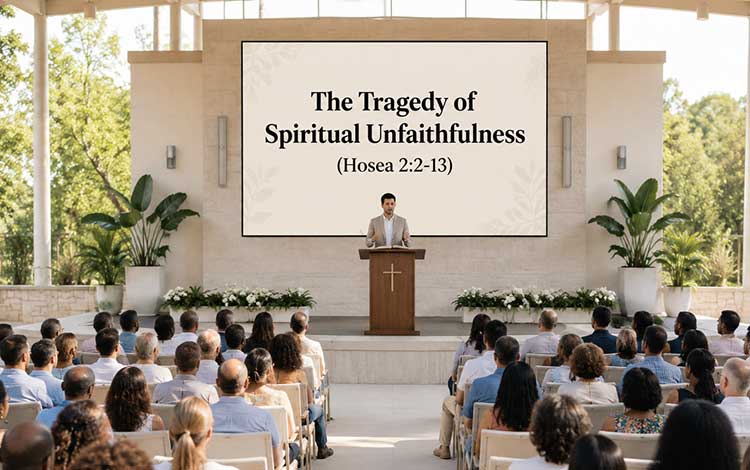
Key Takeaways – The Tragedy of Spiritual Unfaithfulness
- God confronts spiritual unfaithfulness because He desires wholehearted devotion. Like Israel, believers must guard against idols that compete for their love, trust, and worship.
- God’s correction is an expression of His love and grace. When God places obstacles in our path, He often uses them to draw us back to Himself and protect us from greater harm.
- Every blessing comes from God and belongs to God. Believers should gratefully acknowledge His provision and use their time, talents, and resources to glorify Him.
Sermon Outline From Hosea 2:2-13
The book of Hosea presents one of the clearest pictures of God’s covenant love in all Scripture. Through the prophet’s troubled marriage to Gomer, God illustrates Israel’s spiritual adultery. The nation had abandoned her covenant relationship with the Lord and pursued false gods, believing they could provide what only God could give.
In Hosea 2:2–13, God brings a formal charge against His people. He exposes their sin, announces His discipline, and reveals the consequences of their rebellion. Yet even in judgment, His goal is restoration. This passage reminds us that God takes spiritual compromise seriously because He loves His people too much to let them continue wandering from Him without correction.
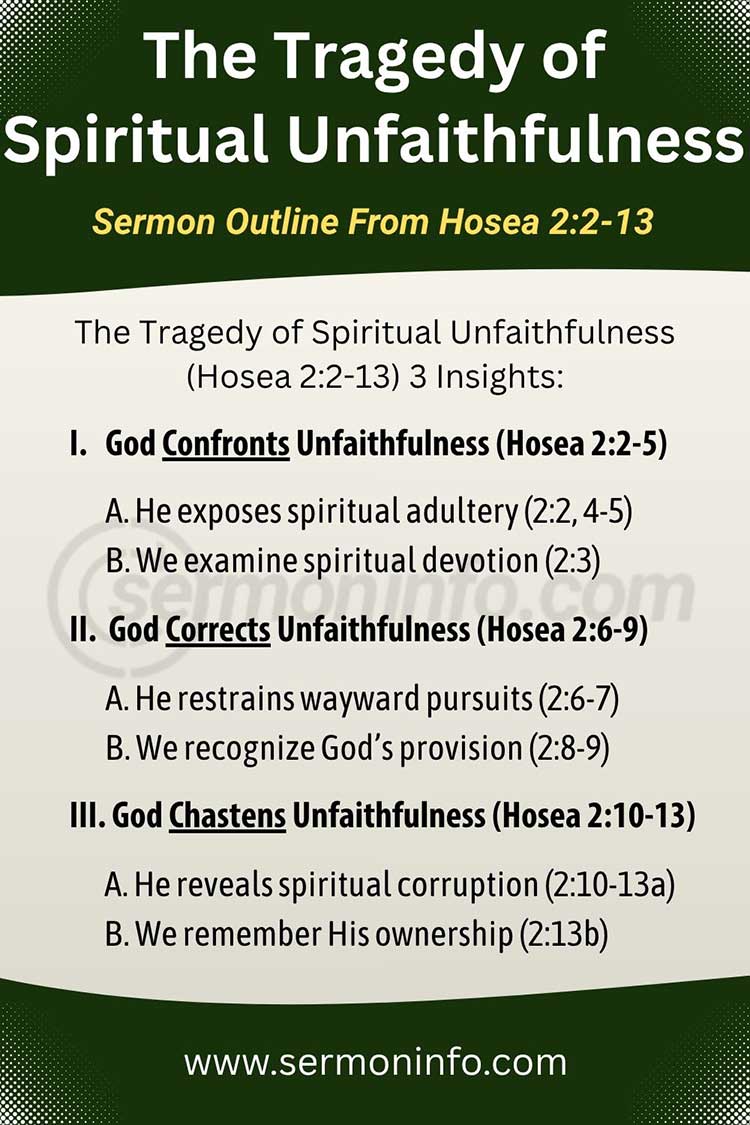
1. God Confronts Unfaithfulness (Hosea 2:2-5)
Just as Hosea confronted Gomer for her unfaithfulness, God confronted Israel for abandoning Him and pursuing false gods (Summary Statement).
A. He Exposes Spiritual Adultery (Hosea 2:2, 4-5)
God compared Israel’s idolatry to a wife abandoning her husband. Just as Gomer pursued other lovers instead of remaining faithful to Hosea, Israel pursued Baal and the false gods of Canaan. She gave her affection, trust, and worship to idols rather than to the Lord who redeemed her. God exposed this sin because He desired truth and repentance, not hidden rebellion.
Notice that God called Israel’s actions spiritual adultery. The nation broke covenant with the Lord and sought satisfaction elsewhere. Many believers face the same temptation today. Money, success, pleasure, and personal ambition can quietly replace devotion to Christ. First John 5:21 warns, “Little children, keep yourselves from idols.” God lovingly exposes misplaced affections so His people can return to Him.
B. We Examine Spiritual Devotion (Hosea 2:3)
God warned Israel that judgment would expose her spiritual condition. The image of a barren wilderness reminded the nation what life becomes when people turn from God. Their outward religion could not hide their inward drift. This warning invites us to examine our hearts honestly before the Lord. Psalm 139:23 says, “Search me, O God, and know my heart.”
Every believer should ask where his deepest devotion rests. A compass that points in the wrong direction will eventually lead a traveler astray. Likewise, a heart devoted to anything above Christ will wander from God’s will. Jesus said, “For where your treasure is, there your heart will be also” (Matthew 6:21). True spiritual health begins when our loyalty belongs fully to God alone. (Source Material: John MacArthur, The MacArthur Bible Commentary, pp. 970–973)
This material provides some ideas and thoughts for a sermon outline from Hosea 2:2-13 (The Tragedy of Spiritual Unfaithfulness).
2. God Corrects Unfaithfulness (Hosea 2:6-9)
Just as a loving husband seeks to turn a wandering spouse back from destructive choices, God used discipline to draw Israel back to Himself (Summary Statement).
A. He Restrains Wayward Pursuits (Hosea 2:6-7)
Israel chased after false gods, believing they would provide security, pleasure, and prosperity. In response, God placed thorns and barriers in her path. He did not do this out of cruelty but out of love. Like a shepherd blocking a dangerous cliff, God restrained Israel so she would see that her idols could never satisfy her deepest needs.
Sometimes God allows disappointments, closed doors, and hardships to redirect His people. Israel would seek her lovers but fail to find them. Then she would remember the goodness she once enjoyed with the Lord. Hebrews 12:6 reminds us, “For whom the Lord loves He chastens.” God’s correction often becomes His invitation to return.
B. We Recognize God’s Provision (Hosea 2:8-9)
Israel enjoyed grain, wine, oil, silver, and gold, yet she failed to recognize God’s hand behind those blessings. Instead, she credited Baal for what the Lord had graciously provided. Her gratitude shifted from the Giver to a false god. This revealed how easily a heart can enjoy God’s gifts while forgetting God’s goodness.
We face the same danger today. A successful career, a healthy family, or financial stability can cause us to overlook God’s daily care. James 1:17 declares that every good gift comes from above. When we remember God’s provision, gratitude grows and pride fades. Every blessing should lead our hearts back to worship the One who gave it. (Source Material: William MacDonald, Believer’s Bible Commentary, pp. 1097–1098)
3. God Chastens Unfaithfulness (Hosea 2:10-13)
Because Israel refused to repent, God allowed her to experience the painful consequences of her spiritual rebellion (Summary Statement).
A. He Reveals Spiritual Corruption (Hosea 2:10-13a)
God declared that He would uncover Israel’s shame before the very idols and nations she trusted. Her false worship promised joy, but it produced emptiness and disgrace. Like a mask removed from a face, God exposed the reality of her spiritual condition. Numbers 32:23 reminds us, “be sure your sin will find you out.”
Israel celebrated feasts and religious ceremonies, yet her heart remained far from God. The Lord removed those celebrations because they had become empty rituals. Many people today maintain outward religion while neglecting genuine devotion. God lovingly exposes hidden sin, not to destroy us, but to lead us toward repentance, cleansing, and restored fellowship with Him.
B. We Remember His Ownership (Hosea 2:13b)
Israel took God’s blessings and used them to honor Baal. She forgot that every harvest, every provision, and every good gift came from the Lord. Instead of worshiping the Giver, she worshiped substitutes. God reminded Israel that what she possessed belonged to Him. Psalm 24:1 declares, “The earth is the Lord’s, and all its fullness.”
This truth speaks clearly to believers today. Our time, talents, resources, families, and opportunities come from God’s gracious hand. We are stewards, not owners. Like a gardener caring for another person’s vineyard, we manage what belongs to the Lord. Therefore, 1 Corinthians 10:31 calls us to do all things for God’s glory, using His gifts to honor Him rather than ourselves. (Source Material: John F. Walvoord and Roy B. Zuck, The Bible Knowledge Commentary: Old Testament, pp. 1382–1385)
Conclusion
As we conclude, Hosea 2:2-13 reminds us that God confronts unfaithfulness, corrects wandering hearts, and chastens persistent rebellion. Israel gave her love to false gods instead of her covenant Lord. Therefore, God exposed her sin, restrained her wayward pursuits, and revealed the emptiness of idolatry. Yet beneath every warning stood His desire to restore His people to faithful fellowship with Himself.
Today, God still calls people to turn from every rival affection and return to Him. Perhaps something has taken first place in your heart. The Lord invites you to trust Him completely because only He can satisfy your deepest needs. If you have never received Jesus Christ as Savior and Lord, come to Him by faith today. He died for your sins and rose again to give you eternal life. Place your trust in Him, follow Him wholeheartedly, and experience the joy of belonging to the One who loves you perfectly.
Closing Prayer
Heavenly Father, we thank You for the timeless truths found in Hosea 2:2-13. Thank You for loving Your people enough to confront sin, correct wandering hearts, and discipline those You call Your own. Forgive us for the times we have allowed other things to compete for our devotion. Search our hearts, reveal anything that dishonors You, and draw us into a deeper relationship with You. Help us love You with all our heart, soul, mind, and strength.
Lord, we thank You for sending Your Son, Jesus Christ, to redeem us and bring us into fellowship with You. Keep our eyes fixed on Him and guard us from the empty promises of this world. Teach us to recognize Your daily provision and to use every blessing for Your glory. Strengthen our faith, deepen our obedience, and fill us with gratitude for Your unfailing love. May we leave today committed to following You wholeheartedly until the day we see You face to face. We pray in Jesus’ name. Amen.
Frequently Asked Questions (FAQ)
Q: What is spiritual adultery in the Bible?
A: Spiritual adultery occurs when people give their devotion, trust, and worship to something other than God. In Hosea 2, Israel pursued false gods instead of remaining faithful to the Lord. The passage warns believers to guard their hearts against modern forms of idolatry.
Q: Why did God compare Israel to an unfaithful wife?
A: God used Hosea’s marriage to Gomer to illustrate Israel’s covenant unfaithfulness. Just as Gomer pursued other lovers, Israel pursued idols and abandoned her relationship with God. The comparison highlights both the seriousness of sin and God’s persistent covenant love.
Q: Why did God discipline Israel in Hosea 2?
A: God disciplined Israel to expose the emptiness of idolatry and bring His people to repentance. His correction was not motivated by cruelty but by love. Like a caring father, God used discipline to restore a broken relationship and draw Israel back to Himself.
Q: What can Christians learn from Hosea 2:2-13 today?
A: Christians learn that anything taking God’s rightful place becomes an idol. Hosea 2 encourages believers to examine their hearts, recognize God’s provision, and remain faithful to Him. The passage reminds us that God lovingly corrects His people when they wander.
Q: How does Hosea 2 reveal God’s love and grace?
A: Although God confronted Israel’s sin and announced discipline, His ultimate goal was restoration. Hosea 2 shows that God does not abandon His people when they fail. Instead, He pursues them, corrects them, and invites them back into faithful fellowship with Himself.

The Bible Knowledge Commentary (2 Volumes) by John F. Walvoord
BONUS: What does Hosea 2 teach about God’s discipline?
Hosea 2 teaches that God’s discipline flows from His covenant love, not from cruelty or rejection. When Israel pursued false gods, the Lord placed obstacles in her path and frustrated her sinful pursuits (Hosea 2:6-7). God used correction to show that idols could never satisfy her deepest needs. His discipline aimed to bring His people back to Himself.
God’s discipline also exposes misplaced affections and reminds believers of their dependence on Him. Israel forgot that God provided her grain, wine, oil, silver, and gold (Hosea 2:8). Likewise, God uses loving correction to restore spiritual priorities. Hebrews 12:6 says, “For whom the Lord loves He chastens.” His discipline seeks repentance, renewed fellowship, and spiritual growth.
BONUS: Why did Israel turn to false gods in the Book of Hosea?
Israel turned to false gods because she believed they provided the prosperity, security, and blessings she enjoyed. Instead of thanking the Lord for His provision, she credited Baal for her grain, wine, oil, silver, and gold (Hosea 2:8). Her heart drifted from God, and she trusted created things rather than the Creator who had redeemed her.
Israel also followed the spiritual influence of the surrounding nations and abandoned covenant faithfulness. She pursued other lovers, which symbolized her devotion to idols (Hosea 2:5). This pattern reflects the danger of loving the world more than God. 1 John 2:15 warns believers, “Do not love the world or the things in the world.” A divided heart often leads to spiritual compromise.
BONUS: What are the consequences of idolatry according to Hosea 2?
Idolatry brought shame, loss, and divine discipline upon Israel. God exposed the emptiness of her false worship and removed the blessings she wrongly attributed to Baal (Hosea 2:9-10). The idols she trusted could not protect or satisfy her. Numbers 32:23 reminds us, “Be sure your sin will find you out.”
Idolatry also damaged Israel’s fellowship with God and led to spiritual blindness. The nation forgot the Lord who had redeemed and provided for her (Hosea 2:13). As a result, God allowed painful consequences to reveal her need for repentance. Believers today face similar dangers when anything takes God’s rightful place in their hearts. 1 John 5:21 says, “Keep yourselves from idols.”
BONUS: How does Hosea’s marriage to Gomer symbolize God’s relationship with Israel?
Hosea’s marriage to Gomer served as a living illustration of God’s relationship with Israel. Just as Gomer repeatedly left Hosea to pursue other lovers, Israel repeatedly abandoned the Lord to follow false gods. Through this painful marriage, God revealed the depth of Israel’s spiritual adultery and covenant unfaithfulness (Hosea 1:2; 2:5).
Yet Hosea’s continued love for Gomer also reflected God’s enduring love for His people. Although Israel deserved judgment, God remained faithful to His covenant promises and sought her restoration. Hosea’s pursuit of Gomer pictures God’s pursuit of wandering sinners. Jeremiah 31:3 declares, “Yes, I have loved you with an everlasting love.” God’s grace reaches out even when His people stray from Him.
BONUS: What does Hosea 2 reveal about God’s covenant faithfulness?
Hosea 2 reveals that God’s covenant faithfulness remains steadfast even when His people act unfaithfully. Although Israel pursued idols and broke covenant obligations, God continued to pursue her and call her back. His discipline demonstrated His commitment to the relationship rather than His abandonment of it. Lamentations 3:22 says, “His compassions fail not.”
God’s faithfulness also appears in His desire to restore rather than destroy. He exposed Israel’s sin, corrected her rebellion, and prepared the way for future renewal. Unlike human faithfulness, God’s faithfulness never changes. Second Timothy 2:13 declares, “If we are faithless, He remains faithful.” Believers can trust God’s promises because His character never fails.
BONUS: How can believers avoid spiritual unfaithfulness today?
Believers can avoid spiritual unfaithfulness by keeping Christ first in their hearts and lives. Daily prayer, Bible study, and obedience strengthen our relationship with God and guard against wandering. Jesus said, “Abide in Me” (John 15:4). When believers remain close to the Lord, they recognize false substitutes and resist the pull of worldly idols.
Believers should also regularly examine their hearts and give thanks for God’s provision. Idolatry often begins when people trust God’s gifts more than God Himself. First John 5:21 warns, “Keep yourselves from idols.” As we worship God, serve Him faithfully, and remember His goodness, our devotion grows stronger and our love for Him remains steadfast.
| Sermon Outline From Hosea 2:2-13 – Free Expository Sermon Outlines | |||
|---|---|---|---|
| Number | Main Point | Bible Verse | Meaning |
| 1 | God Confronts Unfaithfulness | Hosea 2:2-5 | God exposes Israel’s spiritual adultery because she abandoned her covenant relationship with Him and pursued false gods. |
| 2 | God Corrects Unfaithfulness | Hosea 2:6-9 | God lovingly places obstacles in Israel’s path to show that idols cannot satisfy and that every blessing comes from Him alone. |
| 3 | God Chastens Unfaithfulness | Hosea 2:10-13 | God reveals the shame and consequences of Israel’s idolatry to bring her to repentance and renewed devotion. |
Source Material
John MacArthur, The MacArthur Bible Commentary (Nashville: Thomas Nelson, 2005), 970-973
William MacDonald, Believer’s Bible Commentary, rev. ed. (Nashville: Thomas Nelson, 1995), 1097–1098
John F. Walvoord and Roy B. Zuck, eds., The Bible Knowledge Commentary: Old Testament (Colorado Springs, CO: David C. Cook, 1985), 1382–1385