The mechanical layout of Scripture is a valuable skill to aid students or preachers in determining the author’s meaning within the Scriptures.
The mechanical layout of Scripture outlines a verse or verses of Scripture in order to expose the flow of thought in a visual way. You will clearly see the main thought and subordinate thoughts as you sketch the mechanical layout on your notebook.
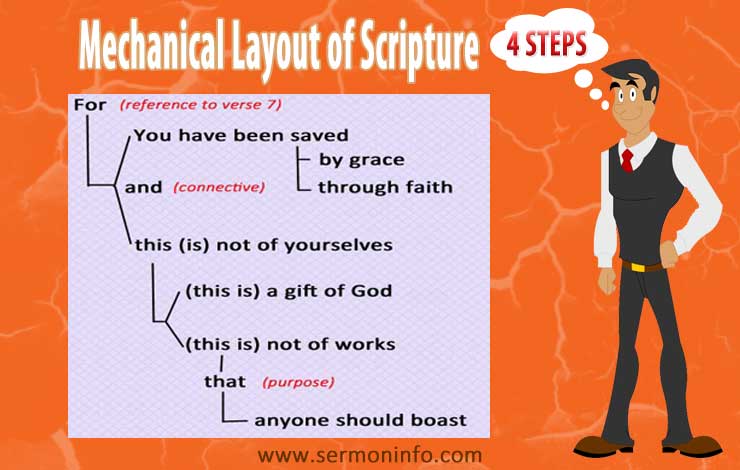
Mechanical Layout of Scripture
The mechanical layout of Scripture is a diagrammatical way to layout the relationships between the thought patterns in Scripture. It is a learned skill which helps you to study the Bible for yourself.
The layout of Scripture in this way separates main thoughts from minor thoughts so that you can form outlines for teaching and preaching.
This valuable skill is a flexible method of diagramming the Scriptures. You can choose to what degree you break down the passage. Some people call this block diagramming. Either way it is a great skill to learn for teaching and preaching.
To prepare a mechanical layout of Scripture, you will need to analyse the structure of Scripture, to sketch the layout of Scripture and design the flow chart of Scripture.
1. Analyze the Structure of Scripture
You will need a rudimentary knowledge of grammar and syntax and this requires work. There is no easy solution when it comes to grammar and syntax.
Grammar defines each word in a sentence. Syntax defines how words function in a sentence.
For example, in John 3:16, we read these words: For God so loved the world. The word “God” is a noun and it functions as the subject of the sentence. The word “world” is a noun and it functions as the object of the sentence.
A. Grammar – Parts of Speech
- noun – names a person, place or thing
- pronoun – replaces the noun
- verb – shows action or state-of-being
- adjective – modifies a noun
- adverb – modifies a verb, adjective and another adverb
- preposition – shows how things go together
- conjunction – joining words
- interjection – shows strong and sudden feeling
B. Syntax – Parts of Speech Functions
- subject – is the one doing or being something
- predicate – is what the subject does or is
- object – is the entity acted upon by the subject
- complement – completes a given expression
- modifier – provides additional information in adverbial and adjectival form
By recognizing the parts of speech and how they function together in sentences, you will be on your way to sketch the mechanical layout.
It is also important to recognize that sentences are made up of words, phrases and clauses (see below for more information).
2. Sketch the Mechanical Layout
You need to remember that this method is flexible. Don’t think you need to get it exactly right from the start. It is a skill that is learned over time. You will get better and sharper with experience.
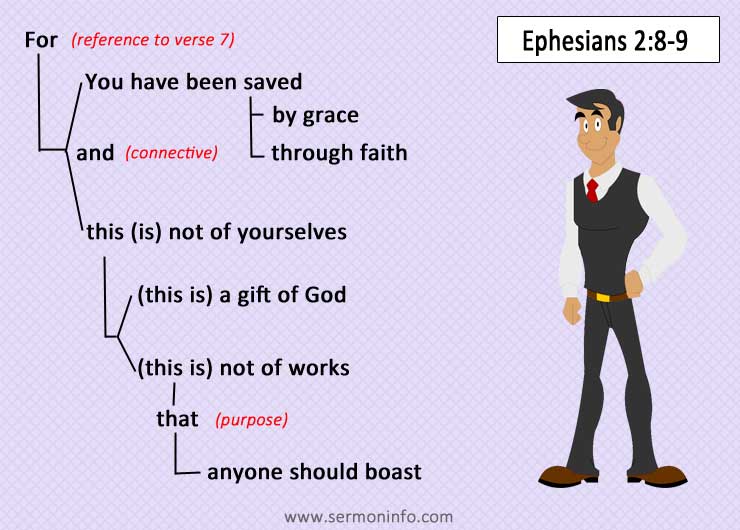
I want to look at an example from Ephesians 2:8-10. “For by grace you have been saved through faith, and that not of yourself; it is the gift of God, not of works, lest anyone should boast.
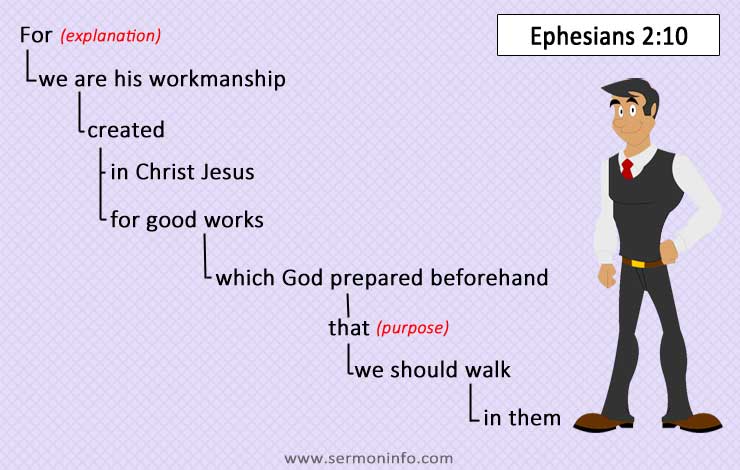
For we are his workmanship, created in Christ Jesus for good works, which God prepared beforehand that we should walk in them.”
The first thing you need to do is to discover the main thoughts in these verses. In verses 8 & 9, you will find the main thought to be: you have been saved. In verse 10, you will find the main thought to be: we are his workmanship.
Once you have discovered the main thoughts, you will need to discover the subordinate thoughts in these verses.
You can see the images below for examples of how I sketched a mechanical layout of Scripture from these verses.
3. Design the Flow Chart
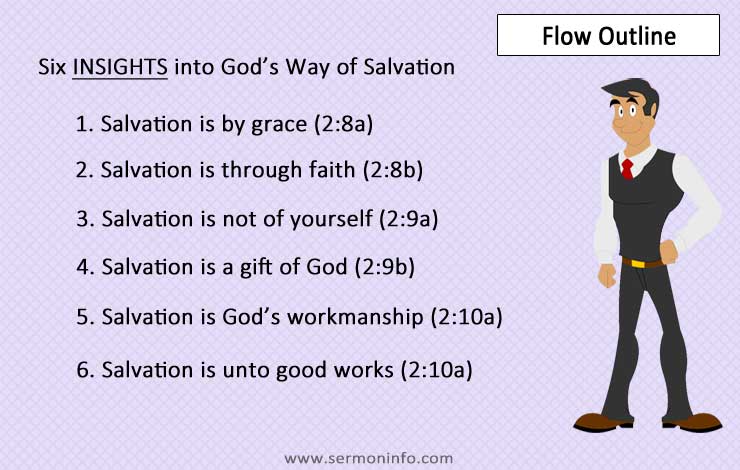
One of the great advantages of the mechanical layout of Scripture is that it becomes the platform for developing an outline for teaching and preaching.
The flow chart can easily be transformed into a preaching outline (see image below).
4. Understand Sentence Structure
Sentences are units of thought made up of words, phrases and clauses. When you sketch a mechanical layout of Scripture, you will need to recognize how words, phrases and clauses work in sentences.
The parts of speech will help you recognize how words function in sentences. However, you will need to be able to recognize how phrases and clauses work together to make up sentences.
A. How Phrases Work
A phrase is a group of words that function together. However, a phrase does not contain a subject and a verb. A phrase adds meaning to words or groups of words.
There are three kinds of phrases: prepositional phrases, participle phrases and infinitive phrases.
A prepositional phrase consists of a preposition and the object of the preposition. You have been saved by grace through faith. The two prepositional phrases are: by grace and through faith. Prepositional phrases can function as adverbs or adjectives.
A participle phrase is a partial-verb form that functions as an adjective, adverb or a noun. These participle phrases are very common in the Bible. They are easy to spot in the Greek text but not so easy in the English text.
- These things says he who has the sharp two-edged sword (Rev. 2:12b)
- He who has an ear, let him hear …” (Rev. 2:17a)
- Blessed is he who reads and those who hear … and keep those things written in it (Rev. 1:3).
An infinitive phrase is a verbal form that consists of the word “to” plus the verb (eg to live, to die, to love, to walk, to pray). Infinitives function as nouns, adjectives and adverbs.
- God gave him to show his servants (Rev. 1:1; used as an adverb)
- To live is Christ, and to die is gain (Phil. 1:2; used as a noun)
- You are worthy … to receive glory and honor and power (Rev. 4:11; used as an adjective)
B. How Clauses Work
A clause is a group of words that contains a subject and a verb. The two main types of clauses are: independent clauses and dependent clauses.
Independent clauses are able to stand alone and make sense by themselves.
- I know your affliction and poverty (Rev. 2:9a)
- I have the keys of hades and death (Rev. 1:18b)
- He had in his right hand seven stars (Rev. 1:16)
Dependent clauses are not able to stand alone or make sense by themselves.
Because dependent clauses cannot stand on their own, they are subordinate to other clauses. They function as noun clauses, adjective clauses and adverb clauses.
- God gave him to show his servants things which must shortly take place (Rev. 1:1b; used as an adjective)
- Whatever is not from faith is sin (Rom. 14:23; used as a noun)
- Having turned, I saw seven golden lampstand (Rev. 1:12b; used as an adverb)
It might seem difficult at first but once you learn the skill of recognizing the structure of sentences, you will be on your way sketching the mechanical layout of Scripture.