The Sermon Outline From Psalm 1:1-6 unpacks true happiness in the Lord by contrasting the righteous life with the path of the ungodly.
Key Takeaways – True Happiness is Found in the Lord
- True happiness is found in God and His Word — The blessed person delights in God and His Word, and finds joy by meditating on it day and night (Psalm 1:2).
- The righteous follow God’s path — They avoid ungodly counsel, sinful behavior, and scornful attitudes, choosing instead to walk in God’s way (Psalm 1:1).
- The wicked face judgment — Their lives are unstable like chaff in the wind, and they will not stand in the final judgment (Psalm 1:4-5).
- God approves the righteous — The Lord watches over the way of the righteous, granting them prosperity, fruitfulness, and eternal blessing (Psalm 1:3, 6).
- The wicked perish apart from God — The path of the wicked ends in destruction, while the righteous find life and joy in the Lord God Almighty (Psalm 1:6).
Sermon Outline From Psalm 1:1-6
Everyone is searching for happiness. Some chase it in possessions, others in popularity, and still others in pleasure. Yet lasting joy often slips through their fingers.
Psalm 1 gives us a different picture. It describes two kinds of people—the blessed and the ungodly—and shows where true fulfillment is found. Like a tree planted by rivers of water, the righteous person flourishes because his roots go deep into God’s Word.
As we examine this psalm together, we will see the contrast between the blessed life, the judged life, and the approved life. True happiness, lasting joy, and eternal blessing are found only in the Lord Jesus Christ.
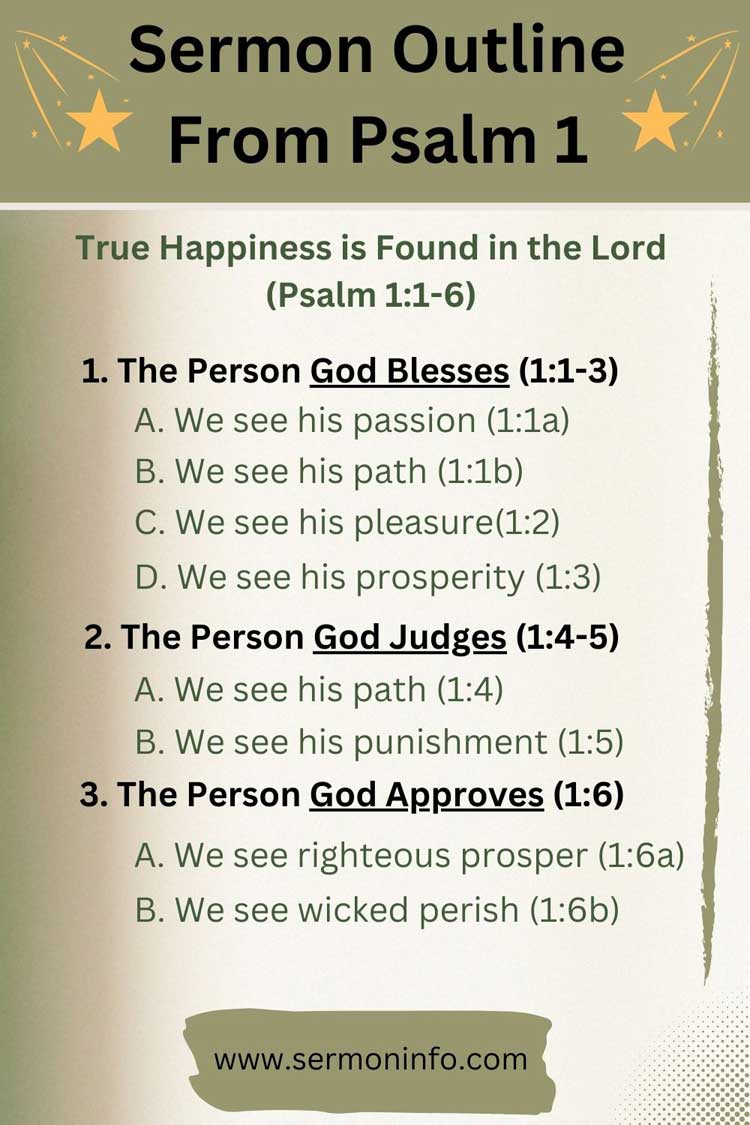
1. The Person God Blesses (1:1–3)
A. We see his passion
“Blessed is the man … his delight is in the law of the Lord.” (1:1a)
The blessed man is marked not by what he avoids, but by what he loves. His passion is God’s Word. Psalm 1:2 says his delight is in the law of the Lord. He does not approach Scripture as a burden but as a joy-filled treasure for his soul.
Think of Jeremiah who declared, “Your words were found, and I ate them, and Your word was to me the joy and rejoicing of my heart” (Jeremiah 15:16). Passion for God’s Word is the heartbeat of a blessed life. The more we hunger for His truth, the more we find real satisfaction and happiness in Him.
B. We see his path
“Who walks not in the counsel of the ungodly, Nor stands in the path of sinners, Nor sits in the seat of the scornful.” (1:1b)
The psalmist shows us the downward spiral of sin. The blessed man does not walk in the counsel of the ungodly, stand in the way of sinners, or sit in the seat of the scornful. He knows compromise always leads to captivity.
This picture is real. One small step with wrong company can soon become a settled position. Paul reminds us in 1 Corinthians 15:33, “Bad company corrupts good morals.” The righteous person avoids this destructive path because he chooses God’s way, not the world’s way.
C. We see his pleasure
“But his delight is in the law of the Lord, And in His law he meditates day and night.” (1:2)
The blessed man finds true pleasure in God’s Word. He meditates on it day and night. Meditation here means more than reading. It is turning God’s truth over in the mind and pressing it into the heart.
Just as a cow chews the cud, the believer savors Scripture until it becomes part of him. Joshua 1:8 says meditation leads to success and obedience. Real pleasure comes when the Word shapes how we think, speak, and live every single day.
D. We see his prosperity
“He shall be like a tree Planted by the rivers of water, That brings forth its fruit in its season, Whose leaf also shall not wither; And whatever he does shall prosper. (1:3)
The psalmist compares the righteous to a tree planted by streams of water. His life is nourished by God’s Word. He flourishes because his roots reach into a constant source. His prosperity does not depend on outward circumstances but inward strength.
This tree bears fruit in season. It does not wither when trials come. Its leaves stay green, showing vitality and life. The psalmist declares, “Whatever he does shall prosper.” True prosperity is walking in God’s will and living in the abundance of His blessing.
To All My Students: This material provides some ideas and thoughts for a message from Psalm 1:1-6 (True Happiness is Found in the Lord).
2. The Person God Judges (1:4–5)
A. We see his path
“The ungodly are not so, But are like the chaff which the wind drives away.” (1:4)
The ungodly are not like the tree. They are like chaff, dry and worthless, blown away by the wind. Their life has no stability, no root, and no lasting substance. Without God, they drift from one thing to another, never finding true meaning.
Jesus described this in Matthew 7:27. A house built on sand cannot stand when storms come. The ungodly path is unstable and destructive. People may chase success or pleasure, but apart from God, it all ends in emptiness and loss.
B. We see his punishment
“Therefore the ungodly shall not stand in the judgment, Nor sinners in the congregation of the righteous.” (1:5)
The psalmist says the ungodly will not stand in the judgment or in the congregation of the righteous. That is a sobering reality. Their way may seem attractive now, but it ends in eternal separation from God.
Revelation 20 reminds us of the great judgment when every person will give account. Only those in Christ will stand secure. The punishment of the ungodly is not just in eternity, but in the present emptiness of a life without God.
3. The Person God Approves (1:6)
A. We see the righteous prosper
“For the Lord knows the way of the righteous.” (1:6a)
The Lord knows the way of the righteous. His approval rests on them. To be “known” by God is not just awareness but relationship. He watches, guides, and blesses those who walk with Him. His eye is always on the righteous for their good.
Psalm 37:23 says, “The steps of a good man are ordered by the Lord, and He delights in his way.” That is true prosperity: walking daily in God’s approval and enjoying His favor through Christ.
B. We see the wicked perish
“But the way of the ungodly shall perish.” (1:6b)
The way of the ungodly will perish. It may look attractive and successful for a time, but it cannot last. Without Christ, their path ends in ruin. The contrast is sharp. One path leads to life, the other to destruction.
Jesus echoed this in Matthew 7:13–14. The broad road leads to destruction, but the narrow way leads to life. God’s approval rests on those who trust His Son. Without Him, there is only judgment and loss.
Concluding Summary
Psalm 1 makes the path of happiness clear. The righteous delight in God and His Word, while the wicked follow a road that ends in ruin.
The blessed man prospers because his roots draw strength from God Himself. The ungodly perish because they reject the only source of life. God invites us to walk the way of blessing, not destruction.
The choice is set before us today. Will we follow the world’s empty path, or will we follow God and His Word which give everlasting joy?
Source Material
Holman Old Testament Commentary of the Psalms (Volume 1 & Volume 2) by Steven J. Lawson
An Expositional Commentary of the Psalms (Volume 1, Volume 2 and Volume 3) by James Montgomery Boice
A Commentary of the Psalms (Volume 1, Volume 2 and Volume 3) by Allen P. Ross
The NIV Application Commentary of the Psalms (Volume 1) by Gerald H. Wilson
Frequently Asked Questions (FAQ)
Q: What does “blessed” or “happy” mean in Psalm 1:1?
A: In Hebrew, “blessed” (ashre) conveys more than a fleeting emotion. It’s a deep, ongoing state of favor and flourishing with God. It means being content, living rightly, and walking in God’s way. Psalm 1:1 shows that true happiness begins by rejecting ungodly counsel and embracing God’s wisdom.
Q: Why does Psalm 1 urge us to avoid walking, standing, and sitting with the ungodly, sinners, and scornful?
A: These three verbs show a progressive path of influence. Walking means casual advice, standing means involvement, and sitting means full participation with mockers. Avoiding them protects the heart. As believers, our path matters: what we engage with shapes what we become.
Q: What does “delight in the law of the Lord” look like in daily life?
A: Delighting in God’s Word means more than duty. It’s a joy, a longing for His truth. It might show in reading Scripture first thing, memorizing verses, applying Truth in decision-making, or pausing to meditate on a phrase. It means letting God’s Word shape your thoughts, your relationships, your priorities. Psalm 1:2 underscores meditation “day and night.”
Q: How does the metaphor of a tree planted by streams of water in Psalm 1:3 describe prosperity?
A: That tree has stability, continual nourishment, and seasons of fruit. Its leaves do not wither, even under stress. The image shows the righteous person rooted in God’s Word, drawing from His sustaining presence. Prosperity here is holistic—it includes spiritual growth, fruitfulness, peace, and effectiveness in life.
Q: What is the final outcome for the wicked according to Psalm 1:4-6?
A: The psalm warns that the wicked are unstable like chaff blown by the wind. They will not stand in judgment nor be part of the righteous congregation. Their way leads to destruction. Ultimately God “knows the way of the righteous, but the way of the wicked shall perish.” This is not merely poetic—it’s part of divine justice and faithfulness.
| Number | Main Point | Bible Verse | Meaning |
|---|---|---|---|
| 1 | The Person God Blesses | Psalm 1:1–3 | The righteous delight in God’s Word, walk in His way, and flourish like a fruitful tree. |
| 2 | The Person God Judges | Psalm 1:4–5 | The ungodly live unstable lives like chaff and will not stand in God’s judgment. |
| 3 | The Person God Approves | Psalm 1:6 | The Lord watches over the righteous, but the wicked will perish apart from Him. |