The sermon outline from Acts 6:1-7 teaches that biblical service strengthens the church when believers respect God’s priorities, fulfill distinct roles, and work together in unity so the Word of God advances. Faithful service protects spiritual leadership and produces lasting spiritual fruit.
Key Takeaways – Serving Supports God’s Ministry Design
- God expects churches to address real needs honestly. Acts 6 shows that healthy churches acknowledge problems early instead of ignoring tension or unmet needs.
- Biblical priorities protect spiritual health. God assigns leaders to prayer and the ministry of the Word so doctrine, direction, and spiritual growth remain strong.
- Delegated service strengthens the whole church. When qualified believers serve according to their gifts, ministry functions smoothly and unity increases.
- Faithful service leads to gospel growth. When serving supports God’s design, the Word of God spreads and lives change through Christ.
Sermon Outline From Acts 6:1-7
The early church in Jerusalem grew quickly after Pentecost, and growth brought both blessing and strain. New believers joined daily, cultures mixed, and practical needs increased. Soon, some widows were overlooked, and tension surfaced among sincere believers. Acts 6 shows us that even Spirit-filled churches face real challenges, and God cares deeply about how His people respond when pressure rises.
In Acts 6:1–7, Scripture reveals how service fits within God’s ministry design. This passage explains how the church addressed real needs while protecting prayer and the ministry of the Word. It shows why God values ordered service, clear roles, and shared responsibility. These truths matter because churches today face the same pressures and opportunities.
As we study this passage, we will learn how God uses faithful service to support spiritual leadership and advance His work. This text prepares us to serve wisely, honor biblical priorities, and trust God’s design for ministry. Let us approach this passage ready to learn and willing to apply God’s truth.
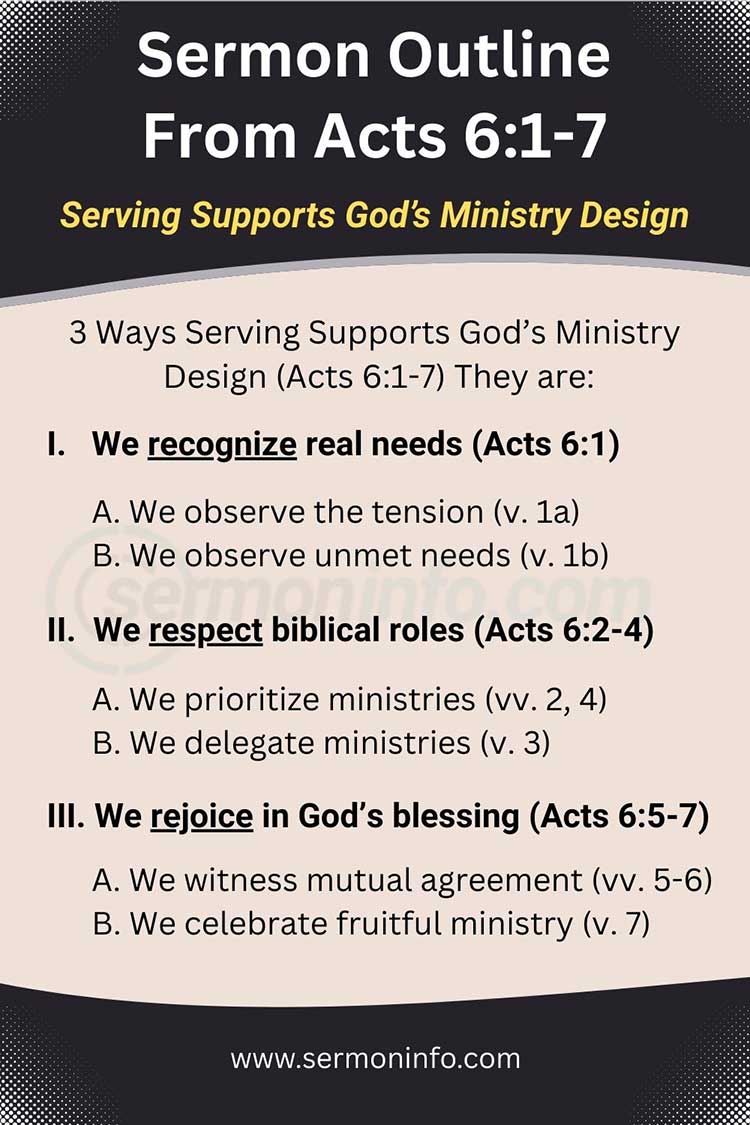
1. We recognize real needs (Acts 6:1)
Healthy service in the local church begins when believers honestly acknowledge real problems that arise as God’s work grows.
A. We observe the tension (Acts 6:1a)
The church in Jerusalem experienced rapid growth, and growth brought pressure. As the number of disciples multiplied, cultural differences between Hebrew and Hellenistic believers surfaced. These believers shared the same faith in Christ, yet background and language created strain. Growth exposed tension that unity alone could not automatically solve.
This moment reminds us that spiritual growth does not remove human weakness. Even strong churches face relational challenges. God records this tension to teach us that recognizing problems early protects unity and honors Christ. Ignoring tension allows division to deepen, but addressing it biblically strengthens the church.
B. We observe unmet needs (Acts 6:1b)
The tension revealed a specific problem: certain widows were overlooked in daily distribution. This neglect was not intentional, but it was real. Widows depended on the church for daily care, and unmet needs affected both physical welfare and spiritual trust within the body.
God values practical compassion alongside spiritual ministry. When needs go unmet, faithfulness suffers and relationships weaken. Acts 6 shows that recognizing unmet needs is not criticism but stewardship. Believers serve God well when they see needs clearly and respond with wisdom, humility, and love.
This material provides some ideas and thoughts for a sermon outline from Acts 6:1-7 (Serving Supports God’s Ministry Design).
2. We respect biblical roles (Acts 6:2–4)
God strengthens His church when each believer serves within the roles He establishes and protects the priorities He assigns.
A. We prioritize ministries (Acts 6:2, 4)
The apostles understood that they could not do everything without neglecting their primary calling. They clearly stated that leaving the ministry of the Word to serve tables was not God’s design for them. God had appointed them to prayer and the teaching of Scripture, which formed the spiritual foundation of the church.
This priority did not diminish practical service; it preserved spiritual health. When leaders guard prayer and the Word, the church remains anchored in truth. Scripture shows that spiritual leadership must stay focused, because when teaching weakens, faith weakens and confusion grows.
B. We delegate ministries (Acts 6:3)
Rather than ignoring the need, the apostles guided the congregation to appoint qualified servants. These men had good reputations, spiritual maturity, and wisdom. Delegation allowed ministry to continue without compromising leadership responsibilities or unity within the church.
God uses delegation to multiply effectiveness, not to avoid responsibility. When believers serve according to their gifts, the whole body functions well. Acts 6 reminds us that delegation honors God’s design and allows every believer to participate meaningfully in His work.
3. We rejoice in God’s blessing (Acts 6:5–7)
When believers follow God’s ministry design, the church experiences unity, spiritual health, and visible evidence of God’s blessing.
A. We witness mutual agreement (Acts 6:5–6)
The congregation responded positively to the apostles’ guidance. The solution pleased the whole multitude, showing unity of heart and purpose. The church selected men who met biblical qualifications and trusted the apostles to affirm them through prayer and laying on of hands.
This agreement reflected spiritual maturity, not personal preference. The believers valued God’s order more than individual opinions. Unity flowed from shared submission to God’s Word. When churches seek biblical solutions, cooperation grows and ministry moves forward with peace.
B. We celebrate fruitful ministry (Acts 6:7)
The outcome of faithful service appears clearly in verse seven. The Word of God continued to spread, and the number of disciples multiplied greatly. Even many priests became obedient to the faith, showing the gospel’s powerful reach.
Fruitful ministry followed obedient structure, not human strategy. God blessed the church because leaders remained faithful to their roles and servants embraced their calling. Acts 6 reminds believers that when service supports God’s design, He produces lasting spiritual fruit.
Conclusion
Acts 6:1–7 teaches that God blesses the church when believers serve according to His design. The early church faced real needs, honored biblical roles, and experienced spiritual fruit. Service supported the ministry of the Word rather than competing with it. God used faithful structure to preserve unity and advance the gospel.
This passage challenges us to examine how we serve today. We must recognize needs honestly, respect God-given priorities, and value every role within the body. When believers serve humbly and biblically, the church remains healthy and Christ receives glory. God still works powerfully through ordered, faithful service.
Now is the time to respond. Ask God where He wants you to serve and how you can support His ministry design. Commit to prayer, faithful service, and cooperation within the church. When each believer serves according to God’s plan, the Word of God continues to spread and lives are changed.
Closing Prayer
Heavenly Father, we thank You for Your wisdom and design for the church. Thank You for teaching us through Your Word that every role matters and every act of service honors You. Help us to recognize real needs, respect the priorities You have established, and serve with humble, willing hearts. Keep us faithful to prayer and grounded in truth.
Lord, guide us as we respond to what we have learned. Show each believer where You desire them to serve, and give us unity as we work together for Your glory. Strengthen our church so Your Word may continue to spread and lives may be changed through Jesus Christ. We ask this in His precious name. Amen.
Frequently Asked Questions (FAQ)
Q: Why is Acts 6 important for church leadership today?
A: Acts 6 shows how God designed leadership and service to work together. Leaders protect prayer and the Word, while qualified believers handle practical needs. This balance preserves unity, prevents burnout, and allows the gospel to advance without distraction.
Q: Does Acts 6 establish the role of deacons in the church?
A: Acts 6 provides the biblical foundation for servant leadership later called deacons. While the term is not used directly, the function clearly appears. These servants support ministry needs so pastors and elders can focus on teaching and prayer.
Q: Why did the apostles refuse to serve tables in Acts 6?
A: The apostles did not reject service itself. They protected their God-given calling to prayer and the ministry of the Word. Neglecting that responsibility would weaken the church spiritually, even though the practical need was real and important.
Q: What qualifications mattered most for those chosen in Acts 6?
A: The church selected men of good reputation, full of the Holy Spirit, and wisdom. God valued character and spiritual maturity over skills alone. Effective service flows from a faithful walk with the Lord, not merely organizational ability.
Q: How does serving according to God’s design lead to church growth?
A: When believers serve biblically, unity strengthens and distractions decrease. Acts 6 shows that orderly service allowed the Word of God to spread and disciples to multiply. God blesses churches that follow His design rather than human preferences.

Believer’s Bible Commentary by William MacDonald
BONUS: Why must church leaders prioritize prayer and the Word of God?
Church leaders must prioritize prayer and the Word of God because God appoints them to provide spiritual direction and doctrinal stability. In Acts 6:2–4, the apostles refused to abandon prayer and teaching, knowing the church depends on God’s truth, not human effort. Prayer keeps leaders dependent on God, while Scripture keeps them faithful to His will.
When leaders neglect prayer and the Word, spiritual weakness follows. Paul reminded Timothy that Scripture equips believers for every good work (2 Timothy 3:16–17). Teaching God’s Word guards the church from error, strengthens faith, and promotes maturity. God uses praying, Bible-centered leaders to protect unity and advance the gospel faithfully.
BONUS: Why does God value order and structure in church ministry?
God values order and structure in church ministry because He works through purpose, clarity, and obedience. In Acts 6:1–7, God used clear roles and delegated service to protect unity and advance the Word. Order allowed each believer to serve effectively without neglecting spiritual priorities.
Scripture teaches that God is not the author of confusion but of peace (1 Corinthians 14:33). Structure helps the church function as one body with many members (1 Corinthians 12:12–27). When ministry follows God’s design, believers serve with harmony, leadership stays focused, and the gospel moves forward faithfully.
BONUS: How does delegation help prevent burnout in church ministry?
Delegation prevents burnout in church ministry by sharing responsibility according to God’s design. In Acts 6:2–4, the apostles delegated practical care so they could remain devoted to prayer and teaching. Delegation protected leaders from overload and allowed ministry to continue effectively.
Scripture affirms shared service throughout the body of Christ. Moses learned this principle in Exodus 18:17–23 when he appointed capable helpers. Paul also taught that each believer has a role to serve (Ephesians 4:11–12). God uses delegation to strengthen leaders, equip believers, and sustain long-term ministry faithfulness.
BONUS: What happens when the church minimizes prayer and the teaching of God’s word?
When the church minimizes prayer and the teaching of God’s Word, spiritual weakness follows. In Acts 6:2–4, the apostles warned that neglecting prayer and Scripture would damage the church’s foundation. Without these priorities, confusion increases, discernment weakens, and ministry becomes driven by human effort rather than God’s power.
Scripture shows that God’s Word produces spiritual growth and stability (2 Timothy 3:16–17). Prayer keeps the church dependent on God’s wisdom and strength (Colossians 4:2). When these ministries fade, faith becomes shallow, unity suffers, and the gospel’s influence declines. God calls His church to remain anchored in prayer and truth.
| Number | Main Point | Bible Verse | Meaning |
|---|---|---|---|
| 1 | We recognize real needs | Acts 6:1 | Church growth revealed tension and unmet needs that required honest, loving attention. |
| 2 | We respect biblical roles | Acts 6:2–4 | God protects spiritual health when leaders prioritize prayer and the Word while others serve faithfully. |
| 3 | We rejoice in God’s blessing | Acts 6:5–7 | Obedient service produced unity, spiritual growth, and the continued spread of God’s Word. |