Faith that leads to salvation (Sermon Outline on Faith) trusts Christ alone for forgiveness and eternal life. It includes sincere repentance and reliance on His finished work. Good works never earn salvation, but a changed life gives evidence that genuine faith has taken root.

Key Takeaways – Faith That Leads To Salvation
- Saving faith trusts Christ alone. We receive salvation through God’s grace, not through good works or religious effort (Ephesians 2:8–9).
- Saving faith turns from sin. Genuine repentance changes our direction and leads us to depend on Christ’s righteousness (Acts 3:19; 2 Corinthians 5:21).
- Saving faith produces a changed life. We confess Jesus openly and follow Him in daily obedience as evidence of His saving power (Romans 10:9; Colossians 2:6).
Sermon Outline on Faith
Have you ever tried to fix something that was already perfectly made—only to make it worse? Many people approach salvation the same way. They try to add their own good works to God’s finished gift of grace. But Ephesians 2:8–9 reminds us that salvation isn’t earned—it’s given. God’s grace is a gift we receive by faith, not a trophy for effort.
Faith that saves begins when we stop trusting ourselves and start trusting Jesus. It calls us to release our pride, repent from sin, and rest in Christ alone. Through His grace, we are made new and made right with God.
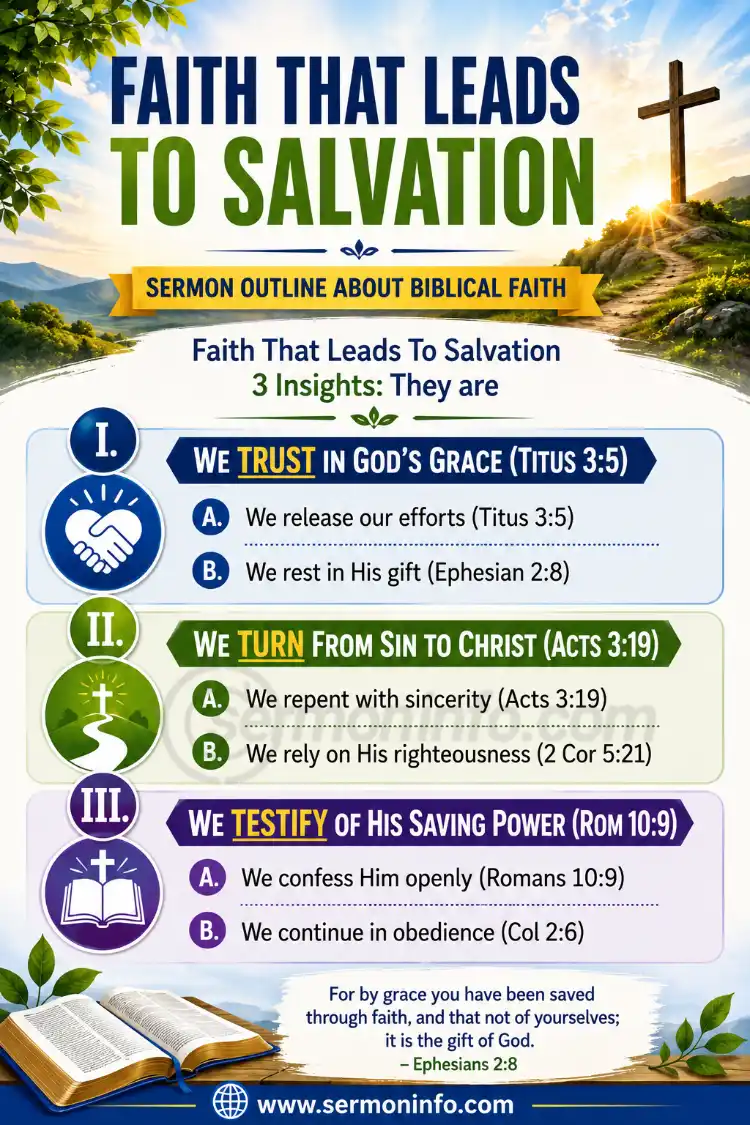
Today, we will examine faith that truly leads to salvation—a faith that trusts God’s grace, turns to Christ, and testifies of His saving power.
1. We Trust in God’s Grace (Titus 3:5)
“Not by works of righteousness which we have done, but according to His mercy He saved us, through the washing of regeneration and renewing of the Holy Spirit” (Titus 3:5)
A. We release our efforts (Titus 3:5)
Many people spend their lives trying to earn God’s approval through good works, hoping their effort will outweigh their sin. But Scripture says, “Not by works of righteousness which we have done, but according to His mercy He saved us” (Titus 3:5). We must stop striving and start trusting in Christ’s finished work.
When Jesus cried out, “It is finished” (John 19:30), He meant the debt was paid in full. Salvation isn’t a reward for human effort—it’s the result of divine mercy. We release our self-reliance and rest in what Jesus already accomplished on the cross. When you stop trying to save yourself, you finally allow grace to do its saving work.
B. We rest in His gift (Ephesians 2:8)
“For by grace you have been saved through faith, and that not of yourselves; it is the gift of God.” (Ephesians 2:8)
Salvation is not a paycheck earned after years of service. It’s a gift freely given to those who believe. Ephesians 2:8 tells us, “For by grace you have been saved through faith.” Like a child opening a gift, we receive it with joy and gratitude, trusting God’s promise completely.
Resting in God’s gift means living free from the pressure of performance. We stop asking, “Have I done enough?” and begin saying, “Jesus did enough.” His grace assures us we’re secure, not because of our goodness, but because of His goodness. When we rest in that truth, peace replaces pressure, and gratitude replaces guilt.
This material provides some ideas and thoughts for a sermon outline on biblical faith (Faith That Leads To Salvation).
2. We Turn from Sin to Christ (Acts 3:19)
“Repent therefore and be converted, that your sins may be blotted out, so that times of refreshing may come from the presence of the Lord” (Acts 3:19).
A. We repent with sincerity (Acts 3:19)
True faith always involves a turning point. Acts 3:19 calls us to “repent and be converted, that your sins may be blotted out.” Repentance isn’t just regret—it’s a change of direction. We turn away from sin because we’ve discovered something better: a Savior who forgives and restores.
When we turn from sin, we’re not just saying no to evil—we’re saying yes to Jesus. Repentance is not punishment; it’s freedom. It’s walking out of darkness and into the light of God’s grace. Real repentance doesn’t make us perfect, but it does make us willing to follow Christ wherever He leads.
B. We rely on His righteousness (2 Corinthians 5:21)
“For He made Him who knew no sin to be sin for us, that we might become the righteousness of God in Him.” (2 Corinthians 5:21)
Paul writes, “For He made Him who knew no sin to be sin for us, that we might become the righteousness of God in Him.” Our salvation rests completely on Christ’s righteousness, not ours. We trust His record, not our resume. He became what we were, so we could become what He is—right before God.
When you stand before God, your good deeds won’t be enough. But Christ’s righteousness covers you completely. That’s grace in action! We rely on Jesus’ perfect life, not our flawed efforts. Like a child trusting a father’s strong hand, we depend fully on His righteousness to bring us safely home.
3. We Testify of His Saving Power (Romans 10:9)
“That if you confess with your mouth the Lord Jesus and believe in your heart that God has raised Him from the dead, you will be saved” (Romans 10:9).
A. We confess Him openly (Romans 10:9)
When Jesus saves you, silence is no longer an option. Romans 10:9 says, “If you confess with your mouth the Lord Jesus… you will be saved.” Confession isn’t a formality—it’s a declaration. We speak up because our hearts overflow with gratitude for what Christ has done.
Public confession strengthens private faith. When you share your testimony, it encourages others to believe. Remember the man in Mark 5 who was freed from demons? Jesus told him, “Go home to your friends and tell them what great things the Lord has done for you.” Our story becomes His story when we speak His name.
B. We continue in obedience (Colossians 2:6)
“As you therefore have received Christ Jesus the Lord, so walk in Him.” (Colossians 2:6)
Paul exhorts believers, “As you have received Christ Jesus the Lord, so walk in Him.” Saving faith doesn’t stop at the altar—it walks into everyday life. Obedience isn’t drudgery; it’s our joyful response to God’s grace.
We obey because we love the One who saved us. The more we walk with Him, the more our lives reflect His goodness. Obedience proves our faith is alive and genuine. Just as fruit reveals a healthy tree, ongoing obedience reveals a heart transformed by Christ.
Conclusion
True saving faith doesn’t stop at belief—it transforms the believer. When we trust in God’s grace, we find rest for our striving souls. When we turn from sin, we discover the joy of forgiveness and the power of new life in Christ.
And when we testify of His saving power, our faith becomes visible for all to see. The Christian life is not silent—it’s a living witness of God’s mercy.
So, let’s ask ourselves today: Do we simply believe, or do we believe unto salvation? May our faith not just be spoken, but shown—anchored fully in Jesus Christ, our Redeemer and Lord.
Frequently Asked Questions (FAQ)
Q: What is faith that leads to salvation?
A: Saving faith means trusting Jesus Christ alone for forgiveness and eternal life. We stop relying on good works and rest in His death and resurrection. God saves us by grace through faith, and genuine faith begins a transformed life of obedience (Ephesians 2:8–9).
Q: Is salvation by faith alone or by faith and works?
A: God saves sinners through faith in Christ alone, not through human works. Good works follow salvation as evidence of spiritual life, but they never purchase forgiveness. Genuine faith produces obedience because the Holy Spirit changes believers from within (Titus 3:5; James 2:18).
Q: Does saving faith require repentance?
A: Yes. Biblical repentance means turning from sin toward Jesus Christ. It involves more than regret; it changes our direction and allegiance. We do not reform ourselves before coming to Christ. We come honestly, trust His mercy, and receive His power for a new life (Acts 3:19).
Q: How can I know that I am truly saved?
A: Assurance rests first on God’s promise and Christ’s finished work, not on feelings. Those who repent and trust Jesus receive eternal life. A growing desire to obey God, love Christ, and follow Scripture also provides evidence that the Holy Spirit has begun His transforming work.
Q: Can genuine saving faith exist without obedience?
A: Genuine saving faith produces spiritual fruit. Obedience does not earn salvation, but it reveals a changed heart. A continual absence of repentance and godly growth should cause serious self-examination. Living faith increasingly follows Christ, submits to Scripture, and displays His transforming grace (James 2:26).
BONUS: What kind of faith pleases God?
Faith that pleases God trusts His character, believes His promises, and seeks Him sincerely. Hebrews 11:6 says, “Without faith it is impossible to please Him.” This faith looks beyond feelings and circumstances. It rests in God’s truth and expects Him to remain faithful.
God-pleasing faith also obeys. Noah built the ark because he believed God’s warning (Hebrews 11:7). Abraham followed God’s call and trusted His promise (Romans 4:20–21). Genuine faith acts on Scripture, depends on Christ, and keeps walking with God when obedience becomes costly.
BONUS: Why do people confuse faith and works?
People confuse faith and works because they fail to separate the root of salvation from its fruit. God saves us by grace through faith, not by human effort (Ephesians 2:8–9; Titus 3:5). Good works cannot earn forgiveness or add anything to Christ’s finished work.
However, genuine faith produces obedience and godly fruit. James says, “Faith by itself, if it does not have works, is dead” (James 2:17). Works reveal living faith, but they never create it. God saves believers through faith, then prepares them to serve Him faithfully (Ephesians 2:10).
BONUS: What is biblical faith?
Biblical faith trusts God’s character, receives His Word, and depends fully on Jesus Christ. Hebrews 11:1 calls faith “the substance of things hoped for.” Romans 10:17 says faith comes through hearing God’s Word. True faith rests on God’s promises, not on feelings or human wisdom.
Biblical faith also responds with obedience. Abraham believed God and acted on His command (Hebrews 11:8). Works never earn salvation, because God saves by grace through faith (Ephesians 2:8–9). However, living faith produces visible fruit, while dead faith remains empty (James 2:17).
BONUS: Why do people try to earn salvation?
People try to earn salvation because pride resists receiving grace as a gift. Many trust good deeds, religion, or moral effort to make themselves acceptable to God. Yet Scripture says, “Not by works of righteousness which we have done” (Titus 3:5).
Others try to earn salvation because they misunderstand God’s holiness and Christ’s finished work. No human effort can remove sin. Jesus paid the full price at the cross (John 19:30). God saves by grace through faith, “not of works” (Ephesians 2:8–9).
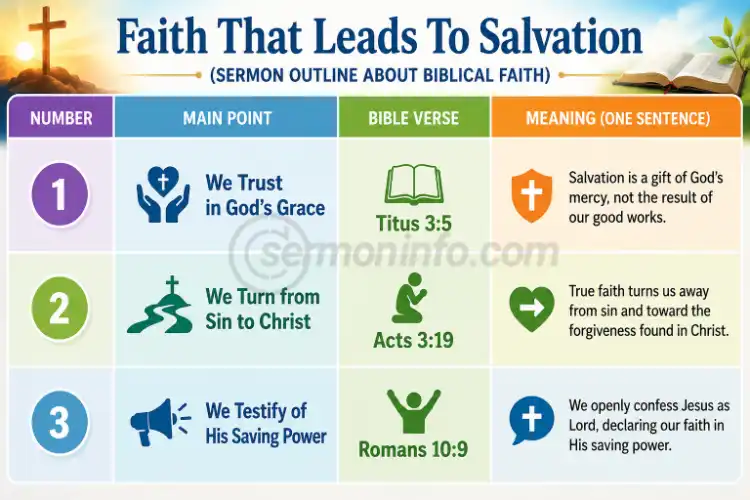
| Sermon Outline on Biblical Faith – Free Topical Sermon Outline | |||
|---|---|---|---|
| Number | Main Point | Bible Verse | Meaning |
| 1 | We Trust in God’s Grace | Titus 3:5 | Salvation comes through God’s mercy, not through human effort or good works. |
| 2 | We Turn from Sin to Christ | Acts 3:19 | Genuine faith repents of sin and turns wholeheartedly to Jesus Christ for forgiveness. |
| 3 | We Testify of His Saving Power | Romans 10:9 | Saving faith openly confesses Christ and produces a life that follows Him in obedience. |

Source Material
Believer’s Bible Commentary by William MacDonald (Commentary on the Whole Bible)
The MacArthur Bible Commentary by John MacArthur (Commentary on the Whole Bible)
Wiersbe Bible Commentaries by Warren Wiersbe (Commentary on the Whole Bible)
Systematic Theology by Wayne Grudem
Christian Theology by Millard J. Erickson
The Moody Handbook of Theology by Paul Enns
Biblical Doctrine by John MacArthur and Richard Mayhue
Further Information
7 Bible Verses on Faith This article examines the importance of why faith is foundational for salvation in Jesus Christ.
Faithful Fathers Who Finish Well This sermon outline from 2 Timothy 4:6-8 points out 3 features of faithful fathers who finish well, which will keep us grounded, growing, and going for God.