How To Prepare 3-Point Sermons That Are Clear, Biblical, and Memorable means studying Scripture carefully and organizing its main truth into three clear points that explain the text, apply it faithfully, and point listeners to Christ with clarity and purpose.
Key Takeaways – How To Prepare 3-Point Sermons
- Begin with Scripture, not ideas. Start sermon preparation by studying the biblical text carefully. Let the passage shape the preaching topic, structure, and main points so God’s Word leads the message.
- Build three clear, connected main points. Develop three main points that explain and support the preaching topic. Each point should flow naturally from the text and move the sermon forward with clarity.
- Use structure to strengthen clarity and flow. A 3-point sermon outline provides direction, balance, and progression. This structure helps listeners follow the message, remember the truth, and apply it to daily life.
- Write, practice, and preach from the heart. Prepare a clear manuscript, practice it out loud, and preach in your own voice. As a result, the sermon stays focused, confident, and open to the Holy Spirit’s guidance.
How To Prepare 3-Point Sermons
Preparing a sermon can feel overwhelming at times, especially when you want to honor Scripture and truly help your listeners. Most preachers feel the weight of that responsibility each week. We want to speak clearly, faithfully, and with purpose. That desire often creates pressure before the message even begins.
One structure has proven helpful across generations: the 3-point sermon. It brings focus to the preacher and direction to the congregation. Each point guides listeners step by step through the passage. Rather than limiting Scripture, this structure highlights its natural flow and meaning.
When used well, a 3-point sermon helps people understand, remember, and live out God’s truth. It organizes biblical teaching without watering it down. In this guide, I will walk with you through simple steps for preparing sermons that honor God’s Word and serve God’s people with clarity and care.
1. The 3-Point Sermon Explained
A 3-point sermon has three main parts: the introduction, the body of the sermon, and the conclusion. The introduction presents the subject and sets the direction for the message. It prepares hearts and minds to listen with understanding. This opening section gently leads the congregation into the truth of the passage.
The body of the sermon contains the sermon outline itself. This is where the subject receives careful explanation and clear development through three main points. Most of the sermon time is spent here because this section carries the weight of biblical teaching. Strong preaching grows from a well-shaped outline.
The conclusion then brings the sermon to a purposeful close. It calls listeners to application and action in response to God’s Word. I often say a sermon is like a plane flight. The introduction is the take-off, the sermon body is the flight, and the conclusion is the landing. For that reason, sermon preparation begins with the sermon outline.
2. The 3-Point Sermon Outline Explained
Now, the 3-point sermon outline also includes three key elements that work together. These are the preaching topic or subject, the main points with their sub-points, and the key word or hinge word. Each part helps shape the message with clarity and purpose. Together, they guide both the preacher and the listener.
With that in mind, an example of a 3-point sermon from Psalm 100:1–5 appears below. This passage clearly shows how structure supports biblical truth. It also reveals how the outline grows naturally from the text itself.
In the next section, I will walk through this example step by step. I will explain how each part of the 3-point sermon works within the outline. As we move through it, you will see how this structure helps you prepare sermons with confidence and care.
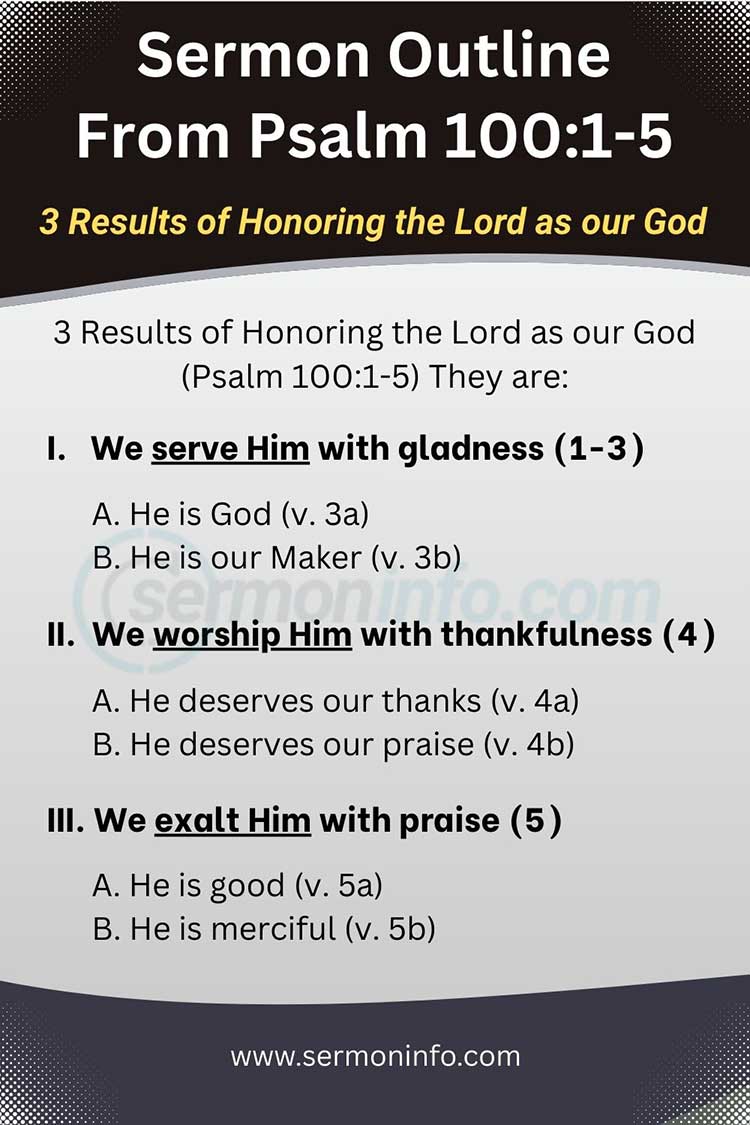
There are 3 results of honoring the Lord as our God. They are:
- We serve Him with gladness (1–3)
- He is God (v. 3a)
- He is our Maker (v. 3b)
- We worship Him with thankfulness (4)
- He deserves our thanks (v. 4a)
- He deserves our praise (v. 4b)
- We exalt Him with praise (5)
- He is good (v. 5a)
- He is merciful (v. 5b)
Sermon Outline From Psalm 100:1-5
A. The Preaching Subject or Topic
Every sermon outline begins with a clear preaching subject or topic. For Psalm 100:1–5, one fitting topic is “Honoring the Lord as our God.” A strong subject gives the sermon focus and direction. It also keeps the preacher anchored to the main idea of the passage.
After shaping the preaching topic, I begin asking key questions. I consider the how, what, why, when, or where connected to the subject. In this case, the “what” question fits best. What are the benefits or results of honoring the Lord as our God?
By asking the “what” question, the preacher views the text from a helpful angle. That perspective draws out the meaning of the passage. What are the results of honoring the Lord as our God? The rest of the 3-point sermon outline exists to explain those results clearly.
B. The Main Points and Sub-points
Once you know the preaching topic, you then construct the three main points of the sermon outline. The three main points simply expand and explain the preaching topic. They give shape to the message and guide the listener through the text with clarity.
What are the results of honoring the Lord as our God? We serve Him with gladness (vv. 1–3), we worship Him with thankfulness (v. 4), and we exalt Him with praise (v. 5). Each main point grows naturally from the passage and supports the preaching topic.
The sub-points then expand and explain the main points in greater detail. With main point three, I developed two sub-points. The reason we exalt Him with praise is because He is good (v. 5a) and because He is merciful (v. 5b).
Main points and sub-points should remain parallel in both thought and structure. We serve Him with gladness (vv. 1–3). We worship Him with thankfulness (v. 4). We exalt Him with praise (v. 5). We praise Him because He is good (v. 5a), and He is merciful (v. 5b).
C. The Key Word or Hinge Word
The key word or hinge word swings all the main points from the preaching topic. It must be a plural noun that connects each point clearly. There are three RESULTS of Honoring the Lord as our God. The first result is we serve Him with gladness (vv. 1–3). The second result is we worship Him with thankfulness (v. 4), and the third result is we exalt Him with praise (v. 5).
The key word or hinge word also works as a transition between points. It helps the sermon move forward without confusion. When I finish preaching the first main point, I move to the next main point by simply saying, “The second result of honoring the Lord as our God is we worship Him with thankfulness.”
Most people enjoy this structure because the sermon flows naturally and feels easy to follow. Each point connects smoothly to the next. Therefore, the 3-point sermon outline has cohesion, clear sequence, and steady progression.
Once you work through this structure, everything becomes clearer. The preaching topic, main points, sub-points, and the key word or hinge word come together naturally. You will find sermon writing becomes easier each week. This approach remains one of the best ways to write a clear and effective 3-point sermon.
Charles Koller offers a clear and helpful discussion on key words in his book How To Preach Without Notes, especially in the section found on pages 51–55.
How To Preach Without Notes by Charles W. Koller
3. The 3-Point Sermon Manuscript Explained
When working on a 3-point sermon manuscript, I keep three key practices in mind.
First, I focus on writing clear and helpful content that supports each point of the sermon. Next, I take time to mark up the manuscript so it becomes easy to follow while preaching. Finally, I practice the manuscript out loud to become comfortable with the flow and transitions.
These simple steps strengthen confidence and clarity. The following suggestions will help you apply each one effectively.
A. The Manuscript Content
Once you complete your 3-point sermon outline, you move on to writing the message itself. This step allows you to flesh out each point with clear explanations. It also gives space for helpful illustrations and real-life applications. These elements help listeners connect biblical truth to everyday living.
After you finish writing the body of the sermon, you then turn to the introduction and the conclusion. Writing them last keeps them focused and connected to the message. Each part now supports the main idea with clarity and purpose.
I often remind myself that a sermon works like an airplane flight. The introduction serves as the take-off, the body of the sermon becomes the flight, and the conclusion brings the message to a safe landing. This picture keeps the sermon balanced and moving forward.
B. The Manuscript Mark-up
I prepare a full sermon manuscript so I can keep a clear printed and digital record. This practice helps me stay organized and focused. Still, a sermon manuscript differs greatly from an academic paper. I arrange it in point form so I can mark it easily and use it as a guide while preaching.
For that reason, I keep everything brief and clear, including the outline, introduction, and conclusion. While preaching, I expand each point naturally in my own words. I never read the manuscript line by line. This method keeps the message alive and engaging.
I encourage you to adopt this approach as well. Write your manuscript using short, clear notes. Then learn to preach with growing confidence in your own voice. It takes time, but your preaching will strengthen as you speak from the heart instead of reading every word aloud.
C. The Manuscript Practice
When I prepare a three-point sermon this way, I know the manuscript well. I can recall the main point, the sub-points, and the supporting details. In most cases, I could preach the message without notes if needed. Even so, I always carry the manuscript with me to the pulpit because it helps me stay focused and steady.
Before preaching, I practice by speaking through the manuscript out loud. This habit helps me feel the flow and follow each transition smoothly. It also helps me remember illustrations and applications. I want confidence in the message, not hesitation during delivery.
Talking through the sermon usually takes about an hour. That time allows me to adjust wording or add helpful insights. Through practice, I give the Holy Spirit space to guide me. At times, He prompts me to add something, and at other moments, He leads me to leave something out.
How To Preach Without Notes by Charles W. Koller
BONUS: Why the 3-Point Sermon Structure Still Works Today?
The 3-point sermon has endured because it reflects how people naturally process information. Scripture itself often presents truth in clear movements, progressions, or contrasts. Three points are enough to develop truth without overwhelming the hearer. They provide balance, direction, and momentum in preaching.
In a distracted age, listeners benefit from structure. A clear outline helps them follow the message, take notes, and recall the main ideas later. Rather than limiting creativity, the 3-point format actually frees the preacher to focus on explanation, illustration, and application. It becomes a framework that supports faithful exposition instead of competing with it.
BONUS: Some Common Mistakes to Avoid When Preparing 3-Point Sermons
One common mistake is forcing three points onto a passage that does not support them. Faithfulness to Scripture must always come before structure. Another mistake is turning points into vague slogans rather than clear truths drawn from the text.
Preachers should also avoid overcrowding each point with too much material. Simplicity aids clarity. Finally, do not neglect prayer. Sermon preparation is not merely an academic task but a spiritual responsibility. Ask God to guide your study and prepare both your heart and the hearts of your listeners.
BONUS: How to Illustrate Sermon Points Without Distracting From the Text?
Illustrations help listeners connect truth to real life. They make abstract ideas concrete and memorable. Good illustrations clarify rather than compete with the message. They should serve the point, not steal attention from it.
Use illustrations drawn from everyday life, Scripture, history, or personal experience when appropriate. Keep them brief and relevant. Ask yourself whether the illustration reinforces the truth of the passage or simply fills time. When illustrations are well chosen, they help the congregation see how biblical truth intersects with daily living.