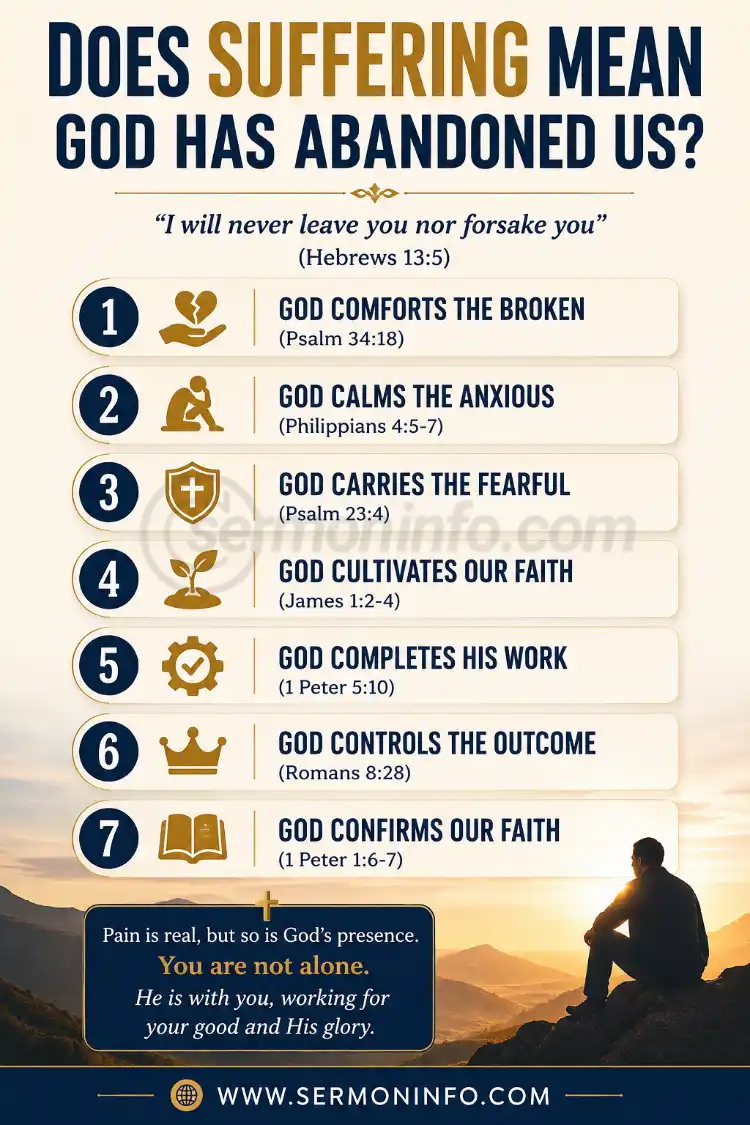
Suffering does not mean God has abandoned us—it means He is actively working in us. Through every trial, He comforts, calms, carries, cultivates, completes, controls, and confirms. His purpose in suffering is not to destroy but to draw us closer, shaping our hearts into the likeness of Christ.

Key Takeaways – Does Suffering Mean God Has Abandoned Us?
- God Comforts the Broken (Psalm 34:18) – Suffering never means separation from God; it reveals His nearness. In pain, He meets us personally and comforts us deeply.
- God Calms the Anxious (Philippians 4:5-7) – God replaces our panic with peace when we pray. His presence guards our hearts, proving He never abandons His children.
- God Carries the Fearful (Psalm 23:4) – Even in dark valleys, we are not alone. The Good Shepherd walks beside us, guiding and protecting us through every trial.
- God Cultivates Our Faith (James 1:2-4) – Suffering is not punishment; it’s preparation. God uses trials to strengthen faith, develop endurance, and mature our spiritual walk.
- God Completes His Work (1 Peter 5:10) – Every season of suffering has purpose. God restores, strengthens, and establishes His people after the trial has done its work.
- God Controls the Outcome (Romans 8:28) – God works all things together for the good of those who love Him. He turns pain into purpose and loss into lasting growth.
- God Confirms Our Faith (1 Peter 1:6-7) – Suffering refines our faith like gold in the fire. Genuine faith shines brighter and brings glory to God through endurance.
Does Suffering Mean God Has Abandoned Us?
When suffering strikes, the first thought that often crosses our minds is, “Has God abandoned me?” Pain can cloud our vision and tempt us to doubt His care. Yet, Scripture tells a different story—one of divine presence in the darkest places.
Think of Job sitting in ashes, surrounded by confusion and loss. Though he couldn’t see God’s hand, God was still at work—refining, restoring, and revealing His greater purpose.
Today, we will explore 7 ways God works through suffering. Each truth reminds us that hardship doesn’t signal God’s absence but reveals His activity. Through every trial, He is near, shaping our faith, strengthening our hearts, and showing us that His grace always runs deeper than our pain.
1. God Comforts the Broken
“The Lord is near to the brokenhearted and saves the crushed in spirit.” (Psalm 34:18)
A. We Find Him in Pain
God never avoids our suffering. He meets us in it. When life collapses and our hearts ache, the Lord draws near. David knew this well. Surrounded by danger and fear, he discovered that pain became the place where God’s presence grew undeniable. He does not run from sorrow; He runs toward His hurting child.
Sometimes, we only see the depth of God’s compassion when the bottom falls out. Pain strips away distractions and pushes us toward His arms. Just as Jesus wept beside Mary and Martha in John 11:35, God enters our tears. He doesn’t explain away the pain—He enters it, transforming despair into holy ground where His comfort begins.
B. We Feel His Nearness Deeply
When life breaks us, God becomes more than an idea; He becomes real, close, and comforting. His presence fills the cracks our suffering exposes. Many of us can testify that in our darkest seasons, His peace became tangible—closer than our breath, quieter than our fears.
David didn’t say God is sometimes near the brokenhearted. He said He is near. His comfort isn’t a concept; it’s a presence. Like a loving Father, He bends low, whispers grace, and wraps us in peace the world can’t give (Philippians 4:7). When everything else feels distant, He remains wonderfully close.
2. God Calms the Anxious
“The Lord is at hand … and the peace of God, which surpasses all understanding, will guard your hearts and your minds in Christ Jesus.” (Philippians 4:5-7)
A. We Pray Instead of Panic
When trouble comes, anxiety screams for control. Yet God invites us to pray, not panic. Prayer anchors us when fear floods our hearts. It redirects our focus from the chaos around us to the Christ within us. Paul didn’t say the storm stops when we pray, but that peace starts when we do.
Every anxious thought becomes a cue to pray. God doesn’t scold our worry; He invites our trust. When we turn to Him, we discover His peace standing guard over our minds like a divine soldier. Prayer doesn’t always change our situation, but it always changes our perspective.
B. We Rest in His Peace
God’s peace doesn’t come from understanding—it comes from trusting. The world says peace follows control; God says peace follows surrender. When we hand our fears to Him, He replaces anxiety with assurance. His peace protects our hearts like armor that deflects despair.
We can rest knowing the Lord is at hand. He doesn’t watch from a distance; He walks beside us. Each breath of faith pushes back fear. Philippians 4:7 reminds us that His peace “surpasses understanding,” meaning it doesn’t always make sense—it just makes us steady.
3. God Carries the Fearful
“Even though I walk through the valley of the shadow of death, I will fear no evil, for you are with me.” (Psalm 23:4)
A. We Trust His Presence Always
David never denied the valley; he declared God’s presence within it. We still walk through shadows, but we do not walk alone. God’s nearness drives out fear because His presence holds more power than our pain. The valley may feel dark, but it’s not directionless when the Shepherd leads the way.
When suffering tempts us to question God’s care, His Word answers back—He walks with us. Fear fades when we realize the Lord doesn’t send us through valleys; He guides us through them. His rod and staff don’t just correct—they comfort.
B. We Follow His Leading Confidently
Even when we can’t see where He’s taking us, we can trust who’s leading us. Faith isn’t about knowing the path; it’s about knowing the Shepherd. God carries us when we can’t carry ourselves.
Sometimes, He calms the storm; other times, He carries us through it. Either way, His faithfulness never falters. Psalm 23:4 reminds us that His presence isn’t seasonal—it’s constant. He doesn’t walk ahead of us only; He walks with us.
4. God Cultivates Our Faith
“Count it all joy, my brothers, when you meet trials of various kinds… for you know that the testing of your faith produces steadfastness.” (James 1:2-4)
A. We Grow Through Hard Trials
Faith doesn’t grow in comfort; it grows in conflict. God uses trials to build spiritual muscle. Every challenge tests our trust, teaching us to rely more deeply on His strength. Trials don’t destroy faith—they develop it.
James doesn’t say we enjoy the trial but that we count it joy because of what it produces. God uses pain as a classroom, not a punishment. When we view suffering through faith’s lens, we begin to see God’s purpose in every test.
B. We Endure With Joyful Hearts
Joy in suffering doesn’t mean we deny pain; it means we trust God’s process. Joy says, “God, I don’t understand this, but I know You’re working.” That’s steadfast faith.
Each trial becomes a tool in His hands to refine us. Like gold tested by fire, faith becomes more genuine through struggle. When we choose joy amid hardship, we declare that our hope is stronger than our hurt.
5. God Completes His Work
“After you have suffered a little while, the God of all grace… will himself restore, confirm, strengthen, and establish you.” (1 Peter 5:10)
A. We Wait on His Restoration
God’s restoration always follows His refining. Peter reminds us that suffering is temporary but grace is eternal. Our pain has an expiration date; His promise doesn’t. While we wait, He works.
Every delay in relief is a display of divine timing. God never wastes our waiting. When the season ends, restoration comes—not halfway, but whole.
B. We Stand in His Strength
Suffering shows us how weak we are—but it also shows us how strong God is. His strength sustains what our strength can’t. Through hardship, He shapes our hearts and fortifies our faith.
When God restores us, He doesn’t return us to who we were; He raises us to who we’re meant to be. His grace not only carries us—it completes us.
6. God Controls the Outcome
“And we know that for those who love God all things work together for good.” (Romans 8:28)
A. We Trust His Sovereign Plan
When life feels random, God’s Word reminds us—nothing is wasted. Every hardship is a thread in His larger design. He doesn’t cause all things, but He uses all things. His sovereignty turns what was meant for harm into something holy.
We may not always see how, but faith says, “God, I trust that You know what You’re doing.”
B. We Believe His Goodness Holds
God’s goodness doesn’t fluctuate with our circumstances. It remains steady even when life feels shattered. Romans 8:28 assures us that His definition of “good” often means “what makes us more like Christ.”
Our pain doesn’t disprove His goodness; it displays it. When we surrender outcomes to Him, we find peace knowing He’s already written the ending.
7. God Confirms Our Faith
“Though now for a little while you have been grieved by various trials… so that the tested genuineness of your faith… may result in praise and glory.” (1 Peter 1:6-7)
A. We Rejoice Through Refining Fires
Trials don’t ruin true faith; they reveal it. Peter says our faith is like gold—it must be refined by fire to shine. God allows difficulty not to destroy us but to display what’s real.
Every tear, every test, proves our faith has roots. We rejoice not in the fire itself but in what God produces through it.
B. We Shine With Eternal Hope
Our faith, once tested, reflects Christ more clearly. The world sees His strength through our endurance. Temporary pain produces eternal praise.
When we suffer well, we testify that our hope isn’t anchored in ease but in eternity. God confirms our faith by carrying us through what once terrified us, proving His presence never fades—even in the fire.
Conclusion
Suffering never means God has abandoned us. Instead, it proves He is actively involved—comforting, calming, and carrying us through every valley. He turns pain into purpose.
When life feels unbearable, remember that the same God who allowed the cross also brought forth resurrection. What looked like abandonment became redemption. His silence never means absence; His delay never means disinterest.
God uses suffering to build our trust and confirm our faith. He completes what He begins and controls every outcome for His glory. So, when sorrow whispers, “God has left you,” remember His promise: “I will never leave you nor forsake you.” That truth anchors us when nothing else makes sense.
Closing Prayer
Heavenly Father, we thank You that You are near to the brokenhearted. Lord, when we face trials and suffering, remind us that Your presence never leaves us. Comfort our hearts, calm our fears, and strengthen our faith.
Help us to trust Your plans, see Your hand at work, and rejoice even in refining fires. May our trials produce endurance, hope, and glory to Your name. Guide us, Lord, through every valley, and let us proclaim Your goodness through every hardship. In Jesus’ name, Amen.

Frequently Asked Questions (FAQ)
Q: Why does God allow suffering if He loves us?
A: God allows suffering to deepen our faith and refine our character. Romans 5:3–4 teaches that suffering produces endurance, character, and hope.
Q: Does God punish us through suffering?
A: Not necessarily. While some suffering results from sin, God often uses trials to teach and strengthen us, as seen in James 1:2–4.
Q: Why do I feel abandoned by God during hardship?
A: Feelings of abandonment are common but don’t reflect God’s presence. Psalm 34:18 assures that God is near the brokenhearted.
Q: What does the Bible say about suffering?
A: The Bible acknowledges suffering as part of life but emphasizes God’s presence and purpose in it. Romans 8:28 assures that God works all things for good.
Q: How can I find peace during suffering?
A: Turning to prayer, Scripture, and community can bring comfort. Philippians 4:6–7 encourages presenting our requests to God for peace beyond understanding.

The Power of Suffering by John MacArthur
| Number | Main Point | Bible Verse | Meaning |
|---|---|---|---|
| 1 | God Comforts the Broken | Psalm 34:18 | God draws near to the brokenhearted, showing His presence even in our deepest pain. |
| 2 | God Calms the Anxious | Philippians 4:5-7 | Through prayer, God replaces anxiety with peace that guards our hearts and minds. |
| 3 | God Carries the Fearful | Psalm 23:4 | God walks with us through dark valleys, guiding and protecting us from fear. |
| 4 | God Cultivates Our Faith | James 1:2-4 | Trials refine our faith, producing endurance, maturity, and spiritual growth. |
| 5 | God Completes His Work | 1 Peter 5:10 | God restores, strengthens, and establishes us after the suffering has fulfilled its purpose. |
| 6 | God Controls the Outcome | Romans 8:28 | God orchestrates all events for the good of those who love Him, even in hardship. |
| 7 | God Confirms Our Faith | 1 Peter 1:6-7 | Suffering tests faith, proving its genuineness and resulting in praise and glory to God. |
Source Material
Believer’s Bible Commentary by William MacDonald (Commentary on the Whole Bible)
The MacArthur Bible Commentary by John MacArthur (Commentary on the Whole Bible)
Wiersbe Bible Commentaries by Warren Wiersbe (Commentary on the Whole Bible)
Systematic Theology by Wayne Grudem
Christian Theology by Millard J. Erickson
The Moody Handbook of Theology by Paul Enns
Biblical Doctrine by John MacArthur and Richard Mayhue
Further Information
Why Does God Allow Suffering? – This article looks at the fact that God’s word doesn’t give us easy answers, but it does give us hope, comfort, and understanding.
7 Reasons God Allows Suffering – This article helps us understand that suffering touches every life in one way or another, but it is not without purpose.
Seven Purposes of Suffering in the Bible – This article provides 7 purposes of suffering and how God comforts us in our suffering.
7 Ways God Works Through Suffering This article explains how trials and hard times displays God’s love and comfort during these times.