The 3 Implications of the Power of Prayer show that prayer draws us near to God, relieves anxiety, and brings supernatural peace. It transforms hearts, strengthens faith, and invites God’s guidance into daily life. Prayer is both relational and practical, impacting our thoughts, emotions, and spiritual growth.
Key Takeaways – 3 Implications of the Power of Prayer
- Prayer reminds us that God is near. Prayer helps us recognize that God walks with us in every moment and guides our decisions with wisdom and care.
- Prayer releases the weight of anxiety. When we bring every concern to God with thanksgiving, worry loses its power and our hearts find new strength and confidence.
- Prayer brings supernatural peace. God responds to prayer with a peace that protects our hearts and minds and keeps us steady during pressure, uncertainty, and spiritual battle.
- Prayer is a daily choice that strengthens faith. Choosing prayer over worry, fear, or self-reliance helps us trust God’s timing, God’s presence, and God’s perfect plan.
- Prayer connects real life to real hope. Through prayer, we experience God’s comfort, God’s guidance, and God’s peace in practical, everyday situations.
3 Implications of the Power of Prayer
Prayer is one of God’s greatest gifts to His people, yet many of us live without tapping its strength. Life pulls us in every direction, and our hearts often feel stretched thin. But God invites us to slow down and remember that He is near.
As we open Philippians 4, Paul reminds us that prayer anchors our minds. It steadies our hearts when worries rise and pressures mount. God never asked us to carry these loads alone.
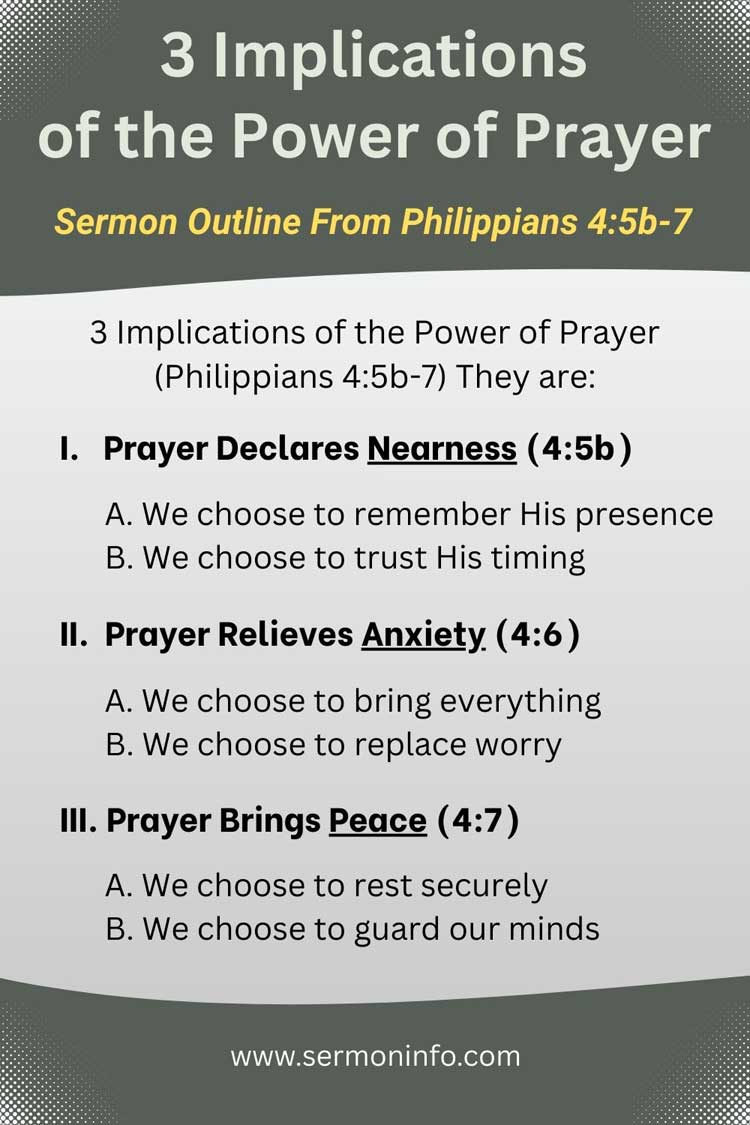
Today, we will look at three simple truths that show the power of prayer. Prayer declares God’s nearness, prayer relieves our anxiety, and prayer brings a peace that only comes from Christ.
1. Prayer Declares Nearness (Phil 4:5b)
The Lord is at hand—right here, right now—so prayer becomes the way we acknowledge His nearness in every circumstance.
A. We Choose to Remember His Presence
When Paul says, “The Lord is at hand” (Philippians 4:5b), he reminds us that God does not watch from a distance. He stands close. We pause in prayer to remind our hearts that the Father walks with us in every moment. Even on heavy days, His presence stays steady and real because He promised that He will never leave us (Hebrews 13:5).
As we face decisions, pressures, and unexpected turns, prayer pulls our focus back to the God who guides us. We often forget His nearness when life becomes busy. But when we pray, we slow down long enough to notice His hand at work. We remember that the God who helped David in the valley helps us today.
B. We Choose to Trust His Timing
We often want answers now, but God works with perfect wisdom. His nearness means He does not delay from distance but acts with purpose. When we pray, we rest in His timing. The Lord who knows the end from the beginning always moves at the right moment for our good and His glory (Isaiah 46:10).
Sometimes His timing feels slow. Sometimes it surprises us. Yet prayer helps us place our confidence in the God who sees the whole path. We surrender our business and trust His timing. He has never failed His people, and He will not fail us now. So we choose to trust that His timing arrives exactly when His plan requires it.
2. Prayer Relieves Anxiety (Phil 4:6)
Prayer is God’s antidote to worry, redirecting our restless hearts toward His faithful hands.
A. We Choose to Bring Everything
Paul urges us to bring every request to God with prayer and thanksgiving. We usually carry things longer than we should. Prayer opens our hands so we can give God what troubles us. He invites us to bring everything because He cares deeply for us and understands every worry we face (1 Peter 5:7).
When we pray, we refuse to hide anything from the Father who already knows our thoughts. We speak honestly. We come boldly. Whether we face family issues, pressure at work, fear of the future, or a private burden, we bring it all to Him. This choice frees our hearts because God never turns away a seeking child.
B. We Choose to Replace Worry
Worry grows fast when we feed it, but prayer redirects our attention to God. Instead of repeating anxious thoughts, we choose thankful prayer. Gratitude reminds us of what God has already done. It strengthens faith. It shifts our focus from fear to trust. This simple step weakens anxiety and invites peace into our hearts.
When we replace worry with prayer, we experience a real change. Our problems may stay, but our perspective changes. The God who answered us before will answer again. As we pray with thankfulness, we trade fear for faith, doubt for confidence, and restlessness for steady hope. God uses this exchange to anchor our hearts.
This material provides some ideas and thoughts for a message about the Power of Prayer (3 Implications of the Power of Prayer). Subscribe to our FACEBOOK PAGE for the latest articles.
3. Prayer Brings Peace (Phil 4:7)
God answers our praying hearts with a supernatural peace—beyond logic, beyond emotion, beyond circumstance.
A. We Choose to Rest Securely
Paul describes a peace that surpasses all understanding. This peace does not come from calm circumstances. It comes from Christ. When we pray, God settles our hearts with a confidence deeper than feelings. We rest because His peace stands firm even when life feels unstable. Jesus gives real peace to His people (John 14:27).
This peace does not remove every storm, but it steadies us inside the storm. Prayer helps us experience a calm that this world cannot produce. It comes from knowing the One who holds every detail. As we rest in Him, we discover a security that no fear can break and no trouble can erase.
B. We Choose to Guard Our Minds
Paul says God’s peace “guards” our hearts and minds in Christ Jesus. The word gives the picture of a soldier on duty. Through prayer, God protects our thoughts from anxiety, doubt, and discouragement. He places His peace at the door of our minds. It stands watch. It pushes back the lies that try to unsettle us.
When fear tries to rush in, prayer places Christ at the center. His peace becomes our shield. Worry may knock, but it does not get to rule. Prayer strengthens the spiritual defenses of our minds. It keeps our thinking clear and our hearts steady because God Himself guards us when we seek Him.
Conclusion
As we reflect upon these three truths, we see that prayer is far more than words. It is our lifeline to a God who stands close. When we pray, we remind ourselves that He is near and working.
Prayer also helps us fight worry. We choose to bring everything to Him, and He replaces our fear with confidence in His care. This is not theory. This is real help for real moments.
And when we pray, God covers us with His peace. His peace guards our hearts and minds in Christ. So today, let’s walk out with courage and talk to the God who listens, loves, and stays near.
Closing Prayer
Heavenly Father, we thank You for the gift of prayer. Thank You that You are always near, listening, guiding, and comforting us.
Lord, help us to bring every concern to You, trusting Your timing and resting in Your perfect peace. Guard our hearts and minds, and strengthen our faith to walk boldly in Your presence every day. In Jesus’ name, Amen.
Source Material
Believer’s Bible Commentary by William MacDonald (Commentary on the Whole Bible)
The MacArthur Bible Commentary by John MacArthur (Commentary on the Whole Bible)
Wiersbe Bible Commentaries by Warren Wiersbe (Commentary on the Whole Bible)
Frequently Asked Questions (FAQ)
Q: How does prayer help with anxiety?
A: Prayer gives us a way to surrender our worries to God, which helps reduce stress and calm our minds. According to research, this act slows our thought processes, lowers stress responses, and creates a space for emotional release.
Q: Can praying really bring peace even when life is chaotic?
A: Yes. Through prayer, we invite God’s supernatural peace into our hearts. This peace “surpasses all understanding” (Philippians 4:7), guarding our minds even when external circumstances remain difficult.
Q: Why does prayer help me feel closer to God?
A: Prayer declares God’s nearness by reminding us that He is not distant — He walks with us in every situation. This relational connection draws us into intimacy with our Heavenly Father.
Q: Is prayer just a spiritual practice, or does it have real mental health benefits?
A: It’s both. Prayer functions spiritually — connecting us to God — but also has measurable mental health effects, such as reducing stress and promoting emotional regulation.
Q: How can I practice humility according to the Bible?
A: While God may answer in different ways, the key is not always fixing the problem but deepening trust. Prayer helps us cast our cares on God and rest in His timing, knowing He is working for our good.
| Number | Main Point | Bible Verse | Meaning |
|---|---|---|---|
| 1 | Prayer Declares Nearness | Philippians 4:5b | Prayer reminds us that God is always close, guiding and walking with us in every moment. |
| 2 | Prayer Relieves Anxiety | Philippians 4:6 | Prayer allows us to bring every concern to God, replacing worry with trust and thankfulness. |
| 3 | Prayer Brings Peace | Philippians 4:7 | Prayer invites God’s supernatural peace to guard our hearts and minds, keeping us steady in all circumstances. |