Discover the conquering power of confession in this Sermon Outline From Psalm 6:1-10, showing God’s mercy and deliverance.
Key Takeaways – The Conquering Power of Confessing Sin
- Confession Unlocks Freedom – Admitting our sin to God releases guilt and opens the door to His mercy and restoration.
- God’s Discipline Is Loving – Accepting His rebuke teaches humility and strengthens our spiritual walk.
- Mercy Heals the Soul – Pleading for God’s forgiveness provides comfort, hope, and renewed strength in Christ.
- Deliverance Brings Confidence – Trusting God’s response to our confession restores joy and secures victory over sin.
- Biblical Model of Repentance – Psalm 6 guides believers in personal confession, prayerful appeal, and reliance on God’s saving power.
Sermon Outline From Psalm 6:1-10
David’s words in Psalm 6 are raw, honest, and deeply personal. He is crushed under the weight of sin and guilt. Like a wounded man calling for help, he pleads with God for mercy and longs for relief.
We know what that feels like. We have all carried the heaviness of failure, regret, and the painful consequences of our choices. Sin drains our strength, clouds our minds, and unsettles our hearts.
But Psalm 6 reminds us of hope. When we acknowledge our sin, appeal to God’s mercy, and affirm His deliverance, confession becomes the pathway to freedom. Today, we will see the conquering power of confessing sin.
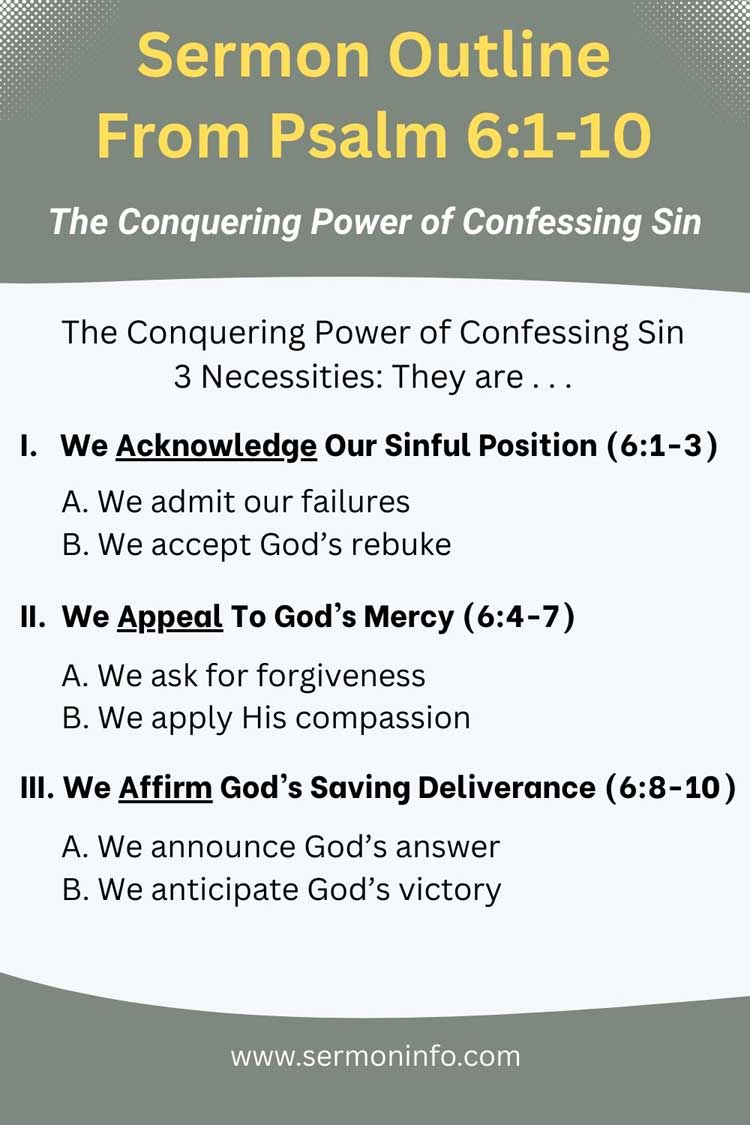
1. We Acknowledge Our Sinful Condition
“O Lord, do not rebuke me in Your anger, Nor chasten me in Your hot displeasure. Have mercy on me, O Lord, for I am weak; O Lord, heal me, for my bones are troubled. My soul also is greatly troubled; But You, O Lord—how long?” (Psalm 6:1–3)
A. We Admit Our Failures
We cannot heal what we refuse to admit. David cries, “O Lord, rebuke me not in your anger” (v.1). He owns his weakness, not hiding behind excuses. When we finally confess sin has wounded us, the door opens for God’s grace to begin mending what guilt and pride destroyed.
Think about Peter after denying Jesus. He wept bitterly because he knew he had failed (Matthew 26:75). Yet that confession led to restoration. When we stop pretending and bring our failures into the light, God meets us there with mercy and strength.
B. We Accept God’s Rebuke
David does not resist God’s correction. Instead, he bows under it, knowing discipline is love, not wrath. Hebrews reminds us, “The Lord disciplines the one he loves” (Heb. 12:6). God’s rebuke restores what sin damages and points us back toward His holiness.
Parents correct children not to harm but to help them grow. God’s rebuke works the same way. When we accept His discipline, He molds us into Christ’s likeness and reminds us we belong to Him. Correction is proof of His care, not rejection.
To All My Students: This material provides some ideas and thoughts for a message from Psalm 6:1-10 (The Conquering Power of Confessing Sin).
2. We Appeal To God’s Mercy
“Return, O Lord, deliver me! Oh, save me for Your mercies’ sake! For in death there is no remembrance of You; In the grave who will give You thanks? I am weary with my groaning; All night I make my bed swim; I drench my couch with my tears. My eye wastes away because of grief; It grows old because of all my enemies.” (Psalm 6:4–7)
A. We Ask For Forgiveness
David cries, “Turn, O Lord, deliver my life” (v.4). He knows forgiveness cannot be earned; it must be asked for in humility. When we bring our sin before God, we find His mercy ready to cover us in Christ.
Think of the prodigal son. He came home broken, yet his father ran to embrace him (Luke 15:20). That is forgiveness in action. When we ask, God answers with pardon, not punishment, because of Jesus’ sacrifice on the cross.
B. We Apply His Compassion
David admits his soul is weary and his eyes dim with sorrow (vv.6–7). He finds hope not in himself but in God’s steadfast love. Mercy is not abstract; it is applied personally when we receive it by faith.
Like ointment on a wound, God’s compassion soothes our soul. We remember His promises: “His mercies never come to an end” (Lam. 3:22). When despair threatens to drown us, His love lifts us and gives us strength to keep walking in faith.
3. We Affirm God’s Saving Deliverance
“Depart from me, all you workers of iniquity; For the Lord has heard the voice of my weeping. The Lord has heard my supplication; The Lord will receive my prayer. Let all my enemies be ashamed and greatly troubled; Let them turn back and be ashamed suddenly.” (Psalm 6:8–10)
A. We Announce God’s Answer
David boldly declares, “The Lord has heard my plea” (v.9). Confession turned sorrow into confidence. He does not whisper it; he proclaims it. Faith grows when we testify of God’s answered prayers.
Our stories matter. When you share how God forgave and restored you, others find courage to confess their sin too. God delights in hearing us, and He invites us to declare His mercy to the world.
B. We Anticipate God’s Victory
David sees his enemies retreat in shame (v.10). He knows God’s deliverance is certain. Confession not only cleanses the heart; it clears the path for victory.
Jesus said, “In the world you will have tribulation. But take heart; I have overcome the world” (John 16:33). When we confess and trust Him, we walk forward with confidence, knowing sin does not have the final word.
Concluding Summary
David’s tears gave way to triumph. Though he began with sorrow, he ended with confidence because God heard his confession and answered.
We experience the same victory when we stop hiding, start confessing, and fully trust the mercy of God through Jesus Christ. His grace does not crush us; it restores us and places our feet back on solid ground.
So, let’s remember this truth: confession is not defeat, but victory. Sin may wound us, but God’s mercy delivers us and makes us whole again.
Source Material
Holman Old Testament Commentary of the Psalms (Volume 1 & Volume 2) by Steven J. Lawson
An Expositional Commentary of the Psalms (Volume 1, Volume 2 and Volume 3) by James Montgomery Boice
A Commentary of the Psalms (Volume 1, Volume 2 and Volume 3) by Allen P. Ross
The NIV Application Commentary of the Psalms (Volume 1) by Gerald H. Wilson
Frequently Asked Questions (FAQ)
Q: What is the main theme of Psalm 6?
A: Psalm 6 is a heartfelt prayer of confession and plea for mercy. David acknowledges his sin, seeks God’s forgiveness, and trusts in His deliverance. It highlights the journey from spiritual distress to restoration through genuine repentance.
Q: How does confessing sin lead to spiritual healing?
A: Confession opens the door to God’s mercy. By admitting our failures, we allow God to cleanse us, restore our relationship with Him, and renew our strength. Psalm 6 exemplifies how acknowledging sin brings both healing and hope.
Q: What does Psalm 6 teach about God’s discipline?
A: David recognizes that God’s rebuke is not punitive but corrective. Accepting God’s discipline is essential for spiritual growth, as it leads to repentance and a closer walk with Him. Psalm 6 emphasizes the loving nature of God’s correction.
Q: Why is it important to confess our sins to God?
A: Confession restores our fellowship with God, removes guilt, and brings peace. Psalm 6 demonstrates the power of coming before God with a contrite heart, seeking His mercy and experiencing His forgiveness.
Q: How can Psalm 6 guide us in personal repentance?
A: Psalm 6 provides a model for repentance: acknowledging sin, seeking God’s mercy, and trusting in His deliverance. By following David’s example, we can approach God with sincerity and find restoration.
| Number | Main Point | Bible Verse | Meaning |
|---|---|---|---|
| 1 | We Acknowledge Our Sinful Condition | Psalm 6:1–3 | Confessing our failures and accepting God’s discipline opens the door to His mercy. |
| 2 | We Appeal To God’s Mercy | Psalm 6:4–7 | Pleading for forgiveness invites God’s compassionate restoration and strengthens faith. |
| 3 | We Affirm God’s Saving Deliverance | Psalm 6:8–10 | Trusting God’s answer transforms sorrow into confidence and secures victory over sin. |