The meaning of the “two swords” in Luke 22:35–38 reminds believers that difficult days will come, yet Christ prepares His people for every trial. Some views stress protection, others emphasize spiritual readiness or prophecy, but all point believers toward faith, courage, and dependence upon the Lord during seasons of opposition.

Key Takeaways – The Two Swords in Luke 22:35-38
- Jesus Prepared His Disciples for Opposition. Luke 22:35–38 shows that Christ warned His followers about difficult days ahead. The “two swords” passage reminds believers to stay spiritually ready, trust God’s provision, and remain faithful during persecution and hardship.
- The Passage Includes Both Literal and Spiritual Lessons. Some scholars view the swords as literal protection, while others emphasize spiritual readiness or prophetic fulfillment. Each interpretation highlights that Christians must depend upon God rather than human strength during seasons of conflict.
- Jesus Never Promoted Violent Advancement of His Kingdom. Christ later rebuked Peter for using the sword in Gethsemane (John 18:11). The gospel advances through truth, prayer, faithful preaching, and the power of the Holy Spirit, not through violence or force.
- Believers Must Remain Watchful and Spiritually Prepared. The “two swords” discussion encourages Christians to prepare for spiritual battles with Scripture, prayer, and faith. God calls His people to stand firm, live wisely, and trust Him in uncertain times.
The Meaning of the Two Swords in Luke 22
Luke 22:35–38 contains one of the most debated statements in the Gospel accounts. Jesus instructed His disciples to buy a sword, and the disciples responded by presenting two swords. Bible scholars have offered several interpretations of this passage throughout church history.
Evangelical interpreters usually agree that the passage must remain connected to Christ’s approaching suffering, the coming persecution of the disciples, and the larger teaching of the New Testament. The following views represent four of the most common interpretations connected with notable scholars and theological traditions.
1. The Literal Self-Defense Interpretation
This interpretation sees the swords as literal tools for limited self-defense while rejecting violent advancement of Christ’s kingdom (Summary Statement).
A. The Main Idea
Jesus spoke about real swords for practical protection during dangerous travel and growing hostility. The disciples would soon serve in difficult conditions as opposition against Christ increased. This interpretation recognizes the dangers believers faced while spreading the gospel in an unbelieving world.
However, this view does not support violent rebellion or military action. Jesus never called His followers to advance God’s kingdom through force. Instead, the swords represented ordinary protection during uncertain times. Believers today should trust God, walk wisely, and remain spiritually prepared as they serve Christ in a hostile world.
B. Supporting Arguments
The disciples showed Jesus two real swords in Luke 22:38. Dangerous roads and hostile people often threatened travelers in the ancient world. Jesus understood that rejection and persecution would soon increase against His followers after His arrest and crucifixion.
At the same time, Scripture recognizes the reality of evil in society. Romans 13:1–4 teaches that God established lawful authority to restrain wrongdoing. Yet believers must place their confidence in the Lord above human protection. Christians should walk wisely, trust God daily, and remain faithful during difficult seasons of life.
2. The Symbolic Readiness Interpretation
This interpretation views the swords as symbolic language stressing preparedness for spiritual conflict and persecution (Summary Statement).
A. The Main Idea
Many Bible teachers understand the sword as a figurative picture rather than a physical weapon. Jesus used strong language to stress urgency, spiritual readiness, and preparation for coming trials. He knew His disciples would soon face intense opposition after His departure.
The disciples would experience persecution, rejection, imprisonment, and suffering for following Christ. In this interpretation, the sword symbolized readiness for hardship and spiritual conflict, not physical battle. Believers today must remain faithful, trust God’s strength, and prepare their hearts through prayer, Scripture, and obedience to the Lord.
B. Supporting Arguments
Jesus rebuked Peter for using the sword in the garden and told him to put it away (John 18:11). Christ did not establish His kingdom through military force or violent resistance. In John 18:36, Jesus clearly taught that His kingdom operates differently from earthly kingdoms.
Scripture often uses the sword as a symbol for spiritual truth and God’s Word (Ephesians 6:17). The disciples also misunderstood many figurative statements spoken by Jesus during His ministry. Believers today must fight spiritual battles through prayer, truth, faith, and obedience as they trust the Lord’s power and wisdom.
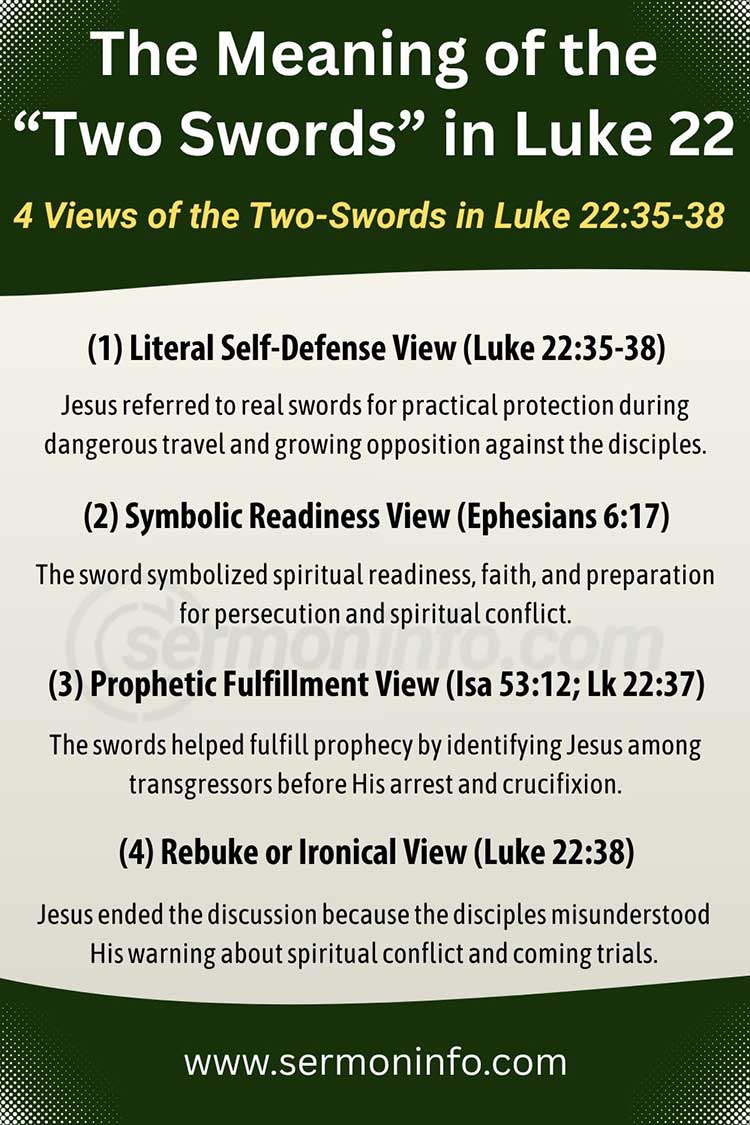
This material provides some ideas and thoughts for a lesson outline about the “Two Swords” in Luke 22:35-38 (4 Views of the Two Swords in Luke 22:35-38).
3. The Prophetic Fulfillment Interpretation
This interpretation sees the swords mainly as part of God’s prophetic plan surrounding Christ’s rejection and arrest (Summary Statement).
A. The Main Idea
This interpretation connects the two swords with changing ministry conditions and the fulfillment of Isaiah 53:12. Jesus knew rejection, suffering, and arrest would soon come upon Him. The presence of swords helped identify Him among transgressors as prophecy declared.
In this view, the swords mainly served a prophetic and judicial purpose rather than a military one. Jesus never encouraged violent resistance against Rome or aggressive warfare. Instead, God sovereignly fulfilled His plan through Christ’s suffering and sacrifice. Believers today should trust God’s purposes, even during difficult and confusing seasons of life.
B. Supporting Arguments
Jesus connected the discussion about the swords directly to Isaiah 53:12 in Luke 22:37. He knew prophecy would soon reach fulfillment through His rejection and suffering. Two swords could never support a military revolt among eleven disciples facing Roman authority.
The swords helped identify Jesus as a supposed criminal leader during His arrest. Yet Jesus immediately stopped violence in Gethsemane and rebuked Peter for using the sword. Christ willingly submitted to the Father’s plan so He could accomplish redemption. Believers today should trust God’s sovereign purposes and follow Christ with faith and humility.
4. The Rebuke or Ironical Interpretation
This interpretation sees Christ ending the conversation because the disciples misunderstood His deeper spiritual warning (Summary Statement).
A. The Main Idea
This interpretation suggests that Jesus spoke with irony or frustration because the disciples misunderstood His meaning. When they presented two swords, Jesus replied, “It is enough,” to end the discussion. He knew they focused on physical weapons instead of the spiritual seriousness of the moment.
This view highlights the disciples’ spiritual dullness before Christ’s crucifixion and resurrection. They often misunderstood His figurative teaching and struggled to grasp God’s greater plan. Yet Jesus remained patient and faithful toward them. Believers today should seek spiritual understanding through Scripture, prayer, and humble dependence upon the Lord.
B. Supporting Arguments
The disciples often misunderstood Christ’s teaching and struggled to grasp His spiritual meaning. Two swords could never realistically protect the entire group from a large arresting crowd. Jesus knew their focus remained on physical matters instead of God’s greater purpose.
When Peter used the sword in the garden, Jesus immediately stopped the violence and rebuked him. The Greek wording may also suggest that Jesus abruptly ended the conversation because of their misunderstanding. Believers today should seek spiritual wisdom through God’s Word and trust His plan even when circumstances seem confusing or difficult.
5. “It Is Enough” — What Did Jesus Mean?
When the disciples presented two swords, Jesus replied, “It is enough.” Scholars and pastors commonly suggest several interpretations:
A. “Two Swords Are Sufficient”
Some interpreters believe Jesus meant that two swords were sufficient for the moment. In this view, the disciples carried literal swords for basic protection during dangerous travel and growing hostility. Jesus recognized changing ministry conditions as opposition against Him increased before the crucifixion.
B. “Enough of This Discussion”
Other interpreters believe Jesus ended the discussion because the disciples misunderstood His meaning. When they presented two swords, they focused on physical weapons instead of spiritual readiness. In this interpretation, Christ used the phrase “It is enough” to stop the conversation and redirect attention toward the coming trials, persecution, and fulfillment of God’s prophetic plan.
6. Balanced Conclusion
Many evangelical scholars combine several interpretations of the two swords in Luke 22:35–38. They recognize that real swords existed, yet Jesus mainly emphasized spiritual readiness for dangerous days ahead. Christ warned His disciples about coming opposition, but He never promoted violent revolution or military resistance.
The disciples still struggled to fully understand Christ’s meaning before His crucifixion and resurrection. Even so, Jesus patiently prepared them for future trials and persecution. This passage encourages believers to endure faithfully, remain spiritually prepared, and trust God during seasons of hardship, uncertainty, and growing opposition to biblical truth.
7. Practical Lessons for Believers Today
Believers today must remain spiritually prepared, trust God during opposition, and faithfully follow Christ through wisdom, prayer, and obedience to His Word (Summary Statement).
A. Christians Must Expect Opposition
Jesus warned His followers that difficult times would come. Believers should not feel surprised when opposition increases (2 Timothy 3:12).
B. Spiritual Readiness Matters
Believers must prepare spiritually through Scripture, prayer, faith, and dependence upon God. Christians fight spiritual battles with spiritual weapons (2 Corinthians 10:3–5).
C. Christ’s Mission Advances Through the Gospel
The church fulfills Christ’s mission through preaching, discipleship, love, truth, and faithful endurance. The gospel changes hearts through the power of the Holy Spirit, not through force.
Frequently Asked Questions (FAQ)
Q: Did Jesus tell His disciples to fight with swords?
A: No. Jesus mentioned swords in Luke 22:35–38, but He later rebuked Peter for using one in Gethsemane (John 18:11). Christ never promoted violent revolution. Instead, He prepared His disciples for coming persecution, hardship, and spiritual conflict as they served Him in a hostile world.
Q: What do the “two swords” symbolize in Luke 22?
A: Some scholars understand the swords literally, while others view them symbolically. Many believe the swords represented spiritual readiness, urgency, and preparation for difficult days ahead. Jesus warned His followers that rejection, persecution, and suffering would increase after His crucifixion and resurrection.
Q: Why did Jesus say, “It is enough”?
A: Many interpreters believe Jesus ended the discussion because the disciples misunderstood His meaning. They focused on physical swords instead of spiritual preparation. Others believe two swords were simply sufficient for practical travel needs. Both views recognize Christ’s warning about coming opposition and changing ministry conditions.
Q: Did Jesus support self-defense in Luke 22:35–38?
A: Some conservative scholars believe Jesus allowed limited personal protection during dangerous travel. However, Christ never encouraged aggressive violence or military action. The broader New Testament teaches that believers advance God’s kingdom through truth, prayer, faith, and the power of the Holy Spirit.
Q: What practical lesson should believers learn from the “two swords” passage?
A: Luke 22:35–38 reminds believers to remain spiritually prepared during opposition and hardship. Christians must trust God, walk wisely, and stand firm in biblical truth. The passage encourages faithful endurance, prayerful dependence upon the Lord, and confidence in God’s sovereign plan during difficult times.

The Bible Knowledge Commentary (2 Volumes) by John F. Walvoord
BONUS: What does Luke 22:35–38 teach about spiritual preparedness?
Luke 22:35–38 teaches that believers must prepare spiritually for difficult days and growing opposition. Jesus warned His disciples that ministry conditions would soon change after His rejection and crucifixion. Christians must remain watchful, prayerful, and grounded in God’s Word as they face trials and spiritual conflict (Ephesians 6:11–17).
The passage also reminds believers to trust God during uncertainty and persecution. Jesus never promoted violent resistance, but He emphasized readiness and faithfulness. Christians should strengthen their hearts through prayer, obedience, and dependence upon the Lord. God equips His people to endure hardship and stand firm in the truth (2 Timothy 3:12–14).
BONUS: Why did Jesus tell His disciples to buy a sword?
Jesus told His disciples to buy a sword because ministry conditions would soon become dangerous and hostile. In Luke 22:35–36, He explained that circumstances had changed after His rejection. The disciples would face persecution, opposition, and difficult travel conditions as they continued proclaiming the gospel.
At the same time, Jesus did not encourage violent revolution or military action. He later rebuked Peter for using the sword in Gethsemane (John 18:11). Many interpreters believe the sword also symbolized spiritual readiness and preparation for coming trials. Believers today must trust God and remain spiritually prepared during hardship (Ephesians 6:17).
BONUS: How does Isaiah 53:12 connect to the two swords passage?
Isaiah 53:12 connects to Luke 22:35–38 because Jesus quoted the prophecy before His arrest. Isaiah foretold that the Messiah would be “numbered with the transgressors.” The presence of swords among the disciples helped authorities treat Jesus like a dangerous criminal rather than the sinless Son of God (Luke 22:37).
This connection reveals God’s sovereign plan in Christ’s suffering and crucifixion. Jesus willingly fulfilled prophecy so He could provide salvation for sinners through His death and resurrection. Even during rejection and injustice, God controlled every detail of redemption. Believers can trust the Lord’s wisdom and faithfulness during difficult seasons of life (Acts 2:23).
BONUS: Did the disciples misunderstand Jesus in Luke 22:38?
The disciples likely misunderstood Jesus in Luke 22:38 because they focused on physical swords instead of spiritual preparation. When they presented two swords, Jesus replied, “It is enough.” Many interpreters believe He ended the discussion because the disciples failed to grasp His warning about coming persecution and hardship.
The disciples often misunderstood Christ’s teaching during His earthly ministry (Mark 8:31–33). Jesus later rebuked Peter for using the sword in Gethsemane (John 18:11). This response shows that Christ did not promote violence. Instead, He called His followers to trust God, remain spiritually prepared, and endure trials faithfully.
BONUS: What is the spiritual meaning of the sword in the Bible?
In the Bible, the sword often represents God’s truth, judgment, and spiritual power. Ephesians 6:17 calls the Word of God “the sword of the Spirit.” Hebrews 4:12 teaches that God’s Word pierces the heart and reveals thoughts and motives. Scripture strengthens believers during spiritual conflict and temptation.
The sword also pictures spiritual warfare rather than physical violence. Christians fight battles through prayer, faith, and obedience to God’s truth (2 Corinthians 10:3–5). Jesus defeated Satan by quoting Scripture during temptation (Matthew 4:1–11). Believers today must study God’s Word daily and trust His power during trials and opposition.
BONUS: How should Christians respond to opposition according to Luke 22?
Luke 22 teaches that Christians should respond to opposition with spiritual readiness, wisdom, and trust in God. Jesus warned His disciples about coming hardship and persecution after His rejection. Believers must remain faithful, prayerful, and grounded in Scripture during difficult seasons (Luke 22:35–36; Ephesians 6:11).
At the same time, Jesus rejected violent retaliation in Gethsemane and rebuked Peter for using the sword (John 18:11). Christians should respond to opposition with faith, truth, humility, and endurance. God calls His people to stand firm, proclaim the gospel boldly, and trust His sovereign care during trials and suffering (2 Timothy 3:12).
| 4 Views of the “Two Swords” in Luke 22:35-38 – YOUTUBE VIDEO | |||
|---|---|---|---|
| Number | Interpretation | Bible Verse | Meaning |
| 1 | Literal Self-Defense Interpretation | Luke 22:36–38 | Jesus referred to real swords for practical protection during dangerous travel and growing opposition against the disciples. |
| 2 | Symbolic Readiness Interpretation | Ephesians 6:17 | The sword symbolized spiritual readiness, faith, and preparation for persecution and spiritual conflict. |
| 3 | Prophetic Fulfillment Interpretation | Isaiah 53:12; Luke 22:37 | The swords helped fulfill prophecy by identifying Jesus among transgressors before His arrest and crucifixion. |
| 4 | Rebuke or Ironical Interpretation | Luke 22:38 | Jesus ended the discussion because the disciples misunderstood His warning about spiritual conflict and coming trials. |