The 7 types of Hebrew parallelism in the bible describe how biblical writers arrange lines of poetry to clarify and strengthen truth. One line repeats, contrasts, completes, illustrates, or mirrors another. These patterns appear often in the Psalms. They help readers understand God’s message clearly, remember His Word easily, and worship Him more deeply.
Key Takeaways – 7 Types of Hebrew Parallelism
- Hebrew parallelism shapes how biblical poetry communicates truth. Writers place lines together so one line repeats, contrasts, or expands the meaning of another.
- Synonymous parallelism repeats the same idea with different words. This pattern strengthens truth and helps readers remember God’s message clearly (Psalm 19:1).
- Antithetical parallelism teaches truth through contrast. One line presents righteousness while the next warns about the opposite path (Psalm 1:6).
- Synthetic parallelism develops a thought step by step. The second line builds on the first and adds deeper meaning (Psalm 23:1).
- Climactic parallelism increases emphasis through repetition and completion. Each line raises the message toward a stronger call to worship or obedience (Psalm 29:1–2).
- Emblematic, alternate, and chiastic parallelism use images and structure. These patterns illustrate truth with pictures, balanced ideas, and mirrored themes (Psalm 1:4; Psalm 8:1,9).
- Understanding parallelism helps believers read the Psalms with greater clarity. These poetic patterns reveal God’s wisdom and encourage deeper trust in His Word.
7 Types of Hebrew Parallelism in the Bible
When we read the Psalms, we notice something beautiful about how God communicates truth. The writers repeat ideas, contrast thoughts, and paint vivid pictures with words. These poetic patterns help truth settle deeply into our hearts. Psalm 119:105 says, “Your word is a lamp to my feet and a light to my path.” God designed Scripture so believers can understand, remember, and treasure His truth.
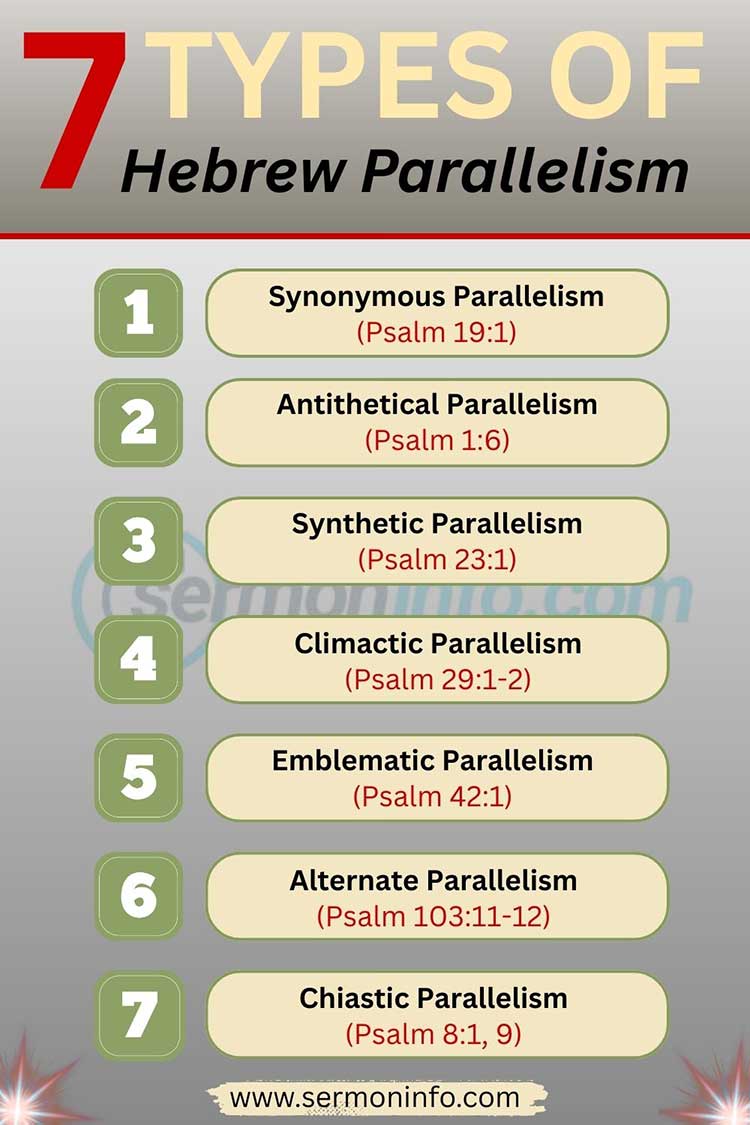
Today we will explore seven types of Hebrew parallelism found throughout the Psalms. These patterns include synonymous, antithetical, synthetic, climactic, emblematic, alternate, and chiastic parallelism. Each one reveals how God shaped His Word with wisdom and purpose. As we study them together, we will see how these patterns strengthen understanding, deepen devotion, and help us trust the Lord during difficult seasons.
1. Synonymous Parallelism
Synonymous parallelism repeats the same truth in different words so the reader clearly understands and remembers the message of God’s Word.
A. Definition
Synonymous parallelism repeats the same idea using different words. The second line strengthens the first line by restating its truth. Psalm 24:1 shows this pattern: “The earth is the LORD’s, and all its fullness, the world and those who dwell therein.” Both lines declare God’s ownership over creation.
This structure helps worshipers remember truth and feel its weight. The repetition presses the message into the heart. Psalm 19:1 says, “The heavens declare the glory of God; and the firmament shows His handiwork.” Both lines proclaim God’s glory through creation. God repeats truth so His people grasp it clearly.
B. Examples
Psalm 103:1 shows synonymous parallelism beautifully. David writes, “Bless the LORD, O my soul; and all that is within me, bless His holy name.” The second line repeats the first idea with stronger devotion. David calls his entire being to praise God. This teaches believers today to worship God with full hearts.
Psalm 114:1 also uses this structure. “When Israel went out of Egypt, the house of Jacob from a people of strange language.” The second line repeats the first idea using another name for Israel. This poetic repetition reminds worshipers that God delivered His covenant people through mighty power.
2. Antithetical Parallelism
Antithetical parallelism places opposite ideas side by side to highlight the difference between righteousness and wickedness.
A. Definition
Antithetical parallelism places two opposite ideas side by side. The contrast highlights truth by showing both the right path and the wrong path. Psalm 1:6 says, “For the LORD knows the way of the righteous, but the way of the ungodly shall perish.” The contrast reveals two very different destinies.
This structure teaches wisdom through comparison. The righteous enjoy God’s favor while the wicked face judgment. Psalm 37:21 shows the same pattern. “The wicked borrows and does not repay, but the righteous shows mercy and gives.” The contrast reveals the character difference between godly and ungodly people.
B. Examples
Psalm 20:7 presents a clear contrast. “Some trust in chariots, and some in horses; but we will remember the name of the LORD our God.” Earthly strength opposes spiritual trust. The psalm reminds believers that real security rests in the Lord, not human power.
Psalm 37:9 also contrasts two outcomes. “For evildoers shall be cut off; but those who wait on the LORD, they shall inherit the earth.” Wicked people face removal, yet faithful believers receive blessing. This contrast encourages patience during injustice because God will settle every account.
3. Synthetic Parallelism
Synthetic parallelism expands the first line by adding new information that completes or develops the original thought.
A. Definition
Synthetic parallelism builds upon the first line with added information. The second line completes or develops the thought rather than repeating it. Psalm 23:1 says, “The LORD is my shepherd; I shall not want.” The second line explains the result of God’s shepherd care.
This structure moves the reader forward in understanding. Each line adds meaning and depth. Psalm 121:3 follows this pattern. “He will not allow your foot to be moved; He who keeps you will not slumber.” The second line strengthens the promise by revealing God’s constant watchfulness.
B. Examples
Psalm 1:3 shows synthetic development. “He shall be like a tree planted by the rivers of water, that brings forth its fruit in its season.” The second line expands the picture of spiritual stability. A life rooted in God’s Word produces steady fruit.
Psalm 128:1–2 provides another example. “Blessed is everyone who fears the LORD, who walks in His ways.” The following line promises blessing from honest labor. The psalm teaches that reverence for God produces real life stability and joy.
4. Climactic Parallelism
Climactic parallelism repeats part of the first line and builds toward a stronger or fuller conclusion.
A. Definition
Climactic parallelism repeats part of the first line and then completes the thought with a rising conclusion. The pattern builds intensity. Psalm 29:1 says, “Give unto the LORD, O you mighty ones, give unto the LORD glory and strength.” The second line repeats the phrase and raises the call to worship.
This structure creates movement and emphasis in Hebrew poetry. Each line advances the message toward its final point. Psalm 96:7 follows the same pattern. “Give to the LORD, O families of the peoples, give to the LORD glory and strength.” The repetition calls all nations to worship God.
B. Examples
Psalm 29:2 continues this rising pattern. “Give unto the LORD the glory due to His name; worship the LORD in the beauty of holiness.” The second line reaches the climax by directing worshipers into reverent praise. The psalm moves hearts toward joyful submission to God’s majesty.
Psalm 134:1–2 also builds upward. “Behold, bless the LORD, all you servants of the LORD.” The next line calls them to lift their hands in the sanctuary. The repeated phrase leads to active worship. God invites His people to express praise with both voice and action.
5. Emblematic Parallelism
Emblematic parallelism uses a vivid image or comparison to illustrate and explain a spiritual truth.
A. Definition
Emblematic parallelism compares truth with a vivid image. One line states the reality while the other line illustrates it with a picture. Psalm 42:1 shows this pattern. “As the deer pants for the water brooks, so pants my soul for You, O God.” The image of thirst explains spiritual longing.
This form helps believers feel truth through familiar pictures. God uses nature to reveal spiritual realities. Psalm 103:13 says, “As a father pities his children, so the LORD pities those who fear Him.” The image of a loving father illustrates God’s compassionate care for His people.
B. Examples
Psalm 1:4 provides a clear emblematic picture. “The ungodly are not so, but are like the chaff which the wind drives away.” Chaff blows away because it has no weight. The image shows how unstable the wicked life becomes when it stands apart from God.
Psalm 92:12 presents a positive example. “The righteous shall flourish like a palm tree, he shall grow like a cedar in Lebanon.” Palm trees endure storms and cedars grow strong. The imagery reminds believers that faithful lives develop strength and stability under God’s care.
6. Alternate Parallelism
Alternate parallelism presents ideas in alternating lines that connect related truths in a balanced pattern.
A. Definition
Alternate parallelism arranges ideas in an alternating pattern. The first and third lines connect, while the second and fourth lines connect. This structure often appears in four line sections of Hebrew poetry. Psalm 103:11–12 shows this movement of thought within two pairs of ideas.
This arrangement helps readers follow two related themes. One theme may describe God’s mercy while the other shows His forgiveness. The alternating lines guide the listener through balanced truths. This pattern strengthens memory and helps worshipers grasp God’s character more fully.
B. Examples
Psalm 103:11–12 illustrates alternating ideas about mercy and forgiveness. “For as the heavens are high above the earth, so great is His mercy toward those who fear Him.” The next verse adds another image. “As far as the east is from the west, so far has He removed our transgressions.”
Psalm 107 also contains alternating praise and deliverance. Verse 8 calls people to thank the Lord for His goodness. Verse 9 explains how He satisfies the longing soul. The pattern repeats throughout the psalm, reminding believers that God’s rescue leads to grateful worship.
7. Chiastic Parallelism
Chiastic parallelism arranges ideas in a mirror pattern so the beginning and ending lines frame the central message.
A. Definition
Chiastic parallelism arranges ideas in a mirror pattern. The first idea corresponds with the last idea, while the middle lines connect together. This structure forms a literary frame that highlights the central message. Psalm 8 demonstrates this pattern through repeated praise of God’s majestic name.
This design draws attention to the main point in the center. Writers use it to guide readers toward the heart of the message. In Psalm 8 the opening and closing lines repeat praise. The middle verses celebrate God’s authority over creation and humanity’s honored place within it.
B. Examples
Psalm 8:1 and Psalm 8:9 repeat the same praise. “O LORD, our Lord, how excellent is Your name in all the earth!” These verses frame the psalm. The repeated line surrounds the middle section, which explains God’s glory revealed in creation and humanity’s responsibility.
Psalm 67 also reflects this structure. Verses 1 and 7 speak about God’s blessing. The center focuses on nations praising God. The arrangement highlights the mission of God’s people. When God blesses His people, the nations see His glory and respond with worship.
Conclusion
Today we explored seven beautiful patterns in Hebrew poetry. We saw synonymous, antithetical, synthetic, climactic, emblematic, alternate, and chiastic parallelism. Each pattern reveals how God shaped His Word with wisdom and clarity. These structures repeat truth, contrast ideas, and paint vivid pictures. Through them, the Psalms help us understand God’s character, promises, and faithfulness.
God gave His Word not only to inform our minds but also to guide our hearts. The Psalms call us to trust the Lord in every season of life. If you have never trusted Christ, turn to Him today. Jesus died for our sins and rose again. Place your faith in Him as Savior and Lord, and receive eternal life (Romans 10:9–10).
Frequently Asked Questions (FAQ)
Q: What is Hebrew parallelism in the Bible?
A: Hebrew parallelism is a poetic structure where two or more lines express related ideas. One line may repeat, contrast, expand, or illustrate the other. This pattern appears often in the Psalms and Proverbs and helps readers understand, remember, and meditate on God’s truth more clearly.
Q: Why did Hebrew writers use parallelism in Scripture?
A: Hebrew writers used parallelism to strengthen meaning and make truth memorable. Repetition and contrast helped listeners understand important spiritual ideas. These poetic structures also guided worship and teaching. Many Psalms use parallel lines to emphasize God’s character, promises, and works among His people.
Q: What are the main types of Hebrew parallelism?
A: The seven common types include synonymous, antithetical, synthetic, climactic, emblematic, alternate, and chiastic parallelism. Each type organizes poetic lines differently. Some repeat ideas, others contrast or build them. Together they show how biblical poetry communicates truth clearly and powerfully.
Q: Where is Hebrew parallelism found in the Bible?
A: Hebrew parallelism appears mainly in poetic and wisdom books such as Psalms, Proverbs, Job, and parts of Isaiah. These books use poetic structures to teach spiritual truth. Psalm 19:1 and Psalm 1:6 are well known examples where parallel lines reinforce the message.
Q: How does understanding Hebrew parallelism help Bible study?
A: Understanding Hebrew parallelism helps readers see how lines relate and reinforce meaning. Recognizing these patterns clarifies emphasis, contrast, and development in a passage. This deeper understanding allows believers to interpret Scripture more accurately and appreciate the beauty of God’s inspired Word.
BONUS: What is the difference between synonymous and antithetical parallelism in the Psalms?
Synonymous parallelism repeats the same idea using different words to strengthen the message. The second line reinforces the first line with similar meaning. Psalm 19:1 shows this pattern: “The heavens declare the glory of God; and the firmament shows His handiwork.” Both lines proclaim God’s glory through creation.
Antithetical parallelism presents two opposite ideas to highlight truth. The second line contrasts the first and shows a clear difference. Psalm 1:6 illustrates this pattern: “For the LORD knows the way of the righteous, but the way of the ungodly shall perish.” The contrast reveals two very different spiritual outcomes.
BONUS: How many types of Hebrew parallelism are found in biblical poetry?
Biblical poetry commonly contains seven types of Hebrew parallelism. These include synonymous, antithetical, synthetic, climactic, emblematic, alternate, and chiastic parallelism. Writers used these patterns to strengthen meaning and highlight truth. Psalm 19:1 shows synonymous repetition, while Psalm 1:6 presents antithetical contrast between the righteous and the wicked.
These poetic structures help readers understand how biblical writers organized ideas. Hebrew poetry focuses on balanced thoughts rather than rhyme. Psalm 29:1–2 repeats phrases to build a climactic call to worship. As believers recognize these patterns, they better understand the message and appreciate the beauty of God’s Word.
BONUS: What is an example of parallelism in Psalm 1?
Psalm 1 contains clear examples of Hebrew parallelism. Verse 6 shows antithetical parallelism. It says, “For the LORD knows the way of the righteous, but the way of the ungodly shall perish.” The verse places two opposite paths side by side. One leads to life under God’s care, while the other leads to destruction.
Psalm 1:3 also shows synthetic parallelism. It describes the righteous person as “a tree planted by the rivers of water, that brings forth its fruit in its season.” The next lines expand the image by explaining stability and blessing. This picture reminds believers that a life rooted in God’s Word produces lasting fruit.
BONUS: How does Hebrew parallelism help readers interpret the Psalms correctly?
Hebrew parallelism helps readers see how one line explains or strengthens another. The structure guides interpretation by repeating or contrasting ideas. Psalm 19:1 says, “The heavens declare the glory of God; and the firmament shows His handiwork.” Both lines reveal the same truth, helping readers understand the message clearly.
Parallelism also highlights emphasis and application. Psalm 1:6 contrasts two paths: “The LORD knows the way of the righteous, but the way of the ungodly shall perish.” The contrast clarifies the outcome of each life direction. Recognizing this structure helps believers grasp the psalm’s warning and encouragement.
BONUS: Why is parallelism important in understanding Hebrew poetry in the Bible?
Parallelism forms the foundation of Hebrew poetry. Biblical writers used balanced lines instead of rhyme to communicate truth. Psalm 19:1 says, “The heavens declare the glory of God; and the firmament shows His handiwork.” The repeated idea strengthens the message and helps readers recognize the emphasis in God’s Word.
Parallelism also clarifies meaning and guides interpretation. Psalm 1:6 contrasts two outcomes: “The LORD knows the way of the righteous, but the way of the ungodly shall perish.” The contrast highlights the difference between righteousness and wickedness. When believers recognize this pattern, they understand the message of the psalm more clearly.
BONUS: What is chiastic structure and how does it appear in Scripture?
Chiastic structure arranges ideas in a mirror pattern. The first line corresponds with the last line, while the middle lines highlight the main message. Psalm 8 shows this pattern. Verse 1 and verse 9 repeat the same praise: “O LORD, our Lord, how excellent is Your name in all the earth!”
This structure draws attention to the central truth of a passage. In Psalm 8 the middle verses describe God’s glory in creation and humanity’s honored role under His authority. The mirrored opening and closing lines frame the message. This pattern helps readers focus on God’s majesty and His purpose for mankind.
BONUS: What are the different types of parallelism in Hebrew poetry?
Hebrew poetry uses several types of parallelism to communicate truth clearly. The most common forms include synonymous, antithetical, and synthetic parallelism. Psalm 19:1 repeats the same idea in two lines, while Psalm 1:6 contrasts the righteous with the wicked. These patterns help readers see emphasis and meaning within the text.
Other forms include climactic, emblematic, alternate, and chiastic parallelism. Psalm 29:1–2 repeats phrases to build a rising call to worship. Psalm 42:1 uses a vivid image of a thirsty deer to express longing for God. These poetic patterns deepen understanding and highlight the beauty of God’s inspired Word.
An Expositional Commentary – Psalms by James Montgomery Boice
| 7 Types of Hebrew Parallelism in the Bible | |||
|---|---|---|---|
| Number | Main Point | Bible Verse | Meaning |
| 1 | Synonymous Parallelism | Psalm 19:1 | The second line repeats the same idea with different words to strengthen the message about God’s glory in creation. |
| 2 | Antithetical Parallelism | Psalm 1:6 | The second line contrasts the first, showing the difference between the path of the righteous and the destiny of the wicked. |
| 3 | Synthetic Parallelism | Psalm 23:1 | The second line completes or expands the thought by explaining the result of the Lord’s shepherd care. |
| 4 | Climactic Parallelism | Psalm 29:1–2 | The repeated phrase builds toward a stronger call to give glory and worship to the Lord. |
| 5 | Emblematic Parallelism | Psalm 42:1 | One line presents a picture from nature while the other explains the spiritual truth of longing for God. |
| 6 | Alternate Parallelism | Psalm 103:11–12 | Alternating lines develop two related ideas, describing both God’s great mercy and His complete forgiveness. |
| 7 | Chiastic Parallelism | Psalm 8:1, 9 | The first and last lines mirror each other, framing the central message about God’s majesty and humanity’s place in creation. |