The 5 Kinds of Grace in the Bible show how God’s kindness reaches from our greatest needs to the smallest details of everyday life.

Key Takeaways – 5 Kinds of Grace in the Bible
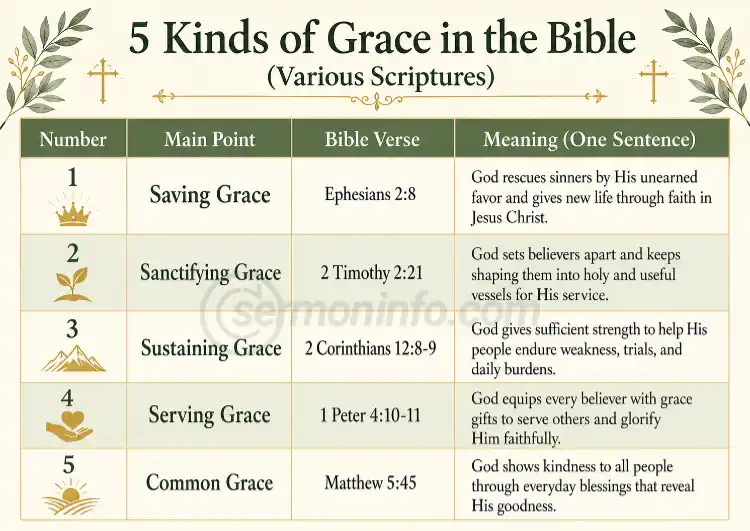
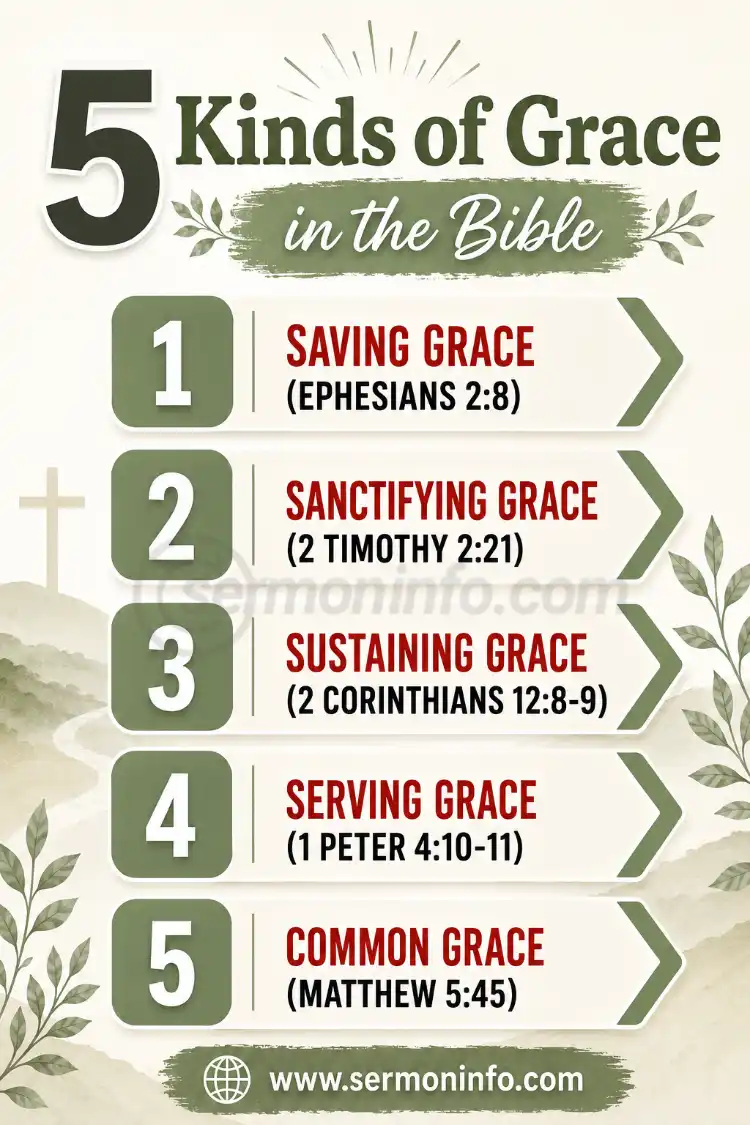
- Saving Grace: God’s unearned favor rescues sinners and brings them into new life through faith in Jesus Christ (Ephesians 2:8).
- Sanctifying Grace: Grace continues to work after salvation, transforming believers into Christlikeness and empowering godly living (2 Timothy 2:21).
- Sustaining Grace: In trials and weakness, God gives strength to endure, offering peace and power through His constant presence (2 Corinthians 12:9).
- Serving Grace: God equips every believer with gifts and grace to serve others in love and build up the Church (1 Peter 4:10).
- Common Grace: God shows kindness to all people through daily blessings, pointing hearts toward His goodness and truth (Matthew 5:45).
- These five kinds of grace reveal how God’s kindness reaches into every area of life—offering hope, help, and purpose through Christ.
5 Kinds of Grace in the Bible
Grace is more than a word we sing—it’s the lifeline of our faith. God’s kindness reaches into every part of our lives. From the moment He saves us to the strength He gives daily, grace sustains us.
Think of Peter, sinking on the water—Jesus didn’t scold him, He reached out in grace. That’s our God. He meets us where we are, and His grace covers every step of our journey.
Today, we’ll explore 5 Kinds of Grace in the Bible—each one a powerful reminder of God’s loving presence in every season.
1. Saving Grace
“For by grace you have been saved through faith, and that not of yourselves; it is the gift of God.” (Ephesians 2:8)
A. Grace That Rescues Sinners
God’s saving grace meets us in our worst moment—not when we’ve cleaned ourselves up, but when we’re still dead in sin. Ephesians 2:8 reminds us, “For by grace you have been saved through faith.” This grace isn’t earned. It is freely given by a holy God who delights in rescuing broken people.
Think of the thief on the cross. He had no chance to do good works, yet Jesus said, “Today you will be with Me in Paradise” (Luke 23:43). That’s saving grace. It doesn’t depend on our past or performance—it flows from God’s mercy. Jesus didn’t come to improve us. He came to save us, and grace makes that possible.
B. Grace That Calls for Faith
While grace is a gift, God calls us to respond. We don’t earn salvation, but we must reach for it with the hand of faith. Ephesians 2:8 says we’re saved “through faith.” Faith is not a work—it is trust. It is laying down our pride and embracing wholly the finished work of Christ.
Imagine falling into deep water. Grace throws the rope, but faith grabs hold. Believing in Jesus means turning from self-reliance and saying, “Lord, save me.” Just like Peter cried out as he sank, our cry of faith activates grace’s rescue. God saves those who stop trying to save themselves.
“This material provides some ideas and thoughts for a message about the 5 Kinds of Grace in the Bible.
2. Sanctifying Grace
“Therefore if anyone cleanses himself from the latter, he will be a vessel for honor, sanctified and useful for the Master, prepared for every good work.” (2 Timothy 2:21)
A. Grace That Sets Us Apart
Sanctifying grace is God’s ongoing work of transforming us after He saves us. It’s not just about going to heaven—it’s about becoming more like Jesus now. Paul writes that if anyone “cleanses himself… he will be a vessel for honor, sanctified, useful to the Master” (2 Timothy 2:21). Grace sets us apart for God’s purposes.
God didn’t just save you to sit on a pew. He saved you to shine. Sanctifying grace shapes your thoughts, words, and desires. It gently prunes and purifies. You’re not perfect, but you’re being changed—from the inside out—by grace that doesn’t quit.
B. Grace That Shapes Our Living
Sanctification doesn’t happen by accident. Grace empowers you to obey, to resist sin, and to grow in love. It teaches you to say “No” to ungodliness and “Yes” to Christ (Titus 2:11–12). This grace doesn’t just forgive your past—it forms your future.
Think of a potter shaping clay. God’s hands are full of grace as He molds you day by day. You might not feel it every moment, but grace is working, even in your struggles. Stay in His Word, stay near His heart, and watch grace do what you can’t do alone.
3. Sustaining Grace
“Concerning this thing I pleaded with the Lord three times that it might depart from me. 9 And He said to me, ‘My grace is sufficient for you, for My strength is made perfect in weakness.’ Therefore most gladly I will rather boast in my infirmities, that the power of Christ may rest upon me.” (2 Corinthians 12:8–9)
A. Grace That Strengthens the Weak
Paul pleaded three times for God to remove his thorn, but the Lord answered, “My grace is sufficient for you” (2 Corinthians 12:9). Sustaining grace doesn’t always remove the problem—it gives strength to stand in it. God meets us in weakness and gives divine power to carry on.
You may feel tired, worn out, or stretched thin. But sustaining grace says, “You are not alone.” Like manna in the wilderness, God gives fresh grace every day. It’s not always loud or flashy—but it’s always enough.
B. Grace That Endures the Storm
Life will bring pain. But God’s grace enables us to walk through it with courage and faith. He doesn’t promise ease—but He promises presence. When Paul couldn’t change his circumstance, grace changed his perspective.
Think of Job. Everything was stripped away, but God’s sustaining grace kept him worshiping. Friend, your storm may be fierce, but His grace is stronger. He hasn’t forgotten you. His grace will carry you through.
4. Serving Grace
“As each one has received a gift, minister it to one another, as good stewards of the manifold grace of God.” (1 Peter 4:10)
A. Grace That Equips for Ministry
God never calls without equipping. 1 Peter 4:10 says, “As each has received a gift, use it to serve one another.” That’s serving grace. It’s the strength and skill God gives you to bless others. Whether preaching, praying, encouraging, or cleaning, it’s all grace in action.
You may feel unqualified, but grace qualifies. Moses stuttered, Timothy was timid, yet both were used by God. Why? Because grace filled the gap. You don’t need to be the best—you just need to be available. God will do the rest.
B. Grace That Blesses Through Action
Serving grace flows through you to others. When you serve in love, people experience God’s grace firsthand. Your hands become His hands. It’s not about applause—it’s about impact. God uses everyday acts of grace to meet deep needs.
Think of Dorcas in Acts 9. She simply made clothes, yet her grace-filled service touched lives. You don’t have to do something grand—just do something godly. Serve where you are, and grace will multiply.
5. Common Grace
“That you may be sons of your Father in heaven; for He makes His sun rise on the evil and on the good, and sends rain on the just and on the unjust.” (Matthew 5:45)
A. Grace That Touches the World
Jesus said the Father “makes His sun rise on the evil and on the good” (Matthew 5:45). That’s common grace. It’s God’s undeserved kindness poured out on all humanity. Rain falls, crops grow, babies are born—all because God is good to all, even those who ignore Him.
From every breath to every sunrise, common grace surrounds us. It’s the steady kindness of God in ordinary life. It keeps this broken world from falling apart completely.
B. Grace That Points to God
Common grace is a gentle whisper from heaven—an invitation to seek the Giver behind the gifts. Romans 2:4 says it’s His kindness that leads us to repentance. These daily blessings are not random—they’re divine breadcrumbs leading us home.
When unbelievers enjoy beauty, laughter, or love, they’re tasting grace. Let that drive you to gratitude and witness. Common grace doesn’t save—but it opens hearts to the One who can.
Conclusion
Grace isn’t just a doctrine to study—it’s a gift to live by. God’s grace saves us, shapes us, strengthens us, and sends us. Whether you’re standing tall or barely holding on, His grace meets you right where you are.
Remember Paul’s thorn? God didn’t remove it, but His grace was enough. That same grace is enough for you. So lean in. Trust Him. Walk forward, knowing that the God of all grace walks with you.
Frequently Asked Questions (FAQ)
Q: What are the five kinds of grace in the Bible?
A: The Bible doesn’t list an exact “five kinds,” but many teachers describe five dimensions: saving, sanctifying, sustaining, serving, and common grace. These categories help us appreciate how God’s unmerited favor operates in different areas of life—delivering, transforming, empowering, serving, and blessing universally.
Q: What is saving grace in the Bible?
A: Saving grace is God’s unmerited favor that delivers sinners from sin and brings spiritual life through faith in Christ. It is unconditional—it cannot be earned—and forms the foundation for our reconciliation with God.
Q: What does common grace mean?
A: Common grace refers to God’s kindness extended to all people—believers and unbelievers alike—through everyday blessings and moral order. It includes sunshine, rain, conscience, and societal stability, because God “makes His sun rise on the evil and on the good.”
Q: How does sustaining grace help believers?
A: Sustaining grace equips believers to endure trials and weakness. As Paul was reminded, “My grace is sufficient for you,” indicating that God’s grace supplies strength even when challenges don’t vanish.
Q: Can grace transform us?
A: Yes—sanctifying grace goes beyond rescue; it actively transforms believers, shaping them into Christlikeness. This grace teaches us to renounce ungodliness and live uprightly in response to God’s salvation.
| Number | Main Point | Bible Verse | Meaning |
|---|---|---|---|
| 1 | Saving Grace | Ephesians 2:8 | God’s unearned favor that rescues sinners and grants new life through faith in Christ. |
| 2 | Sanctifying Grace | 2 Timothy 2:21 | Grace that transforms believers by setting them apart and empowering holy living. |
| 3 | Sustaining Grace | 2 Corinthians 12:9 | God’s strength given in weakness to help believers endure trials and hardship with faith. |
| 4 | Serving Grace | 1 Peter 4:10 | Grace that equips believers with spiritual gifts to serve others and build up the Church. |
| 5 | Common Grace | Matthew 5:45 | God’s general kindness shown to all people through daily blessings and moral order. |

Source Material
Biblical Doctrine by John MacArthur and Richard Mayhue
Systematic Theology by Wayne Grudem
Christian Theology by Millard J. Erickson
Growing in Grace by Bob George
Classic Christianity by Bob George
Disciplines of Grace by R. Kent Hughes